February 19, 1851

Farm

Feb 19  Wednesday  A[u]gustus & wife came this morning in

the stage  We had our breakfast about six Oclock

and I had my morning work most done

We went to Mr Torreys to make a call met Alson

and Lavinia coming.  Alson went back to the poor

farm & Lavinia went with us to Mr Ts  Alson came

here to tea.  Augustus has engaged Mr Torreys

tenement if he concludes to take it   Beautiful weather.

Breakfast at six a.m., at work by seven.  That was the way it was done in the small industrial town of North Easton. By the time Augustus and Hannah Lincoln Gilmore arrived, the men of the house were at the factory and Evelina had washed the dishes, dusted the parlor and instructed Jane McHanna on the menu for dinner and  tea, probably adding additional directions on finishing up the ironing or some other piece of housework.

Off she went, then, to the home of her old brother-in-law, Col. John Torrey, with their mutual nephew, Augustus, only to meet her brother (and Augustus’s father,) Alson Gilmore, en route.  Alson had brought one of his daughters, Lavinia Eveline Gilmore, into town for a visit with the Ameses.  Evelina was fond of her niece, so the visit promised to be pleasant.

Alson soon drove off.  Evelina said he was headed to the “poor farm,” which may have been a jest expressing her opinion of the old family place or perhaps an expression of concern over the economics of the Gilmore homestead.  Or Alson may actually have been on an errand to an Almshouse located in the center of Easton*, near the church that the family attended.  Perhaps Alson was in search of temporary laborers for his farm, although why he would need help in the middle of winter is questionable.  Maybe he had an official role in its oversight.

Many towns had poor houses where the indigent lived; Worcester, Massachusetts established one in the late 1830s in alarmed response to a rising influx of immigrants.  Some citizens were afraid of the diseases that immigrants might be bringing with them, so part of the impetus for setting up a poor farm or poor house or Almshouse, as they were also known, was to establish a discrete site for new arrivals, pending further inspection.

Incidentally, today was an anniversary that probably went unnoticed in the Ames family.  On this date in 1810, a baby named Angier Ames was born.  He was the fourth son of Old Oliver and Susanna Angier Ames, coming along after Oliver Jr. and before William Leonard.  He only lived to be fifteen months old, dying in the summer of 1811 of an unrecorded cause.  Old Oliver wrote no record of this child; did he think of him on this day, some forty years later?

*A shout-out to Frank Mennino, Curator of the Easton Historical Society, for his capable sleuthing about the “poor farm.”  As he pointed out to me, the Almshouse can be identified on an 1855 map of the town. Thank you, Frank!

January 31, 1851

photo

Jan 31st Friday  This morning sat down with mother quite early

mended several articles. & altered the waist of Delaine Dress

Augustus came in the stage & dined here & carried mother

to Mr Torreys.  I went about two & passed the afternoon

Called on Mrs Lothrop at Dr Wales, Engaged the

school house for O Foss to keep a private school.

Came home quite early & wrote her a letter.  Sewed

on Susans panteletts.  Very cold but not quite as cold as yesterday

Evelina and her mother, Hannah Lothrop Gilmore, sat together and sewed this morning.  After mending several items – there was always mending to be done – Evelina reworked the waist on a delaine dress, “delaine” meaning “of wool” in French.  It was a popular and durable fabric in this era.  But altering the waist begs the question, did she have to take it in or let it out?  And had she begun to wear her sleeves in the new “pagoda” style?

Augustus Gilmore, Evelina’s nephew and Hannah’s grandson, soon arrived and, once Oakes and his sons came home from the factory at noon, they all dined together. Augustus was close to his Ames cousins, and worked for the company from time to time.  After dinner,  Augustus accompanied his grandmother to the Torrey house in the village, where Hannah’s granddaughters, Abby and Malvina, lived.  Evelina joined them there a bit later, and paid another call as well, on Mrs. Lothrop.  There were many Lothrops in Easton, so we can’t know just which one Evelina visited.

We can know that Evelina was somehow involved in the setting up of a private classroom.  A young woman named Orinthia Foss, with whom Evelina corresponded, was due to arrive in North Easton to teach.  The genesis of this arrangement is a mystery. Was Evelina doing this because of concerns about Susies’ schooling?  Who else was involved? And who was Orinthia Foss? How was she hired?

Whatever the back story was on this new little school, Evelina took a bold step today when she committed to renting a schoolhouse.  She promptly returned home to write Orinthia with the good news.

January 25, 1851

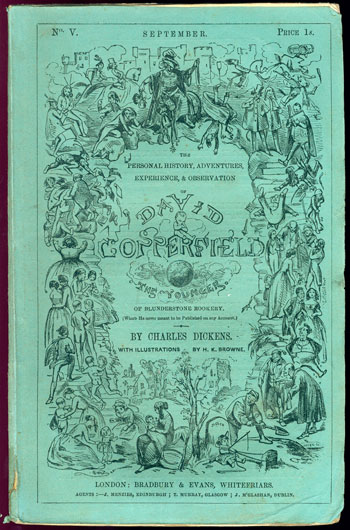
Charles Dickens, David Copperfield

1851

Jan 25 Saturday.  Have been sweeping and dusting the house and 

have done a little of everything and not much of anything.  Have got

the chambers in pretty good order for once in my life.  Have

mended Mr Ames coat & vest.  Took the time when he was 

from home because he has but one suit beside his go to meeting

poor man!  Called at Mr Torreys just at night.  This eve

have been mending & have had no time to read.  Commenced

reading David Copperfield.  Mr Ames at Boston.  Very warm & fine

Evelina could be critical of others, but she was most critical of herself.  Her self-deprecation often took a humorous tone, as in having done “a little of everything and not much of anything.”  She really tried to get things organized at home today, tackling perhaps one of her biggest challenges: keeping her husband Oakes in decent clothes.

Family lore would have it that Evelina was miserly, lore that is reinforced by Reverend William Chaffin.  Chaffin blamed Evelina for Oakes’ shabby “pantaloons,” believing that Evelina  “being economical kept them well mended instead of encouraging him to buy new ones.”  Yet Chaffin also acknowledged Oakes’s indifference to outfit, telling us that while on a trip into Boston with a friend, Reuben Meader, Oakes responded to Meader’s suggestion that he should wear better clothes by saying: “Oh, I can wear poor clothes if I want to, but some men can’t.”

Oakes spent money on gifts; he was well-known and well-liked for his charitable instincts.  However, unlike his brother, Oliver Jr., who shopped for bespoke outfits in Boston, Oakes didn’t spend a dime on his apparel; he simply didn’t care, so  Chaffin was unjustified to blame Oakes’s appearance on Evelina.  She tried to keep him mended, and we know that she was willing to spend money on clothes; certainly she kept the dressmakers in Easton occupied.  But she must have met resistance if and when she tried to improve her husband’s wardrobe.

Today’s hard work had a reward: opening the pages of David Copperfield, the newest book by Charles Dickens.

January 24, 1851

Doll

Jan 24 Friday.  Was very busy this morning about house  Sent

for Abby to go to Augustus’s.  Mr Torrey called to say that

she could not go & made a long call and was as plausible

and good as ever.  Went to Augustus about ten

and alone, but had the pleasure of Mr Whitwells

company back as far as his house  This evening have

called at Mr Holmes but did not see Miss Eaton

Have finished both of the dolls frocks of pink, blue lace  Fine day

The doll that Evelina has been working on since the beginning of the year was finished today.  Wooden with painted features and lace dresses, it was fashioned as a miniature adult.  Baby dolls didn’t come in until almost the 20th century. Isn’t it interesting that the doll was handmade and not store-bought?  It was just a few years too early for Evelina to be able to buy a porcelain doll out of Germany and France, the ones with the big glass eyes, leather hands and silk dresses that speak to us today of Victorian taste. Those manufactured dolls began to enter the American market in the 1860s. With Yankee ingenuity, and not a little help from others, Evelina made her own doll for her daughter. How did Susie like the it?  We don’t get to find out, nor do we know when Evelina gave it to her daughter, but we can guess it was a pleasant surprise.

John Torrey called at the Ames house today.  A former colonel in the local militia, Torrey was also Evelina’s brother-in-law.  He had been married to Evelina’s late sister, Hannah, who died in December, 1848, leaving behind two daughters, Abigail and Mary “Malvina”.  The Torrey family lived right in the village of North Easton, so Evelina was able to see her nieces often.  Abby is 20 years old as the diary opens, Malvina only ten.

Reverend Whitwell featured in Evelina’s diary again today; she certainly seemed to enjoy his company.  She may have been someone who placed ministers up on a pedestal; they were the spiritual leaders of the day and she was a woman of sincere faith.  But, despite his being described by Chaffin as a serious, scholarly type, he may also have been an attractive novelty at a gray time of year.  He was new to the neighborhood and sought the acquaintance of Oakes and Evelina. Did Evelina have a little crush on him?