May 9, 1852

wetsheet


Sunday May 9th  Our own family all went to meeting

& Oliver  George is much worse and we fear

will never be any better is very much out of his

head  Helen is quite sick with her face

had the Dr  Went into Mrs John Howards

at noon & carried her some flower seeds.

Mr & Mrs Swain made a long call this afternoon 

after they left I went to sit with George to assist

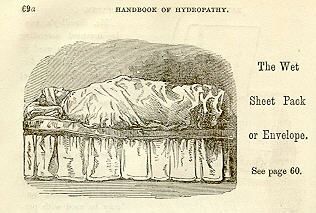
Sarah  They are laying a wet sheet once an hour


George Witherell was getting sicker and sicker. Perhaps to lower his temperature and reduce the involuntary spasms in his limbs and face, his family and physician were “laying a wet sheet once an hour.” They wrapped his body in a cold, wet sheet, and covered him with wool blankets to make him sweat. Everyone was trying to bring down his fever, soothe his nervous system and help him sleep. It was a desperate measure, but in the absence of effective medicines, it was the only option.

A wet-sheet wrap is a form of hydrotherapy, a controversial treatment meant to quiet a violent or agitated person. Opponents of this form of hydrotherapy feel that it’s been misused in certain psychiatric institutions, some patients attesting to being tied up for ten to twelve hours in icy sheets, an application that seems more punitive than restorative. Yet others in the medical profession, such as alternative care-givers in our modern age, tout wet-sheets – if applied properly – as a healthful therapy that induces sleep and calms the nervous system. Its effectiveness seems tied to the intention of the person applying the therapy and the nature of the illness of the person being wrapped.

Helen Angier Ames next door was also “quite sick.”  No wet sheets for her, but she was having her swollen face attended to. It sounds as if she might have had a bad abscess, also a dangerous condition in the era before antibiotics. Dr. Swan, if it was he who was attending the Ameses, was being kept busy.  His little gig would have been pulling up to the Ames compound at all hours of the day and night. Few in the family were getting any rest.  Evelina left the house briefly, to take some flower seeds to Caroline Howard, but returned home to help her sister-in-law.


May 2, 1852

IMG_0157 (1)

Frontispiece, Breck’s Book of Flowers, 1851

Sunday May 2d

1852 Have been to church and at noon went

into Mrs Howards with Mother & Henrietta

After meeting went with Oakes A & Mrs

S Ames to call on Mrs Perkins at Mr Kimballs

also called at Mr Nahum Williams

Mrs Kimball has her garden laid out quite

prettily but the walls are too narrow I think

Evelina was almost as interested in other people’s gardens as she was in her own. After church, she and her son, Oakes Angier Ames, and sister-in-law,  Sarah Lothrop Ames, made a few calls around the neighborhood. The day “was cloudy + fair by turns,”* and as they visited, Evelina was able to see what others were doing in their yards.

The group stopped at the home of John and Lusannah Kimball, whose garden Evelina judged to be pretty, certainly, but “too narrow.” Perhaps Mrs.Kimball was building a perennial border, as opposed to the central bed configuration that Evelina used. Taste in gardening design was changing, with the latest ideal illustrated in Joseph Breck’s popular new book on flowers. Was this the look that Evelina was aiming to achieve in her yard?

The whole family seemed to be out and about, at least for the ride to and from the meeting house. The usual group, representing all three Ames households, was in attendance.  It would be the last Sunday ever for this particular ensemble.  In only two weeks, the Ameses would be back at church for a funeral for one of their own.

*Oliver Ames, Journal, Stonehill College Archives, Arnold Tofias Collection


April 28, 1852

Unitarian Church, Bridgewater, Mass

1852

Wednesday April 28  Have been to the ordination of

Mr Ballou of W Bridgewater with Oakes A & 

Sister Sarah, Mr H Ballou, Briggs of Plymouth

Brigham [illegible] Ballou of Stoughton &c

Mrs Witherell dined at old Mrs Ames, the

rest of us at Mr Thomas Ames.  On my return 

stoped at Augustus’.  Oakes A came to tea

Miss S Lincoln Rachel Augusta & Abby here

It was the middle of a work week, but the Unitarian ministry was busy. In Bridgewater, (or West Bridgewater) a Mr. Ballou was ordained as minister. The name Ballou was associated with many late 18th and 19th century men of the cloth, particularly with Hosea Ballou, an early leader of the Universalist Church. Today’s Mr. Ballou wasn’t he, but may have been a relative.

Why were the Ameses invited to this ordination? Why did they attend? What was the connection? Were they related to the Ballous? They were distantly related to various Ameses in the area, including Thomas Ames, a 52 years-old farmer, who kindly had them to dine.

On this special occasion, as the Unitarians in Bridgewater were honoring ritual and perpetuating their ilk, a forward-looking and entirely new event took place in Boston. The first electric fire alarm in the world “was rung from what is now Box 1212 for a fire on Causeway Street. Created by Dr. William Channing and Moses Farmer, the system consists of forty miles of wire, forty-five signal boxes, and sixteen alarm bells. Police officers and members of the Boston Night Watch are given keys to the locked boxes to enable them to turn in alarms.”* What’s particularly amazing is that “[p]art of the system is still in use today.”*

*Jim Vrabel, When in Boston, 2004, p. 160

April 25, 1852.

Lilac_bush-2edq3ho

Sunday April 25th  A very pleasant day and have

all been to meeting.  Came home at noon

with Hannah & sister and Susan, all returned

in the afternoon.  After meeting called at

Olivers to see Mr & Mrs A Lothrop and rode to

Mr Manley to speak for some plants

Augustus & Hannah rode with us as far as

Mr Swains  Emily & Susan went also to Mr Manlys

Lilacs, a fragrant favorite for gardeners and civilians alike, were among the plants that Evelina selected at Edwin Manley’s today. In the 19th century, many a New England farmhouse featured lilacs close to the door, as American poet Walt Whitman famously describes in When Lilacs Last in the Dooryard bloom’d, his elegy for Abraham Lincoln:

…In the dooryard fronting an old farm-house near the white-wash’d palings,

Stands the lilac bush tall-growing with heart-shaped leaves of rich green,

With many a pointed blossom rising delicate, with the perfume strong I love,

With every leaf a miracle – and from this bush in the dooryard,

With delicate-color’d blossoms and heart-shaped leaves of rich green,

A sprig with its flower I break…

Today after church, the sermons and small social obligations dispensed with, Evelina thought about her flower beds. The day was “fair” and “some warmer,”* so with niece Sarah Emily Witherell and daughter Susan Eveline Ames, she rode up to visit her go-to gardener “to speak for some plants.”  Mr. Manley indicated he would bring the plants by the next day.  Evelina wouldn’t have been able to plant anything today, it being the Sabbath, but she could imagine where she would put the plants, and how they would look, the anticipation of which added to her delight.

*Oliver Ames, Journal, Stonehill College Archives, Arnold Tofias Collection


April 18, 1852


paul-revere-1

1852

April 18 Sunday.  Another unpleasant sabbath but we have

all been to meeting.  Oliver & wife staid at home

this afternoon.  Mr Whitwell gave us two short but

good sermons of about 20 minutes  At intermission

went into Mrs J Howards with Mrs E Howard

Mrs L Howard & Mrs Dr. Deans    called a few moments

on Mrs Whitwell.  Have finished Night & Morning

As was their custom, the Ameses attended church today en masse, at least in the morning. They drove separate carriages to the meeting house through the “cloudy, cold + misty”* morning. Oliver Jr. and his wife Sarah Lothrop Ames rode home at noon, but Evelina and her family, presumably, busied themselves at intermission with various opportunities to socialize.

Oakes Ames most likely slept through the sermons, even though they were “short.” Evelina, however, liked Reverend Whitwell’s sermons today, as she often did. Would he have made any allusion to the historic date?  April 18 was the anniversary of the 1775 ride of Paul Revere and William Dawes to warn “every Middlesex village and farm” of the approach of British forces.  It was a date that American schoolchildren once had to memorize.

Less than a decade later, poet Henry Wadsworth Longfellow would immortalize the historic date in Paul Revere’s Ride:

Listen my children and you shall hear

Of the midnight ride of Paul Revere,

On the eighteenth of April in Seventy-Five;

Hardly a man is now alive

Who remembers that famous day and year…

Longfellow, one of the most popular American poets of the 19th century, wrote Paul Revere’s Ride some eighty-five years after the dramatic events in Concord and Lexington that opened the Revolutionary War. It was published in The Atlantic Monthly in January, 1861, on the eve of the Civil War.  Many believe that the poet, an adamant abolitionist, wrote the piece to remind American citizens of the historic principles and great bravery that shaped the formation of the United States.


Oliver Ames, Journal, Stonehill College Archives, Collection of Arnold Tofias


April 11, 1852

article-2606221-1D23CB0C00000578-490_964x613


Sunday April 11th  Mr Whitman of E Bridgewater preached

He gave us two good sermons but he is very dull and

I was very sleepy. Came home at noon  Alson & wife

came to Augustus’ After meeting went into Edwins

Augustus & E Andrews came there.  Susan staid

at home from everything  It has been very pleasant

In the tradition of their Puritan ancestors, Evelina and her family did not celebrate Easter. No hidden eggs or little bunnies or even new bonnets appeared in the Unitarian homes of Easton on Easter Sunday, 1852. Many of the Catholic families in town, however, would have celebrated this significant Christian holiday, further underscoring the strong cultural differences between the new Irish and the old Yankees of Massachusetts.

Other parts of the country celebrated this holiest of Christian remembrances. It was the German community of the mid-Atlantic states, better known as the Pennsylvania Dutch who, some say, introduced the Easter bunny to America in the 1700s. The rabbit and the egg were symbols of the Germanic fertility goddess Eostre, whose pagan festival was eventually taken over by early Christians as a celebration of Christ’s death and resurrection.

It being Sunday, the Ameses went to meeting, at least, for both an afternoon and a morning service. Reverend Whitwell, the usual minister, was replaced today by Mr. Whitman from East Bridgewater who was, unfortunately, “very dull.” Evelina struggled to stay awake.


April 4, 1852

Crucifix


1852

April 4th Sunday.  Orinthia and self went to the

Catholic meeting this forenoon after waiting more than

an hour the priest came and driveled over a mess

of nonsense in latin, they distributed palm as they called

it being nothing more than cedar & pine twigs.

Sat there three tedious hours, came home and

went to our church in the afternoon. since have

written a letter to Sister H. &c  Susan went over to Anna.

Evelina’s ill-tempered condescension continued today when she and her sidekick, Orinthia Foss, attended a morning service at the little Catholic church on Pond Street. It was Palm Sunday. Father Thomas was late – not unusual for an itinerant priest – and the service was in Latin, a language that Evelina didn’t understand, all for a holy day that Unitarians didn’t acknowledge. Most vexing of all, perhaps, was that the palms weren’t even real.

By her own account, Evelina was better satisfied by a service in the afternoon at her own church. The question is, why did Evelina attend the Catholic service to begin with? Out of curiosity? Out of respect for her own Catholic servant, Jane McHanna? Was this Orinthia’s idea?

Whatever her motive, Evelina came away from her “three tedious hours” as anti-Catholic as ever. Such feelings would not have been encouraged by her husband, Oakes, who was more welcoming of the Irish newcomers. But Evelina would have found reinforcement at home from her father-in-law, Old Oliver, who was no fan of the Irish Catholics in Easton, for all the work they did at the shovel shops.

In Easton, in Boston and all over New England, differences between the old Puritan customs and the transplanted Irish culture were pronounced and, for many, unyielding. In strictly religious terms, Unitarians couldn’t imagine a religion that kowtowed to a foreign leader, as they deemed the pope, while Catholics were incredulous that Protestants could just shake off the time-honored and revered practices of the original church. The melding of the two cultures would be a long time coming, and in some circles is still a work in progress.

March 28, 1852

Ames-Shovel-Handle-2

Ames Shovel Handle Factory, Oakland, Maine*


March 28 Sunday  Went to church this morning and

at noon called at Mrs Wm Reeds with Henrietta

Hannah came at noon but was faint and

I carried her home and got back to church about

the time the services were over  After went down

to the new shops with Mrs W, S Ames Augusta Orinthia

found Mr. Ames, Oliver & Cyrus L there returned by Edwins

and all called there  Mr Ames & self went to Augustus’ this evening

The new shops were up, and various family members rode by to see them after church. No more “dismal ruin”, as reported by Evelina only three weeks earlier. Risen like a phoenix from the ashes of the old shops, the shovel works were about to begin operations in new, if temporary, quarters.

It was a large group that gathered to consider the new buildings. Evelina, who had missed the afternoon service in attending to her ailing niece, Hannah Lincoln Gilmore, nonetheless rode back from church to the site. Accompanying her were her sisters-in-law, Sarah Witherell and Sarah Ames; another niece, Augusta Pool Gilmore; and sometime boarder and frequent companion, Orinthia Foss.  At the site, by accident or design, they found Oakes Ames and his brother, Oliver Ames Jr., and Cyrus Lothrop, a brother of Sarah Lothrop Ames who often resided with his sister. The group must have marveled at the swift reincarnation of the shovel works.

Perhaps a celebratory spirit inspired the crowd to assemble en masse at the nearby home of newlyweds Augusta and Edwin Gilmore.

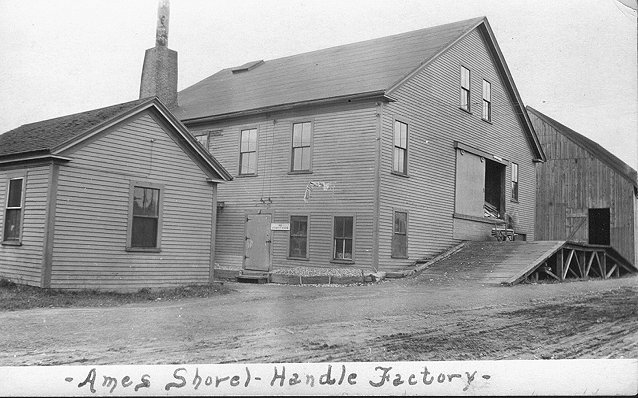
*Image of Ames Shovel Handle Factory, Oakland, Maine courtesy of the Oakland Maine Area Historical Society. Included to illustrate what the rebuilt shovel factory could have resembled.

March 21, 1852

9291031-apples-are-stored-in-the-cellar-to-keep-fresh

1852

March 21 Sunday  Have all been to meeting except

Susan who is not very well  George carried

Amelia home at noon  I had a very pleasant

visit from her of nearly two weeks.  Orinthia

called with me into Edwins after church & we

helped ourselves to apples from the cellar.  Augusta

sent us one filled with sand and cheese.

Called at Mr Whitwells at noon & at Mrs J Howard a moment

Spring had arrived; Amelia Gilmore left the Ames’s home and hospitality and headed back to her own quarters in southeastern Easton. George Oliver Witherell, 14-year old son of Sarah Ames Witherell, obligingly carried her home in a carriage during the intermission at church. Evelina, meanwhile, visited with the Whitwells and the Howards.

After church Evelina and Orinthia went to the home of Edwin and Augusta Gilmore and helped themselves to “apples from the cellar.” That the young couple still had apples from the previous fall suggests that the harvest had been good and the storage arrangements even better. We presume that Evelina and Orinthia took the apples with the permission of the Gilmores; Augusta sending over a barrel “filled with sand and cheese,” corroborates that. But why is a barrel with cheese also filled with sand? Any thoughts, readers?


March 14, 1852


Preach

1852

March 14th Sunday  Amelia & self went to hear

Willard Lothrop preach as he calls it

at this methodist meeting house but he

was not able to make out much  We called

at Mr Torreys & Augustus’ at noon

Edwin & wife were here to supper but

went home before dark.  Have read the

white Rover in Gleasons pictorial


With the factory shut or, in this case, with the carpenters away, Sunday was a quiet day in North Easton. This particular Sunday “was cloudy all day + in the evening + night there was considerable rain – wind north east.”* The Ames family usually went to church at a meeting house in Easton Center, but on this Sunday Evelina did something different.

Her family may have gone to the usual Unitarian service with Reverend Whitwell, but Evelina and her sister-in-law, Amelia Gilmore, stayed in the village and attended a service at the Methodist meeting house. This tiny church, since moved to another location, sat in an intersection of North Easton now known at The Rockery. So small was it that one visiting preacher declared he could “spit into the gallery from the pulpit.** Its intimate dimensions were just right for another session of Spiritualism with Willard Lothrop, who preached in his own personal way.

Evelina and Amelia may have been motivated to try to communicate with departed family members, but they came away disappointed. Lothrop failed “to make out much.”  Although Lothrop and others in Easton continued to advocate for their belief, Evelina pulled away from it. This is her final entry on the topic of Spiritualism.


*Oliver Ames, Journal, Stonehill College Archives, Arnold Tofias Collection

**William L. Chaffin, Oakes Ames, Easton, early 20th c., p.3