July 25, 1852


images

Massapoag Pond

July 25th  Have been to meeting and at intermission

went into Mrs John Howards with Mother

Had a very pleasant call met a number 

of ladies carried Miss Jarvis a boquet

of flowers  After meeting rode to Mashpog 

pond with Mr Ames & Susan.  Came home

through Sharon & went by Col Tisdales

a very pleasant ride but feel much fatigued


Evelina had a “very pleasant” time at church today. She carried some flowers from her garden with her and gave them to a friend, Miss Jarvis, at intermission. She was worn out by the end of the day, however, because after church, she, her husband, and daughter drove up to Massapoag Pond in Sharon. The day was sunny and warm and the drive along the woods may have been pleasant, especially as they drew near the water. There were old iron works in the area; perhaps they were what interested Oakes in the outing.

On the way home, the threesome drove by the home of the late Col. Israel Tisdale. Frank Mennino, curator at the Easton Historical Society, tells us that:

“The Tisdale family was well known in the area from colonial days, once operating an inn on Bay Road. Later, the family built two farmhouses and ran a large farm on Mountain Road. One of the houses was the house that Oakes and Blanche [Ames] stayed in while Borderland was being built, and was lived in for many years by the Manning and Kent families. It burned in the early 1980’s after being empty for some time. Mountain Road was ‘party central’ back then.”

Oakes, Evelina and Susie did no partying as they ventured home, but they did have “a very pleasant ride,” nonetheless.
 

July 18, 1852

Church

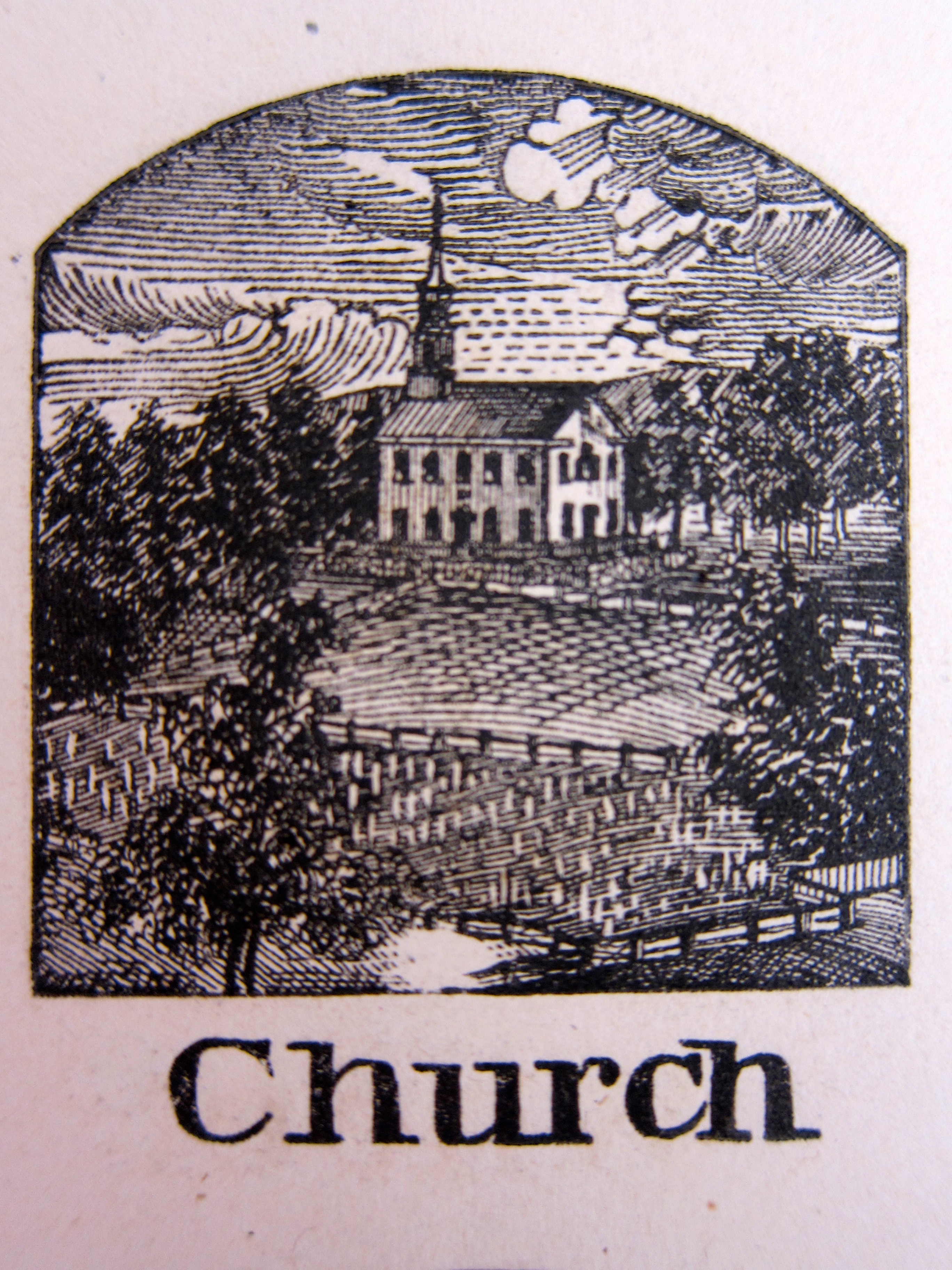
July 18th Sunday  Have been to meeting as usual

Mr Whitwell preached well.  Went to Mr

Whitwells with Mother & Henrietta at noon

When we came from church Mr Ames

& self rode up to the ponds, found Oliver &

Fred there  Called this evening with Mr

Ames at Augustus found him threatened

with a fever & quite unwell.  Called on Lavinia

Williams a moment and Mrs Savage who is quite ill.

The good news today was that Evelina was comfortably back in her own pew at her own church, listening to her favorite minister preach. During the intermission between sermons, she even took her mother and sister-in-law, Henrietta Williams Gilmore, to the parsonage for tea. After church she and Oakes “rode up to the ponds,” meaning that they may have ridden not just to Shovel Shop Pond, but also beyond to Flyaway or Great Pond. There they ran into Oliver (either their son or Oakes’s brother-in-law) and Fred Ames.*

The not-so-good news was a run of illness among family and friends. Evelina’s nephew, Alson “Augustus” Gilmore, was suffering from some kind of fever. This was not an uncommon ailment during the hottest weeks of summer; many infants, especially, were prone to dehydration when the thermometer went up. Evelina had to be concerned that Augustus was so ill so suddenly. Hannah Savage (her near neighbor for whom her old servant, Jane McHanna, was now working) had been ill for some time. Hannah was thought to be dying; a watch would soon begin for her.

*It seems likely that it was Oliver (3) and not Oliver Jr with  Fred “up to the ponds.”  If it had been Oliver Jr., it’s probable that Sarah Lothrop Ames would have been with them.  She wasn’t. And it’s equally likely that the two young college men would be enjoying their familiar camaraderie, now that each was home from school.

July 11, 1852

imgres-1

Luther Sheldon 

(1785 – 1866)


July 11th Sunday  Went to meeting with Mrs A L Ames

this morning to Mr Sheldons church  The

church is just painted and looks nicely.

Their organ is good & fine ringing but they

had a most miserable preacher a stranger.

Communion at our church this afternoon  Mrs

Ames partook with them

Instead of going to her usual Unitarian service in Easton Center this morning, Evelina accompanied Almira Ames to the Easton Evangelical Congregational Society, also known as “Mr. Sheldon’s church.” Luther Sheldon was an orthodox Congregationalist, a man of “good sense and fine character”* who had once been embroiled in a difficult schism in the local church in the 1830s. This was a period when Unitarianism first developed and uprooted many Congregationalists. Sheldon and his congregation not only survived the division but, according to local historian Edmund Hands, were instrumental in keeping local rancor and partisanship to a minimum. The two separate churches settled into peaceful coexistence, and Sheldon and his wife continued to earn general approbation.

Partisanship still existed in a few pockets, however. Evelina often expressed dislike for any man of the cloth other than her own William Whitwell, and today was no exception. She might not have criticized Mr. Sheldon himself, but she had no problem slamming today’s visiting minister at the Congregational church as “a most miserable preacher.” What could he have said to earn such disdain?

For the afternoon service, Evelina and Almira returned to “our church.”

*Edmund C. Hands, Easton’s Neighborhoods, 1995, p. 131

July 7, 1852

Funeral

1852

July 7th Wednesday  Made some muslin bands and 

partialy made a pair of sleeves to wear

with them  This afternoon have attended the 

funeral of H Gilmore  Mr Carver baptized

their child Helen. Mr Sanford made some

remarks and not very good in my opinion.

We returned from the grave to aunt Gilmores

and stopt to tea  Adoniram & wife & Mr & Mrs

Whitwell were there, Mr Carpenter & Jones called

there

Wearing black armbands, Evelina and her family attended the funeral of her cousin, Henry Tisdale Gilmore. Just shy of 36, he had died the day before of the “fits.” We might imagine that Henry was epileptic and died from a sudden seizure. He left behind a 30-year-old widow, Chloe, and a young daughter, Helen.

This branch of the Gilmores lived in Raynham, a town to the south of Easton. Cassander Gilmore, Henry’s older brother, manufactured shoes; Henry had been his partner. Now Cassander’s son, Othniel (one of many with that name), took Henry’s place. Cassander was well-known and well respected in the area, having served as state representative and state senator. He was a first cousin to Evelina on her father’s side, and it was he who summoned the Ames family to the funeral.

Evelina saw various relatives at the funeral, naturally, including her widowed aunt, Sally Gilmore. Reverend William Whitwell and his wife, Eliza, too, attended the funeral, but didn’t participate in the service. The local minister, Robert Carver, baptized the young Helen while another minister, Mr. Sanford, read a eulogy. Ever loyal to her own minister, Evelina found the latter’s remarks were “not very good.”


June 20, 1852

Lemon

Sunday June 20th  Have been to meeting all day Mother

went this afternoon and returned home  Mr Sanger

of Dover preached  Since meeting have been to 

Alsons with Edwin & wife & Oakes Angier.

Called at Mr Pools  Was treated with strawberries

& ice cream at Alsons and with lemonade

at Mr Pools  Frank went to a sing at Cohassett

Father gave me quite a lecture on cooking stoves

says we have had a dozen and we have had four


No Mr. Whitwell at church today. Instead, Rev. Ralph Sanger of the First Church of Dover led the service. Dr. Sanger was an older minister in the area, having graduated from Harvard in 1808, a year before Evelina was born. He had spent his entire ministerial life in Dover where he was well regarded. He also served several terms in the Massachusetts Legislature and was the chaplain for the Massachusetts State Senate.

After church came an afternoon of sweet sensations. Strawberries, ice cream and lemonade were served at two different homes where Evelina, Oakes Angier, and the young Gilmore couple called. The fresh fruit was a seasonal treat, and the ice cream and lemonade no doubt delightful as well.

Not all was sweet at home, however. Old Oliver got cross with his daughter-in-law and gave Evelina “quite a lecture” about her cooking stove. She was about to get a new one in her kitchen, certainly with her husband’s approval, but her father-in-law had no patience for it.  He didn’t see the need to update the kitchen equipment. We might remember that Oliver had grown up watching his own mother cook over a hearth, a style of cooking that had served for generations.  And here was his daughter-in-law planning to install another stove under his roof.

Even the little bit of rain that fell around sunrise didn’t cheer Old Oliver up.

June 13, 1852

Lobster

June 13

1852 Sunday  Went to meeting this morning & returned

at noon and mother came with me to make

a visit  Did not go back this afternoon on

account of getting tea  Mr Patterson is here

came last night  Edwin & wife stoped to 

tea from meeting had lobster.  Read to

mother in  [entry incomplete]


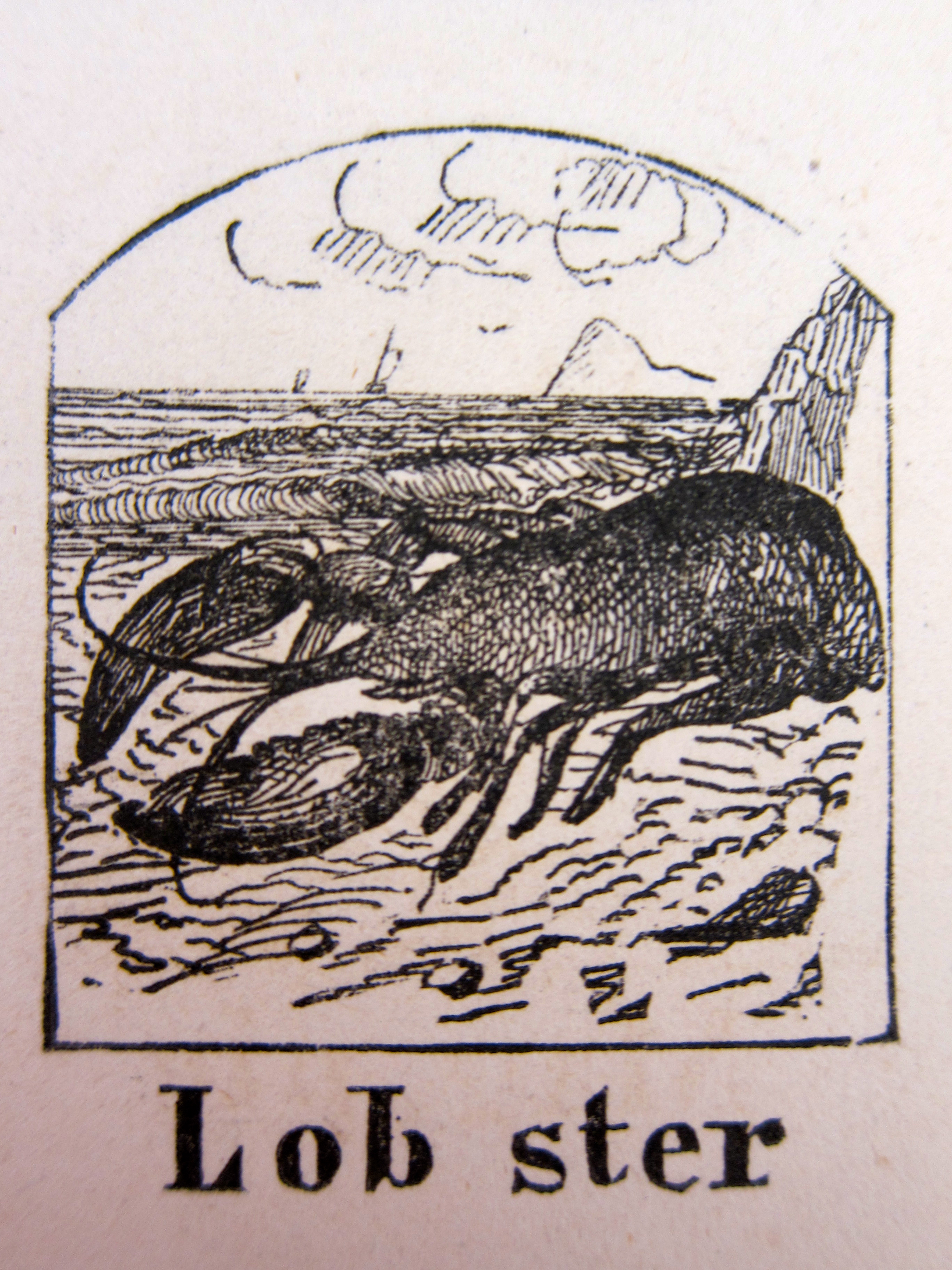
The Sabbath was another “fair day + pritty warm + verry dry.”* Old Oliver had to be getting edgy about the prospects for this year’s hay crop, not to mention the potentially poor output from the cornfields and the crop gardens all around town.

The family all trooped to church for the morning service, but Evelina, bringing her eighty-year old mother home with her, skipped the afternoon sermon “on account of getting tea.” She had to prepare lobster for Edwin and Augusta Gilmore. We might assume that on the previous day, Oakes Ames picked up a lobster (probably quite fresh, although cooked and canned were available) in Boston on his usual Saturday visit. Lobsters were plentiful, inexpensive and, as a rule, larger than those we dine on today. He was probably familiar enough with the crustacean to buy one that was fresh.

The well-known household advisor Lydia Maria Church approved of lobsters, and offered advice on buying them:

‘A female lobster is not considered so good as a male.  In the female, the sides of the head, or what look like cheeks, are much larger, and jut out more than those of the male. The end of the lobster is surrounded with what children call ‘purses,’ edged with a little fringe.  If you put your hand under these to raise it, and find it springs back hard and firm, it is a sign the lobster is fresh; if they move flabbily, it is not a good omen.’

Moving flabbily could never be considered a good omen.


*Oliver Ames, Journal, Stonehill College Archives, Arnold Tofias Collection

** Lydia Maria Church, The American Frugal Housewife 


June 6, 1852

FullSizeRender

Office of Ames Shovels, ca. mid-to-late 1850s

1852

Sunday June 6th  Have been to meeting as usual

Mr Whitwell preached  Came home alone

with Mr Ames at noon Have read

but very little partly written a letter

to Oliver.  Mr Ames said he would go 

with me to Augustus’ to make a call but

he did not come from the office in season

Sermons, reading and writing filled Evelina’s day. She began a letter to Oliver (3), off at college.

It may have been the Sabbath, but that didn’t preclude Oakes and Oliver Jr spending time in the office next door to the house. The two men often met there at the end of each workday “to catch up with their correspondence (all letters were written and copied by hand), discuss business together and go over accounts with the head bookkeeper.”* That they met on a Sunday evening seems unusual, but it may not have been. The shovel firm was about to build a new, stone factory, one that would be more fire-resistant than the old one that burned down in March. These plans were being developed even as the business was in swing, making shovels and filling orders. Oakes and Oliver Jr. were extra busy.

As had happened before, Oakes Ames forgot to take Evelina out as promised, or came home too late to go, so she missed a visit to her nephew Augustus Gilmore and his family. Was Oakes’s chronic oversight just absent-mindedness, or was he more consciously choosing to ignore social obligations when they proved inconvenient? And how did he make it up to his wife?

Winthrop Ames, The Ames Family of Easton, Massachusetts, 1938, p. 129


May 23, 1852

Preach

Sunday May 23d  Mr Rogers of Canton preached to day

I did not like him any better than Mr Whitwell

Alson Mother & Helen came home with us

at noon.  Oakes A carried Miss Foss to the 

sing and home  Ellen H & Rebecca White went

with them  Mr Ames & self made a long call

at Mr Swains  Mr Rogers made a short call

as he was going to church

Robert P. Rogers, the Unitarian pastor from Canton, led the service in Easton today, presumably switching places with the regular minister, William Whitwell, as the clergy often did in those days. Rogers was only twenty-seven or twenty-eight years old; his post in Canton was his very first.  As yet unmarried, and certainly younger and less seasoned than Mr. Whitwell, Rogers did not impress Evelina. He paid her the compliment of making “a short call” before church, but she was partial to the Whitwells.

Young Mr. Rogers would soon leave Canton for a pulpit in Gloucester where he would serve as minister for the remainder of his ministerial life.  He must have done well there, or they wouldn’t have kept him around for so long. Decades later, however, Mr. Rogers would return to Canton to live out his last days.

Between and after today’s services, folks were moving around town quite a bit. Old Oliver noted that it was “some cloudy” but also “pritty warm,” so it was pleasant to visit.  The dry roadbeds, though dusty, would have been relatively smooth. Evelina brought her brother and mother home after the morning service, Oakes Angier carried three young women to a sing after church, and Evelina and Oakes went over to see John and Ann Swain in the late afternoon. Everyone socialized.


May 22, 1852

large-1057

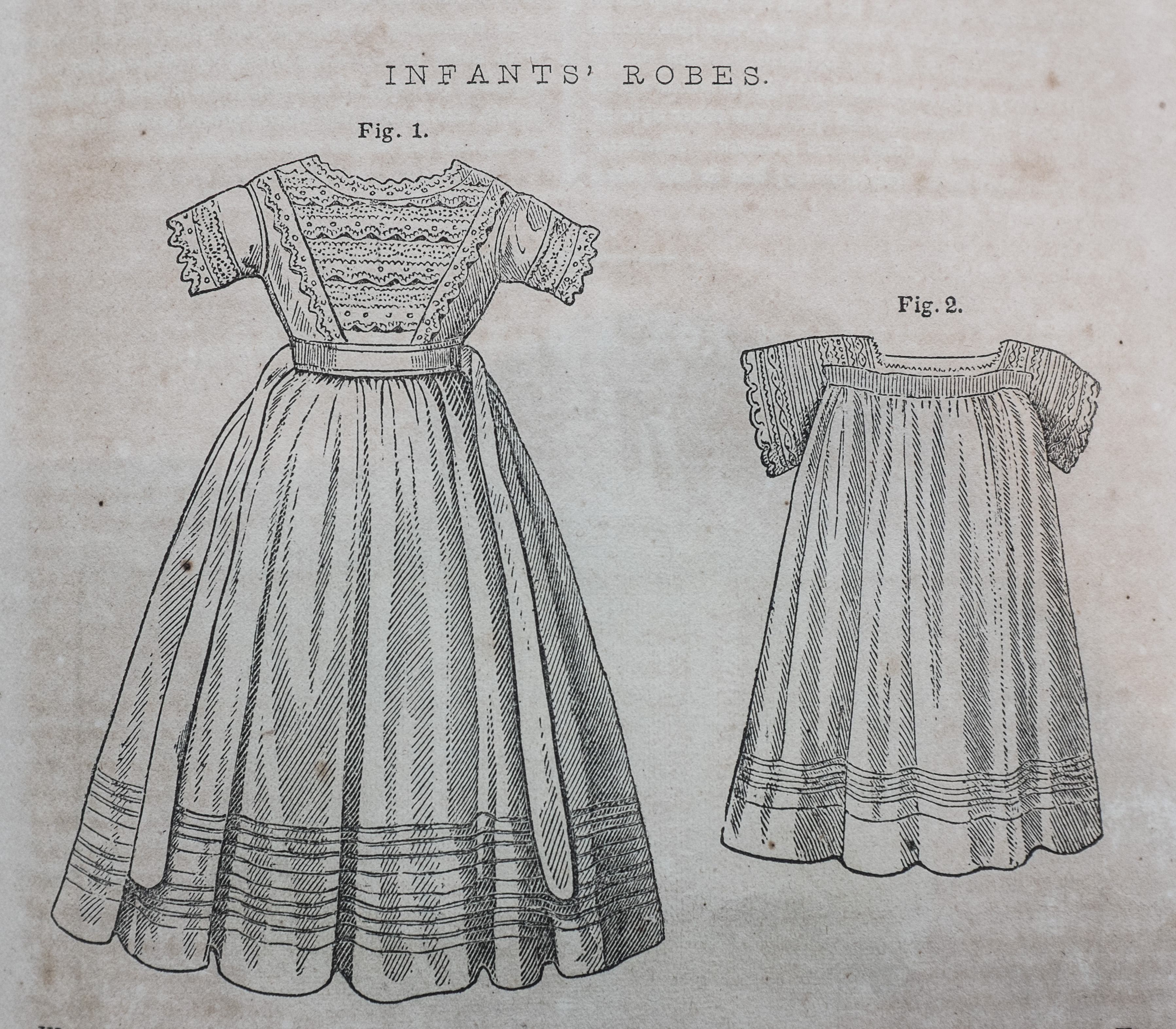
Infant wear from Godey’s Lady’s Magazine, 1851

Sat May 22d

1852  Mrs Paterson here again to day and has cleaned 

Susans chamber, windows & doors in Franks and

taken up the carpet and cleaned the front

chamber except the floor  Lavinia & Orinthia

came about eleven,  Edwin & Augusta here to tea

and went home with Lavinia  Mrs McHanna stood

godmother for McCabes child


Spring cleaning continued.  Mrs. Patterson returned to help Evelina clean, and the two women worked hard. Windows, doors, carpets and more were scrubbed, wiped or beaten, as appropriate.

Jane McHanna, the Ames’s regular servant, must have had time off today. She attended a baptism, presumably at the little Catholic church on Pond Street, to act as a godmother for a child of the McCabes. About this time, there was an Irish family in Easton, Bernard and Hannah McCabe, who had young children. Perhaps Jane became a godmother for three-year old William McCabe or, more likely, a younger sibling. There were several McCabe families in Bristol and Plymouth counties at this time, however, so we can’t be certain who this young child was.

The baptism or christening of infants was an important rite for both Catholics and Protestants. They had different approaches, certainly, but the intent was the same: to bless a child and erase its original sin. Unitarians differed from the Catholics and Calvinist-based Puritanism on this latter issue, as Unitarians didn’t accept the notion that children were born depraved. It was a critical doctrinal point. Jane McHanna would have accepted the more traditional view, and probably considered it an honor to have been selected as godmother.

May 16, 1852

lclapp-1

1852

Sunday 16th May Mr Whitwell preached a funeral sermon

and very good  At noon mother Henrietta

and self spent at Mr Whitwells  After meeting

Mr Ames Susan & I rode to Mr Clapps made

quite a long call  he has but a very few 

flowers in blossom, pansys were very pretty

Have engaged a trellis of him

The last formal recognition of the death of fourteen year old George Witherell took place in the Unitarian church this Sunday when the minister “preached a funeral sermon.”  Different from the ritual text that probably defined the graveside service just three days earlier, the sermon was presumably a collection of thoughts about death in general and the death of the young man in particular.  Reverend Whitwell knew the family well and, being an articulate and thoughtful wordsmith, must have offered the family some personal comfort and consolation.

Evelina appeared to be recovering her strength. With her husband and daughter, she rode to Stoughton after church to visit Lucius Clapp, where they made “quite a long call.” Evelina discussed flowers and a trellis. Was this trellis ordered in place of the one at the front door that was being built only ten days earlier?  Or was this a new trellis entirely, designed perhaps for the garden?  Was this the year of the trellis?

One imagines that Oakes Ames offered less direction about the trellis than his wife.  What he might have preferred to discuss with Lucius Clapp was their shared interest in the Whig party, or their mutual respect for temperance.  According to one nineteenth century historian, Mr. Clapp was a “kind-hearted”* man with a “modest and retiring nature.”* His politics were informed and liberal:

Formerly a Whig, Mr. Clapp has been identified with the most progressive political creeds. He was one of the original Free Soilers, and chairman of the first Free-Soil meeting held in Stoughton. Since its organization he has supported the Republican party. He has been [a] member of school committees several years, and selectman of Stoughton seven years, and now (1883) holds that position. He has always been pronounced in advocacy of temperance, and has been connected with every movement for the betterment and advancement of his native town. He is an attendant and supporter of the Methodist Episcopal Church.”*

Mr. Clapp and Mr. Ames would have had much to talk over.


*D. Hamilton Hurd, History of Norfolk County, Massachusetts, 1884, pp. 424-425