January 24, 1852


IMG_2669


1852

Jan 24th  Saturday   Worked all the forenoon mending

Olivers overcoat & pants. Have finished my worsted

hood in Olivers this afternoon.  Julia Pool

Augusta & Edwin were there to tea. Mr Ames

has been to Boston & has brought home Oliver a

gold watch  Fred & Oliver have fine time and 

are wide awake  They sleep together.  Fred came 

in here tonight.

Evelina must have written this entry at night, perhaps in her bedroom where she could hear her son Oliver (3) and nephew Fred Ames conversing and laughing elsewhere in the house.  The first cousins, college men both, enjoyed one another’s company and were spending the night together. Up to now, they were the only family members in recent memory to go to university and must have had some stories to compare.

The fond regard that Oliver (3) and Fred held for one another would last throughout their lives, although it would be sorely tested on occasion. As grown men caught up in the high stakes of the railroad business, they found themselves holding opposing views more than once.  And after the sudden death of Oakes Ames and the attendant financial woes that followed, Oliver (3) defended his father’s legacy, while Fred supported his own father’s efforts to recoup funds that Oliver, Jr. believed were his.  In other words, Oliver (3) and Fred faced off over money. Yet they moved in similar circles, invested in similar capitalist ventures and, in 1893, when Fred himself died quite suddenly, Oliver (3) grieved, “completely broken down by [the] sad news.”*

Those difficult times lay ahead, but on this day, Oliver (3) had something to celebrate.  His father, Oakes, had given him a gold watch, perhaps in honor of his 21st birthday, which was right around the corner. Perhaps, too, Oakes was honoring his middle son for his successful studies at Brown University, studies that Oakes had initially resisted. The watch was certainly a sign that Oakes was proud.

*Oliver Ames Third, Diary, September 13, 1893, Collection of Stonehill College Archives
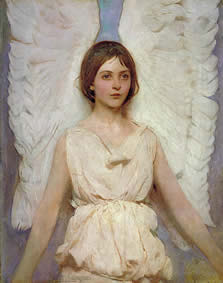


January 5, 1852

Abbott H. Thayer, Angel, 1887, oil Smithsonian American Art Museum Gift of John Gellatly

Abbott H. Thayer, Angel, 1887, oil
Smithsonian American Art Museum
Gift of John Gellatly


/52

Monday Jan 5 th

Another stormy Monday and we have not been 

able to put our clothes out  Susan washed the

dishes this morning and Jane has done the rest

of the work.  I have finished Susans hood and 

it looks very nice  Mrs Witherell came from

Boston to night  Mr Witherell died about six

yesterday morning


Old Oliver was keeping track of the stormy weather, noting that “it raind + snowd all last night. the snow fell about 2 inches deep + is a snowing now wind north east but it does not blow so hard as it did yesterday. it snowd untill about 3 O clock but was cloudy all day.” One imagines that he had his face close to the window panes of his sitting room – or accounting office, perhaps – as the snow fell outside.

Sarah Witherell returned from Boston in that same snow and wind, having managed to reach her father-in-law’s bedside before he passed away. She would gather her children and return to the city for the funeral.

Evelina, meanwhile, sewed and supervised household chores. “Another stormy Monday” meant that wet laundry was dried in the kitchen and around the house, near heat registers and the air tight stove that helped keep Evelina’s plants from freezing. Parts of the house were draped with white sheets and garments, the floors or carpets wet beneath them. Susie Ames helped some by doing the dishes, a chore that was becoming her regular responsibility. Jane McHanna, of course, bore the lion’s share of the work, with the laundry and “the rest.”


December 29, 1851

1_f5848b408e8936030e8b62e01d05ba09

Thomas Valentine Sullivan (1800-1859)

Monday Dec 29th  Have been at work about the house all

day  Helped Susan wash the dishes this morning

cleaned the dining room swept & dusted the

parlour & sitting room chambers entry &c  This

evening have spent in Olivers quilted the lining

to Susans hood  Helen has a bad cold and has

come home  It has cleared off very pleasant

It was an average Monday at the Ames’s house. Jane McHanna washed clothes and linens in big tubs in the kitchen while Evelina swept and dusted all around the house.  Susie Ames worked, too, helping her mother with the breakfast dishes.  After the chores and meals were over, Evelina visited next door with some sewing in hand.

In Boston, however, the day was more noteworthy. An iconic American institution – so familiar to most of us in the 21st century that it seems to have always existed – was formed today. Borrowed from London, where the original organization had been founded six years earlier, a Young Men’s Christian Association was formed at the Old South Church. The “Y” was born in the U. S. A.

The driving force behind the creation of an American YMCA (another had just opened in Canada) was Thomas Valentine Sullivan, a sea captain who had chosen to spend his retirement working as a missionary on the Boston waterfront. According to the Y’s own history, Sullivan noted a “need to create a safe ‘home away from home’ for sailors and merchants.”*  Young men who found life on the street too dangerous or unsavory could take refuge at the Y for “Bible study and prayer.”*

Among her dishrags and dustmops, Evelina wouldn’t have known about Capt. Sullivan and his new work. Yet the small, hopeful gathering at the Old South Church would grow into a major, caring resource for millions of people.


*http://www.ymca.net


December 27, 1851

imgres-1

Sat Dec 27th  Have put more sugar lemon & ginger to the syrup

of the citron  swept and dusted the rooms got

the lining ready to quilt to Susans hood quilted

the lining to Susans bonnet and fixed the collar

to my cloak  A[u]gustus Lothrop brought me a 

bushel of cranberries.  A Augustus called to bring

soap shoes &c that he got me in Boston


The cold temperature continued, Old Oliver noting in his diary that “the thermometer according to the papers was down to 8 in some places.”* Such temperatures wouldn’t have harmed the bushel of cranberries that Evelina received today. As author Mrs. Cornelius advised in her 1846 household guide, “cranberries keep well in a firkin of water. If they freeze, so much the better.”**

Cranberries were common in New England.  There is debate over whether they were served at the earliest Thanksgiving dinners, but there’s no debate that both Native Americans and English settlers consumed the fruit in season. Botanist Judith Sumner notes that: “Wild cranberries were originally hand-picked, but efficient New-Englanders soon crafted scoops that could be used to rake the berries from the lax stems.  During the nineteenth century, bogs carpeted with wild cranberries transformed into cultivated sites that were raked systematically each fall.”***  Augustus Lothrop, the youngest brother of Sarah Lothrop Ames, evidently cultivated cranberries at his farm in Sharon.

Henry David Thoreau enjoyed cranberries, finding them in the wild and eating them raw.  He considered them “a refreshing, cheering, encouraging acid that literally puts the heart in you and sets you on edge for this world’s experiences.”***

*Oliver Ames, Journal, Stonehill College Archives, 1848-1863

**Mrs. Cornelius, The Young Housekeeper’s Friend, New York, 1846

*** Judith Sumner, American Household Botany, Portland, Oregon, 2004, p. 124


Ed. note:  Horace “Augustus” Lothrop was the youngest brother of Sarah Lothrop Ames.  He lived in Sharon.

Alson “Augustus” Gilmore was a nephew of Evelina Gilmore Ames, son of her brother Alson. He lived in Easton.

December 20, 1851

unnamed Dec 20 Saturday  Have been very busy all day working

on different articles  Mended some clothes

for Frank, the stockings and mended the

places that were cut & bound the end of

some pieces of carpeting Jane finished the 

second robin that she has made for Frank

Mr Ames brought home some marble rubber

and lining & ribbon for Susans bonnet   ”


[T]his was a fair day and not verry cold” was the weather report from Old Oliver Ames. It was a normal Saturday at the Ames’s house in all respects. Evelina mended clothes, darned socks and repaired some carpeting.  Jane McHanna sewed, too, having recovered from an acute indisposition caused by coal the day before. She finished a “robin” (which one reader suggests was a kind of tough work pants) for Frank Morton Ames, Evelina’s youngest son.

Oakes Ames went into Boston, as usual, for a weekly check-in with shovel customers, after which he went shopping for his wife. From a list Evelina must have given him, he made his way along Washington Street and around Faneiul Hall, probably knowing just which shop to go to for such-and-such ribbon or a well-priced bolt of flannel. He returned to North Easton laden with parcels wrapped in paper and tied with string.

December 15, 1851

Hood

Monday Dec 15  The girls have both been washing to 

day but it was so windy they could not put their clothes

out  Jane has sewed this afternoon the bags for the

sausages  I knit on Susans hood this morning

and this afternoon commenced knitting on a little

hood for the fair  Mrs Witherell & Ames have been

in awhile and are to work for it

While her servants Jane and Mary struggled with the Monday laundry, Evelina began to knit. Her nephew, Augustus Gilmore, had fetched some yarn – or worsted, as she called it – for her on Saturday while in Boston, and she was finally able to get to it today.

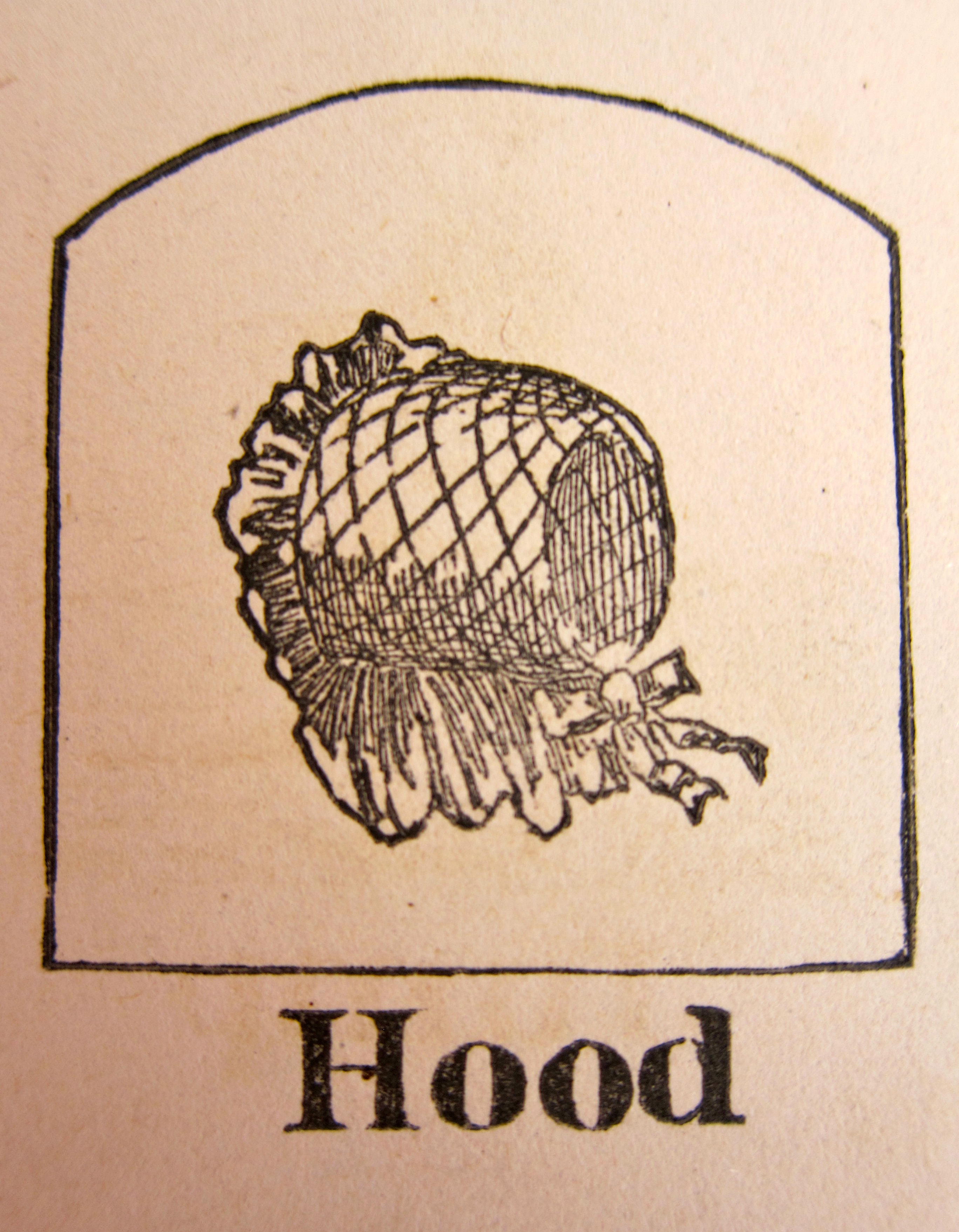
Evelina “knit on” two hoods, one for her daughter Susan and another for a church fair that was coming up. A hood might take a few different shapes, from a fitted piece that covered the top, sides and back of one’s head to one that covered the top and sides only, as in the period illustration above. The one above – which isn’t knitted, but sewn – is really just a variation of a bonnet.

Jane McHanna, too, worked with a needle today once the washing was done. She sewed some cloth bags for the pounds and pounds of sausage that had been produced on Saturday.  Sausage was usually forced into casings made from pig intestines, and this may have been the case with the pork that Evelina and Sarah Witherell produced.  But it may be that an additional cloth covering was desirable for storage or identification.  Hard to know.  Any thoughts from readers who have made their own sausages?


December 14, 1851

330px-Mayor_B_Seaver

Benjamin Seaver

Mayor of Boston, 1852 – 1854

Sunday 14 Dec  Have not been to meeting to day on

account of my cough.  Jane went to meeting 

at eight Oclock got breakfast before she went.

I have been writing and reading

Mr Swain & wife have spent the evening here

Mr Swains brother has been there a week or two

I have not seen him  The babe grows very 

fast and is a great wonder

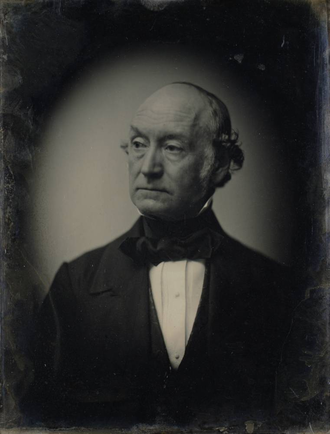
In an unusual occurrence for a Sunday in New England in the 19th century, an election – or an announcement of the results of an election – was held on this day.  A new mayor, Benjamin Seaver, was elected to govern the City of Boston, a post he would hold through 1853. He was a Whig, one of that dying breed whose successful election surely gave the Ames men a lonely branch to cling to in the swirling flood of new political parties.

According to modern historian Jim Vrabel, Seaver won with 3,300 votes and defeated Dr. Jerome Smith and Adam Thaxter. (Only men voted in the election, of course.) Seaver was noteworthy for his interest in erecting a public library for the city. During his administration, a committee would be formed, plans (some already in the works) developed, a first librarian hired, and private funding obtained for the project.

At the same time that Seaver came in, “the entire Board of Aldermen” were voted out, “reportedly for refusing Daniel Webster” – a hometown favorite – ” use of Faneuil Hall because an abolitionist group had earlier been denied its use.”* Webster had advocated for passage of the Fugitive Slave Act, something for which abolitionists never forgave him. Just goes to show that the issue of slavery informed all levels of political intercourse in this decade before the Civil War.

On the home front, besotted new parents Ann and John Swain spent the evening with Evelina and Oakes, talking about their son.  Evelina seemed smitten, too, writing that the baby boy was “a great wonder.” Like the new mayor and the Board of Aldermen, however, she and that baby’s parents couldn’t know what sorrow lay ahead.


Jim Vrabel, When in Boston, Boston, p. 157

December 13, 1851

$(KGrHqJHJFMFJusCVdz8BSe+hz0oG!~~60_35

Sat Dec 13th  Have tried my lard cleaned hogs head

and fat and the meat ready choped & seasoned 

for filling  Have been to work all day on them

together with Jane & Mary.  Have 78 lbs meat

Mr Ames & Augustus have been to Boston.

Augustus got me some worsteds for hood

Frank & Oakes chopped my meat & Sarahs, she

had 28 lbs.

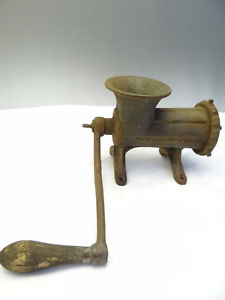
Sarah Witherell and Evelina Ames, sisters-in-law bent on taking care of some pork fresh from the slaughter of a few Ames hogs, had 106 pounds of pork between them to be turned into sausage. In addition to the capable hands of servants Jane McHanna and Mary, they had help from Evelina’s sons Oakes Angier and Frank Morton, who chopped the meat, and probably the fat, too,  into manageable chunks. Together with other ingredients – see below – the meat was forced into a grinder like the one pictured above.

Most likely, the women didn’t need to follow a recipe to make the sausage, having made it countless times before.  But if they did, they could have turned to Sarah Josepha Hale’s instructions in The Good Housekeeper.  They would have had to multiply the recipe times thirty or so:

“TO MAKE SAUSAGE MEAT. — Chop two pounds of lean with one of fat pork very fine – mix with this meat five teaspoonfuls of sale, severn of powdered sage, two of black pepper, and one of cloves.  You can add a little rosemary, if you like it”*

And sausage wasn’t the only product from the pork that Evelina, Sarah, Jane and Mary worked on.  They made lard and dressed a hog’s head. It was a most productive day in the Ames kitchen.

*Sarah Josepha Hale, The Good Housekeeper, Boston, 1841

December 4, 1851

Clerk

Dec 4th  Thursday.  Returned from Boston to night

Have got the greater part of the things

I wanted.  could not suit myself in all.

Mother spent yesterday with Augustus & to day

at Mr Torreys returned here this evening

Left Mr Orrs this morning did not dine there

it takes so much time  Julia is at home

It is three weeks [entry ends here]


After seeing her husband off on his business trip to New York, Evelina spent yesterday and today shopping in Boston. She seemed satisfied with her purchases, though she confessed that she “could not suit myself in all.” Was she buying cloth or ribbon or other fashion accessories, or decorative items for the refurbished parlor, or foodstuffs for the pantry? It was early December, a time in our own culture when we modern folks are apt to be out (or online) shopping for Christmas presents. Evelina may have been buying Christmas gifts for her family, although that is unlikely, as the Ameses barely recognized Christmas, let alone celebrated it.

Although public opinion in New England was changing, a poor opinion of Christmas prevailed among the Yankees of Evelina’s generation, and certainly of Old Oliver’s. It was based on a Puritan tradition that considered Christmas as “an emblem of popery.”  Yankees “were strongly influenced by the traditions of Calvinism and the routine of the established Congregational church, honoring a certain stoicism, hard work, and stern independence.”  Instead of Christmas, “Thanksgiving was the most important day of the year.”* That would change.

But Evelina must have caught the train back to Stoughton, or the stage home to Easton, empty-handed of the kind of Christmas plunder that her favorite author, Charles Dickens, so famously described.


*Jane Nylander, “Our Own Snug Fireside,” 1993, New Haven, p. 8


December 3, 1851


railnet1850

Dec 3d  Wednesday.  Mr Ames started for New York by

way of Boston.  I went to Boston with him dined

at Mr Orrs  Melinda went for Selina and

she passed the night there with me.  I was very

busy shopping all day  In the evening Mr & Mrs

Norris  Selina & self played cards  Past eleven

when we retired.  Mr & Mrs Byram were there


As Old Oliver wrote at one point in his journal, “Oakes went to New York the 3rd of this month to settle up our accounts.”  With his natural bonhomie and sharp talent, Oakes was the best salesman on the Ames team.  On this trip, he would be away for eight days, delivering invoices, collecting payments, checking on inventory and bringing new orders back home.

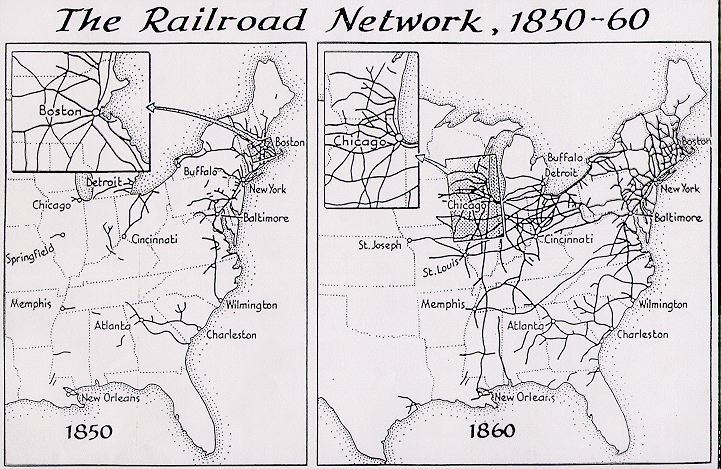
Evelina accompanied her husband into Boston, where they stopped for midday dinner at the Orrs’ before Oakes boarded his train. He would have traveled to New York by way of Springfield, or else taken the Old Colony line down to Fall River where steamboats picked up passengers to complete the trip to New York City.  Evelina, meanwhile, stayed in Boston to shop and enjoy a bit of socializing with the extended Orr family. She played cards past her bedtime.

Back in Easton, shovel making and farm work went on as usual.  Old Oliver, as always, noted the weather: “this was a fair day wind north west + cold. ”  He added that  “we kild 4 hogs to day everage wate 356 lb sold to the workmen at 7 cents a pound those we sent to boston sold for 7 ¼ cents”.  He sold some of the fresh pork to his workmen, probably through the Ames store, and sent the surplus to Boston to be sold.