May 22, 1851

stock-footage-senior-women-planting-a-flower

1851

Thursday May 22d  The first thing after breakfast set out

a plant that Orinthia sent me last night.  Then

went to work in the sitting room taking up the 

carpet cleaning the closets &c  have finished cleaning

the room and the carpet partly down.  Aunt Orr

& Harriet, James Mitchell came to visit Mrs

Witherell about two Oclock and I left my work to

see them  Quite pleasant

Ordinarily, Evelina was tired and listless after a day in Boston, but not today. Orinthia Foss sent her a plant, a sweet token of friendship and thanks, and “the first thing” Evelina did was head to the garden to plant it. Before doing her chores! The plant meant a lot to her and the gesture from her young friend buoyed the day.

Carpet cleaning, closet cleaning, &c, &c, as Evelina would say, took up the morning and some of the afternoon. Guests arrived in the other part of the house, making a welcome interruption from housework.

The Orrs and Mitchells were old connections from Bridgewater, and their families had long been intertwined with the Ameses. Some of the earliest Ameses had settled in Bridgewater and, as a young man, Old Oliver had lived there. As we’ve noted before, Evelina boarded with one branch of the Orr family whenever she stayed over in Boston.  Aunt Orr was probably Susan Orr, a close friend who could remember when Oakes Ames was a baby.

There were many Mitchells in Bridgewater. James Mitchell, who ended up as a merchant in Philadelphia, was one of them.  He was married to a woman from Belfast, Maine named Harriett Lavinia Angier (possibly a distant relative in the Angier line.) He and his wife didn’t appear often in the Ames written records, but they were among the few non-family members who, years after this, would attend the funeral of Horatio Ames.  Perhaps James Mitchell and Horatio Ames had been friends growing up.

Mrs. James Mitchell’s married name was Harriett Angier Mitchell, almost the same as Harriett Ames Mitchell, Oakes’s youngest sister who was married to Asa Mitchell. The Harriett who accompanied James Mitchell today was most likely his wife, not Oakes’s sister. Confusing to us, certainly, but straightforward to them. Otherwise, a pleasant day in all respects.


May 21, 1851

faneuil-hall


May 21

Wednesday  This day have been to Boston and had a hard days

work but accomplished very little  Had a green silk

bonnet made for me which fitted […] no better than the

other that I sent back. Mr Remick paid back the four

dollars and I was glad to get off so well after all my 

trouble.  Spent most of the time with Sarah [and] Oliver in

looking for her things.  Bought me a pair of cuff pins

Called at Martin Halls store about some sugar

The search for the perfect bonnet continued today. It was back to Boston, to Alfred Remick & Co. to pick up a bonnet that Evelina had ordered – green silk this time instead of blue plaid – and it still didn’t fit. She had left the instructions up to her husband, Oakes.  Had he gotten it wrong or was the milliner once again at fault? So much for “all my trouble.”

Like yesterday’s diary entry, the tone of this one is self-deprecatory, even grumpy. Gone is the light-hearted pleasure she had expressed earlier in the month when gadding about buying plants for the garden in the company of Orinthia Foss or her nieces. Evelina couldn’t seem to get things to go her way. Her inability to find a bonnet was proving irksome, and the best she could manage was to tag along with her sister-in-law, Sarah Ames, and brother-in-law, Oliver Ames Jr., while they did some shopping. She did buy a pair of cuff pins, however, which was consolation of a sort.

While they were at Faneuil Hall, Evelina purchased or ordered or, at the very least, inquired about some sugar from a grocer there. Faneuil Hall was – and is – a prominent, historic building in Boston. In the middle of the 19th century, it featured a spreading marketplace, called Market Square, where merchants such as Martin Hall sold their wares.  Upstairs there was a large hall for civic gatherings. The illustration above, by Winslow Homer, shows Faneuil Hall in 1861, at the very start of the Civil War, ten years after Evelina bought sugar there. The image of a regiment of Massachusetts volunteers famously marching off to Washington was published in Harper’s Weekly, a periodical to which Evelina and Oakes subscribed.


May 10, 1851

7411thumb2

Sat May 10th  My bonnet does not fit me at all.  Mr Ames

called to see if they would take it back & make

me another I shall have another journey into

Boston for a bonnet. I have not felt like

doing much to day and never do after being

in Boston. Orinthia came home to night in

fine spirits. feels rather better satisfied with

her purchases that I do. The weather tolerably pleasant.

The bonnet that Evelina ordered from Alfred Remick & Company in Boston didn’t fit, so Evelina asked her husband Oakes to return it for her while he was in Boston.  He always went into the city on business on Saturdays.  The idea of Oakes Ames, a tall, large-chested man with a charismatic but somewhat rough-hewn manner, standing at a millinery counter negotiating the fine points of his wife’s headware, is a mental image to be treasured. This man, who could build shovels, advise a president, and imagine a continental railroad, could also cajole a store clerk and convince him or her to take back the hat his wife just bought. Oakes Ames was a force to be reckoned with, a force who also loved his wife.

Evelina, having dispensed her husband on that important errand, puttered around the house in desultory fashion as she was wont to do after a trip to Boston.  Schoolteacher and boarder Orinthia Foss returned to the house from the city happy and light-hearted, pleased with her shopping.  She must have brightened Evelina’s flagging spirits – or made her more disappointed with her own acquisitions.

May 9, 1851

champney2-thumb

*

May 9th Friday  Went out shopping about eight Oclock

and at ten met Mrs George Ames at Mr Daniels

She walked around with me looking for a dress

and other things, likewise met Abby & her cousins

and about 5 Oclock came across Orinthia She

said she should certainly be at home, but missed

of the cars. Mrs Ames left at half past 5 for N.Y.

with Mr Peckham. Returned home much fatigued


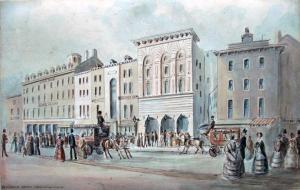
In Boston, stores opened so early that Evelina could start shopping at eight in the morning. She had ordered a bonnet the day before which she was able to pick up later in the day, so today’s shopping was more leisurely. She and her cousin-in-law, Almira Ames, stepped along “looking for a dress and other things.”  They probably walked along Washington Street and its side streets. Others from Easton were in town, too: her niece Abby Torrey and her own boarder, Orinthia Foss. The women were breaking out of their little town to find goods in the big city. The weather must have been especially cooperative.

Evelina finally returned to Easton “much fatigued.” Almira Ames, meanwhile, left for New York accompanied by the head clerk for O. Ames & Sons, John Peckham. They would have traveled by stagecoach or train from Boston or Stoughton. They were not running off together.  Rather, Mr. Peckham had shovel business in the city and, like a gentleman, accompanied the Widow Ames on what otherwise would have been a solo journey for each of them. Presumably, Almira lived in New York at this point in her life, although previously, she had lived in North Easton.


*Benjamin Champney (1817-1901), New Boston Theater, Washington Street, 1850

WC GC031/Benjamin Champney Watercolors Collection, Princeton University Library


May 8, 1851


image


Thursday May 8  Went to Boston and walked around

all day trying to find a bonnet but could not get

one to fit me ready made. Engaged to have one

made of blue plaid silk at Alfred Remick & Co.

Went with Oakes Angier to call on Mrs Stevens

She spent the night with me at Mr Orrs

Julia was at home and a Miss Orr a cousin or hers,

was there & Miss Foule dress making


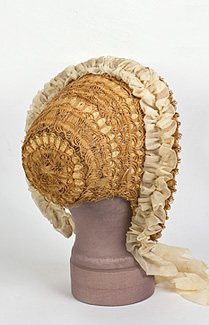
Evelina left off gardening today to go bonnet-hunting in Boston, for it was the season to switch from winter to summer headware.  She searched from store to store and must have visited a range of establishments running from small millinery shops to larger dry goods stores.  She would have seen bonnets displayed on mannequin heads such as the one in the illustration above.  Try as she might, however, she couldn’t find one she liked, so she ordered one instead.

Alfred Remick & Co was one of many dry goods merchants in the city. In 1851, Boston was a premiere center for the dry goods trade, according to the Boston Board of Trade, which reported years later that “according to our extensive New England domestic manufactures, Boston was from 1830 to 1850 the chief Dry Goods market of the country.” * Boston had lost that dominance by the outbreak of the Civil War and, with the ongoing and rapid settlement of the west, the competitive reach of rail freight traffic, and the impetus to widespread manufacturing brought on by the war, Boston never regained its preeminence.

Such concerns were not in Evelina’s mind, however, because she needed a new bonnet and couldn’t find one. After finally placing her order, she and Oakes Angier, the eldest son who carried her into town, called on a family friend, Mrs. Stevens.  As usual when staying in Boston, Evelina spent the night at the Orrs’ house.

*Annual Report of the Boston Board of Trade, Merchants Exchange, 1881, Vol. 128

April 24, 1851

Slave_kidnap_post_1851_boston

1851 Thursday  April 24th  Julia here to finish Susans dresses

She is very slow We have got the waist done

to her Delaine & finished the print dress & cut

the lining to my dress This afternoon called 

at Augustus’ & Mr Whitwell with Mrs Peckham

A[u]gustus returned from New York this morning

and is here again to dine Hannah went to

Alsons while he was gone Pleasant weather


Evelina and Julia Mahoney sewed today, perhaps trying to make up for time lost yesterday. Evelina’s nephew, Augustus, returned to the Ames’s dinner table after a business trip to New York. Meanwhile, his expectant wife, Hannah Lincoln Gilmore, and son Eddie were staying out at the Gilmore farm with his parents, Alson and Henrietta.

Had Augustus run into any abolitionist fervor while in New York?  Probably not as great as in Boston, where controversy continued in the aftermath of the Fugitive Slave Act and the capture and rescue of Shadrach Minkins. While some of the most prominent abolitionists of the day, like William Lloyd Garrison, lived in Boston, the city was nonetheless home to many citizens who were less adamant about the issue.  They might not have liked slavery, but they feared the radicalism of the anti-slavery rhetoric more.  They were law-abiding, and the law said that slaves were property and had to be returned to their owners. Daniel Webster had decreed it, and they supported the law accordingly. The controversy pulled at everyone.

When another escaped slave, Thomas Simms, was caught in Boston, the Mayor of Boston, John P. Bigelow, ordered him sent back south. The aldermen and the police supported the move, and the black population of the city became even more nervous than before, as the poster above illustrates. Have TOP EYE Open!

April 12, 1851

City

1851

April 12 Saturday  Went to Boston with Mr Ames. Have 

purchased a carpet & paper for the dark bedroom,

bought Susan a dark french print & borage

DeLaine Bible &c &c dined at Mr Orrs no one

at home but Mrs Orr & Mr Norris.  All gone to East

Bridgewater Mrs George Ames returned from 

New York with Mr Peckham Snowed a

little this morning but otherwise pleasant.


Oakes Ames made his usual Saturday trip to Boston and took a happy Evelina with him. It was the first time she had been to the city since January 17, and she didn’t seem to mind a light snow at the start of her journey. After three months in the country, she was excited to be in town, gazing at cobblestones, masonry, store fronts, and being part of the bustle of carriages and pedestrians.  Time to do some shopping.

She found some fabric for dresses for Susan. She bought a Bible. For whom? Why? With purpose and forethought, she selected new carpet and wall paper for at least one of the bedrooms at home that she and Jane had emptied out the day before. The carpet and wall paper, and more perhaps, would surely be delivered to North Easton rather than carried home.

As she had before, Evelina and Oakes, presumably, dined with their long-time friends, the Orrs, whose family, like theirs, had originally settled in Bridgewater. Evelina often stayed with the Orrs, but today she and Oakes only dined with Melinda Orr (Mrs. Robert Orr) and her son-in-law, Caleb Norris.

Today also marked a return visit to Easton by Almira Ames, widow of Old Oliver’s nephew George. She was a first cousin by marriage to Oakes, Oliver Jr., and Sarah Witherell and was used to visiting North Easton. In fact, she had spent enough time in North Easton to be listed in the 1850 census as living in the Ames household. In 1851, however, Almira seemed to be living in New York City. She was something of a favorite relative among the Ames women.


March 15, 1851

Rein

1851

March 15th Saturday  This morning Orinthia & myself gave the sitting

room &c a thourough cleaning & afterwards sat down to 

sewing.  Mended a number of articles  Orinthia put some

new sleeves into an old shirt of Franks that were small

This afternoon Orinthia Susan & I went down to Mothers with Charley,

called at Mr Guilds & Howards to see about her school and at Major Sebas & Mrs R

Howards.  Mr Ames brought from Boston Velvet chalk.  Pleasant

Charley was a horse, one of several that the Ames family owned.  Today Charley was put to work pulling Evelina, her daughter Susan and the new teacher, Orinthia Foss, in a carriage along the rough road from North Easton to the Gilmore farm near the Raynham town line. This, after Evelina’s mentioning only the day before the “bad traveling” on the local roads. They must have had a bumpy ride.  The weather was nice, though, so on they went.

Coming back from the Gilmore farm, they made several calls, the first two at Mr. Guild’s and at Elijah and Nancy Howard’s on school matters.  Evelina continued to act with or for Orinthia Foss “about her school.”  The ladies were on a roll with their visiting and stopped in at Seba and Eleuthera Howard’s farm.  Their last stop was a visit to Mrs. Roland Howard, a widow who was also a member of the Sewing Circle.

Evelina, Orinthia and Susan weren’t the only travelers out this day.  Oakes Ames made his usual Saturday trip into Boston on shovel business and brought back some “Velvet chalk” for dressmaking.

February 22, 1851

Rubbers

Feb 22nd  Saturday  This morning sat down to sewing

quite early to work on Susans apron.  Mr Torrey called 

to see about Augustus having his tenement.  Augustus

has engaged Mr Wrightmans house for the present.

Lavinia & myself passed this afternoon at Mr Torreys.

Called at the store, met Mrs. Peckham & Miss

Georgianna Wheaton there  Miss Foss came to night.  Mr

Ames has been to Boston brought Susan Rubbers.

Cleared off pleasant to night

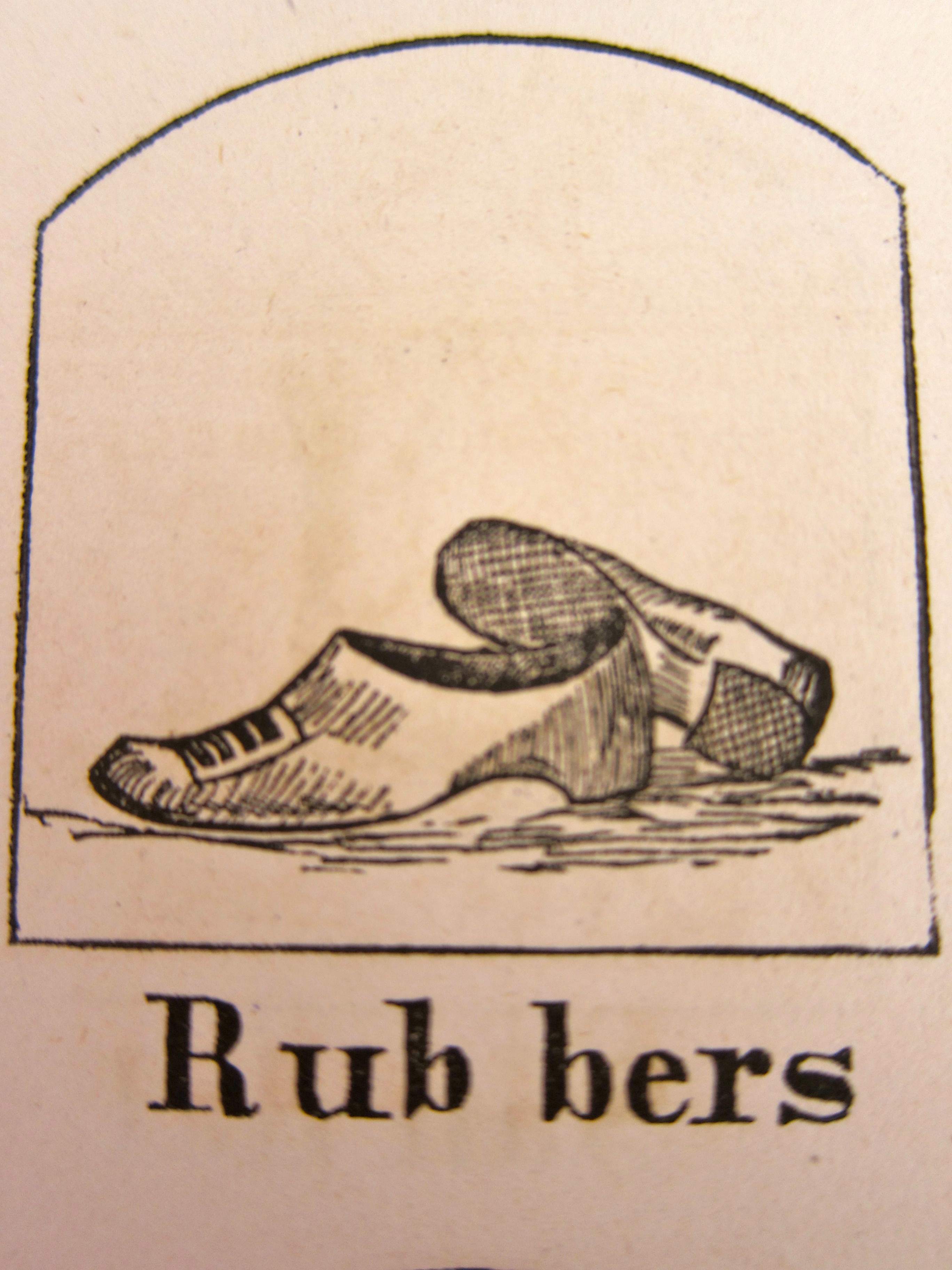
In his journal today, Old Oliver noted that “It’s pretty muddy now,” which explains why Oakes Ames returned from Boston with overshoes, known as rubbers, for his daughter.  Probably everyone in the household donned rubbers during this late winter wetness.

Evelina negotiated the streets just fine, it seems, as she and her niece traveled the short distance to the center of town to call at the company store and at her brother-in-law’s house.  Their mutual nephew, Augustus Gilmore, had decided not to rent from Col. Torrey and would be settling his family instead at a Mr. Wrightman’s house.  And at the end of the day, a new person entered the domestic scene.  Miss Orinthia Foss, the new schoolteacher, arrived from Maine.

February 22 is a date that people acknowledged in 1851 in a manner similar to the way people do in 2014, because it’s George Washington’s birthday.  In this year of Evelina’s diary, President Washington had only been dead for a little over fifty years.  People were alive who could still remember him; Old Oliver was one of them.  Old Oliver was born in 1779, while the Revolutionary War was being fought.  He was two years old when the British surrendered at Yorktown, and eight years old when representatives of the new states assembled in Philadelphia to write a constitution.  George Washington was elected to head that convention and became the country’s first president in 1789, when Old Oliver turned ten.  When Washington died in 1799, beloved and mourned, Old Oliver was a twenty-year old bachelor just making his way in the world.  Much about that world would change over Old Oliver’s lifetime, but the reverence that citizens of the United States felt for their first leader would hold strong.

February 10, 1851

Storm

Feb 10th Monday  Warm this morning but not pleasant  Jane 

put her clothes out but the wind commenced blowing quite

hard with some rain, so that the clothes had to be taken

in & were dried over the registers  Cut Susan a Chemise

out of the width of  1  1/4 yd wide cloth and partly made it

Worked about house as usual on washing days in 

the forenoon  Wind blows quite hard this eve.

What a jungle of white linens the Ames house featured this Monday, with Jane McHanna having to drape dripping laundry around the heat registers.  So much for Evelina’s cleaning the floors the other day.  Miserable winter weather – snow, rain, ice, wind and rain again – was wreaking havoc with the domestic schedule.

One person in the Ames household celebrated her 12th birthday today: Sarah “Emily” Witherell.  Emily was born in New Jersey where her parents had lived while her father, Nathaniel Witherell, Jr., worked with William Leonard Ames, her mother’s brother, at various Ames enterprises.  Tragedy had struck in recent years, though, with the death of her father and the subsequent “drounding” of her two year old brother, Channing.  Emily was stricken with loss at an early age.

With her mother, Sarah; older brother, George Oliver Witherell; and grandfather Old Oliver Ames,  Emily now lived in North Easton, Massachusetts in “the other part of the house”.  She probably still attended school, but she and Susie Ames were too far apart in age at this point to be close friends, although they would soon find themselves sharing  piano lessons.  Her cousin Oliver (3) found Emily to be outspoken and opinionated; she was, evidently, unafraid of speaking her mind at a time when candor in women was not prized.

Emily never married.  After Old Oliver died in 1863, when she was about twenty-four, Emily and her mother moved into Boston, eventually taking up residence in Back Bay at the Hotel Hamilton and living off of distributions from investments managed by her male cousins.  A spinster cousin, Amelia Hall Ames, the only daughter of William Leonard Ames, eventually moved in with Emily.  These two cousins, in turn, may have undertaken to raise yet another cousin, Eleanor Ames, a granddaughter of William Leonard Ames. All that is in the future; on this day in 1851, we can hope that Emily had a special birthday despite the weather. She deserved a happy moment.