November 25, 1851


kitchen

*

Tues Nov 25th  Mary has done the ironing to day except

the fine clothes and they look much better than usual

Jane is rather better to day and has washed the dishes

and assisted some about the housework.  I have made a

dickey for Mr Ames. Passed the afternoon at Father Ames

with Mr & Mrs Swain & Mrs Meader  Mrs S Ames,

Fred & Helen came home to night

Family members began to gather in anticipation of Thanksgiving. Fred and Helen Ames came home from their respective schools in Cambridge and Boston, adding animation to the quieter house next door.  Surely their parents, Sarah Lothrop and Oliver Ames, Jr., were pleased to see them.  Oliver (3), away at school in Providence, was getting ready for his travel home.

No one was making merry yet, however.  Everyone still had work to do. The new girl, Mary, did some ironing, evidently better than Jane McHanna usually did.  Jane herself, still recovering from an illness that had laid her low for almost ten days, was able to wash dishes and help out a bit. Evelina, after supervising Mary and Jane, was finally freed up to sew and socialize.  She was in a happier state of mind.

The men of the family were working as well.  While Oakes, Oliver Jr, Oakes Angier, and Frank Morton were at the shovel shop, Old Oliver and some of his men began “a building an ice hous.”**

“About sunsett,” it began to snow.


*Image of a mid-19th century kitchen, Courtesy of http://www.victorianpassage.com

**Oliver Ames, Journal, Courtesy of Stonehill College Archives, Tofias Collection


November 23, 1851

1850-shawl2

*

Sunday Nov 23d  Jane with Michaels sister got the

breakfast this morning but after breakfast Jane 

went to bed  I could not go to church this morning

Augustus came home at noon and brought Mr

Davidson  Mrs Meader Hannah & self went

back with him  This evening sat with my shawl

& bonnet on from 6 to 8 Oclock waiting for Mr

Ames to go to Mr Swains and then took them off did not go


For the second time this month, Oakes Ames forgot to take his wife somewhere. On this occasion, they had planned to visit Ann and John Swain.  Evelina had missed the morning meeting and although they had company at noon, and she made it to the afternoon service, she was still eager to get out and socialize. As night fell, she put on her “shawl & bonnet” and waited for her husband to pick her up. He didn’t show. She “did not go.”

Evelina had been disappointed two weeks earlier when Oakes had forgotten her, but the tone of her diary entry on that day had been tolerant. This time, she was likely less forgiving. Once Oakes finally walked in the door, more than two hours late, Evelina must have let him have it. Surely she got mad. Surely they argued.

Oakes’s excuse would’ve been that he’d been off electioneering, just like the last time he forgot to fetch his wife.  The next day was another town meeting and, in anticipation, he’d obviously gotten sidetracked, probably with friends. At least Evelina could be certain that he hadn’t been out drinking; Oakes was a teetotaler. But she would have been left to wonder what the outcome would be of her husband’s absorption into politics, and how it might alter their relationship.

Jane McHanna, meanwhile, was still sick.  Evelina was not having a great week.

*Image courtesy of wwwVictoriana.com


November 12, 1851

IcePond-732701

*

Wedns Nov 12th  Painted the closets in the sitting

room chamber which with other things has taken

me most of the day.  Susan has passed the 

afternoon at Mr Swains  Mr Whitwell called

this afternoon. I felt very sorry to stop my work as

I was very much engaged at the time  Have not

sewed at all to day  This evening have felt too much

fatigued


According to Old Oliver, “this was a fair cold day wind north west. the factory pond was frozen over this morning”  It was a good day to stay indoors, which Evelina did.  She still hadn’t completed all the refurbishments on the house, so she spent the day painting the shelves in the closet in the sitting room; the shelves in the parlor were already finished.  By evening, she was “too fatigued” even to sew.

Daughter Susie spent the day at the home of Ann and John Swain, perhaps playing with Ann’s niece, Ellen Meader.  Reverend William Whitwell braved the north west wind and paid a call on Evelina.  Much as she liked him and admired his Sunday sermons, she was less than pleased to set aside her painting for his visit.

And “the factory pond” – probably Shovel Shop Pond – had skim ice, at least, all the way across it.  What did that do to shovel production?  How did the dams, flumes, and wheels work when the water began to ice up?


*Photo courtesy of Kenneth Aisawa, http://www.theboundsofcognition.blogspot.com

November 11, 1851

Helen Angier Ames

Helen Angier Ames


Tues Nov 11th  Jane and Bridget washed this morning and I have

cleaned the front chamber closet and put things in

order in the chamber and worked about house untill about

four and went to tea in Olivers  Mr & Mrs Swain and 

Mrs Meader (Mrs Swains brothers wife) were there

Father & Sarah and her children dined there  They

had ducks for dinner

Post-election political discussions were no doubt rebounding in print news across the nation but in North Easton, Massachusetts, at the Ames compound, domestic concerns held sway. There was washing, cleaning and tidying up to be done. Laundry day had been postponed from its usual Monday slot; perhaps Evelina had waited for Jane McHanna to return from Mansfield. Evelina didn’t like doing laundry at all.

Today was Helen Angier Ames’s fifteenth birthday.  The only daughter of Sarah Lothrop Ames and Oliver Ames, Jr., she was at school in Boston, so not able to celebrate at home. Neither was her brother Fred at table, for he was at Harvard.  Perhaps the roast duck that Sarah and Oliver served to their dinner guests was in Helen’s honor, in absentia.

Helen Ames never married, choosing instead – or learning to accept – spinsterhood in North Easton and Boston.  She had a small social life with friends and family and when the railroads became more established, she traveled with her parents and cousins to places like Niagara Falls, Detroit, and points west. She played piano very well, occasionally playing the reed organ at the Unitarian church, where she was “acknowledged to be the best performer.”** Her uncle, Cyrus Lothrop, named one of his sailing vessels after her: the Schooner Helen A. Ames.

As a teenager, Helen enjoyed the company of Evelina’s niece, Lavinia Gilmore, another young woman from Easton who would never marry. Helen also was in school with a friend from Bridgewater named Catherine Hobart, the youngest daughter of a family well known to the Ameses.  Catherine, or Cate, would one day become her cousin Oakes Angier’s wife.

Helen’s father died in 1877, her mother not until 1894.  In 1882, at the age of 46, she herself “died suddenly in the prime of a life of thoughtful and generous service, deeply honored, loved, and lamented.”* Her brother, Fred, commissioned John LaFarge to create a stained-glass window, the Angel of Help, for Unity Church in memory of a sister he had loved.


*William L. Chaffin, History of Easton, Massachusetts, 1886, pp. 411-412

**Winthrop Ames, The Ames Family of Easton, Massachusetts, privately printed, 1937, p. 130


November 9, 1851

Nurse


Sunday Nov 9th  Did not go to meeting to day on account of

Bridgets being sick.  Expected Mr Ames home at noon to carry

me this afternoon but he went off electioneering and 

forgot all about it.  This evening have been to Mrs

Swains with Mr Ames & Susan  Her nurse is there

and her brothers wife and daughter of about Susans

age  Mr & Mrs Meader returned home about a week since


Not only did Oakes Ames stop in Canton for a Whig meeting on Saturday, but he spent Sunday afternoon “electioneering” and forgot to go home at noon to take Evelina to church for the afternoon service.  In personal terms, this was not an auspicious beginning to his political career, but it was certainly indicative of the wholeheartedness and zeal with which he approached politics.  If Oakes and Evelina had, in fact, reached an understanding about his getting into politics – about which we can only conjecture – we have to wonder if that understanding had already been violated.  Yet Evelina’s diary is not particularly dispirited; she writes matter-of-factly and without obvious annoyance.  Perhaps she already understood and forgave her husband’s capacity for preoccupation.

After missing church in the morning because of a sick servant and in the afternoon because of an absent-minded husband, Evelina must have been pleased at last to go out in the evening. She, Oakes and their daughter Susie paid a call on Ann and John Swain, a younger couple who were relatively new in town.  New parents, their infant son was being tended by a nurse, while two relatives, the last remainders of a crowd who had arrived to tend at the birth, were still visiting.  Ellen Meader, a little girl about Susie’s age, was there with her mother, Sarah Bliss Meader, wife of Ann Swain’s brother, Reuben Meader.

November 6, 1851

OLYMPUS DIGITAL CAMERA

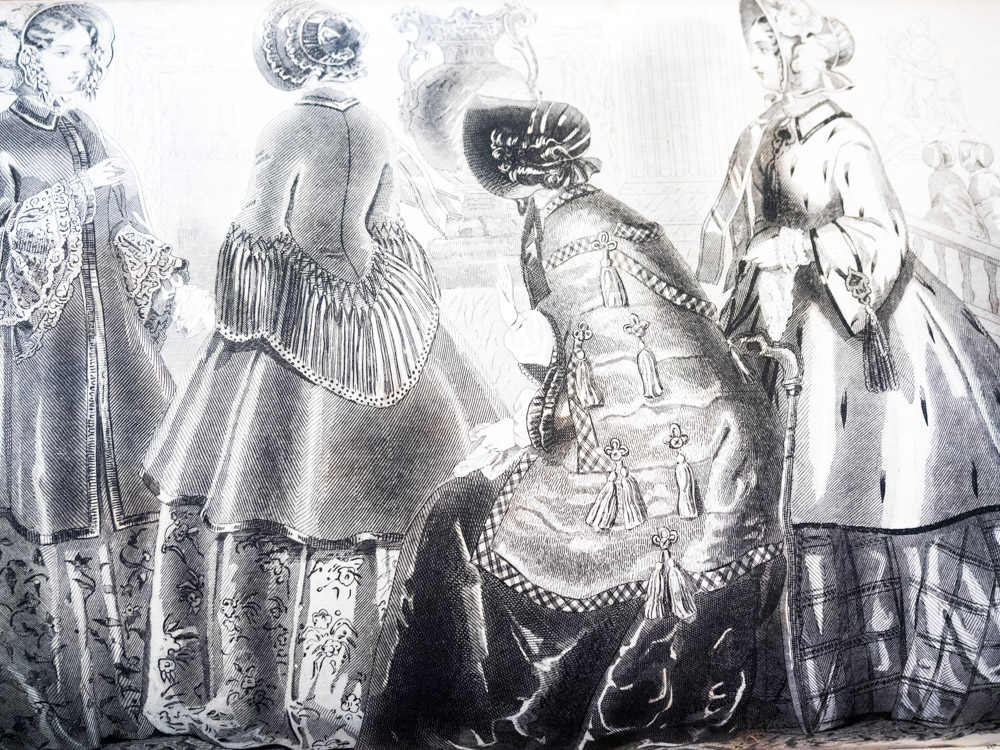
Winter wear from Godey’s Lady’s Book, November, 1851


Thurs Nov 6th  Worked about the house awhile this

morning and about eleven went into the

other part of the house to sit with the ladies

sewed the shirt onto my delaine dress.

Mrs Hubbell & Mrs Ames returned to New York

this afternoon  After they left Mrs S Ames &

self called on Mrs Swain & we went

to Augustus  Mr Bartlett is here will spend the night


After a morning of choring, sewing, and visiting, the Ames women were out and about this afternoon under fair skies. Houseguests Mrs. Hubbell and Almira (Mrs. George) Ames were carried to Mansfield to catch the train for New York.  No doubt they had on their best traveling dresses for the journey. They had been visiting Sarah Witherell and Old Oliver for better than a week.  Servant Jane McHanna traveled with them as far as Mansfield.

After midday dinner, Evelina joined another sister-in-law, Sarah Lothrop Ames, to pay a call on their young friend, Ann Swain.  Mrs. Swain, the wife of the new Ames clerk, John Swain, was a new mother already doting on her first-born son. There would be many visits to ooh and aah over the infant.  Similar oohing and aahing might have been dispensed at their second afternoon call, this one to Augustus Gilmore, his wife Hannah, and her three month old son, Willie.  Even if obligatory, surely these visits were preferable to the calls that the Ames women also made on the sick and the dying.


October 31, 1851

apple_barrel

*

Friday 31st  Have taken up the bedroom and stair carpets

and Bridget has cleaned the front entry

I have been very busy all day about the house

Mrs Hubbell, Ames, and Mrs S Ames have been

to Sharon  Mrs Witherell called at Mrs Swains

this afternoon but I was so busy that I could 

not accompany her.  Passed the evening in

the other part of the house.  Mr Scott painting

Mr Hawkins lectured at the methodist meeting house


Evelina’s autumn version of spring cleaning continued today as she tackled the upstairs carpets. Mr. Scott was still in the house, painting, and servant Bridget O’Neill cleaned the front entry which had also undergone repainting. “Very busy all day about the house,” Evelina evidently didn’t even venture out of doors.

Others did go outside. Sarah Ames Witherell paid a call on new mother Ann Swain, while Sarah Ames, Almira Ames and Mrs. Hubbel rode to nearby Sharon. Old Oliver noted in his journal that “this was a fair day + some cooler wind north west +considerable of it.”

Some miles northward, in Concord, Henry David Thoreau noted in his journal that “The wild apples are now getting palatable. I find a few left on distant trees, that the farmer thinks it not worth his while to gather. He thinks that he has better in his barrels, but he is mistaken, unless he has a walker’s appetite and imagination, neither of which can he have.”**  Two farmers in Evelina’s life, her father-in-law, Old Oliver, and her brother, Alson Gilmore, might take exception to Thoreau’s characterization of them as men without imagination.

In the evening, a Mr. Hawkins gave a lecture at the Methodist meeting house, right in the village.

* Barrel of apples, http://nbarnett2.wordpress.com/2010/02/15/the-importance-of-good-packing/

**Henry David Thoreau, Journal, http://hdt.typepad.com/henrys_blog/2004/10/october_31_1851.ht

October 16, 1851


OLYMPUS DIGITAL CAMERA

*

Thurs Oct 16th Lavinia came back with O & F and spent the 

night  Sat with her awhile and sewed some on

the waist of my dress and sewed some buttons on

Franks vest  Went with Augustus with her

about Eleven and stopt an hour.  This afternoon

have been to Augustus Lothrop with Mrs S Ames

He has been sick about a week with the

Typhoid fever.  Bought 3 Bl apples of N Alger

Mrs Swain has a son born this morning

Evelina’s niece, Lavinia Gilmore, stayed the night with the Ameses, having ridden from the Gilmore farm with her cousins Oakes Angier and Frank Morton Ames.  Lavinia often visited with the Ameses in North Easton, evidently enjoying the bustle that the village of North Easton provided, relative to life on the farm. Today she sat and sewed with her aunt, who always enjoyed company while sewing. Somewhere along the way in today’s comings and goings, Evelina purchased three bushels (or barrels) of apples from Mr. N. Alger, a probable neighbor of Lavinia and her family.

In the afternoon, Evelina went with her sister-in-law, Sarah Lothrop Ames, to visit one of Sarah’s many brothers. This youngest brother, Horace “Augustus” Lothrop, lived in nearby Sharon where he ran a cutlery company.  He was quite ill with typhoid fever, a bacterial disease that was all too common in the 19th century. Spread by unsanitary conditions, typhoid fever killed more than 80,000 soldiers during the Civil War. Happily, Augustus Lothrop would survive his bout with the disease.

Another survivor today was Ann Swain, who came safely through the birth of her first child, a son. No doubt the relatives who had gathered to help were thankful and pleased.


Illustration of nursery furniture from Godey’s Lady’s Book, 1851

October 8, 1851

03615

*

Wednes Oct 8th  Have been sewing pretty steady to day have finished

my dark french print dress and have worn it this

evening  This afternoon called at Mrs Swains with

Mrs S Ames  Her brothers wife is there from Nantucket

with two children & her nurse is there and with her

father & mother made quite a family, nine of them

Mrs Swain said  She appears quite smart

She doesn’t mention her condition in her journal today, but Evelina was still afflicted with nettlerash, and would continue to be for another several days.  Why was her version of this troublesome condition so much more severe than her daughter’s had been?  Did the two, in fact, even have the same illness?

The only way to cope was to keep moving forward.  As least Evelina seemed able to sit and sew, enough to complete a “dark french print dress” she had been working on for some time. (Perhaps the fabric was not unlike the example of a 19th century French print fabric in the above illustration.) She even changed into the new dress for the evening.  Sarah Lothrop Ames may have stopped in from next door for the two sisters-in-law went to call on Ann Swain, wife of John Swain, the new bookkeeper and clerk at the shovel company.

Ann Swain was pregnant, almost at full term and doing well, appearing “quite smart.” She was surrounded by relatives – “nine of them” – who had evidently traveled from Nantucket in order to assist at the birth. The baby would be Mrs. Swain’s first, and her parents as well as others were on hand to help. Neither Sarah nor Evelina would be needed.

Courtesy of http://www.french-treasures.blogspot.com


September 7, 1851


Ames Home and Office, North Easton, Massachusetts ca. 1852 - 1862

Ames Home and Office, North Easton, Massachusetts
ca. 1852 – 1862

*

Sunday 7th  Have been to meeting all day  Mother

Mrs Stevens & I went to Mr Whitwells at

intermission Mrs Whitwell made a cup of tea

for us, brought mother home with us from meeting

at night  Mr Ames & I called at Mr Swains

Mr & Mrs Peckham are to leave tomorrow for

Taunton & the children & Mrs Metcalf  Thursday

The weather is very warm  Gave Mrs Stevens

some cuff pins it being her birth day.

Despite today’s heat, Evelina and her guest Mrs Stevens, and others of the Ames family, presumably, attended both morning and afternoon sessions of church. When the last service was over, they carried Evelina’s 79-year-old mother, Hannah Lothrop Gilmore, to North Easton to stay for a few days.

An important transition was taking place this week at the shovel works.  John Peckham, former clerk, and his family were leaving for Taunton.  His place in the Counting Office was being taken by John Swain, whom Oakes and Evelina went to visit late in the day.  Swain and his wife, Ann Meader Swain, probably hailed from Nantucket.  They had connections in North Easton, but the move to a new abode was still a big change for the young couple. Oakes, with his wide-armed jocularity and Evelina with her easy, approachable manners, must have made the Swains feel welcome.  Over the years, their friendship would solidify.

Many decades later, when Ann Swain was the only one of the foursome still alive, she told historian and minister William Chaffin about the special relationship between John Swain and Oakes Ames:

“…[H]er husband had his regular salary supplemented by an addition from Mr. Ames. Mr. Swain did more or less work for him, besides the regular office work when he was head clerk. Mr. Ames was not very methodical and his transactions for the day in Boston, jotted down in a notebook rather hastily, would sometimes be in a tangle when he came to the office in the evening (office work in those days always going on in the evening), and he would say to Mr. Swain, ‘Come, John, you help me straighten out these things.’ In common with all the persons who served him Mr. Swain had a strong affection for Mr. Ames.”**


*Ames Homestead with Counting Office on far left.  Residence demolished in 1951.

**William Chaffin, Oakes Ames, private publication