July 3, 1852


500

Catharine Hayward Copeland Ames and Frank Morton Ames*


July 3d Sat  Was about house the greater part of the 

forenoon.  Made cake Mrs Ames Tumbler rule

After dinner helped do up the work for Hannah

to go to Bridgewater afterwards mending Susans

dresses.  Was expecting Augustus wife here & Orinthia

but they did not come.  About 5 Oclock went

into Mrs Witherells & stoped to tea.  Frank has

gone a ride to Middleboro with Cate Copeland

The bad news today was that “this was a fair cold day wind verry high a verry bad day to git in hay.”** Evelina’s father-in-law, Old Oliver, was clearly not pleased with this year’s haymaking, at least not to date. Not enough rain in the beginning to have the hay grow well and, today, too much cold wind to bring it in properly.

The regular news today included mending and baking. Evelina evidently tried a new cake recipe, using the “Tumbler rule” that she got from Mrs. Ames – probably Almira Ames, who was visiting. A tumbler was a common word for a drinking glass, which suggests that at least one of the cake’s ingredients – flour, perhaps – was measured by filling a tumbler.  Hard to say, but it must have been fun to try a new recipe for an old standard.

We get a peek into the family’s future with Evelina’s notation that her 18-year-old son, Frank Morton, went “a ride” with a girl named Cate Copeland. Cate was Catharine Hayward Copeland, daughter of Hiram Copeland, a farmer, and his wife Lurana – and a future daughter-in-law to Evelina. Cate was all of 15, but not too young to be of interest to Frank. Four years later, the couple would marry. Over the course of their lives together, in North Easton, Canton, and Boston, they would produce seven children, six of whom would survive to adulthood.

* Image of Catharine Hayward Copeland Ames and Frank Morton Ames courtesy of ancestry.com

**Oliver Ames, Journal, Stonehill College Archives, Arnold Tofias Collection
 

July 1, 1852


OLYMPUS DIGITAL CAMERA


Thursday July 1st  Transplanted some in the garden

this morning but there came up a shower

and put a stop to it  I then went to

mending on some of Susans clothes  Susan

was quite sick last night and not well

enough to go to school to day.  This afternoon 

Mrs Witherell S Ames A Ames rode to make calls

found all the ladies that we were to call on at Mr E Howards


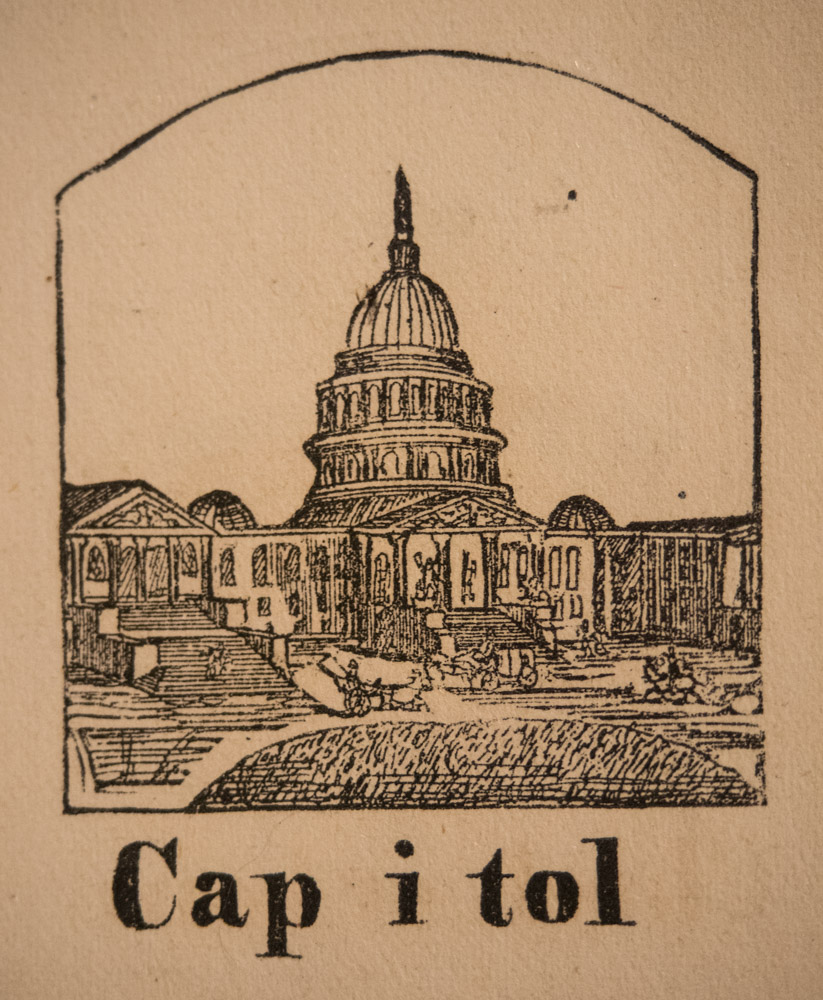
In Washington, D. C., Senator Henry Clay of Kentucky became the first person ever to lie in state in the Capitol rotunda.  A giant in his day, he had served in the House of Representatives, the Senate, and as Secretary of State. He was the man who had created the Whig Party and aspired to the presidency, who always spoke passionately for the Union and was willing to compromise to preserve it. As he himself noted in a speech in 1844, “It has been my invariable role to do all for the Union. If any man wants the key of my heart, let him take the key of the Union, and that is the key to my heart…”* He had dedicated his life to public service and the country thanked him.

The next such person to lie in state in the rotunda would be Abraham Lincoln.

Less august (but no less meaningful to Evelina) events transpired in North Easton today. Evelina, Almira Ames, Sarah Ames and Sarah Witherell “rode to make calls.” This activity marks the first time that Sarah Witherell had ventured out socially since the death of her son, George, six weeks earlier.

Old Oliver made note of the rain that had interrupted Evelina’s early morning work in the garden: “It raind a little last night + there was a little rain this forenoon it was a warm day + cloudy most of the time.”**

*Henry Clay, from 1844 speech, as quoted in “Henry Clay,” by Robert V. Rimini, New York, 1991

** Oliver Ames, Journal, Stonehill College Archives, Arnold Tofias Collection

June 30, 1852

Stage

Wednesday June 30th  Mr Ames left home this morning

for New York and Conn  Mrs James Mitchell

her mother & Grace came to father Ames & I

called into see them  Mrs Mitchell made 

quite a long call in here and at Olivers

Mrs Almira Ames came by the stage

to night from Conn she left New York

about four weeks since

Oakes Ames went to New York and Connecticut today on shovel business, as his father and wife each noted in their diaries. He wasn’t the only Ames on the road, either. Almira Ames, widow of cousin George Ames, arrived in North Easton from Connecticut and New York. Oakes probably went by “the cars,” as they called the railroad, while she definitely traveled in a stagecoach. Their separate modes of travel demonstrate the transformation that was taking place in transportation.

The railroad was moving in and would shortly become the dominant mode for long-distance transportation for the rest of the century and beyond. As Mrs. Penlimmon, a character developed by popular author Fanny Fern, opined only two years later:

‘The days of stage coaches have gone by.  Nothing passes for muster now but comets, locomotives and telegraph wires. Our forefathers and foremothers would have to hold the hair on their heads if they should wake up in 1854. They’d be as crazy as a cat in a shower-bath, at all our whizzing and rushing. Nice old snails!”*

How life was changing.

In more local traffic, Harriet Lavinia Angier Mitchell came to call with her mother and daughter on Old Oliver and Sarah Witherell in the other part of the house, on Evelina, and on Sarah Lothrop Ames next door. Mrs. Mitchell was a cousin of Old Oliver’s late wife, Susannah Angier Ames.

Fanny Fern, Fern Leaves from Fanny’s Port-Folio, ca. 1854, p. 50

November 7, 1851

330px-Quince


Friday Nov 7th  Mr Bartlett left in the stage this morning

and George & Mrs Witherell went to Boston I have made

13 lbs Quince preserve 4 lbs jelly and a lot of marmalade

and painted my leaf for the table and it has

kept me busy all day.  Jane went to Mansfield

yesterday with Mrs H & Ames. Bridget is here yet

was taken with a bad pain in her stomach this

evening & sent for her husband & Dr Wales

Mr. Bartlett of Maine departed the house this morning, and Sarah Ames Witherell rode into Boston with her fourteen-year old son, George Oliver Witherell. Her guests, too, had departed, and she was free to go into town.

Without assistance from servants Jane McHanna, who was away, or Bridget O’Neil, who was sick, Evelina stood over her stove today turning at least a peck of quinces into preserves, jelly and marmalade. The store of fruit would be an important addition to the Ames’s dinner table over the winter.  A period recipe for making quince preserves, from The Young Housekeeper’s Friend; Or, A Guide to Domestic Economy and Comfort reminds us of the challenges 19th century cooks faced when preserving food:

“Weigh a pound of best sugar for a pound of fruit, pared and cored.  Boil the fruit in water until it becomes so soft that care is necessary in taking it out. Drain the pieces a little as you take them from the water, and lay them into a jar […] Stone jars will do very well, but if glass is used, it is easy to see whether fermentation commences, without opening them.  Quinces done in this way are very elegant, about the color of oranges, and probably will not need scalding to keep them as long as you wish.  If any tendency to fermentation appears, as may be the case by the following May or June, set the jar (if it is in stone) into the oven after bread has been baked, and the quince will become a beautiful light red, and will keep almost any length of time.” *

Quince is a fruit that we Americans don’t see much of in the 21st century, but it was commonly used in the 19th.  A poor eating fruit, too sour to consume raw, it was high in pectin and kept well, once cooked.  In fact, quince was one of the earliest fruits to be made into marmalade; the word marmalade derives from marmelo, the Portuguese word for quince.**


Mrs. Cornelius, The Young Housekeeper’s Friend; Or, A Guide to Domestic Economy and Comfort, New York, 1845.

** “Quince,” Wikipedia, November 5, 2014


November 4, 1851

450px-Caraway_seed_cake


Tuesday Nov 4th  Put down the parlour carpet this

forenoon baked some cake &c &c  Mrs Buck &

Mrs Drake (formerly Lucy Reed) called about half

past eleven.  Mrs Hubbell & Ames & Mrs Witherell

Father were here to tea  They all dined

at Olivers.  Mrs Hubbell commenced knitting

me a hood. I have put the trimming on the sleeves

of Susans Delaine dress


The day was “cloudy […] + cold + chilly,”* according to Old Oliver, meaning that baking “cake &c &c” in the shared brick oven at the Ames compound might have been pleasurable.  At least it was one way to stay warm. It may still have been in the oven when Polly Buck and Lucy Drake, the former Reed sisters, came for a short call.  Local women, Polly was married to Benjamin Buck, who lived in the village; Lucy was the wife of Ebeneezer Drake.

In all likelihood, Evelina baked the cake – seed cake, perhaps – to serve at tea later in the day. She invited Mrs. Hubbell and Almira Ames, visitors from New York, as well as Sarah Witherell and “Father Ames” to join the family in their newly redecorated parlor. How happy Evelina must have been to show off the recent refurbishments.

Mrs. Hubbell and Almira Ames had midday dinner earlier in the day next door, at Sarah Lothrop and Oliver Ames Jr., a gathering to which Evelina and Oakes don’t appear to have been invited. In turn, Oliver Jr and Sarah Lothrop didn’t appear for tea at Evelina and Oakes’s. It may be that Evelina and Sarah Lothrop Ames agreed to split hospitality responsibilities for the day. Almira Ames was a favorite cousin who often came to visit; she had even lived with family for a period after Old Oliver’s wife, Susannah, died.


* Oliver Ames, Journal, Courtesy of Stonehill College Archives


November 5, 1851

Thread

Wednesday Nov 5th  This forenoon I painted the water pails and 

several kegs or butter firkins  Looked over my sheets

and put them in order.  Afternoon went to the sewing 

circle at Mr Horace Pools our last meeting for the 

season  Mrs Elijah Howard had the bag and we

had no work  We were invited to Mr Sheldons Mrs

Hubbell Ames & Witherell went  Father has

changed Dominic for another horse of Nelson Howard

Evelina demonstrated her range of housekeeping skills today.  She put fresh paint on wooden pails, kegs and firkins for her pantry, cellar and shed, and organized her linen closet.  Her house was in order for the coming winter.

The last Sewing Circle of the year met this afternoon at Abby and Horace Pool’s house.  As always, the Unitarian ladies gathered in fellowship to sew and have tea, probably in the company of Rev. William Whitwell.  Today, however, they had no shared sewing to do, as Nancy Howard, whose turn it was to bring “the bag” of work, failed to deliver it.  No matter; the women seemed to cope.  Some went on to visit Luther Sheldon and, presumably, his wife Sarah.

The Reverend Luther Sheldon was the minister of the local Orthodox Congregational Church. A conservative and devout man in his mid-sixties, Sheldon had been involved two decades earlier in a controversial schism within Easton’s Congregational Church that resulted in the splitting off of a new congregation of Unitarians – including the Ameses.  Old Oliver and his sons had taken a leading role in encouraging Unitarianism, and made some enemies in the process.  Rev. William Chaffin, who came to town many years later, included an extensive examination of the controversy in his 1866 town history.

What did Old Oliver think of his daughter, Sarah Witherell, and their houseguests paying a call on the Sheldons? Or did he pay any attention at all to their socializing?  He may have been too busy horse-trading.


November 6, 1851

OLYMPUS DIGITAL CAMERA

Winter wear from Godey’s Lady’s Book, November, 1851


Thurs Nov 6th  Worked about the house awhile this

morning and about eleven went into the

other part of the house to sit with the ladies

sewed the shirt onto my delaine dress.

Mrs Hubbell & Mrs Ames returned to New York

this afternoon  After they left Mrs S Ames &

self called on Mrs Swain & we went

to Augustus  Mr Bartlett is here will spend the night


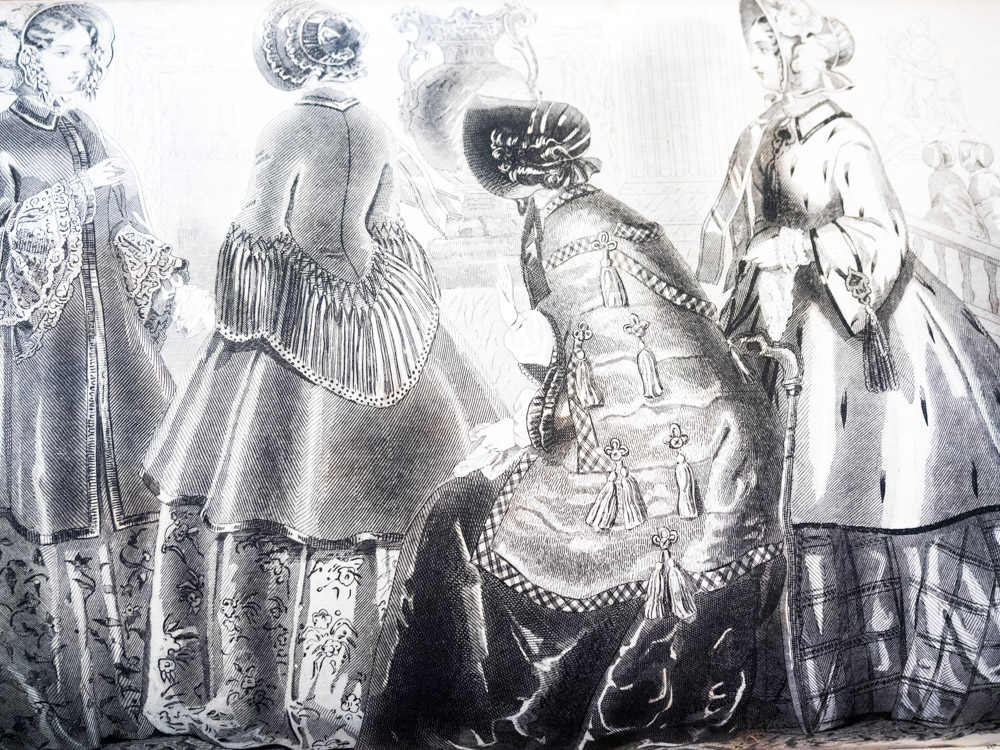
After a morning of choring, sewing, and visiting, the Ames women were out and about this afternoon under fair skies. Houseguests Mrs. Hubbell and Almira (Mrs. George) Ames were carried to Mansfield to catch the train for New York.  No doubt they had on their best traveling dresses for the journey. They had been visiting Sarah Witherell and Old Oliver for better than a week.  Servant Jane McHanna traveled with them as far as Mansfield.

After midday dinner, Evelina joined another sister-in-law, Sarah Lothrop Ames, to pay a call on their young friend, Ann Swain.  Mrs. Swain, the wife of the new Ames clerk, John Swain, was a new mother already doting on her first-born son. There would be many visits to ooh and aah over the infant.  Similar oohing and aahing might have been dispensed at their second afternoon call, this one to Augustus Gilmore, his wife Hannah, and her three month old son, Willie.  Even if obligatory, surely these visits were preferable to the calls that the Ames women also made on the sick and the dying.


October 31, 1851

apple_barrel

*

Friday 31st  Have taken up the bedroom and stair carpets

and Bridget has cleaned the front entry

I have been very busy all day about the house

Mrs Hubbell, Ames, and Mrs S Ames have been

to Sharon  Mrs Witherell called at Mrs Swains

this afternoon but I was so busy that I could 

not accompany her.  Passed the evening in

the other part of the house.  Mr Scott painting

Mr Hawkins lectured at the methodist meeting house


Evelina’s autumn version of spring cleaning continued today as she tackled the upstairs carpets. Mr. Scott was still in the house, painting, and servant Bridget O’Neill cleaned the front entry which had also undergone repainting. “Very busy all day about the house,” Evelina evidently didn’t even venture out of doors.

Others did go outside. Sarah Ames Witherell paid a call on new mother Ann Swain, while Sarah Ames, Almira Ames and Mrs. Hubbel rode to nearby Sharon. Old Oliver noted in his journal that “this was a fair day + some cooler wind north west +considerable of it.”

Some miles northward, in Concord, Henry David Thoreau noted in his journal that “The wild apples are now getting palatable. I find a few left on distant trees, that the farmer thinks it not worth his while to gather. He thinks that he has better in his barrels, but he is mistaken, unless he has a walker’s appetite and imagination, neither of which can he have.”**  Two farmers in Evelina’s life, her father-in-law, Old Oliver, and her brother, Alson Gilmore, might take exception to Thoreau’s characterization of them as men without imagination.

In the evening, a Mr. Hawkins gave a lecture at the Methodist meeting house, right in the village.

* Barrel of apples, http://nbarnett2.wordpress.com/2010/02/15/the-importance-of-good-packing/

**Henry David Thoreau, Journal, http://hdt.typepad.com/henrys_blog/2004/10/october_31_1851.ht

October 29, 1851

1157676_l

*

Wednesday Oct 29.  I have been what I call puttering

about house most all day and have accomplished

but very little.  papered the fireboard and pasted

the loose places in Franks chamber  Mr Scott

has painted the sitting room & closet

Mrs Hubbel & Ames came from New York this morning

H O A Orr came for Susan this afternoon  Mr

Walton is there. Mrs Holmes and Abby called

Mr Ames came home from Boston to night

Many comings and goings in North Easton today, under a cloudy sky.  Almira Ames, widow of George, an Ames cousin, arrived from New York with a Mrs. Hubbel in tow. They came for a visit with the obliging Sarah Witherell and Old Oliver Ames in the other part of the house.

Susan Orr, meanwhile, who had been staying with Sarah Witherell and her father for almost a month, was picked up this afternoon by her brother, Hector Oakes Orr. Susan, age 53, and Hector, age 51, were first cousins of Sarah Witherell and her siblings on the Angier side of the family.  Susan and Hector were two of five children of Susanna Angier Ames’s sister, Mary and her husband, Dr. Hector Orr, of Bridgewater. Their shared grandparents were Oakes and Susanna (Howard) Angier.

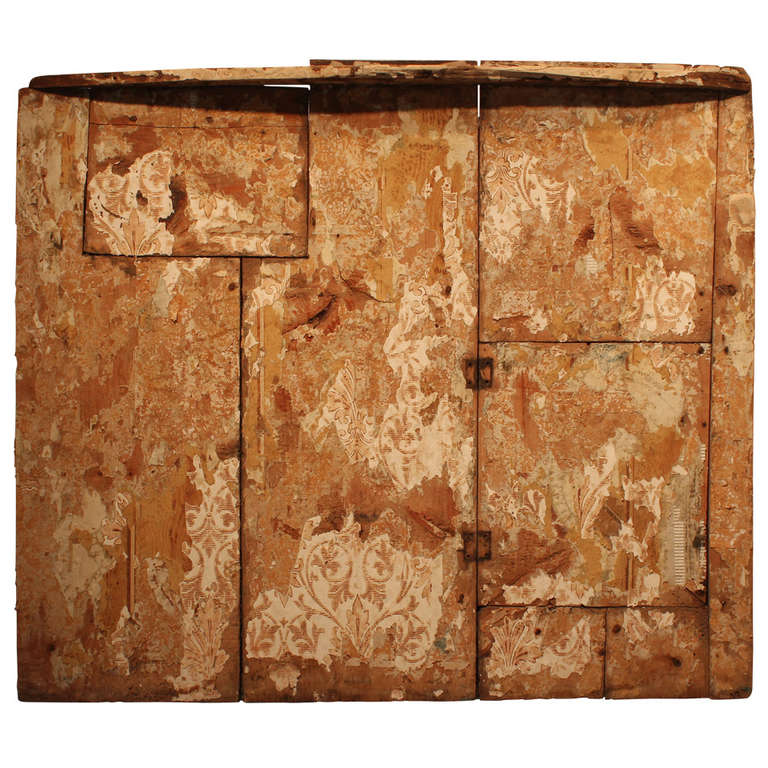
Evelina’s niece on the Gilmore side, Abigail Williams Torrey, paid a call with Harriet Holmes (the neighbor who had been so ill back in August). A Mr. Walton floated somewhere in the picture; Evelina’s inclusion of his name is a bit vague. And chugging along in the background of the various calls was Mr. Scott painting the woodwork in the sitting room. Evelina concentrated on papering a fireboard when she wasn’t attending to the influx of visitors. For readers who don’t have fireplaces, a fireboard was a piece of wood, textile or ironwork fitted to the opening of a fireplace for periods when the fireplace wasn’t being used.  Fireboards made from wood, most common in the countryside, were often decorated with wallpaper or painting.


* 19th century papered fireboard, Pennsylvania, courtesy of 1stdibs.com.


May 9, 1851

champney2-thumb

*

May 9th Friday  Went out shopping about eight Oclock

and at ten met Mrs George Ames at Mr Daniels

She walked around with me looking for a dress

and other things, likewise met Abby & her cousins

and about 5 Oclock came across Orinthia She

said she should certainly be at home, but missed

of the cars. Mrs Ames left at half past 5 for N.Y.

with Mr Peckham. Returned home much fatigued


In Boston, stores opened so early that Evelina could start shopping at eight in the morning. She had ordered a bonnet the day before which she was able to pick up later in the day, so today’s shopping was more leisurely. She and her cousin-in-law, Almira Ames, stepped along “looking for a dress and other things.”  They probably walked along Washington Street and its side streets. Others from Easton were in town, too: her niece Abby Torrey and her own boarder, Orinthia Foss. The women were breaking out of their little town to find goods in the big city. The weather must have been especially cooperative.

Evelina finally returned to Easton “much fatigued.” Almira Ames, meanwhile, left for New York accompanied by the head clerk for O. Ames & Sons, John Peckham. They would have traveled by stagecoach or train from Boston or Stoughton. They were not running off together.  Rather, Mr. Peckham had shovel business in the city and, like a gentleman, accompanied the Widow Ames on what otherwise would have been a solo journey for each of them. Presumably, Almira lived in New York at this point in her life, although previously, she had lived in North Easton.


*Benjamin Champney (1817-1901), New Boston Theater, Washington Street, 1850

WC GC031/Benjamin Champney Watercolors Collection, Princeton University Library