September 21, 1851

1525-105430-a-flumere

*

Sunday Sept 21st  Have been to meeting  Mr Ames & self came

home at noon and Horace Pool came with us

and they rode up to the great pond where they are

building a new floom.  Brought Abby Torrey from

meeting & carried her back  She & Malvina are spending 

a week at Alsons  Miss Latham & her brother Edward

came to our meeting this morning and to the other 

part of the house after  I called into see them

The new flume going in at Great Pond was attracting local attention. After church, Oakes Ames and Horace Pool rode up to see it. Oakes had been in Boston when his father, Old Oliver, had begun the work, and no doubt he was curious to see the progress.  No one would have been working on it today, as it was Sunday.

The flume was intended to harness water power for the shovel factory. It was basically an inclined ditch lined with stones and boulders to shunt the water along. Some flumes – such as those used in lumbering – are lined with wood, but that wasn’t likely to be the case here, given the scarcity of wood, the availability of stones, and the expectation of longevity. Old Oliver’s oxen must have been used to haul the many stones, and man-power used to put each one in place.  The channel itself would have been dug with Ames shovels, naturally.

Evelina, perhaps moving about slowly on sore feet, went to church and caught up with various friends and family members, including nieces Abby and Malvina Torrey. She popped into the other part of the house – the section lived in by Old Oliver and his daughter Sarah Witherell – to greet some visitors there.  She was settling back into her routine after the Boston holiday.

Photograph of an old flume, blogoteca.com/afonsoxavier, courtesy of Hadrian


September 8, 1851

1856_tea_BostonAlmanac


Monday Sept 8th  Mother Mrs Stevens & self sat down

to work in my chamber  The weather is very

hot  After dinner we went into the other

part of the house awhile it being so much

cooler  Abby came here to tea. Oakes A

Frank & Mrs Mitchell went to a party to Mr

Cushing Mitchells this Evening & are to spend the night

Tea had been on the serving tray very much of late, with or without short biscuits. Evelina served tea to her niece, Abby Torrey, today while yesterday she took tea at the parsonage during intermission. Three days ago, she hosted a small tea party for a guest, Mrs. Latham, her sister-in-law, Sarah Ames Witherell, and others. Evelina’s grandson, Winthrop Ames, described the importance of tea time some eighty years later:

“Supper, always called Tea, at seven was the sociable occasion.  It was usually consisted of cold meats, hot biscuits, preserves and cakes – an easy menu to expand for unexpected guests. Every week at least, and usually oftener, one household would invite the others and their visitors to tea; and the whole Ames family might assemble…”*

Although the Ameses grew and raised much of their own food, tea was a commodity that had to be purchased. Coffee and sugar, too.  As the above advertisement from 1856 indicates, tea and coffee could be purchased in bulk in Boston (not surprisingly, given Boston’s long history of importing tea into its harbor!) Black tea was the general favorite and, as the ad suggests, could be obtained in different grades of excellence.  Did the Ameses order in bulk?  Did they acquire a chest of tea at the family rate? Their careful use of money would imply that whichever Ames did the purchasing got the best product for the lowest price possible.

The weather, meanwhile, continued to be very hot. It didn’t prevent brothers Oakes Angier and Frank Morton and their youngest aunt, Harriett Ames Mitchell, from traveling to Bridgewater for a party and an overnight. Social goings-on continued.  No doubt, tea was served.

*Winthrop Ames, The Ames Family of Easton, Massachusetts, 1938, p. 128

September 3, 1851

Trunk

Wednes Sept 3d  Alson came this morning & brought

Orinthia and staid to dinner and carried Mrs Stevens

home with him  Orinthia has been packing her clothes

Mrs Stevens stiched three more collars for me & Mrs

Witherell two that are for Frank.  Abby Torrey called

this afternoon &c and on her return Orinthia & I went

to the store  Pauline passed the afternoon with Helen

Orinthia Foss was packing her clothes, getting ready to return home to Maine. What prompted the departure isn’t clear. Did she lose her job, or was she called home on family matters? She would return to North Easton eventually, but did she know that when she left?  How did she feel about leaving this town where she had lived for six months? How did Evelina feel about the loss of her young friend, even temporarily?

Orinthia wasn’t the only one with a trunk to be packed. Oliver Ames (3), too, was a day away from departure and had a trunk into which his mother – and others, perhaps – were placing his new collars and mended shirts. Last minute sewing was still going on, but by this time the trunk would have been nearly full of the clothes that Oliver would need for a term at college.

That Oliver was going away to study at Brown was just shy of miraculous.  At 20, he was old to be going, for one thing; in the nineteenth century, the average students were teenaged, like Fred Ames at Harvard. But more than that, his father Oakes had not wanted him to go. According to one 19th century acquaintance of Oliver, Oakes “had inherited some measure of that Puritanical contempt for the liberal arts.” After completing prep school, Oliver had been directed to work at the factory, “to learn the trade of shovel-making. But the desire for a higher education remained strong, and when at the end of his five years apprenticeship he had mastered the trade, his father yielded to his solicitations, and allowed him to enter Brown University.” * Oliver had earned his ticket out.

* Hon. Hosea M. Knowlton, “Address,” Oliver Ames Memorial, 1898, pp. 98-99


August 28, 1851

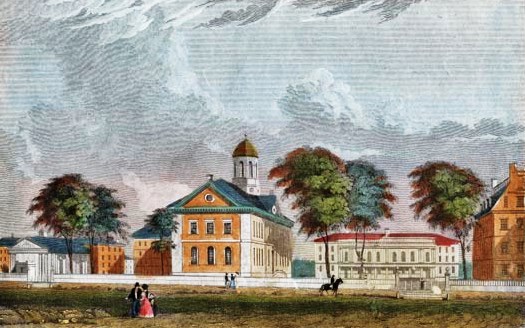
17 Alexander Jackson Davis (American architect, 1803-1892),  Harvard University, Cambridge, Mass. 1850

*

Thursday Aug 28th  Have done but very little sewing to day.

Mrs Fullerton Abby & Malvina here to tea.  Mr & Mrs

Whitwell called.  Mr Whitwell walked up and sent

Mr Tilden with a carriage for his wife.  Mrs Hyde

Mrs James Mitchell & Mrs Watson came from E Bridgewater

& Mrs Watson & Peckham to the other part of the house

to tea. Alson here to dinner & tea

Frederick left for Cambridge this morning

There was much socializing in North Easton today, but it paled in importance when compared to the departure of Frederick Lothrop Ames for college. Though only 16 years old, Fred  was entering Harvard College as a sophomore, making him a member of the class of 1854.

A notable nineteenth-century commentator would arrive at Harvard just after Fred had graduated.  Henry Adams, Class of 1858, would have this to say about the college in Cambridge before the Civil War:

“Harvard College, as far as it educated at all, was a mild and liberal school, which sent young men into the world with all they needed to make respectable citizens, and something of what they wanted to make useful ones. Leaders of men it never tried to make. Its ideals were altogether different. The Unitarian clergy had given to the College a character of moderation, balance, judgment, restraint, what the French call mesure, excellent traits, which the College attained with singular success, so that its graduates could commonly be recognised by the stamp, but such a type of character rarely lent itself to autobiography. In effect, the school created a type, but not a will. Four years of Harvard College, if successful, resulted in an autobiographical blank, a mind on which only a water-mark had been stamped.”**

Was Fred Ames stamped by his time at Harvard? He certainly appreciated his years there, and became “warmly interested in everything that pertained to the welfare of Harvard, as evinced by his well-known liberal gifts to several of its departments.”***


* Alexander Jackson Davis, “Harvard University,” Cambridge, Massachusetts, 1850

** Henry Adams, Education of Henry Adams

*** Harvard “Report for Class of 1854,” 1894

August 27, 1851

2004-D03-395

Wedns Aug 27th  This morning filled the vases with flowers and worked

some about the house and about nine went to Mr

Lothrops with Mrs S Ames to put on the shrouds

Got home about twelve.  Went to the funeral

and to the cemetery  He is the second one that 

has been laid there.  Mrs Fullerton and Abb[y] Torrey

called this evening & Malvina with her bloomer

hat that I gave her

“[A] fair, cool day,” Old Oliver noted in his journal. “Clinton Lothrop buried.” Brother of Sarah Lothrop Ames, a young husband, father, and farmer, Clinton had died of typhus fever. Evelina helped Sarah, Clinton’s only sister, place a shroud on the corpse. In the afternoon, with her husband and family, Evelina attended the funeral service, which would have been at the Lothrop home, and the burial.  Clinton was buried in the new cemetery.

Despite the somber events of the day, Evelina managed to brighten her home with flowers from her garden.  In the evening, her nieces Abby and Malvina Torrey made a call with their relative, Mrs. Fullerton. Malvina wore a “bloomer hat” that Evelina had given her.

The bloomer costume – seen above in the Currier print –  was a fashion phenomenon in 1851. Originally developed by readers of a health publication called The Water-Cure Journal, “Turkish pants” were touted as a healthful alternative to the heavy-skirted dresses and constrictive bodices that women typically wore. They became known as “bloomers” when Amelia Bloomer of Seneca Falls, New York, told the readership of her temperance periodical, The Lily, that she had adopted the style to wear.  She published instructions for making the outfit, and the curious style became a craze.

Although the bloomer costume was admired at first as being healthful, it soon became politicized as women’s reform became prominent in the headlines. To many, the free-flowing bloomers became symbolic of the suffrage movement. Publications that initially praised bloomers recanted as the outfit became more controversial. The fashion held its own through the decade, however, but disappeared after the Civil War, only to revive in the 1890s.

Evelina, sewing maven that she was, had been following the fashion news, but hadn’t opted to make a bloomer costume for herself. With a nod to the trend, however, she acquired a bloomer hat, probably like the one in the Currier print, to give to her ten-year old niece, Malvina.

*Nathaniel Currier, The Bloomer Costume, 1851

August 5, 1851

Haymaking

1851

August 5th Tuesday  Have been sewing part of the day

This afternoon took my work and went to Mr

Torreys with the intention of stopping an hour or two

Abby left this morning for Pembroke & I had a 

long chat with Mr Torrey heard all the news.

On my return called on Mrs Lake found her

about house & quite smart.  Heard that Mrs Holmes

was sick

Haying continued, as Old Oliver noted yesterday in his journal:

“in the morning the wind was south west + there was a verry little sun shine untill about 10 – O – clock when the wind shifted to the north east. + it raind in the afternoon but not butt little we mowd the thin part of the Flyaway and brought it home well. + put it out in small heaps”

Evelina worked on her sewing, as usual, and even carried it with her in the afternoon into the village where she visited Col. John Torrey for “a long chat.”  John Torrey was a widower twice over. He had been married first to an Abigail Williams who died quite young. They had no children. In 1828, Torrey married Evelina’s older sister, Hannah Howard Gilmore, and they had three children, of whom two survived infancy:  Abigail “Abby” Williams Torrey, named for the first wife, and Mary Malvina Torrey. Both girls were close to their Aunt Evelina who seems to have served as a maternal figure after Hannah died sometime in the 1840s.

Col. Torrey was a controversial figure in Easton of whom we know only enough to be curious, and not enough to have that curiosity satisfied. (He should not be confused with another John Torrey who was a prominent botanist in New York in the same era.) Listed as a “Trader” in the census, he earned the title of Colonel by years of service in the local militia. Somewhere along the way Torrey invoked the enmity of a local character and lampoonist named James Adams who wrote a derogatory poem about him. Historian William Chaffin recorded this information without including the piece in question.  Chaffin only said that “Our Hero: A Descriptive Poem,” was published in a sixteen-page pamphlet and was “not merely satirical, but derisive and scathing.”*

* William Chaffin, History of Easton, 1886, pp. 764-765


July 19, 1851

Lightning


1851

July 19 Saturday  To day I have been sitting with mother

sewing on muslin & cambric insertion mending &c

It has been very showery accompanied with heavy

thunder and very sharp lightning  Oakes Angier

went to Mr Algers after some butter to night and

carried Mother home  Orinthia is here to day

called this afternoon to see Abby Torrey 

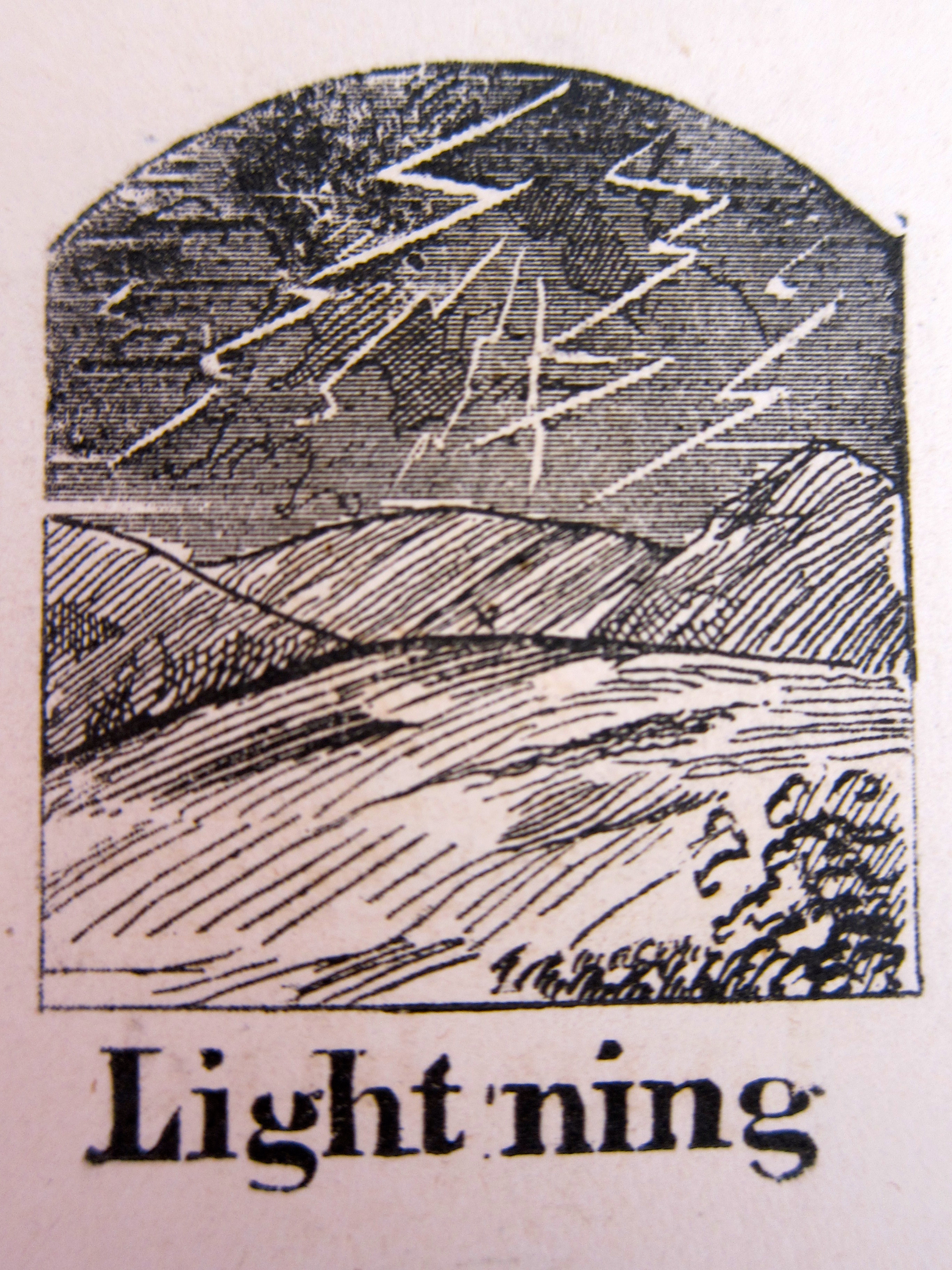
Yesterday’s hot, sticky weather gave way to thunderstorms today, with “very sharp lightning.”

Hannah Lothrop Gilmore returned to the family farm, driven there by her grandson Oakes Angier Ames.  He went on to pick up some butter at the farm of Bernard and Vesta Alger, who lived not far from the Gilmores on the turnpike road.  It’s curious that Evelina was buying butter this summer, because earlier in the year she had been selling it.

Orinthia Foss was back at the Ames’s for a visit, up from the home of Elijah and Nancy Howard where she was boarding. She went into the village to pay a call on Evelina’s niece, Abigail Williams Torrey. Evelina, meanwhile, spent her Saturday mending everyone’s clothes, and working on an “insertion” for one of her dresses.

June 21, 1851

1687-Illustration_from_Theosophie_and_Alchemie-Michael_Maier_and_Johann_Theodor_de_Bry-300x282

21 June Saturday  Early this morning Mrs. Seba Howard

brought Orinthia up and found me in the

garden weeding. We worked there an hour or two

and then went to sewing.  Orinthia on her dress

and I on the hair cloth.  Harriet came and sat

with us awhile in the afternoon and while she

was in I worked on the sleeves to my plaid stone

colour borage  Orinthia called on Abby   Pleasant

Weeding continued to be the dominant occupation of Evelina’s early morning hours. On this Saturday morning her young friend, Orinthia Foss, arrived for the day and immediately stepped to the garden to help weed. Orinthia was carried up from the southern part of town by a contemporary of Evelina named Eleutheria Howard, wife of Major Seba Howard.

Today was summer solstice, the official start of summer and the high water mark of daylight; the women probably would have enjoyed being outside in the garden all day long, but sewing and other duties called. Each woman had a dress she was working on, and Evelina was still piecing together a horsehair cover for her new lounge. Just as they had sat on so many days during the late winter, so the two sat today, on chairs near the windows for light, with folds of cloth in their laps. Harriett Ames Mitchell, Evelina’s sister-in-law, joined them in the afternoon.

Later in the day Orinthia went to call on Abby Torrey, Evelina’s niece who lived right in the village of North Easton.

June 10, 1851

url

June 10th 

Tuesday  Worked all the forenoon and part of the afternoon

weeding the flowers.  Got some Petunias at Mr Savages

The gardener has been to work in my flower

garden most all day weeding and fixing the

beds, has made them wider  This afternoon have

been mending Franks & Olivers pants

Mrs Witherell & Mitchell & Miss Eaton walked

up to Edwins garden.  Abby & Miss Smith called

Bridget ONeil here to work to day


The weather was fine enough that sisters Sarah Ames Witherell and Harriett Ames Mitchell took a long walk north toward Stoughton with their houseguest, Miss Eaton. They headed to Edwin Manley’s garden, a much-visited spot, to see what he had growing. Being on foot, it’s doubtful that they purchased anything to bring home. They may have ordered something to be delivered, however.

In the morning, Evelina went out to look at flowers, too, at the nearby home of William Savage, a shovelworker, and brought home some petunias.  Petunias, a great garden favorite in the latter half of the nineteenth century, originated in South America, appeared in Europe by 1800, but had only recently become available in the United States. Petunias were still so exotic, in fact, that they didn’t appear in the list of annuals in Breck’s Book of Flowers, published in Boston in 1851. How did Mr. Savage come upon them?

The Ames’s new gardener, who had been with the family for almost a month, weeded the flower beds today and worked at making them wider. Evelina’s parlor garden was becoming more and more ambitious. And for some reason, Bridget O’Neil, a servant, worked at Evelina’s today. She had been working next door at Oliver and Sarah Lothrop Ames’ house.  Where was Jane McHanna?

May 15, 1851

pond_water

Ames Long Pond

May 15

Thursday  I was intending to go to Boston with Mrs S Ames

this morning but she has the ague in her face

which prevented and lucky for me that I did

not go for about twelve Oclock Lavinia, Ann Pool,

and Francis, came and this afternoon Abby.  We all

rode to Edwins and Mr Clapps garden and to the ponds

Jane cleaned the […] buttery, and I was working

in the chambers when they came


Sarah Ames was sick once again, this time with what was probably a head cold, so a planned outing to Boston was called off. Sarah had been quite ill for much of the spring; perhaps she hadn’t given herself enough time to recover and was now suffering a relapse.

Normally, Evelina would have been disappointed to miss a trip to Boston, especially as she still needed to buy a bonnet, but a visit from a set of young relatives made for a happy alternative.  Her nieces Lavinia Gilmore and Abby Torrey, nephew Francis Gilmore, and a young friend of theirs, Ann Pool, arrived and rescued her from choring. With Francis holding the reins, presumably, the group rode north toward Stoughton, where they stopped at two farms to look at garden plants, one farm belonging to Edwin Manley, the other to Lucius Clapp.

They also rode by the ponds, including Ames Long Pond, which sits on the boundary between Easton and Stoughton. Most likely they also rode by Flyaway Pond which had been created only six years earlier, in 1845, to supply more water power from the Queset River to the shovel factory. Queset, according to historian Ed Hands, was “the most heavily used of all the drainage systems” in the watersheds of Easton.*  The shovel business would never have started in Easton had it not been for the Queset (Brook) River; O. Ames & Sons absolutely relied on it for decades.

Flyaway Pond is no longer configured the way Evelina and her companions would have seen it during their pleasant afternoon ride. It collapsed during a huge flood in March, 1968, wreaking havoc and causing considerable property damage.   As Hands points out, that 20th century flood washed away an important symbol of the Ames period in Easton, that of the control of the Queset River for commercial purposes.  Evelina couldn’t imagine that future for Flyaway Pond, of course; she could only enjoy riding past it and Ames Long Pond – and others, perhaps? –  in the spring air.

*Edmund C. Hands, Easton’s Neighborhoods, 1995