April 7, 1852

images-2

Five Dollar Gold Piece, 1850

1852

April 7th  Mother is 80 years old this day and notwithstanding

the snow banks have been down to see her and made

her a present of a five dollar gold piece.  She is

not very smart to day but is generaly very well and

capable for one of her years.  Orinthia Abby & Augusta

went with me and we have had a very pleasant visit

Augustus stoped the evening here  Helen came

home this afternoon with her father.

Evelina’s mother, Hannah Lothrop Gilmore, turned 80 years old. She was the grandmother of Oakes Angier, Oliver (3), Frank Morton and Susan Eveline Ames – among other grandchildren –  and first cousin-once-removed of Sarah Lothrop Ames. She was born in Bridgewater in 1772, the fifth child and only daughter of Daniel and Hannah (Howard) Lothrop.  Her mother died soon after she was born and her father remarried two times more and had six additional children.

In 1789, at age 17, Hannah married Joshua Gilmore of Easton. They had a large family, too, producing eight children, of whom Evelina was seventh. By this 80th birthday in 1852, Hannah was a widow with only three offspring still alive. As we have seen, she lived on a farm with a son, Alson Gilmore, but often visited her daughter, Evelina.

Beyond these genealogical facts, little is known of the life of Hannah Lothrop Gilmore. When she was barely twenty, however, and already a mother of her first baby, John, she walked on a trail one day with her husband in an area of Easton known at the Great Cedar Swamp. Town historian William Chaffin recorded the tale:

“There was then no road through Cedar Swamp. Trees were however felled, and on these by hard work pedestrians at certain seasons could pick their way through from Easton to Raynham, or return.

“In 1792 […] Raynham had petitioned the Court of General Sessions for Bristol County to require Easton to build a road through the swamp to connect the two towns. The advantages of such a road were obvious. But Easton stood aghast at the prospect of incurring the expense of building a causeway such a distance and in such depths of mire.  The difficulty is illustrated by the fact that as Joshua Gilmore was going on the footpath through the swamp one day with his wife, carrying a little child in his arms, Mrs. Gilmore was speaking of the difficulty of the passage, and her husband replied that some day the child would ride through the swamp in a carriage; and the idea struck her as so essentially preposterous that she had a hearty laugh over it. However, the Court of Sessions did not, it would seem, share her skepticism, for it ordered Easton to construct the road.”*

The road, known then as the Turnpike Road or Street, was built, and Hannah Gilmore lived to ride it in a carriage.

*William L. Chaffin, History of Easton, Massachusetts, 1886, pp. 454-455
April 3, 1852

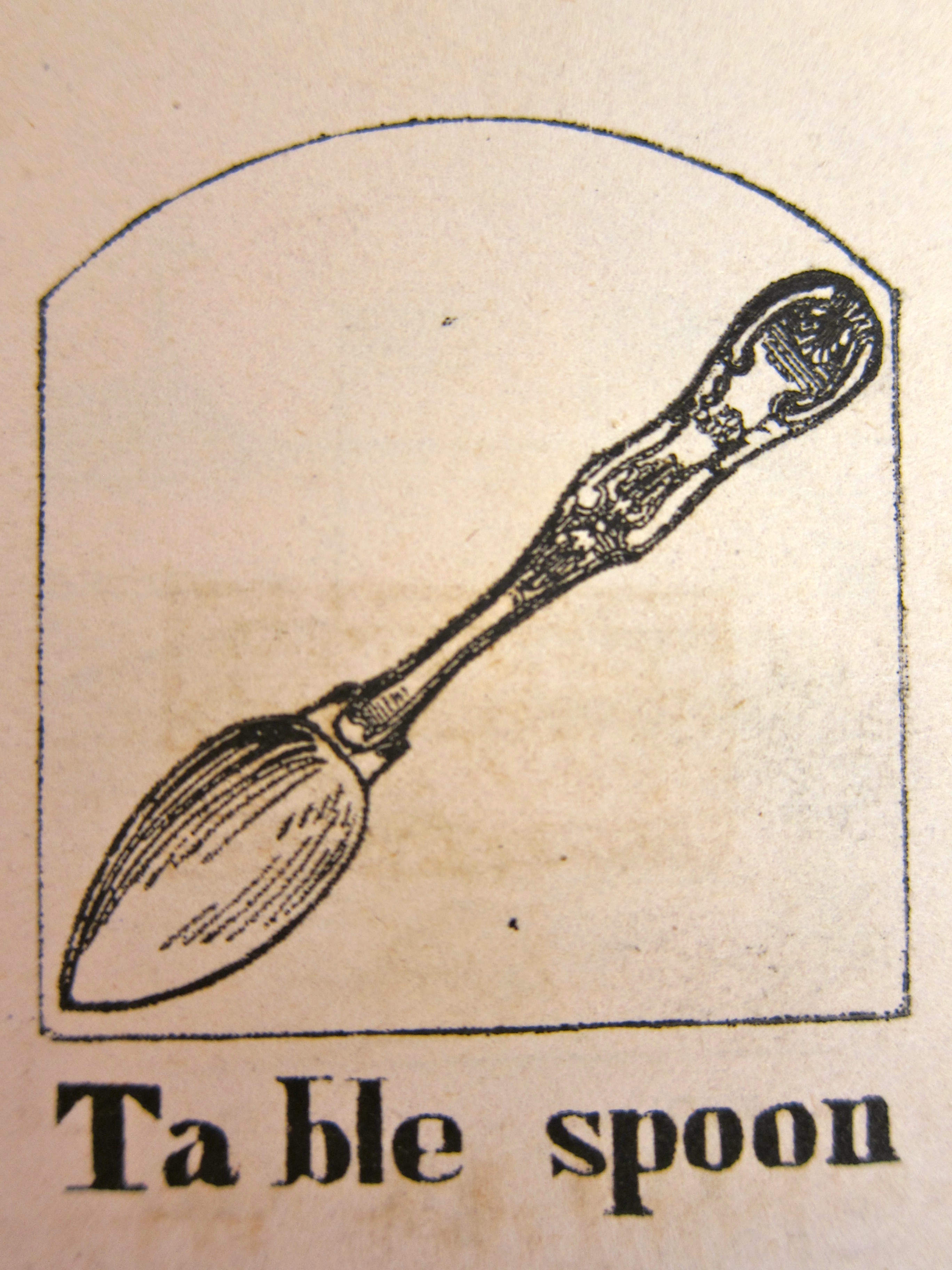
Tablespoon

1852

March [sic] 3rd Saturday  Have made a ribbon head

dress for sister Amelia  Orinthia & self went into

Edwins this noon for some fish chowder.  She gave us

some platters and a great iron spoon to eat with and we

had to wait upon ourselves. We excused her knowing

she was a young housekeeper and knew no better.  She

ought to come here and learn politeness  Called on Mrs

Brett.  her babe is nearly two weeks old. she is not very

comfortable  Called on Abby  Hannah & Mrs J. C. Williams

Young neighbor Augusta Pool Gilmore invited Evelina and Orinthia Foss to midday dinner. This was a sweet gesture, perhaps intended to thank Evelina for her many kindnesses in welcoming Augusta to the village. The young bride may have been excited to debut her skills as a hostess.

However well-meant the invitation was, Augusta still had a lot to learn about entertaining. Evelina, a matron who had welcomed many guests to her dinner table over the years, saw much to judge wrong and in her diary took a snide swipe at the young woman. She criticized Augusta’s faux pas in laying out the wrong cutlery and failing to serve them properly.

While Evelina forgave Augusta her missteps, because the young bride “knew no better,” she also condescendingly noted that Augusta needed to spend time with the Ameses to “learn politeness.” Such scorn was perhaps exacerbated by the presence of Orinthia, who was always looking for ways to laugh. Innocent, inept Augusta was an easy target.

Evelina’s natural empathy returned in the afternoon. She visited other friends and called on another young woman in the neighborhood, Eveline Brett, who was doing poorly after having given birth.

March 20, 1852

faces


from The Philosophy of Laughter and Smiling , 1877

1852

March 20th Saturday  Have cut and basted a purple print

apron for Susan of a pattern that Lavinia

brought from Mary  Abby & Edwin & wife were

here to tea  Orinthia dressed in Franks clothes

and paraded around here awhile.  Send for Mrs

Witherell & Mrs S Ames to see her  We have had

a pretty lively time  Orinthia brought over

Edwin & wife.

The ladies laughed today.  After sewing for hours, breaking only for midday dinner, Evelina and her young friend Orinthia Foss laid down their needles to have tea. Orinthia got it into her head to put on nineteen-year-old Frank Morton Ames’s clothes “and paraded around.” She donned his shop pants, perhaps, and shop coat over one of his white muslin shirts. Evelina and her guests were so amused at the sight that they called in Sarah Ames and Sarah Witherell to see the fun. Cross-dressing was a novelty for these women, and Orinthia’s daring act generated hilarity.

All things considered, these women were probably due for some laughter.  It was the first day of spring, and everyone had been pretty well cooped up for months, excepting the occasional trip into town. More recently, they had suffered through a major fire. Some innocent amusement was a good release.

Evelina’s favorite author, Charles Dickens, knew all about laughter: “It is a fair, even-handed adjustment of things, that while there is infection in disease and sorrow, there is nothing in the world so irresistibly contagious as laughter and good humor.”**

While the women amused themselves at home,  the best-selling novel of the 19th century was published in book form today, in Boston.  We’ll soon find Evelina reading Uncle Tom’s Cabin.


* Clockwise: “The Giggling Laugh, excited by Boisterous Fun and Nonsense.” “The Obstreperous Laugh, instigated by Practical Jokes or Extreme Absurdities.” “The Hearty Laugh of the Gentler Sex.” “The Stentorian Laugh of the Stronger Sex.” “The Superlative Laugh, or Highest Degree of Laughter.“ From The Philosophy of Laughter and Smiling, George Vesey, 1877. Courtesy New York Historical Society, courtesy of CABINET: The Art of Laughter, Issue 17, Spring 2005

**Charles Dickens, A Christmas Carol

March 9, 1852

OLYMPUS DIGITAL CAMERA

19th century oil lantern

1852

March 9th  Tuesday  This morning finished putting

the sitting room chamber in order

Mrs Witherell came in with her work

for an hour or two. I sent for Hannah

Augusta & Abby this afternoon.  Abby

came in this evening  Augustus called  his

wife has the canker and was not able to come


Today “was a fair good day + pritty warm,” * accommodating weather for the carpenters working on the shovel shops. According to modern town historian, Ed Hands, the repair would be rapid enough to allow a resumption of manufacturing “in less than three weeks.” But what happened to the shovel makers during the hiatus? Were they kept on payroll? Or were they given unpaid furlough?

What happened to Patric Quinn? An Irish immigrant with a young wife and two small children, he was the watchman who had dropped his lantern into the varnish on the night of March 2d. He started the fire. Was he injured? Was he held accountable?  Did he stay on payroll? He and his wife Elisa, who sometimes did sewing for Evelina, remained in North Easton. They lived on Elm Street in one of the workers’s houses.

At the Ames compound, Evelina put the sitting room and parlor back in order. She and her sister-in-law, Amelia Gilmore sat and sewed.  They were joined for a time by Sarah Ames Witherell who was followed by young Abbey Torry and Augusta Pool Gilmore. Hannah Lincoln Gilmore was too sick to attend.


*Oliver Ames, Journal, Stonehill College Archives, Arnold Tofias Collection

**Edmund C. Hands, Easton’s Neighborhoods, 1995, p. 163

February 27, 1852

Tea kettle


Feb 27

1852  Friday  this morning I invited Mrs Lothrop here

but she went to Mrs Jason Howards to spend the day

came here this evening  Mrs S Ames & Fred dined

here  Mrs & Mr Horace Pool  Mrs W Williams  Abby

Edwin & wife Oliver & wife & Fred & Mrs Witherell

were here to tea  All came unexpectedly.  Had 

a very pleasant visit from them.

Many folks came to call today.  Sarah Ames Lothrop and her son, Frederick Lothrop Ames, joined the Ameses for midday dinner. (Although Oliver (3) had returned to Brown, Fred hadn’t yet gone back to Harvard.) A real crowd arrived “unexpectedly” for tea.  Sarah and Fred returned, bringing Oliver Ames Jr. with them. Sarah Ames Witherell came in from the other part of the house, resulting in all three sisters-in-law being together. Newlyweds Edwin and Augusta Gilmore walked over from their nearby home, and old Mrs. Gilmore – Evelina’s mother – was already on the premises. The family gathered.

From farther away came Horace and Abby Avery Pool, uncle and aunt to the bride, Augusta.  A Mrs. W. Williams arrived, as did Abby Torrey, Evelina’s niece. Abby’s head must have been full of the previous evening’s entertainment, that of Willard Lothrop’s visit and trance. It’s likely that some of this evening’s conversation turned on spiritualism.  One wonders what Oakes and Oliver Jr. thought of the topic.

Perhaps Evelina served some ginger snaps or currant cake from Tuesday’s baking. The tea itself could have been one of any number of types. Lydia Maria Child published her opinion on the subject: “Young Hyson is supposed to be a more profitable tea than Hysons; but though the quantity to a pound is greater, it has not so much strength. In point of economy, therefore, there is not much difference between them. Hyson tea and Souchong mixed together, half and half, is a pleasant beverage, and is more healthy than green tea alone.  Be sure that water boils before it is poured upon tea  A tea-spoonful to each person, and one extra thrown in, is a good rule.  Steep ten or fifteen minutes.”*

*Lydia Maria Child, The American Frugal Housewife, 1846


February 26, 1852

seance-circle-2


Feb 1852

Thursday 26  Mrs Solomon & Mrs Willard Lothrop spent

the afternoon here.  Willard & Abby Torrey

came this evening  He went into a trance

and preached  told Abby she was a sympathetic

medium  Mother & self had a nice quiet

time in the forenoon  Mrs Witherell

came in awhile  Altered some dickeys

After a quiet morning of sewing, Evelina and her mother were entertained at the end of the day by an unusual event in the Ames parlor.  Willard Lothrop, self-proclaimed Spiritualist, visited at the Ames home where he “went into a trance and preached.”  If it wasn’t a seance, it was close. Lothrop believed he could communicate with the departed. Was there a particular person from the past – a Gilmore relative, for instance – whom Lothrop was trying to reach?

According to historian William Chaffin, “modern Spiritualism” developed in upstate New York around 1848, and spread from there. As noted previously, Easton produced its own adherents who “displayed mediumistic powers,” including Willard Lothrop. “Circles were held.  There were knockings and table-tippings and experiments in the production of musical sounds, etc.  It was not found necessary to import trance speakers, for native talent in that direction was soon developed.”** Abby Torrey, Evelina’s twenty-one year old niece, was in the parlor, too, for this session. Lothrop reached out to her, believing that she had a gift for spiritual telepathy.

Meanwhile, the previous day’s thaw “turnd cold last night + froze the ground up rough”* Carts, wagons and carriages had bumpy roads to traverse.

*Oliver Ames, Journal, Stonehill College Archives, Arnold Tofias Collection

** William L. Chaffin, History of Easton, Massachusetts, 1866, p. 370


February 7, 1852

dickens12_2084187b


Charles Dickens, ca. 1852

(1812 – 1870)


1852  Sat  Feb 7th  Orinthia Miss Burill Susan & self called this

morning on Mrs J Howard, Whitwell & E Howards

left Susan at Mr Howards, came home with Frank

from a sing this evening.  Abby Augusta & Helen were

here awhile this afternoon  Helen went out to Bridgewater

last night and came up with Mr & Mrs James Mitchell this

forenoon  Orinthia went home about five and this

evening we have been into Olivers.  Mr Mitchell returned at nine.


This was a non-stop sociable Saturday for Evelina; she, her daughter Susan, dear companion Orinthia Foss, and another young schoolteacher, Miss Burrell, made calls all morning long. In the afternoon, she entertained three of her nieces and in the evening, visited next door at Oliver Jr and Sarah Lothrop Ames’s house. Chat, chat, chat.

In the larger world of letters, Charles Dickens turned 40 years old today. Even at mid-career, he was known as “The Inimitable,” so great was his talent, so voracious his readers. Evelina loved his work and benefited from his prolificacy.

By this point in Dickens’ life, among the books he had already published were The Pickwick Papers, Nicholas Nickleby, various Christmas novellas including A Christmas Carol, Dombey and Son, and David Copperfield, which Evelina had read the previous year. At this time he was composing Bleak House which, like most of his novels, was published in serial form over many months. Its first episode would come out in March, 1852, and run through September, 1853.

Still waiting to be born were future classics such as Hard Times (which targeted Unitarianism, among other entities), Great Expectations, A Tale of Two Cities, Our Mutual Friend – and more. Dickens wrote articles, made speeches, toured, and even acted. He was a high-profile tour de force with a fertile imagination and a thirst for success. Ralph Waldo Emerson, who heard Dickens speak in Boston, compared the author’s ability to “a fearful locomotive to which he is bound and can never be free from it nor set to rest.”*

*Ralph Waldo Emerson, quoted in Annie Field’s diary, 1868.


January 3, 1852

OLYMPUS DIGITAL CAMERA

*

1852

Jan 3d Saturday 

Finished my old hood and ripped Susans

old one & washed the lining and have partly quilted

it once again  Have spent all the afternoon in 

mending Franks shop coat.  Sewed this evening

untill nearly ten have not read at all

Mrs Witherell received news last night that her

father Witherell is not expected to live and she has gone

to see him.

Three-and-a-half years earlier, Sarah Ames Witherell had lost her husband, Nathaniel Witherell, Jr.  Now, she had the sad duty of traveling to Boston to say goodbye to her husband’s father, Nathaniel Witherell, Sr. Someone must have written a letter to tell her he was ill and, ever dutiful, Sarah Witherell responded quickly to the news.  Off she went.

Better news was that today was the birthday of one of Evelina’s many nieces, Mary “Melvina” (or “Malvina” as Evelina spelled it) Torrey. The youngest daughter of Evelina’s late older sister, Hannah Howard Gilmore Torrey, Melvina turned 11. Her father was Col. John Torrey, a high-profile personage in North Easton, of whom Evelina often writes. Melvina and her sister, Abby Torrey, were great favorites of Evelina; Melvina is the niece to whom Evelina gave a bloomer hat the previous summer.

In another ten years, Melvina would marry an older man, Sanford Blake Strout, who also lived in the village of North Easton, on Center Street. She would bear two sons, Byron Howard Strout and Havilen Torrey Strout.


Illustration from Godey’s Lady’s Magazine, 1851


December 17, 1851

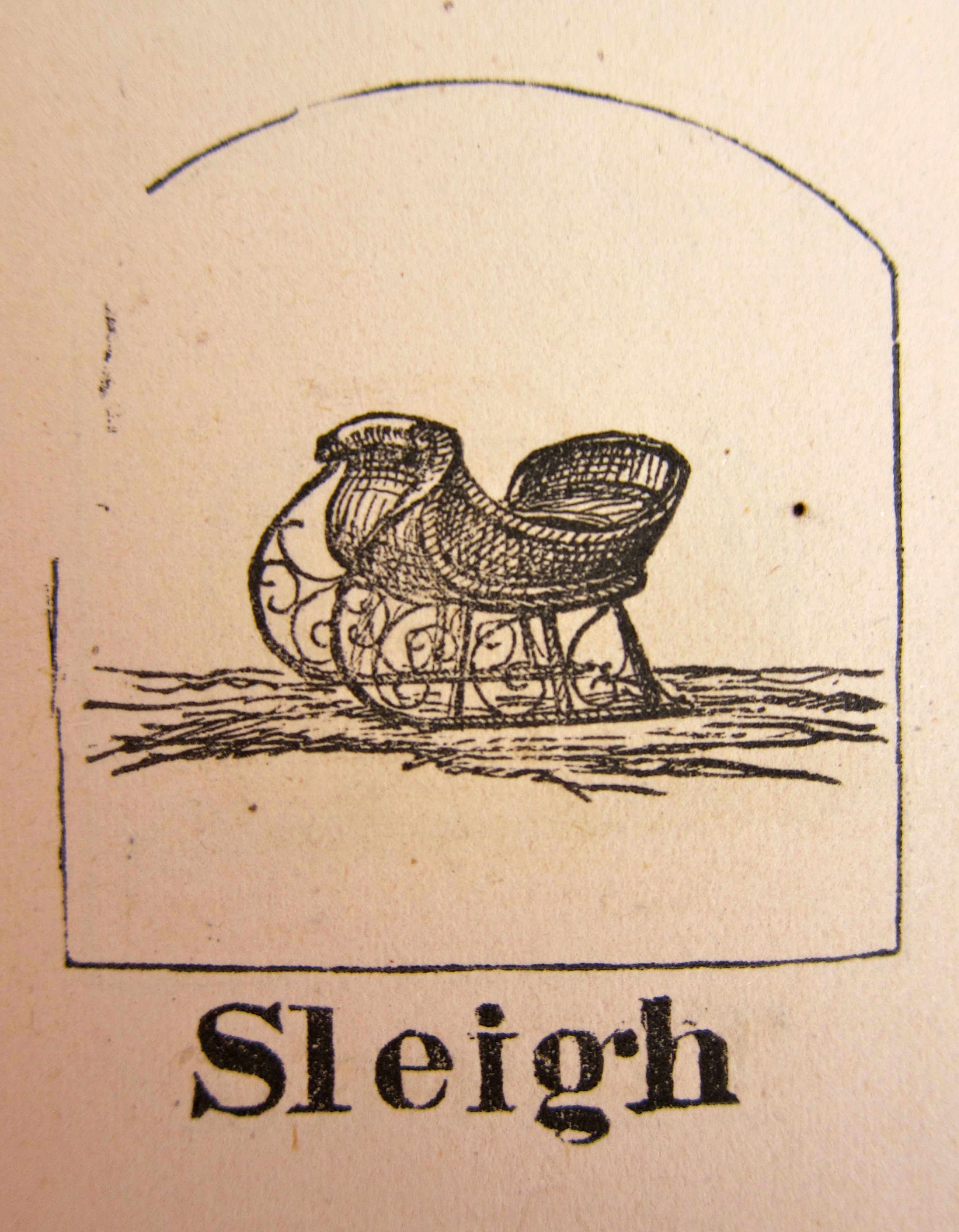
Sleigh

Dec 17th  Wednesday.  Mary went to ironing this

morning and Jane did the housework and I have been

knitting on Susans hood have got the front done and 

commenced the back  Abby spent the afternoon

& Malvina came in past eight  Jane ironed 7

shirts this afternoon  Very cold weather

Old Oliver Ames didn’t always agree with his senior daughter-in-law, but on this day he and she shared the same opinion about the temperature outside. “[T]he coldest day we have had this winter,” he wrote in his journal. Not surprising that Evelina and her servants stayed inside and focused on their indoor domestic responsibilities. All three women seemed to have recovered from their recent colds and illness and they probably wanted to keep it that way.

Some people went outside, though.  Evelina’s nieces, Abby and Malvina Torrey, spent part of their day with her.  They must have walked over from the village – a short walk, fortunately, in the windy, freezing sunshine.  Other Eastonians who were out and about would have moved around best in their sleighs, as a buildup of snow had hardened into a smooth, slick surface on the roadways.  Old Oliver himself may have gotten around that way.  He noted that “light slays run pritty well now.”


October 29, 1851

1157676_l

*

Wednesday Oct 29.  I have been what I call puttering

about house most all day and have accomplished

but very little.  papered the fireboard and pasted

the loose places in Franks chamber  Mr Scott

has painted the sitting room & closet

Mrs Hubbel & Ames came from New York this morning

H O A Orr came for Susan this afternoon  Mr

Walton is there. Mrs Holmes and Abby called

Mr Ames came home from Boston to night

Many comings and goings in North Easton today, under a cloudy sky.  Almira Ames, widow of George, an Ames cousin, arrived from New York with a Mrs. Hubbel in tow. They came for a visit with the obliging Sarah Witherell and Old Oliver Ames in the other part of the house.

Susan Orr, meanwhile, who had been staying with Sarah Witherell and her father for almost a month, was picked up this afternoon by her brother, Hector Oakes Orr. Susan, age 53, and Hector, age 51, were first cousins of Sarah Witherell and her siblings on the Angier side of the family.  Susan and Hector were two of five children of Susanna Angier Ames’s sister, Mary and her husband, Dr. Hector Orr, of Bridgewater. Their shared grandparents were Oakes and Susanna (Howard) Angier.

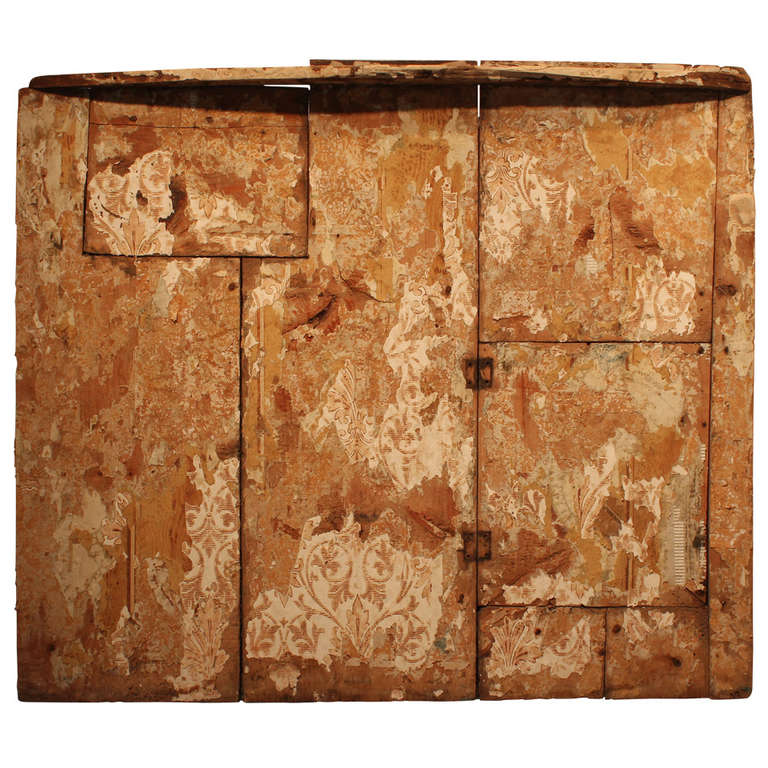
Evelina’s niece on the Gilmore side, Abigail Williams Torrey, paid a call with Harriet Holmes (the neighbor who had been so ill back in August). A Mr. Walton floated somewhere in the picture; Evelina’s inclusion of his name is a bit vague. And chugging along in the background of the various calls was Mr. Scott painting the woodwork in the sitting room. Evelina concentrated on papering a fireboard when she wasn’t attending to the influx of visitors. For readers who don’t have fireplaces, a fireboard was a piece of wood, textile or ironwork fitted to the opening of a fireplace for periods when the fireplace wasn’t being used.  Fireboards made from wood, most common in the countryside, were often decorated with wallpaper or painting.


* 19th century papered fireboard, Pennsylvania, courtesy of 1stdibs.com.