October 6, 1851

OLYMPUS DIGITAL CAMERA

*

Monday Oct 6th  Went down to Dr Swans before 7 or 8 Oclock

so that I might find him at home and he has given

me some powders  When I came back found the

dishes washed and put away  Jane has been remarkable

smart  I have finished my striped french print

and have worn it this afternoon  Mr Brown

commenced school again to day  Passed the evening

at Mr Holmes with Susan


Evelina sought help today from Dr. Caleb Swan, who gave her “some powders” for her nettlerash. She would have mixed a dosage with water and swallowed it.  What was the actual medicine that she ingested? Did it contain the laudanum that was often dispensed to women in that era? Whatever it was, it seemed to make Evelina feel a bit better.

Jane McHanna, the Ames’s servant, washed the breakfast dishes for Evelina while she was at the doctor’s. Jane usually did the cooking and Evelina typically did the washing up, but in this case Jane must have recognized how sick Evelina was.  Evelina was grateful for the assistance and praised Jane for being “remarkable smart.”

The day progressed well afterwards. Little Susie returned to school where Eratus Brown was her teacher. Did she miss her old teacher, Orinthia Foss? Evelina sewed and finished making a “striped french print” dress. Stripes were in fashion that fall, as the illustration above from Godey’s Lady’s Book shows. The illustration also shows that distortion of the female figure for advertising purposes was every bit as popular in 1851 as it is in 2014. The length of the woman’s legs in the drawing is improbable, unless she is standing on stilts under that full skirt. Look at her tiny foot sticking out from the hem!

Evelina even felt well enough to go out in the evening with her daughter.  They went over to the Holmes’s where they probably visited with Harriet Holmes, the neighbor who had been so ill earlier in the summer. The Holmeses had a daughter, Mary, who was about Susie’s age.


Fashion plate from Godey’s Lady’s Magazine, September 1851

September 17, 1851

Ruth_Morrill_wife_of_Justin_S._Morrill


*

Wednesday Sept 17th  Mrs Stevens left for Boston

this morning & sorry I am to have her go

Miss Eddy dined with Mrs Mitchell &

took tea at Olivers  I went in to tea but

went in but a few moments before as I have

been very busy all day.  Made about a dozen

Lbs of peach preserve & some grape jelly

Ruth Swan married to night Oakes A & Mrs H Mitchell

gone to the wedding

The Great Railroad and Steamship Jubilee kicked off in Boston today with the arrival of President Millard Fillmore and other dignitaries from the United States and Canada, all ready to express mutual congratulations over the new railroad and steamboat connection between their countries.

Evelina knew about the events in Boston but stayed focused on domestic responsibilities in North Easton. From fruit she had recently obtained, she made preserves and jelly, a day-long task that kept her “very busy”.

In the evening, her son Oakes Angier Ames and sister-in-law Harriett Ames Mitchell went to the wedding of Ruth Barrell Swan and Justin Smith Morrill of Vermont.  Ruth, a daughter of Dr. Caleb Swan and his first, late wife, was 28 years old and, in the culture of the day, was marrying late. Independent of the affection she must have felt for him, she may also have thought that he was worth the wait. Three years later, Justin Morrill was elected to the U.S. House of Representatives where he served until 1867, when he became a U.S. Senator. He served the state of Vermont until his death in 1898. A founder of the Republican party, he was a leader in establishing the land-grant colleges with his Morrill Land Grant bill in 1862. That same year, he authored the Anti-Polygamy Act which was aimed at the Church of the Latter Day Saints. He was clearly a one-woman man, and that woman was from Easton.

Ruth Ballard Swan of Easton who married Justin Smith Morrill.

August 27, 1851

2004-D03-395

Wedns Aug 27th  This morning filled the vases with flowers and worked

some about the house and about nine went to Mr

Lothrops with Mrs S Ames to put on the shrouds

Got home about twelve.  Went to the funeral

and to the cemetery  He is the second one that 

has been laid there.  Mrs Fullerton and Abb[y] Torrey

called this evening & Malvina with her bloomer

hat that I gave her

“[A] fair, cool day,” Old Oliver noted in his journal. “Clinton Lothrop buried.” Brother of Sarah Lothrop Ames, a young husband, father, and farmer, Clinton had died of typhus fever. Evelina helped Sarah, Clinton’s only sister, place a shroud on the corpse. In the afternoon, with her husband and family, Evelina attended the funeral service, which would have been at the Lothrop home, and the burial.  Clinton was buried in the new cemetery.

Despite the somber events of the day, Evelina managed to brighten her home with flowers from her garden.  In the evening, her nieces Abby and Malvina Torrey made a call with their relative, Mrs. Fullerton. Malvina wore a “bloomer hat” that Evelina had given her.

The bloomer costume – seen above in the Currier print –  was a fashion phenomenon in 1851. Originally developed by readers of a health publication called The Water-Cure Journal, “Turkish pants” were touted as a healthful alternative to the heavy-skirted dresses and constrictive bodices that women typically wore. They became known as “bloomers” when Amelia Bloomer of Seneca Falls, New York, told the readership of her temperance periodical, The Lily, that she had adopted the style to wear.  She published instructions for making the outfit, and the curious style became a craze.

Although the bloomer costume was admired at first as being healthful, it soon became politicized as women’s reform became prominent in the headlines. To many, the free-flowing bloomers became symbolic of the suffrage movement. Publications that initially praised bloomers recanted as the outfit became more controversial. The fashion held its own through the decade, however, but disappeared after the Civil War, only to revive in the 1890s.

Evelina, sewing maven that she was, had been following the fashion news, but hadn’t opted to make a bloomer costume for herself. With a nod to the trend, however, she acquired a bloomer hat, probably like the one in the Currier print, to give to her ten-year old niece, Malvina.

*Nathaniel Currier, The Bloomer Costume, 1851

July 14, 1851

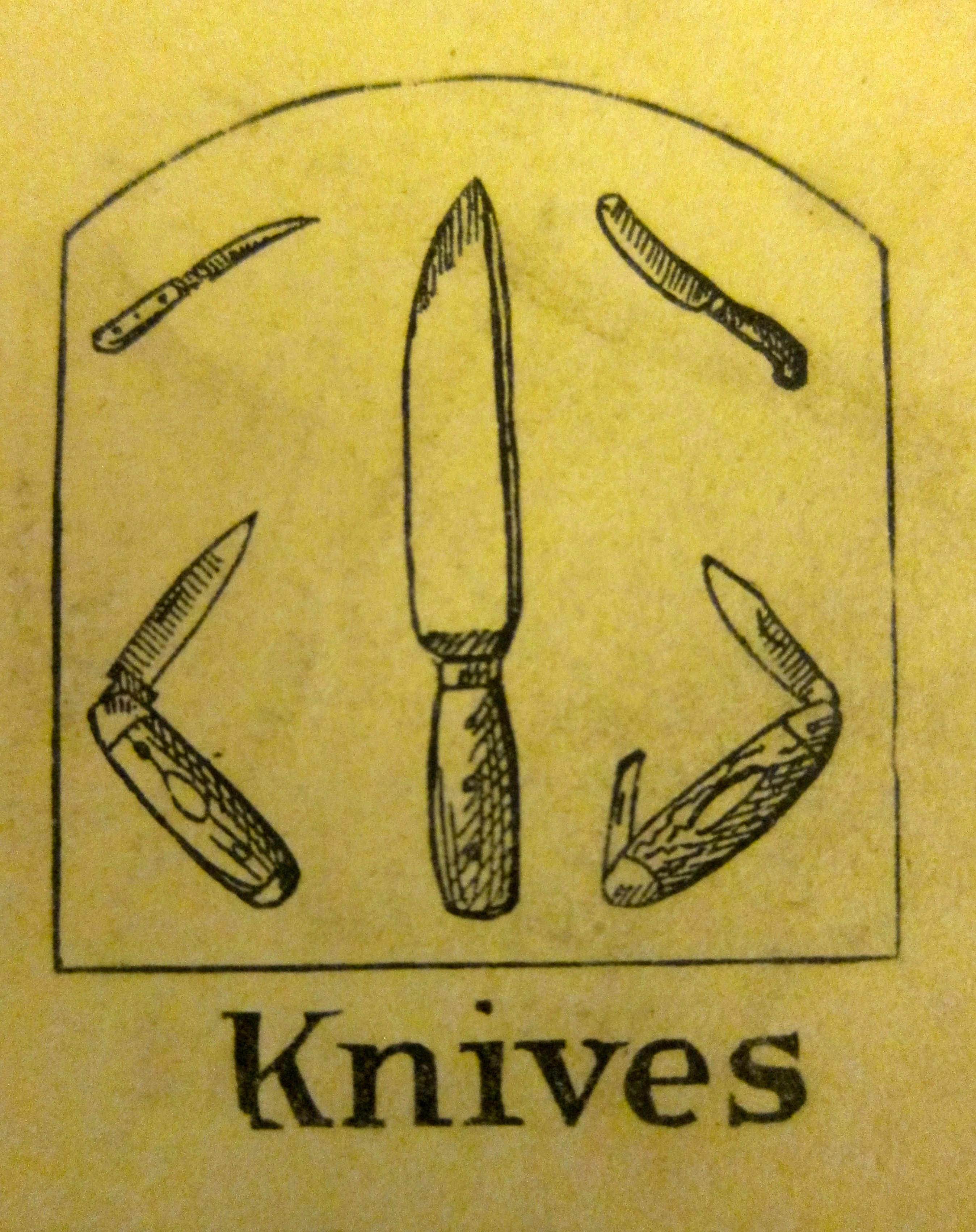
Knives

1851

July 14 Monday  Mr Norris left in the stage this

morning  Mr & Mrs Harris & Mrs Norris for

Bridgewater.  Jane has not done her washing as she

usually does but we have put the house in order

Scoured all the knives &c &c.  Have passed most 

of the afternoon in the other part of the house

the whole family took tea there

The Harrises and Norrises left this morning, releasing Evelina from her hostessing obligations. The house was in disarray; probably, one of the couples slept in a bed in the parlour, the other stayed who-knows-where.  Furniture had to be put back, linens stripped and so on.  Jane McHanna had so much to do in the aftermath of the houseguests that she couldn’t do the Monday washing.  That was unheard of.

Jane and Evelina picked up in the kitchen, too.  One of them scoured the knives. In 1851, knives were made of mild steel, typically high in iron. Stainless steel, which has an alloy of low iron and high chromium, had not yet been developed, and wouldn’t appear until the turn of the 20th century. Knives in the 19th century corroded easily and needed to be cleaned periodically, often by being rubbed with fine sand.  Evelina or Jane might have sharpened them, too.

In the afternoon, Evelina and her whole family had tea at her father-in-law’s, served by her sister-in-law Sarah Witherell.  After a weekend of catering to houseguests, being served tea must have been a pleasure.


June 6, 1851

images

*

1851

June 6 Friday  Worked in the garden an hour or two this morning

mended some cotton stockings swept & dusted &c

About three or four Oclock went with Olivers wife

& Mrs Mitchell to North Bridgewater called at

Mr Summers to take Frank Mitchell home & at Mrs

Carrs & Susan Copelands to get my bonnet  The bonnet

is done well  When I returned home found Orinthia

here.  Jane Howard brought her up. 

At last, a bonnet to take home and trim.  Evelina was clearly pleased.  She picked it up in North Bridgewater (today’s Brockton) with her sisters-in-law Sarah Lothrop Ames and Harriett Ames Mitchell.  The ladies retrieved Harriett’s eldest son, Frank Ames Mitchell, in the process. Not yet ten years old, whom had he been visiting?

Otherwise, Evelina’s day was full of quotidian activities: mending, sweeping, dusting. Nothing out of the ordinary popped up in the domestic department. Gardening, too, continued. On this day, Evelina may have planted the asters she picked up yesterday at the Howards’, compliments of a Howard daughter, Louisa.

Joseph Breck in his Breck’s Book of Flowers, 1851, admired the China Aster: “The varieties are now very numerous, and possess exceeding beauty, some of them being almost as large as a small Dahlia, and much more graceful.”

Breck warned against letting the asters “degenerate in to inferior flowers,” and recommended sowing the seeds in May, “in patches,” and transplanting them to “a bed well prepared the last of June.” It may be that Evelina was transplanting the seedlings a little early.  Time would tell.

* Image from edenbrothers.com


May 27, 1851


VFC021712-26

1851

Tues May 27th  My beadstead was brought this

forenoon  It is very pretty but much to large shall

have it made shorter.  Have had the center table

lowered & new castors put on it.  Put straw carpet in

Franks chamber and it is ready for him to come back

into.  Have not sewed any to day I seem to have been

busy but have not accomplished much for a long while

Pleasant weather  Mr Ames went to Canton this 

afternoon

Redecorating continued.  Not only had things been cleaned and painted or papered, but new furniture was being brought in, and old furniture reconfigured.  Casters, beloved of Victorian housewives, were put in place so that furniture could be rolled for better cleaning.

What prompted Evelina’s burst of refurbishment? New wallpaper, new carpet, new furniture. Did she do some redecorating every spring or was this a departure from the norm? It may be that the new expenditures were relatively recent and stemmed from the increasing prosperity of the Ames shovel business as well as a contemporaneous, burgeoning access to material goods that had once been scarce. In other words, with American manufacturing on the rise,  Evelina and Oakes – and Sarah Lothrop and Oliver Jr. – could now afford and obtain desirable textiles, furnishings and decorative items for their homes.  They went to Bridgewater, Boston and New York, and bought.

One thing was certain. Evelina wouldn’t have proceeded with any of this without Oakes’s approval.  Implicit in her purchases was his consent, tacit or enthused.  For a man who spent nothing on his personal appearance, it’s interesting to understand that he would spend money on decorating his house. It’s also curious to wonder what Old Oliver might have thought about the upgrading at the old family homestead.


May 23, 1851

Road

May 23d Friday  Have finished putting the sitting room in

order and it looks very much better with my new

carpet  About 11 Oclock Mrs S Ames & I started

for North Bridgewater & returned at four.  Called

at Susan Copeland to get her to sew over my straw

bonnet.  It looks like a fright but I shall have

to wear it two weeks more as she cannot do it any

sooner  Mr Whitwell called.  Last night it rained very hard

Various members of the Ames family were on the road today.  Evelina and her sister-in-law, Sarah Lothrop Ames, rode to North Bridgewater on errands.  Sarah seemed to be feeling better after being sick for much of the spring, and Evelina seemed still to be focused on finding a summer bonnet.  She’d have to content herself with looking “like a fright” for a while longer.

Old Oliver Ames, meanwhile, rode home from Plymouth, where he had been since Wednesday on a court matter.  He wrote, “I went as evidence, in a case betwen thomas Ames and Dwelly [illegible]*.” Thomas Ames was a distant cousin, but what the case was about and what Oliver’s role in it isn’t known. Whatever Oliver’s testimony, people on both sides of the case would have paid attention to him. Old Oliver wasn’t known to prevaricate or equivocate.  What he saw or thought, he said.

The rain of which Evelina spoke was probably part of a front that had moved across from the midwest, depositing heavy rain in its path.  Des Moines, Iowa, in fact, was suffering from “The Great Flood of 1851,” an historic deluge that would go on for days. Today anyone can turn on a television or check an app to see what the weather is, but citizens in 1851 could only learn about flooding as it arrived in their area or, if it happened elsewhere, by reading about it a few days later in the newspapers.  We might think we are still at the mercy of the weather, and we are, but at least nowadays we can generally anticipate what might be coming our way in the immediate future.  Not so in 1851.

* Possibly “Goward”

April 17, 1851

imgres-1


1851

April 17th Thursday.  Julia has been here to finish

my Foulard Silk it does very well now & looks

very well indeed after washing It has taken

her two days to cut & make the waist baste

the sleeves & sew on the skirt She is very

slow. Orinthia did not keep school yesterday

or to day on account of the storm It has been

a driving storm to day but not as bad as yesterday

The storm that took down Minot’s Light still raged today.  Safely indoors, Evelina and Orinthia tended to sewing, joined by dressmaker Julia Mahoney, who finally finished the alterations on a silk dress for Evelina. Foulard silk was a popular, lightweight fabric – good for the coming warm weather – that typically featured a small print pattern. Used today for scarves, it could and can be hard to sew because it’s so thin.

Julia took longer to complete the outfit than Evelina thought she should, yet as Julia was probably paid by the piece and not by the hour, Evelina’s annoyance wasn’t based on monetary concerns. Perhaps her exasperation at the dressmaker’s deliberate pace stemmed from her own seasoned agility with needle and thread; perhaps she thought she could do the work faster. But Julia may still have been more skilled in the finer needlework required for high-end ladies’ dresses.  Certainly the end result proved pleasing.

According to Godey’s Lady’s Magazine, “One might as well be out of the world as out of the fashion”.  While North Easton, Massachusetts would never be in the running as a fashion center, some of its citizens cared about style and appearance.  Evelina and her sisters-in-law did. They followed the fashions, via various periodicals and on trips into Boston, and dressed themselves as modishly as they could. As Evelina’s grandson Winthrop Ames later pointed out, “Every season there was a great remaking of old garments to bring them up to date.”

The remaking of garments didn’t preclude the production of entirely new dresses, either.  But older clothes were made and remade to last as long as possible.


March 25, 1851

438px-HardTimesComeAgainNoMore1854

/51

March 25  Worked on Olivers shirt this forenoon

In the morning read to Mother awhile

Mrs J Porter spent the day with Mrs Witherell

I called to see her.  Her youngest boy was with

her between three & four years.  Her oldest daughter

15 & her other son 13 years.  Has lost four children

Abby & Malvina were here to tea.  Pleasant

Augustus went to Boston.  I received a letter from Louisa

J. Mower  Oliver went this morning to New Jersey.  Helen to school

A quiet weekday in Easton, punctuated by departures.  Augustus Gilmore went into Boston, perhaps on errands for the new boot factory. Helen Ames returned to school and her father left for New Jersey on shovel business. Pleasant weather facilitated everyone’s travels.

Sarah Witherell had a visitor today, a Mrs. J. Porter, who brought three children with her. Evelina, who “called to see her,” noted that Mrs. Porter had borne four other children who had died, a sorrow Evelina would have been especially sympathetic to, having lost a child of her own. So had Sarah Witherell. Surely there was a tinge of loss hovering on the edges of this modest gathering, “frail forms fainting round the door,” as Stephen Foster’s classic ballad* from 1854 would soon suggest.

In the United States in 1851, average life expectancy was less than 50 years old. No small variable in that number was the high rate of infant mortality. The expectation that an infant might not survive was so prevalent that some parents didn’t name their children until after the child had lived through its first twelve months.  It wasn’t unusual for census records to show entries for two- or six- or nine-month old babies described as “Infant Not Named.”  Children and young adults died, too, from diseases that we have since held at bay, but babies were especially vulnerable.

*Hard Times Come Again No More

February 10, 1851

Storm

Feb 10th Monday  Warm this morning but not pleasant  Jane 

put her clothes out but the wind commenced blowing quite

hard with some rain, so that the clothes had to be taken

in & were dried over the registers  Cut Susan a Chemise

out of the width of  1  1/4 yd wide cloth and partly made it

Worked about house as usual on washing days in 

the forenoon  Wind blows quite hard this eve.

What a jungle of white linens the Ames house featured this Monday, with Jane McHanna having to drape dripping laundry around the heat registers.  So much for Evelina’s cleaning the floors the other day.  Miserable winter weather – snow, rain, ice, wind and rain again – was wreaking havoc with the domestic schedule.

One person in the Ames household celebrated her 12th birthday today: Sarah “Emily” Witherell.  Emily was born in New Jersey where her parents had lived while her father, Nathaniel Witherell, Jr., worked with William Leonard Ames, her mother’s brother, at various Ames enterprises.  Tragedy had struck in recent years, though, with the death of her father and the subsequent “drounding” of her two year old brother, Channing.  Emily was stricken with loss at an early age.

With her mother, Sarah; older brother, George Oliver Witherell; and grandfather Old Oliver Ames,  Emily now lived in North Easton, Massachusetts in “the other part of the house”.  She probably still attended school, but she and Susie Ames were too far apart in age at this point to be close friends, although they would soon find themselves sharing  piano lessons.  Her cousin Oliver (3) found Emily to be outspoken and opinionated; she was, evidently, unafraid of speaking her mind at a time when candor in women was not prized.

Emily never married.  After Old Oliver died in 1863, when she was about twenty-four, Emily and her mother moved into Boston, eventually taking up residence in Back Bay at the Hotel Hamilton and living off of distributions from investments managed by her male cousins.  A spinster cousin, Amelia Hall Ames, the only daughter of William Leonard Ames, eventually moved in with Emily.  These two cousins, in turn, may have undertaken to raise yet another cousin, Eleanor Ames, a granddaughter of William Leonard Ames. All that is in the future; on this day in 1851, we can hope that Emily had a special birthday despite the weather. She deserved a happy moment.