January 14, 1851

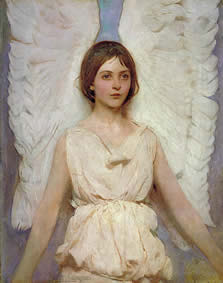
Abbott H. Thayer, Angel, 1887, oil Smithsonian American Art Museum Gift of John Gellatly

Abbott H. Thayer, Angel, 1887, oil
Smithsonian American Art Museum
Gift of John Gellatly

/51

Jan 14  Tuesday.  This morning after taking care of my room went

to the store and into Mr Carrs to offer my assistance there.

Lewis Carr died last night very suddenly bleeding at the 

lungs.  Has been in a decline since last July but was about

the house as usual yesterday and conversed with O A and 

his friends in the evening & told what he was going to do when

he got well.  about ten or eleven Oclock called to his mother

to come quick which was the last word & died almost instantly

This afternoon carried Mr & Mrs Whitwell to A A Gilmores.

The “white plague,” consumption, was a killer; today we know it as tuberculosis and, in parts of the world, it’s still killing.  In 19th century America, it was a leading cause of death, the scourge of young lives, particularly.  Its contagious properties were unknown, which helped it spread.  Although different treatments, such as prolonged rest in warm climates, were tried (when possible), no cure for the disease would be found until the middle of the 20th century.  Some people did recover from TB; most did not.

Lewis Carr, a friend of Oakes Angier Ames, was barely 20 years old. He was the son of Caleb and Chloe Carr of North Easton where the family had lived for generations.  His father, known as “Uncle Caleb” in his later years, was a life-long employee of the shovel works and close to the Ames family.  So close, in fact, that two decades later, Caleb would serve as a pall-bearer at Oakes Ames’s funeral.

It is typical that Evelina would help the Carr family at this time.  She and her sisters-in-law were often called upon to sew the shrouds that corpses were wrapped in, which is what she did on this day for the family.

January 13, 1851

Washing

/51 Jan 13  Washing day of course, and I have been

about house in the morning as usual.  A Augustus dined

with us, come up in the stage.  Made a hair cloth back to

another rocking chair  Went to Mr Whitwells with Mr

Ames this evening, met with Alson & wife.  It is a

beautiful moonshiny evening and we have had a

pleasant ride and have enjoyed myself very much.  Mr &

Mrs Whitwell I like very much  Father killed another

yoke of oxen to day and we have a quarter & the tripe.

Boiled that we had last week to day.

Monday is Wash Day.  This might be a Yankee commandment, were there a written code.  History has it that the first day the Pilgrims got off the Mayflower was a Monday, and the first thing the women did after all those weeks at sea was to wash their clothes.  The timing stuck, and remained a custom for centuries.  On Mondays at the Ames house, Jane McHanna washed the family clothes and linens while Evelina did almost everything else in terms of housework and cooking.  Evelina was not fond of putting her hands into soapy water.

The roads around town must have improved.  This evening, Evelina and Oakes finally got over to the Whitwells’ house, presumbly for a delayed acknowledgment of Mr. Ames and Mr. Whitwell’s shared birthday.  Evelina clearly enjoyed herself.  Another couple was there: Alson and Henrietta Gilmore. Alson is Evelina’s older brother.  He owns the old family farm in the southeast corner of Easton, just north of the town of Raynham.  He and his wife have six children together, as well as a son from Alson’s first marriage.  This is Alson “Augustus” Gilmore, who had midday dinner at the Ames house today.  Augustus lives in Boston as the year opens but will soon move back to North Easton.  He does courier work for the Ames brothers.

Evelina is close to her nieces and nephews; their presence in her life, and her affection for them, is evident throughout the diary.  Less certain is the regard that other members of the Ames family held for the Gilmores; family lore has it that the two families moved in different social circles and that even into the 20th century, the Gilmore clan was looked down on by members of the Ames clan. From Evelina’s happy description of the day, however, we can surmise that she was unaware, on this lovely, “moonshiny” night, anyway, of any discrimination.

January 12, 1851

Preach

/51 Jan 12 Sunday  Have been to church all day and heard two

excellent sermons from Mr Whitwell.  The afternoon text was

“Train up a child in the way he should go and when he is old

he will not depart from it”  Passed this evening at Mr Willard

Lothrop with Mr Ames & met with Minister Norris & Mr Torrey

This noon I stopped to hear Mr Whitwells class in the Sabbath

School afterwards went into Mr Daniel Reeds with Mother

Very warm + pleasant for the time of the year

The Ames family, Unitarians all, attended meeting today and stayed for both services, which encompassed a morning program, an intermission, and an afternoon program.  In their family pew, Evelina, Oakes, Oakes Angier, Oliver (3), Frank Morton and Susan sat with or near Old Oliver, Sarah Witherell and her children, George and Emily.  Also nearby, if not in the same pew, sat Oliver Jr, Sarah Lothrop Ames and their children, Fred and Helen, faces upturned to hear Reverend Whitwell deliver the day’s two sermons.  Eight-year old Susie may have squirmed in her seat; she wasn’t inclined to sit still for the second service.  And Oakes Ames was known to fall asleep, however inspiring Mr. Whitwell’s words were to Evelina.

In 1851, the Unitarians congregated at a church in Easton Centre, a few miles south of the village of North Easton (but still within the boundaries of the Town of Easton, Massachusetts.)  Like many families, the Ameses had to travel by carriage or sleigh to attend Sunday service.  The adults would have ridden, or “been carried,” as the expression went,  but the children may have had to walk the distance.  Children walking to church, regardless of distance, was common.  If this was true for the Ames family, we might imagine that cousins Oliver (3) and Fred walked together, as they were close friends.

At intermission, children went into Sunday School and the adults socialized.  Winthrop Ames, a grandson-to-be, described the scene in his family history (from 1937):

“They tethered their horses in a long, open shed and stayed through both morning and afternoon services, eating the luncheons they had brought and gossiping with the townsfolk during the intermission.”

On this winter Sunday Evelina and her mother, Hannah Lothrop Gilmore visited at the nearby home of Daniel and Mary Reed.  Socializing continued in the evening as Evelina and Oakes called on Willard Lothrop.

January 11, 1851

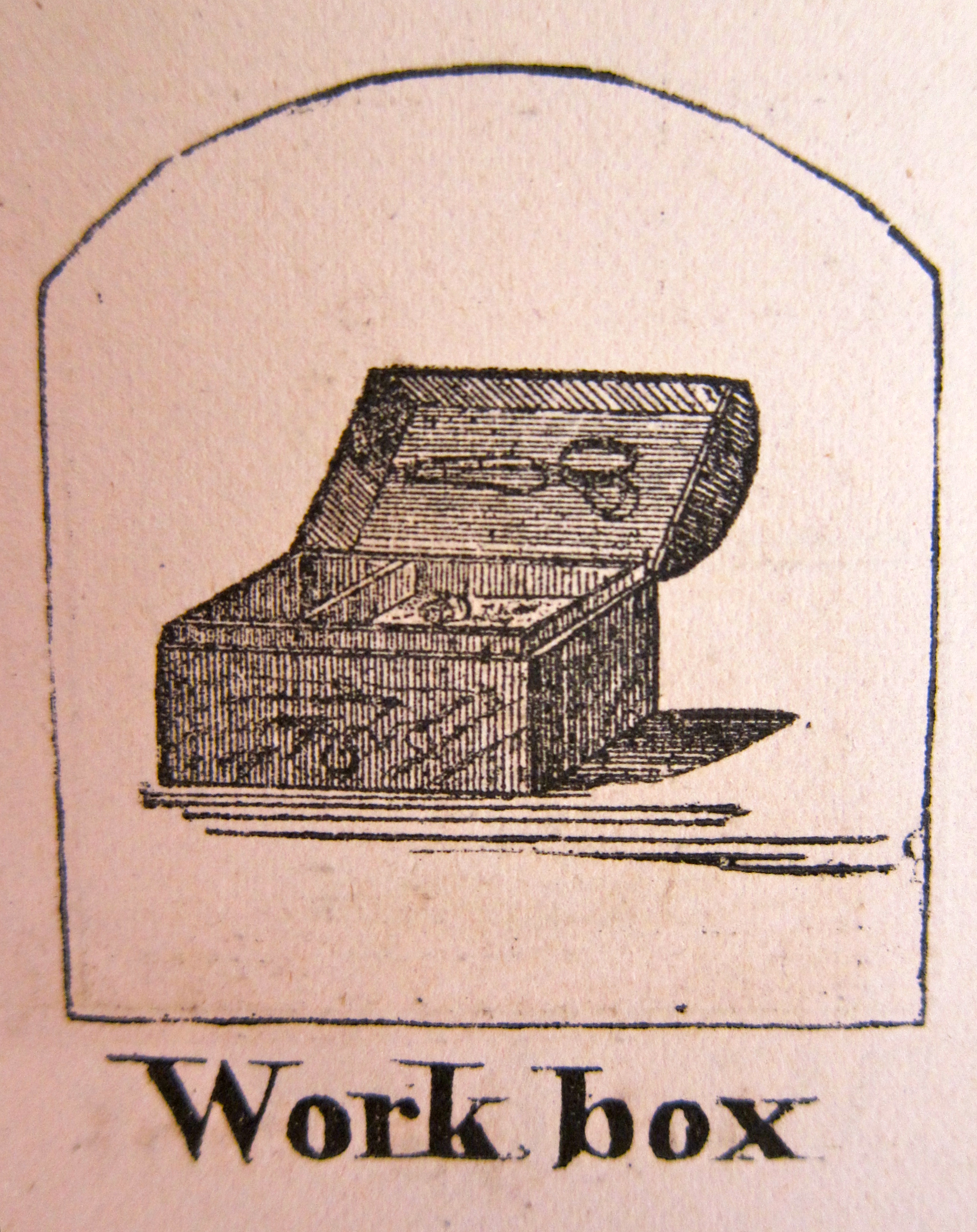
Workbox

/51 Jan 11 Saturday.  Made a haircloth back & cushion for one

of my rocking chairs.  Mrs Witherell brought in her work

and staid about two hours.  Willard Lothrop made

quite a long call.  Told Mrs W that he did think at one

time of coming to see her but she looked so dignified &c that

he could hardly muster courage &c &c  This evening have been

mending stockings & reading the papers.  Mr Ames has been

to Boston bought him a pr of Robbins.  Brought home watch

Very warm, pleasant but sloppy.  Bought 5 3/4 lbs Beef of C Lothrop

While Oakes made his usual Saturday trip into Boston, Evelina and Sarah Witherell sat together in the Ames’s front room, sewing. Evelina was completing a horsehair back and cushion for a rocking chair.  Horsehair upholstery was common in the 19th century, the haircloth being both durable and lustrous, plus relatively inexpensive.  Evelina, accomplished housewife that she was, would naturally have undertaken to do this work herself.

With their work boxes at hand, the two sisters-in-law sat, sewed and conversed until the arrival of a visitor, Willard Lothrop.  Mr. Lothrop, an employee at the shovel shop, was something of a character.  He was a self-declared medium and an impassioned advocate of spiritualism. (He may also have been related to both Evelina and her other sister-in-law, Sarah Lothrop Ames, through the Lothrop family line.  There were many Lothrops in the area.)

Spiritualism was a practice that claimed, in Reverend William Chaffin’s words, “that there is a vital connection between the seen and the unseen worlds by which communication between the two can be maintained.”  Though hardly a new concept, this American iteration took root in the mid-19th century and gained strength for a time after the Civil War.  Many in North Easton, especially those living along the Bay Road, were interested in it.

Lothrop, the purpose of whose call at the Ames house is not disclosed, focused his attention on Sarah Witherell, confessing that he found her unapproachable.  No mention of Evelina being inaccessible!  Lothrop offers us a rare, backdoor insight into the character, or the bearing at least, of the Ames sister of whom we know the least.  Except for her presence in Evelina’s diary, Sarah Witherell left almost no trace behind, no diary, no stories, no grandchildren, no legacy.  In a powerful, visible, active family, she may simply have been its most private member.

After Lothrop left, what did the ladies talk about?  And what are the “Robbins” that Oakes Ames bought in Boston?

January 10, 1851

tcrr_ames

/51

Jan 10th Friday.  Have been baking most all day  Heat

the oven three times.  It rained very hard last night

and carried off most all the snow and it is very wet

and sloppy.  Margaret Keighan here to see Jane.

This is Mr Ames & Mr Whitwells birth day  both

of the same age 47 years.  Have been expecting Mr & Mrs

Whitwell here this afternoon and as they did not come

would have rode there this evening but Mr Ames is engaged

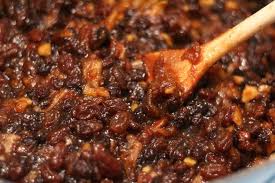
If Evelina and Oakes had been able to visit the Whitwells tonight, they would have had to take the carriage rather than the sleigh because of recent heavy rain.  According to Old Oliver, the sudden wet and warm weather has “took the snow of[f] so much that it spoilt the slaying.”  Evelina, meanwhile, was so tied to the brick oven all day, baking mince meat pies and such , that she had a right to be a little disappointed not to go out this evening.

The Ames family, Puritan stock that they are, don’t overly celebrate anyone’s birthday.  Yet Evelina notes the shared birthday of her husband and the minister.  Oakes Ames was born in North Easton on this day in 1804.  He was the first child of an eventual eight to be born to Oliver Ames and Susannah Angier Ames.  The others to follow would be Horatio, Oliver Jr., Angier (d. in infancy) William Leonard, Sarah, John and Harriett.

Besides Oakes, Oliver Jr. and Sarah are the only siblings who still live in North Easton in 1851.  Except for a stint away at school, Oliver Jr. never moved away.  He and his wife live next door.  Sarah, on the other hand, left for New York in 1836 when she married Nathaniel Witherell, Jr.  Now a widow, she returned to North Easton in the late 1840s and moved back into the old homestead to care for her father after the death of her mother in 1847.

The absentee siblings are away but never forgotten; among the brothers, especially, business deals are ongoing.  Horatio, the black sheep of the clan, lives in Connecticut and runs a forge.  William Leonard had been in New York City and Albany, working as a merchant who sold, among other items, Ames shovels.  When those enterprises failed, he switched to managing a blast furnace, in keeping with the family talent for manufacturing.  But this proved unprofitable, too. By 1851, William Leonard was making his way as a cattleman on the Minnesota frontier.  John, who had also moved to New York City, died in 1844 of a chronic lung ailment.  Harriett is married to a man from Bridgewater named Asa Mitchell, and at this time lives in western Pennsylvania.

As a boy, Oakes moved with his parents to Plymouth while his father worked at various manufacturing efforts, although shovel making predominated.  The family moved back to North Easton in 1813, after the conclusion of the War of 1812, whereupon Old Oliver threw himself into the manufacture of shovels. After that, the family stayed put.

January 9, 1851

images

/51

Jan 9th Thursday

This morning after cleaning my room & doing

my usual mornings work, finished my collars & the

book Mr Whitwell brought.  Cut Susan a sack out of

her plaid cloak.  Prepared some mince pie meat ready

for baking & this evening have been writing in this book.

Had to take the foregoing from memory.  Mr Ames, ague in his face

and come home from the office very early.  Has been

troubled with it several days.  Unpleasant this afternoon

Oakes Ames still had his head cold and came home early from work, something almost unheard of.  He was always on the go. Evelina, meanwhile, worked in the cook room preparing mince meat, a lengthy process that calls for a lot of chopping of meat and suet, not to mention the “stoning” of raisins.

Sarah Josepha Hale, intrepid editor of Godey’s Lady’s Book, had nothing nice to say about mince meat pies. In her book, The Good Housekeeper (1841), she urged American housewives to serve mincemeat only on special occasions:

“The custom of eating mince pies at Christmas, like that of plumb puddings, was too firmly rooted for the ‘Pilgrim fathers’ to abolish; so it would be vain for me to attempt it.  At Thanksgiving, too, they are considered indispensable; but I may be allowed to hope that during the remainder of the year, this rich, expensive and exceedingly unhealthy diet will be used very sparingly by all who wish to enjoy sound sleep or pleasant dreams.”

Evelina was a regular reader of  Godey’s Lady’s Book, but she paid scant attention to Mrs. Hale’s admonishment against mince meat pies.  She served them often; they were a familiar presence at the Ames dinner table.  Considering  the large family to be fed, including three physically active sons between ages 17 and 21, and the ready availability of meat and suet from the oxen provided by her father-in-law, it’s small wonder that Evelina turned to a dish that was hearty and filling.   Mincemeat was a standard in many farming families.

January 8, 1851

Collar

/51

Jan 8th Wednesday

Made some cambric cuffs & collars and

starched & ironed some.  Worked on them most of the

day.  Jane ironed the coloured & coarse clothes

Head aches this evening trying to sew on fine work   gave

it up & went to reading a Thanksgiving story that

Mr Whitwell brought me to read.  Bought 25 cts worth Crackers

Settled with Sarah Ames she paid me for Cheese &c

Have been looking over my expense account  Pleasant

Evelina was an excellent needlewoman.  Like most women in the days before “ready-bought” apparel, she made her own clothes.  She made clothes for everyone in her family, in fact.  By. Hand.  No sewing machine was yet on the market; Isaac Singer and Elias Howe had each invented one but a drawn-out patent dispute was holding up its production.  By the advent of the Civil War, however, and the consequent need for mass production of uniforms, the sewing machine would come into its own, and the production of clothing would become an industry.  The three Ames sisters-in-law would eventually acquire a machine to share.

In the meanwhile, in the last decade before this change, Evelina sewed almost every day.  She occasionally relied on the help of a dressmaker – all the sisters-in-law did.  But Evelina easily made dresses, aprons, and underclothes for herself and her daughter, as well as work shirts and underclothes for her husband and sons.  Collars, handkerchiefs, sheets, linens and more were cut out, run together, fitted, taken up, untucked, hemmed, mended, refitted and re-mended.  The projects were endless, especially as the children were growing, but fortunately, sewing was an occupation that Evelina appeared to enjoy.  She spent more time at it than any other chore – certainly more than doing laundry, which she relegated to Jane McHanna, and probably more than cooking, which she typically undertook only when short-handed.  Sewing was her primary responsibility.

The “Pleasant” at the end of today’s entry describes Evelina’s take on the day’s weather, by the way, and not the prospect of looking over her expense account.  Other Ames diarists of this period followed the practice of describing the day’s weather, Old Oliver especially, but Oliver Jr, too.  Practiced agrarians, they all watched the sky.

January 7, 1851

 Sleighing

/51 Tuesday Jan 7th Jane better and finished her washing and I did the

housework this morning.  Mr Ames went to Boston to get

some grindstones  This afternoon wrote a letter to O

Foss & cut Susan a gingham apron  Mr Whitwell called.

Robinson primed the mantelpieces ready for painting

Ann commenced making fire in the Furnace  Daniel

Wheaton & wife passed the evening at Olivers and we

played cards.  Pleasant & beautiful sleighing

After the cold weather of the previous few days, this Tuesday was mild enough for people to be out and about, enjoying the relative ease of gliding along in their sleighs.  Not so for Oakes Ames; he went into the city in search of grindstones for the shovel shop, most likely taking an ox-drawn wagon to bear the heavy load home.

The Reverend Mr. William Whitwell paid a call at the house.  He and his wife Eliza were relatively new to the community and were becoming good friends with Oakes and Evelina.  Mr. Whitwell would serve as acting  pastor for Easton’s Unitarian congregation for the next seven years.  His eventual successor, the Reverend William Chaffin, described Whitwell as “a good man and a cultivated scholar” whose term was “quiet and uneventful.”*  In fact, Whitwell’s writing on St. Paul can be found in a famous Unitarian publication of the day, The Christian Examiner.

Other little moments in this ordinary day included a new sewing project and the repainting of mantels by Mr.  Robinson, a local painter and paperer.  Meanwhile, Ann Orel, a teenage Irish maid who worked for Sarah Witherell, started up the new coal furnace.  Perhaps the arrival of coal dust necessitated the painting of the mantels?

This evening, Evelina and Oakes walked next door to play cards with Sarah and Oliver Ames Jr. and their mutual acquaintances, Daniel and Hannah Wheaton.  Unitarians had no problem with card playing.

* Chaffin, History of Easton, Massachusetts, 1886, p. 362

January 6, 1851

Ox

/51 Monday Jan 6

Jane commenced washing this morning but was taken sick

and had to leave it.  And I had to do the housework again

Father killed two oxen & gave us the tripe  Went to North

Bridgewater this afternoon in a sleigh with S A, Helen 

and E Quinn.  A A Gilmore here to tea had business in

the office  Bought patch for a quilt for Susans bed   run

it together this evening  Received a letter from 

O Foss  She says Roland A has come from California

Jane McHanna was under the weather this Monday morning – perhaps from yesterday’s drive in the frigid air – and unable to manage the laundry and housework.  In the kitchen, something had to be done with the fresh tripe that arrived from Evelina’s father-in-law. Considered a delicacy, the tripe would soon be served at the midday dinner table.

As was typical for this time of year, Old Oliver slaughtered a yoke of oxen and distributed the meat and offal among the family. As he described it, “we kilt a yoke of oxen to day I had of Charles Gurney the off one weighed 1475 and the other 1330.”  Now 71 and retired from the shovel business, Old Oliver spent much of his time raising oxen. (Farming, too, as we’ll see later.)  He was evidently quite fond of them, and they were extremely useful in the family business for transporting raw material and finished shovels.  Oxen were a common sight in North Easton in 1851; anyone inside the Ames house would have heard ox carts rumbling by on the road.

The weather had improved and  housework couldn’t keep Evelina at home this afternoon.  Off in a sleigh to North Bridgewater she went with Sarah Ames, Sarah’s daughter Helen and a neighborhood dressmaker, Elisa Quinn.  The women were most likely on the hunt for fabric.  Evelina found quilting material, and after tea was over that night, began to put together a quilt for her daughter, Susan.

January 5, 1851

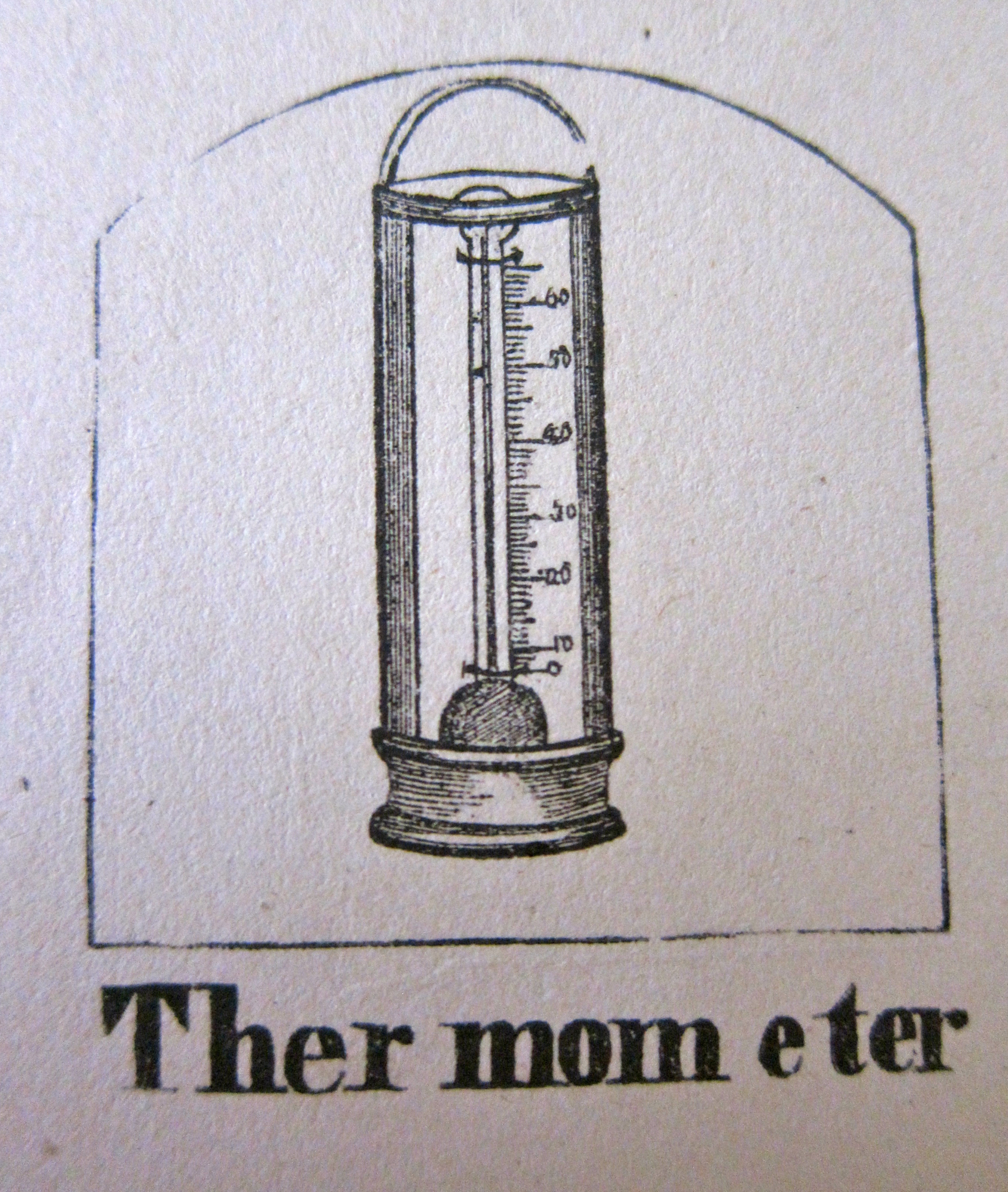
Thermometer

Sun Jan 5   Had to do my own housework to day and did not get

it done in season to go to church  Our Lazy boys did not

rise untill nearly nine Oclock.  No meeting this afternoon

Mr Whitwell attended the funeral of Asa Howards child

Mrs McHanna came home in season to get tea.  Went

with S A to see Miss Eaton found her able to sit up 

most of the day.  She has a bad cough & is failing.

After I came back made a call in the other part of the house

There was no church for the Ames family today.  Without the help of their servant, Jane McHanna, Evelina had to get breakfast and dinner by herself, and didn’t finish the preparations in time to get to morning service at the meeting house.   Oakes Angier, Oliver (3) and Frank Morton, perhaps seizing a rare opportunity, slept late despite their mother’s evident disapproval. The afternoon service, which the family also usually attended, was cancelled.

Truth told, Evelina may have been grateful not to make the two mile ride to church. The weather that day, according to Old Oliver, continued “verry cold,” reported at 14 below zero by “the Mr Pools” who lived several miles south of the Ameses. The Pools would know; they manufactured thermometers. Jane McHanna, meanwhile, had to bear the cold on her drive back from Mansfield, returning to North Easton in time to prepare tea.

Despite the cold, Evelina and  Sarah Ames paid a visit to a sick woman in the neighborhood. Calling on the sick was something that Evelina and her sisters-in-law often did. Although there were doctors in town, there was no hospital, nor was there a habit of placing the seriously ill in a hospital.  People were taken care of at home, by family, friends, and townspeople like the Ames women.  Miss Eaton was suffering from tuberculosis or consumption, as it was known.  Evelina, Sarah Ames, and Sarah Witherell visited her often, taking food and helping the family with whom Miss Eaton was living.

Sarah Ames and Sarah Witherell are sisters-in-law.  Sarah Ames is married to Oakes’s brother Oliver, Jr.  Sarah Witherell is Oakes’s sister.  Both women are younger than Evelina; all three women live in close proximity.