May 14, 1851


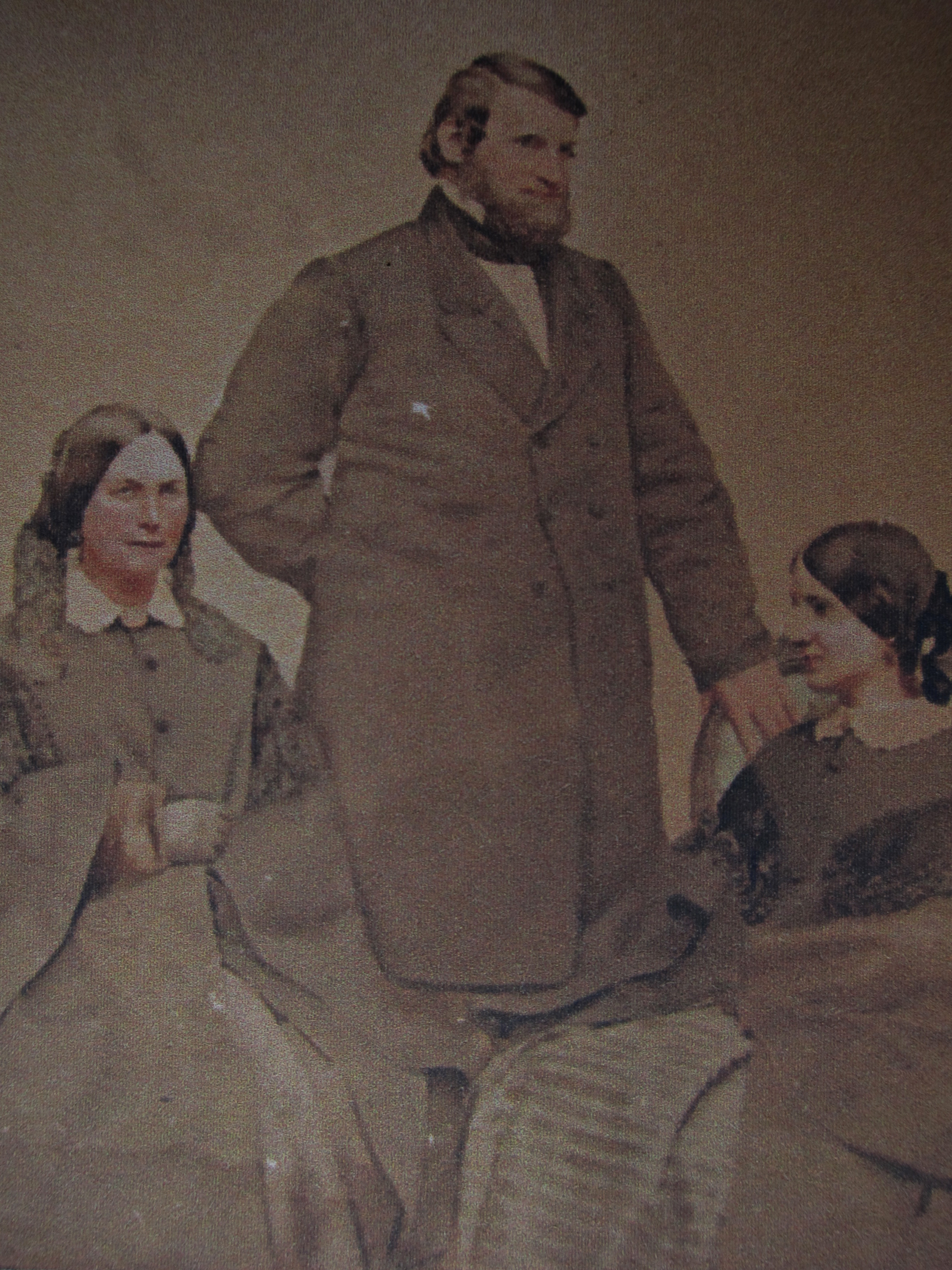
Evelina, Oakes and Susan Ames, ca. 1860 Archives at Stonehill College, Easton, Massachusetts

Evelina, Oakes and Susan Ames, ca. 1860
Archives at Stonehill College, Easton, Massachusetts

Wednesday May 14  Susans birth day and she has had a little

party.  Julia has been here to work on Orinthias

dresses.  Ellen Howard called this evening

came from Jasons. Mrs Holmes called a 

few moments this morning.  I have swept

and dusted the front chamber and taken the 

carpet from the stairs and painted them It

has been a confused day. Pleasant this afternoon

Augustus gone to Boston


Another interruptious day, filled by “confused” and overlapping events: Susie Ames’s birthday party, Julia Mahoney’s work on dresses for Orinthia Foss, calls from Ellen Howard and Harriet Holmes, the usual choring in the downstairs rooms, not to mention Evelina’s removing the carpet from the stairs and painting the treads. What commotion.

Susan Eveline Ames, the only daughter and youngest child of Evelina and Oakes Ames, turned nine years old today and was treated to a little party. Did she have friends over or was the party strictly en famille? Did she have cake? Ginger snaps? Presents? What was a nine-year-old’s birthday party like in 1851?

Born in 1842, Susie Ames came along several years after all her big brothers were born. From the beginning, she was raised differently from them. While they were slated to work, earn and provide, her education and training were oriented toward a future of domestic responsibilities. Like most girls of the time, she was brought up assuming that she would marry and raise a family. If she failed to marry, she would have to make her way as a spinster aunt living with one or more of her brothers, or become a schoolteacher like Orinthia Foss. Which route was hers?  Marriage.

On January 1, 1861, Susan married Henry W. French, a wool merchant. She was 18 years old; he was 27. For many years, the couple lived in the Ames house with her parents, and possibly looked after the house during the periods when congressman Oakes and Evelina were in Washington. For a time, Susan and Henry lived in their own home on Main Street, on the site where the Oakes Ames Memorial Hall came to be built circa 1880.

As Evelina moved into widowhood and grappled with illness and age, Susan looked after her. She and Henry never had any children, so the particulars of her story weren’t passed on to interested offspring. She only comes to life in her mother and brother Oliver’s journals.



May 13, 1851

dried-apples

*

Tues May 13  Mrs Witherell heat her oven and I baked

a loaf of brown bread & some cake & tarts with

her  Orinthia made some sifted dried apple pies

Mr Robinson here to paper the dark bedroom

chamber. Mr Pratt called this morning for Orinthia

to go to meet him & Brown for an examination

We went to Mr Pratts this afternoon and

called at Mr Whitwells


Mr. Robinson, all-purpose painter-and-paperer, was back at Evelina and Oakes’s house today to paper one of the bedrooms. It may be the one that Frank Morton Ames had to move out of some days ago while it was being refurbished.

Orinthia Foss, meanwhile, underwent some kind of scholastic examination.  Evidently, she was being considered to teach at the town’s public school system for which she had to undergo at least an interview.  Her interviewer was Amos Pratt, a former school teacher himself, and member of the Easton school superintending committee (the one on which Oakes Angier had hoped to serve, but had missed by one vote.)  Her other interviewer was Erastus Brown, a butcher by trade who also served on the school committee and taught. Not unlike today, some folks from 160 years ago had to pursue more than one trade to make ends meet. Pratt, who lived in the Furnace Village area of Easton, some miles south and west of North Easton, eventually gave up his teaching career to run a mill.

Before being escorted by Mr. Pratt to her interview, Orinthia helped Evelina and Sarah Witherell with baking.  Evelina made brown bread, cake and tarts; Orinthia made an unseasonal apple pie from dried apples. The apples were remnants of last fall’s harvest, and ordinarily Orinthia would have had to plump them up with hot water or cider or some other liquid in order to form the pie.  How the apples would have been “sifted” is a puzzle; did this mean that the apples were in powder form?  All you cooks out there: what is a sifted dried apple pie?

*jeremy.zawodny.com


May 12, 1851

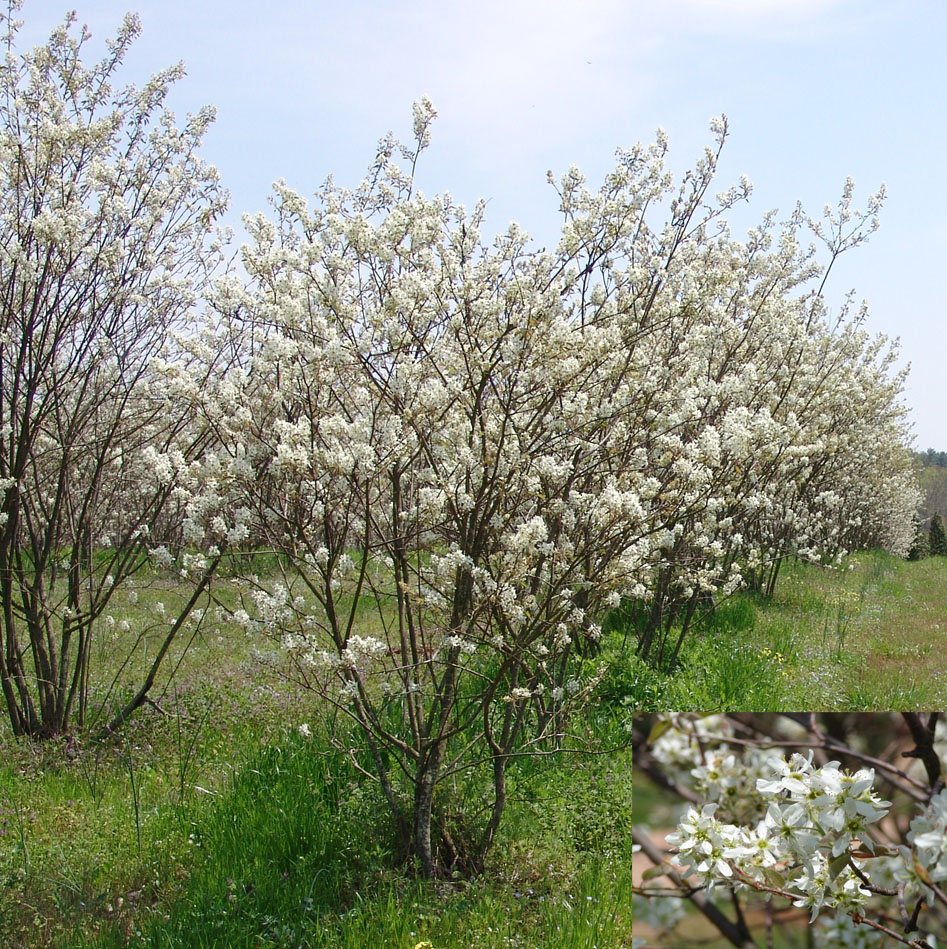
ServiceBerry1

Monday May 12th  Was about house all the forenoon but

cannot tell what doing  Jane has done the washing.

Orinthia washed the dishes for her. This afternoon

Orinthia and I have been out to plant the flower seeds

and I got some Shad berry & Burgundy Rose bushes

from Olivers & flowering Almonds from Alsons We 

were at work in the garden three or four hours

A sure sign of spring in New England is the blooming of the shadbush.  Because its little white flowers are among the earliest to be seen, its blossoms were often used at springtime funerals in the seventeenth, eighteenth and nineteenth centuries. Thus shadbush is also called the “serviceberry” bush for its appearance at funeral services; in some other locations it’s known as the “Juneberry” bush.  Wherever and whenever it grew, its presentation of blossoms was as welcome as the first robin.  The red berries it produced could be used in pies or, if not harvested, would be consumed by those same robins and other birds like cedar waxwings.

The shadberry bushes at Evelina’s were most likely planted out back behind the house near the Queset Brook, where they would tolerate the partial shade and indifferent soil.  However, the Burgundy Rose bushes that Evelina also obtained from her obliging brother-in-law, Oliver Jr., would have required a more selective location in the sun.  Were those roses planted right in Evelina’s flower beds?  Were they as red as their name sounds?

Her brother, Alson Gilmore, provided Evelina with flowering Almond bushes (Latin name is Prunus triloba.)  In contrast to the white serviceberry and the red roses, the flowering almonds produced pink blossoms.  Evelina was evidently aiming for a rosy spectrum in her yard. The flowering almonds like sun, so where might she have planted them?

The work of planting the various bushes took Evelina and Orinthia several hours to complete, and must have given them a real sense of accomplishment – not to mention sore backs.

May 11, 1851

photo

*

Sun May 11th  Have been to church this afternoon. Did

not feel like going in the morning It rained

this forenoon but cleared off quite pleasant

after dinner and after church Oakes A, Orinthia

and I called at Mothers, carried her a poplin

dress that I purchased in Boston.

Have not read any to day. Oakes Lavinia & Orinthia

called on Ann Pool

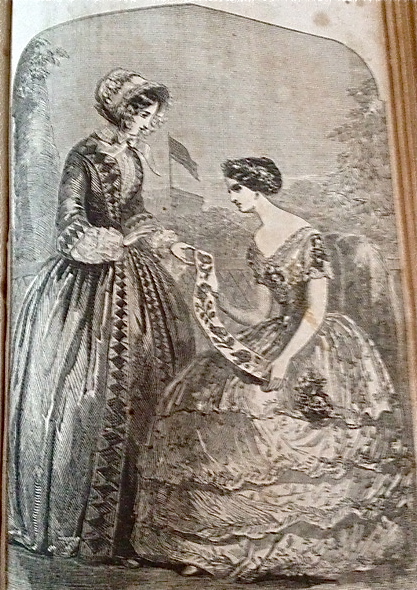
One item that Evelina brought back from Boston was a poplin dress – ready-made, presumably, or perhaps made to order – that she bought for her mother. It had to have been an item that her mother, an elderly country woman, would never have purchased for herself. Hannah Lothrop Gilmore had spent a lifetime sewing her own garments.  She was also unlikely to board a wagon or carriage to go into Boston to shop. The ride from the farmhouse to church on Sundays was about as adventurous as she got. How kind of Evelina to treat her mother in this extravagant way.

Poplin was a popular cotton fabric in the nineteenth century. It was smooth, lightweight and finely woven, more refined than broadcloth, although they were not dissimilar in weave. Both were sturdy and today both are often used for men’s shirts. The dress on the left in the illustration above was a day-dress and probably similar in shape and weight to the poplin dress Evelina bought, perhaps with less trim. The undersleeves were a particular feature of women’s dresses right before the Civil War.

The dress on the right was not something that Evelina would have purchased for her mother, or even for herself at this stage in her life. It was an evening dress with a stylish flounced skirt that would have been entirely too “jeune fille” for old Mrs. Gilmore.

* Spring fashions from Godey’s Lady’s Book, 1851


May 10, 1851

7411thumb2

Sat May 10th  My bonnet does not fit me at all.  Mr Ames

called to see if they would take it back & make

me another I shall have another journey into

Boston for a bonnet. I have not felt like

doing much to day and never do after being

in Boston. Orinthia came home to night in

fine spirits. feels rather better satisfied with

her purchases that I do. The weather tolerably pleasant.

The bonnet that Evelina ordered from Alfred Remick & Company in Boston didn’t fit, so Evelina asked her husband Oakes to return it for her while he was in Boston.  He always went into the city on business on Saturdays.  The idea of Oakes Ames, a tall, large-chested man with a charismatic but somewhat rough-hewn manner, standing at a millinery counter negotiating the fine points of his wife’s headware, is a mental image to be treasured. This man, who could build shovels, advise a president, and imagine a continental railroad, could also cajole a store clerk and convince him or her to take back the hat his wife just bought. Oakes Ames was a force to be reckoned with, a force who also loved his wife.

Evelina, having dispensed her husband on that important errand, puttered around the house in desultory fashion as she was wont to do after a trip to Boston.  Schoolteacher and boarder Orinthia Foss returned to the house from the city happy and light-hearted, pleased with her shopping.  She must have brightened Evelina’s flagging spirits – or made her more disappointed with her own acquisitions.

May 9, 1851

champney2-thumb

*

May 9th Friday  Went out shopping about eight Oclock

and at ten met Mrs George Ames at Mr Daniels

She walked around with me looking for a dress

and other things, likewise met Abby & her cousins

and about 5 Oclock came across Orinthia She

said she should certainly be at home, but missed

of the cars. Mrs Ames left at half past 5 for N.Y.

with Mr Peckham. Returned home much fatigued


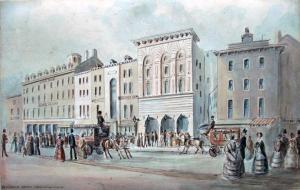
In Boston, stores opened so early that Evelina could start shopping at eight in the morning. She had ordered a bonnet the day before which she was able to pick up later in the day, so today’s shopping was more leisurely. She and her cousin-in-law, Almira Ames, stepped along “looking for a dress and other things.”  They probably walked along Washington Street and its side streets. Others from Easton were in town, too: her niece Abby Torrey and her own boarder, Orinthia Foss. The women were breaking out of their little town to find goods in the big city. The weather must have been especially cooperative.

Evelina finally returned to Easton “much fatigued.” Almira Ames, meanwhile, left for New York accompanied by the head clerk for O. Ames & Sons, John Peckham. They would have traveled by stagecoach or train from Boston or Stoughton. They were not running off together.  Rather, Mr. Peckham had shovel business in the city and, like a gentleman, accompanied the Widow Ames on what otherwise would have been a solo journey for each of them. Presumably, Almira lived in New York at this point in her life, although previously, she had lived in North Easton.


*Benjamin Champney (1817-1901), New Boston Theater, Washington Street, 1850

WC GC031/Benjamin Champney Watercolors Collection, Princeton University Library


May 8, 1851


image


Thursday May 8  Went to Boston and walked around

all day trying to find a bonnet but could not get

one to fit me ready made. Engaged to have one

made of blue plaid silk at Alfred Remick & Co.

Went with Oakes Angier to call on Mrs Stevens

She spent the night with me at Mr Orrs

Julia was at home and a Miss Orr a cousin or hers,

was there & Miss Foule dress making


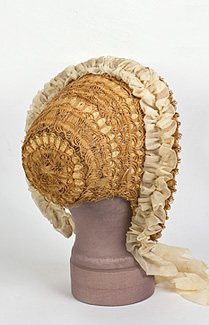
Evelina left off gardening today to go bonnet-hunting in Boston, for it was the season to switch from winter to summer headware.  She searched from store to store and must have visited a range of establishments running from small millinery shops to larger dry goods stores.  She would have seen bonnets displayed on mannequin heads such as the one in the illustration above.  Try as she might, however, she couldn’t find one she liked, so she ordered one instead.

Alfred Remick & Co was one of many dry goods merchants in the city. In 1851, Boston was a premiere center for the dry goods trade, according to the Boston Board of Trade, which reported years later that “according to our extensive New England domestic manufactures, Boston was from 1830 to 1850 the chief Dry Goods market of the country.” * Boston had lost that dominance by the outbreak of the Civil War and, with the ongoing and rapid settlement of the west, the competitive reach of rail freight traffic, and the impetus to widespread manufacturing brought on by the war, Boston never regained its preeminence.

Such concerns were not in Evelina’s mind, however, because she needed a new bonnet and couldn’t find one. After finally placing her order, she and Oakes Angier, the eldest son who carried her into town, called on a family friend, Mrs. Stevens.  As usual when staying in Boston, Evelina spent the night at the Orrs’ house.

*Annual Report of the Boston Board of Trade, Merchants Exchange, 1881, Vol. 128

May 7, 1851

Thread

Wednesday May 7th  Orinthia went to Boston this morning

with Abby Torrey after she left I went into Olivers

on an errand and stopt a long while as I am

sure to do when I ought not and then went into the

other part of the house to bid Mrs Stetson good

by (as Mrs S Ames and Frank went with her to Bridgewater)

and Mrs Lincoln Drake rode up and saw me by

the window and I was obliged to see her, thus the day passed

and I accomplished very little Went with Mrs Witherell

to the sewing circle at Daniel Clarkes


The Sewing Circle held its monthly meeting today, this time at the home of Daniel and Elvira Clark.  Roughly contemporary in age to Oakes and Evelina, the Clarks were members of the Unitarian Church.  Daniel was a carpenter who occasionally did work for the Ames family. Elvira, like Evelina, was a housewife with teenaged children.  She and Evelina visited together last Sunday during the intermission between sermons.

So much socializing went on today that Evelina had to chastise herself – “I am sure to do what I ought not” – when she spent too much time next door visiting her sister-in-law, Sarah Lothrop Ames. Sarah must have been feeling better; although she didn’t go with Evelina and Sarah Witherell to the Sewing Circle, she had improved enough not only to have a good, long chat with Evelina, but also to have an outing to Bridgewater, which she was “carried to” by her nephew Frank Morton Ames.

Evelina stopped in at Sarah Witherell’s to say goodbye to Mrs. Stetson, a friend of the family who was departing for Bridgewater, too. She then was spotted by Caroline Torrey Drake, a friend who stopped in for a visit. Mrs. Drake, a woman in her early fifties, was the mother of eight children: five girls followed by three boys.  Her first child was born when she was 20, her last child when she was 45.  Now that’s childbearing!


May 6, 1851

sweet-peas

*

May 6th Tuesday  Orinthia & I went into the flower garden

and worked some time on the beds but the

ground was very wet as it rained last night.

Robinson has painted the bedroom up stairs

over the first time. This afternoon we planted

some sweet peas and have got the beds ready for

the seeds Had Mr Swain to dine with us

Orinthia finished her school Saturday […]


Mr. Robinson was back doing work for Evelina.  He was the handyman who, earlier in the year, had spilled varnish on the parlor carpet and taken too long to paint the mantels. Either he was an affable favorite of the family or his price was right, or both, for he was back at the Ames’s, this time painting an upstairs bedroom.  Jane McHanna must have been at work, too, keeping busy with meals and chores while she waited for the sun to dry yesterday’s wash. John Swain, the new clerk at O. Ames & Sons, came for dinner.

Despite the wet ground, Evelina and Orinthia, the young teacher who had become her friend, planted sweet peas and worked the ground for seeds yet to come. Sweet peas were a popular flower in the 19th century; John Keats praised them in a stanza of his 1817 poem “I stood tip-toe upon a little hill:”

Here are sweet-peas, on tip-toe for a flight:

With wings of gentle flush o’er delicate white,

And taper fingers catching at all things,

To bind them all about with tiny rings.

The flowers were fragrant, delicate-looking but hardy, and slow to germinate.  Evelina and Orinthia probably placed them in a sunny spot in the beds. Did they need a trellis? Did the ladies wear gloves as they worked, or did they just dig into the dirt? Evelina, at least, probably wore some kind of protection, as she wasn’t at all fond of chaffing her hands.


*sweetpeas, landlund.com

May 5, 1851

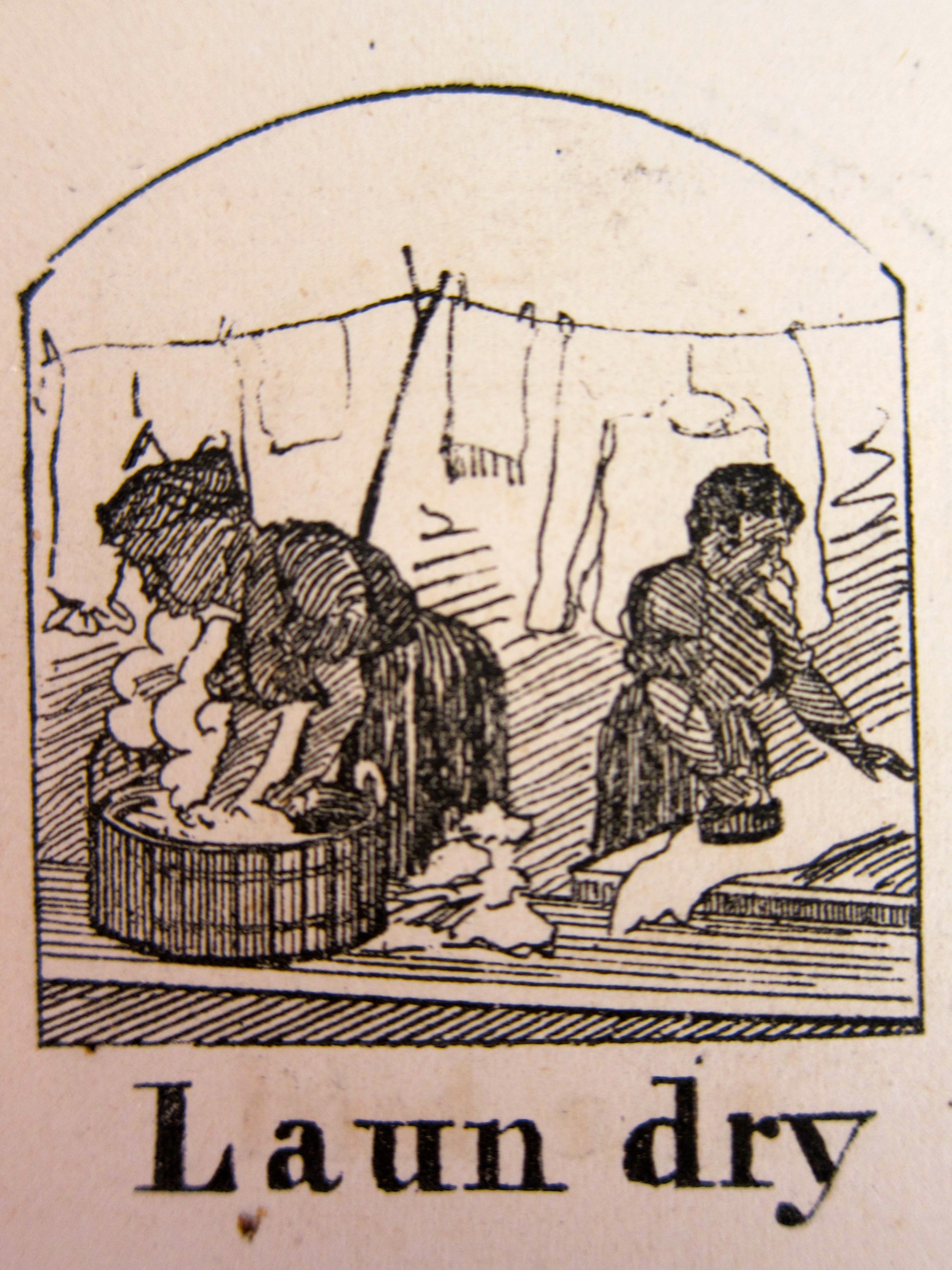
Laundry


Monday May 5th  Made some sponge cake this morning

& swept & dusted rather more than usual Jane washed

the clothes and put them out without rinsing & let

the hard rain come on them. Has been a driving

storm all the […] day Mrs Stetson & Mrs

George [Ames] were here to tea Harriet was taken sick

and went to bed. Charles Mitchell came to see

her in the stage[…]

Jane McHanna had an idea this morning.  If nature was going to keep throwing stormy weather at her on Laundry Day, she’d make it work for her rather than against her. Instead of rinsing them herself, she hung those towels, shirts and all else outside and let the rain rinse the suds off. The “hard rain” saved her some tub time, although hanging those heavy clothes with the suds still on them couldn’t have been easy work.

Meanwhile, Evelina stayed indoors sweeping, dusting and doing some light baking.  Instead of firing up the brick oven, she probably baked her sponge cake right in a tin stove that she most likely had in her kitchen.

Sponge cake was a dessert whose recipe the Puritans brought over from England.  In western cooking, it was one of the earliest iterations of a yeastless batter. Mary Peabody Mann wrote in her 1858 cookbook, Christianity in the Kitchen, that sponge cake “if made right, is the least injurious of any form of cake, because it contains no butter.”  She cautioned, however, that “it is very difficult to make it good.  Eggs must be perfectly fresh, in the first place. They should be kept in cold water the night previous, and the whites should be beaten in a cool place, separately, and to a thick froth, with a cork stuck cross-wise upon a fork, and without stopping once.” Sarah Josepha Hale, meanwhile, in her 1841 The Good Housekeeper, offered her own admonishment that cakes, “those tempting but pernicious delicacies [,are]…to be partaken of as a luxury.”

The man who called on the ailing Harriett Ames Mitchell was her brother-in-law, Charles, who had once lived with Harriett and Asa in Cambridge, before they moved to western Pennsylvania. Charles, younger by several years, was a good friend of the family. Mrs. Stetson was also a friend of the family and Almira Ames was a cousin. Everyone sipped tea while rain fell on the roof, the road, the garden and the white, wet laundry.