April 12, 1851

City

1851

April 12 Saturday  Went to Boston with Mr Ames. Have 

purchased a carpet & paper for the dark bedroom,

bought Susan a dark french print & borage

DeLaine Bible &c &c dined at Mr Orrs no one

at home but Mrs Orr & Mr Norris.  All gone to East

Bridgewater Mrs George Ames returned from 

New York with Mr Peckham Snowed a

little this morning but otherwise pleasant.


Oakes Ames made his usual Saturday trip to Boston and took a happy Evelina with him. It was the first time she had been to the city since January 17, and she didn’t seem to mind a light snow at the start of her journey. After three months in the country, she was excited to be in town, gazing at cobblestones, masonry, store fronts, and being part of the bustle of carriages and pedestrians.  Time to do some shopping.

She found some fabric for dresses for Susan. She bought a Bible. For whom? Why? With purpose and forethought, she selected new carpet and wall paper for at least one of the bedrooms at home that she and Jane had emptied out the day before. The carpet and wall paper, and more perhaps, would surely be delivered to North Easton rather than carried home.

As she had before, Evelina and Oakes, presumably, dined with their long-time friends, the Orrs, whose family, like theirs, had originally settled in Bridgewater. Evelina often stayed with the Orrs, but today she and Oakes only dined with Melinda Orr (Mrs. Robert Orr) and her son-in-law, Caleb Norris.

Today also marked a return visit to Easton by Almira Ames, widow of Old Oliver’s nephew George. She was a first cousin by marriage to Oakes, Oliver Jr., and Sarah Witherell and was used to visiting North Easton. In fact, she had spent enough time in North Easton to be listed in the 1850 census as living in the Ames household. In 1851, however, Almira seemed to be living in New York City. She was something of a favorite relative among the Ames women.


April 11, 1851

Old Oliver Ames


1851

April 11th Friday.  This morning sat down with Lavinia

quite early but did not feel very well.  Washed & ironed

the skirt of my foullard silk dress ready to make 

over  This afternoon went with Lavinia into school 

and then to Mr Torreys and stoped a hour or two

Abby & Malvina came home with us and were here to

tea also Augustus  Quite windy this forenoon 

Oliver Ames, known to Evelina as “Father Ames” and to us as “Old Oliver,” turned 72 today. He didn’t mention his birthday in his journal and the likelihood is that no one else mentioned it either.  He was not a person who encouraged frivolity. As the man who built O. Ames & Sons and made the best American shovels of the 19th century, Old Oliver was well known in his time, as this excerpt from a 19th century biographical sketch shows:

“Hon. Oliver Ames, the founder of the great manufacturing firm of O. Ames & Sons, was born at Plymouth, Mass., April 11, 1779, being the youngest son of Capt. John and Susannah Ames, and was a lineal descendant of William Ames, who came to this country in 1638 and settled in Braintree, Mass. His early education was gained by ordinary common-school instruction, and by the practical experiences of hard work in his father’s blacksmith-shop. These furnished him the groundwork of sober judgment, industrious habits, and a stable and energetic character. At the age of eighteen he went to Springfield, where he learned the trade of gunsmith. In April, 1803, he married Susannah Angier […] and commenced the manufacture of shovels. After a stay of over two years at Easton, he removed to Plymouth to manufacture shovels for Messrs. Russell, Davis & Co. […] until about 1813, when he returned to Easton […where he] had purchased land and a good water-privilege, and had begun the erection of a dwelling-house.

He was one of a company to build a cotton-factory for the manufacture of cotton fabrics. He had manufactured hoes and shovels during his first stay in Easton, but on his second arrival he began again the business that has now become world-famed. Difficulties and embarrassments that would have defeated any one but a man of great ability and persistent energy beset him in these early days. The cotton-factory burned; the war of 1812 had had a disastrous effect upon business; he was endeavoring to restore the business of his father to a prosperous condition; and he had made great outlays in getting established at Easton. But his credit was good and his courage strong; his character and ability alike inspired unlimited confidence; and he worked steadily on to a sure and lasting success.

With only a humble beginning, shovels being made by hand and carried to market upon a one-horse wagon, the business steadily increased, shop being added to shop, workmen increasing by scores, until it has become by far the largest and most prosperous shovel business in the world. He would never allow any work to be sent to the market that was imperfect, and he thus laid the foundation for the great reputation which the Ames shovel has borne, and which it continues to bear.

In 1828-29 he represented his town in the Massachusetts Legislature, serving with marked ability upon the Committee on Manufactures. In 1845 he was elected, contrary to his desires, and by a large vote, to the Massachusetts Senate. He was, however, no lover of office, and desired only that he might have the charge of the highways of his town intrusted to him, a charge he took pride in, and faithfully fulfilled. He was a man of strong and resolute will, of great force of character, indomitable energy, and persevering industry. He was the possessor of a splendid physique, and easily bore off the palm in all feats of strength and skill, especially in wrestling, of which he was very fond. His manly and dignified bearing gave everyone who saw him the impression that they looked upon a man of mark. He was such a man as a stranger, meeting upon the street, would turn to look at a second time. Born of the people, he was always very simple in his tastes and democratic in his feelings and principles. In his likes and dislikes he was equally decided, but his judgments were based upon what he believed to be the real worth of any one, without reference to his station or condition.   He was consequently greatly respected and beloved by his neighbors and fellow-townsmen. He was enthusiastically fond of farming, and, like Daniel Webster, was especially fond of the oxen, always obtaining the best, and taking great pleasure in their management. He took an early stand, both as a matter of principle and practice, in favor of temperance, and brought up his family according to total abstinence principles. He was a decided Unitarian in his religious convictions, having a cordial dislike to the rigid tenets of the Calvinism of his day. He was liberal in his aid of religious institutions, to which he also gave the sanction of his personal attendance. His charities were large, and they were not bounded by the limits of his sect or neighborhood. His defects were such as pertained merely to his limited culture and to the stern conflict and discipline of his early life. Mr. Ames lived to the ripe old age of eighty-four years, dying at North Easton, Sept.11, 1863.”*

*Duane Hamilton Hall, ed., History of Bristol County, Massachusetts,Vol.2, Philadelphia, 1883
 

April 10, 1851


photo

1851

April 10th Thursday  This day is Fast but no one would

think it by the way I have spent it.  I have

moved the bed from the dark bedroom and 

put it in Franks chamber and moved his

cot into Oakes & Olivers chamber for a few

weeks Oakes A Lavinia Orinthia & Susan went

over to the Methodist meeting house to a sing & called

on Ellen H took her with them.  Weather Pleasant

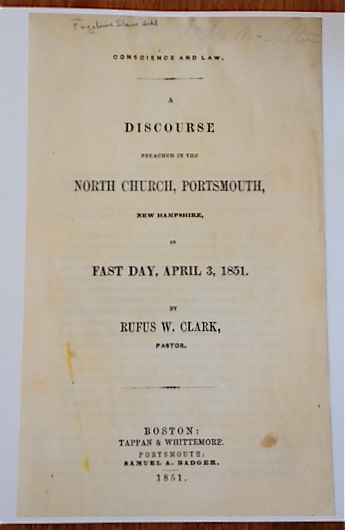
For nearly 275 years, Fast Day was a published holiday in Massachusetts and other New England states (like New Hampshire, above, which celebrated Fast Day on April 3.)   A religious practice brought over from England by the Puritans, the original Fast Days were pious rites of repentance and supplication marked by abstinence and day-long prayer in church, “a day set apart that all might join in the prayer to the Almighty for strength and wisdom”.*  Any calamity, misfortune, drought or disease, regardless of season, might prompt a church leader to call for fasting.

Dating from about 1622, the earliest Fast Days were under the purview of the local clergy, but the practice eventually became widespread enough to become the domain of the state governments.  And where once they were observed on an ad hoc basis as the need for divine intervention arose, Fast Days gradually became a single, annual holiday, usually observed in early April right before spring planting. Over the years, it became a more secular observance and by the latter part of the 19th century, “Not much fasting is done and less praying.”*  In 1894, the governor of Masschusetts abolished the practice of Fast Day and substituted a new holiday, “Patriots’ Day,” in honor of the 1775 Battles of Lexington and Concord and the anniversary of the first bloodshed of the Civil War at a skirmish in which four Massachusetts militiamen died.

Evelina’s entry in her diary proves that Fast Day was anything but a day of prayer and supplication at the Ames’s. Instead, this temperate day in early April marked the start of spring cleaning. Evelina and Jane and perhaps others began upstairs, moving furniture around in order to clean and refurbish two or three of the bedrooms. Much would be disrupted before they were through.

The temporary upshot was that Frank Morton Ames moved into the bedroom shared by his two older brothers. This rearrangement of their sleeping quarters brought the three brothers together in dormitory fashion, yet each maintained his own personal agenda. Tonight, Oakes Angier headed out to a sing at the Methodist meeting house right in the village, taking along a small coterie of females: Cousin Lavinia, sister Susie, the boarding teacher, Orinthia and their mutual friend, Ellen Howard.  Spring was in full swing.


*New York Times, April 20, 1896


April 9, 1851

Wagon

1851

April 9th Wednesday  This day has been a busy one but I can

scarcely tell what I have done but have been about

many things.  Lavinia came this afternoon with her

father He was going to North Bridgewater and

came this way to bring her.  They were here […]

to tea They have all gone to the assembly to

night at Lothrops Hall I believe it is the last

dance for the present A[u]gustus gone to Boston. Pleasant

We all have days that zoom by unaccountably; we get to the end of them and wonder what we did.  Evelina had one of those days today; she could “scarcely tell” how she passed the time.  She probably dealt with various household chores: mending, sweeping, overseeing Jane McHanna, perhaps stirring something on the stove or straightening up a clutter of periodicals in the sitting room.  With three sons and a daughter under her roof, she certainly passed part of the day tending to their needs and conversing with them over small matters. She saw her husband out the door and perhaps urged him not to forget to come home for tea. She may have popped next door to check on Sarah Lothrop Ames, who remained ill in bed.

Her niece Lavinia Gilmore stopped over, having been carried from the Gilmore farm to the village by her father, Alson Gilmore. Did they travel in a farm wagon or a carriage? After tea, Lavinia and her male cousins went to the dance at Lothrop Hall, the last of the season.  Formal socializing for the young set would have to wait until next fall.


April 8, 1851

images-3

1851

April 8th Tuesday  Have been looking over some of Susans

clothes for summer mended & let the tucks down

to her skirts & finished the shirt for Mr Ames

that was cut out a week ago Monday.  Ironed

some collars cuffs &c.  This afternoon have had

a powerful rain  Jane has starched her fine

clothes and got them ready for Ironing and has

ironed some of the coarse clothes

Tucks are pleats. They were sewn into little girls’s dresses by design so that the dresses could be let out as the girls grew taller. Tucking was preferable to lengthening the hems because pleats required less fabric, were easier to put in and take out, and less obvious when changed.  The object of the whole exercise was to make the dresses last as long as possible.

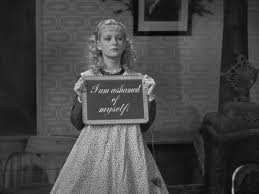
Anyone who has read Little Women or seen the 1933 film version of Louisa May Alcott’s classic tale of the March family will probably recognize the image of Amy March (played here by Joan Bennett). In this scene Amy is being punished by her schoolteacher for bringing pickled limes to class. She is so mortified that she never returns to the school again. The only worse “deggerradation”  she can imagine would be having her clothes shortened by tucking: “Mother doesn’t take tucks in my dresses whenever I’m naughty, as Maria Parks’s mother does […] it’s really dreadful, for sometimes she is so bad her frock is up to her knees and she can’t come to school.”

Most young girls had tucks in their dresses, whether they were the fictional Amy March or the bona fide Susie Ames. And so today, as Evelina got Susie’s summer wardrobe in order, she “let the tucks down” to accommodate her daughter’s new height.  There’s no instance of her taking the tucks back up in order to punish Susie when she was naughty.

This image of Amy March also illustrates the aprons or shifts that little girls wore over their dresses to protect the outfits from soiling.


April 7, 1851

large-1060

“Dress – The Maker” illustration from Godeys, 1851

1851

April 7 Monday  Have had a dress maker to work for Susan

She has cut a new waist to her gingham and fitted

the waist of a light purple dress  I think she has

done very well for Irish.  She appears to be a pleasant 

girl  This evening Orinthia and I have been to Mr

Barrows & Torreys to make a call.  Abby was

very lively & has improved very much in her appearance

within a year or two


After weeks of sewing shirts and mending coats for the men of the family, Evelina turned her attention to outfitting her daughter who, at nearly nine years old, had probably outgrown the previous year’s dresses.  It was time to rework Susie’s old dresses and perhaps make some new.  For this task, Evelina brought in help: a new, young dressmaker named Julia Mahoney.

Like many young women in the village of North Easton, Julia was Irish.  Like many of the older women in the village, Evelina held the Irish in some disdain.  Without necessarily meaning to be unkind, but clearly feeling some superiority, Evelina expressed her prejudice in a backhanded compliment of surprise at Julia’s fine work and pleasant demeanor.  Julia did “very well for Irish.”

Evelina had imbibed some of the Yankee resentment against the Irish immigrants who had moved into Massachusetts, and elsewhere, so rapidly and in such numbers.  While her husband Oakes seemed free from the prejudice, other Ameses, particularly Old Oliver, were not.  His displeasure with the Irish employees at the shovel shop was legendary and the bias came through at home as well.  The old Yankee ways were threatened by the new foreign residents, and antipathy thrived accordingly.

April 6, 1851


800px-Martin_W._Carr_School_-_Somerville,_MA_-_DSC03412

*

1851

April 6 Sunday.  Have been to meeting all day, and 

as usual heard two excellent sermons from

Mr Whitwell.  It rained very hard while

we were going and has rained fast all day.

Edwin called after meeting & Martin Carr &

a Mr Davenport from Attleborough.  Oakes & Oliver

called at Mr Bisbees with them

The Ames family went to both church services today and, as Evelina had come to expect, heard “two excellent sermons” from Rev. Whitwell. Despite the rain, the Ameses had visitors this afternoon. Friends of Oakes Angier and Oliver (3) called: cousin Edwin Williams Gilmore, and friend Martin Carr, who brought a Mr. Davenport with him. The young men all went out together.

Martin W. Carr was the son of “Uncle Caleb” Carr, a long-time employee of the shovel shop, and brother of Lewis Carr, the young man who died back in January from consumption. The family was descended from Robert Carr, an early governor of Rhode Island.

Martin would find his own claim to fame.  A jeweler by profession, he went on to found M. W. Carr and Company, maker of knick-knacks and souvenirs, including “gold and silver jewelry, hairpins, belt and shoe buckles, button hooks and garter belts […] matchbooks, cigarette cases, ashtrays, hatpin holders, letter openers, souvenir spoons, ink stands, magnifying glasses, lamp shades, bud vases, napkin rings and trays with imprints of the homes of American authors such as Emerson, Longfellow and Hawthorne.”**  The factory was a mainstay of Davis Square in the City of Somerville, and Carr himself a prominent citizen involved in many civic activities.  The city honored him in 1898 by naming an elementary school after him. The Easton boy made good.

* Martin W. Carr School, 1898, Somerville, Massachusetts, National Register of Historic Places, now condos.

**Somerville Journal, 1894/Coldwell Banker

April 5, 1851

Store

1851

April 5th  Saturday  Was choring about the house an

hour or two this morning and then went to sewing

on a shirt for Mr Ames.  Mrs S Ames is quite

sick to day has not been able to sit up much.

This afternoon called to see her but did not stay

long as Mrs Connors came to get some butter.  I then

went to the store & got Susan a dark print dress.

Have returned it again.

Sarah Lothrop Ames was sick today; perhaps she caught Evelina’s cold of the week before.  Evelina went to sit with her but was called home to parcel out some butter to a Mrs. Connors.  Although we never hear of Evelina or Jane McHanna churning it, Evelina evidently made household money through the sale of butter. The making of butter was probably one more chore on Jane’s plate.

The Ameses didn’t just sell butter, or just make shovels, for that matter. They also ran a dry goods and general mercantile store in the village, as we have mentioned before. Evelina sometimes shopped there, although it’s uncertain whether or not she had to pay for items she selected.  Today she found a dress for her daughter that she took home and then promptly returned.   Did Susie try the dress on only to find that it was too small?  Or did Evelina want to examine the dress to see how it was made?  And once having captured the overall style and pattern, did she return it?  Had Evelina already determined that she wasn’t going to keep it? Was she, perhaps, treating the store a little bit like a personal closet?

This was a period, too, when “ready-made” clothes were barely on the market. What was this little dress?  Was someone in the village making dresses and selling them there?

April 4, 1851

fc63da74a7d83ab723f4be9af9db4c70

1851

April 4th

Friday  Have been working about house this forenoon

Gave my parlour a thorough sweeping & bedroom

& stairs &c  Have not been at all well and had

hard work to sweep.  Jane finished the ironing

We have had a hard weeks work  This afternoon

I mended the stockings  Called at Olivers awhile

Mrs Peckham called here.  Very Pleasant

Evelina was feeling the effects of a laborious week of domestic duties. Over the past several days, she and Jane McHanna had really turned to in the kitchen, preserving a pig, trying lard, making sausage and doing the bi-weekly baking. On top of that the women had seen to their regular chores, which included ironing and sweeping the rooms free of the spring dust. Evelina managed all this while recovering from the cold of the weekend before. Sitting down to do some mending must have felt good.

She found some compensation by briefly visiting her sister-in-law, Sarah Ames, next door. And at home, Susan Peckham came to call. Mrs. Peckham was the wife of John Peckham, the Ames’s head clerk and bookkeeper. What was the purpose of her call? Susan may simply have desired to be sociable, or she may have had something she needed to communicate. At a time when today’s instantaneous ability to telephone or text someone was unimagined, even the simplest request or slightest inclination to talk to a friend, a relative, or, in this case, the boss’s wife took time and effort. Susan Peckham, whatever her purpose was, had only two options open to her: writing Evelina a note, or calling on her.  She chose the latter.

What might the women have discussed?  Evelina didn’t say.


April 3, 1851

pork-pie_2180207b

1851

April 3  This morning went quite early to baking in the brick

oven made mince & dried apple pies two custards brown

bread three large pork pies & ginger snaps. Alson here

to dine.  Henrietta & the two little girls dined at Mr Torreys

& were all here to tea  This Evening we all went to the 

dancing school.  Mr Whitwell called a few minutes

this afternoon & Mrs S Ames  Quite Pleasant

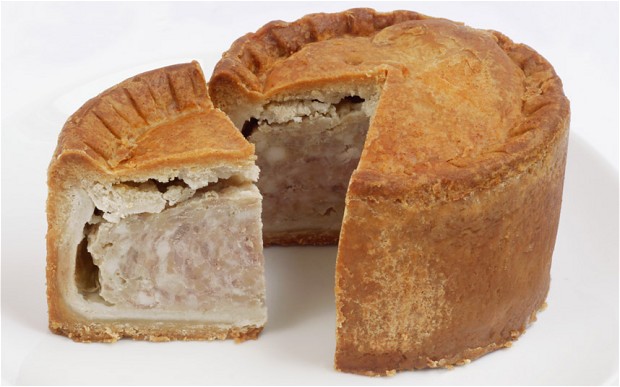
Small wonder that pork pies were on the menu, after Evelina and Jane McHanna spent all of yesterday processing a freshly-“kild” pig. Once again in the kitchen with her apron on, Evelina turned today to baking. As usual, she baked a large quantity of goods in the brick oven that she shared with her sister-in-law, Sarah Witherell. About every ten days or two weeks – or every fortnight, as they might describe it – one or both women would bake up a storm of pies, cakes, bread and cookies, enough to last until the next big baking.

Mince meat pies, brown bread and ginger snaps regularly featured in Evelina’s baking. These are the first pork pies to appear, however.  New, too, are the dried apple pies. Gone by now are the apples in the barrel that was delivered in January from the Gilmore farm, the one that was kept locked in the cellar so that the sons of the house wouldn’t eat up the fruit. Any apples that remained were from a group that must have been dried the previous fall for just this purpose, to provide a little fruit in an otherwise barren season.  By this time of year, housewives had to rely on preserves and dried fruit for variety in the family diet.

The Ames had company for tea: another sister-in-law, Henrietta Gilmore, and her two youngest children, little Henrietta and little Helen, made a rare visit from the Gilmore farm. These two youngest nieces of Evelina are about the same age as little Susie, yet they don’t get much mention in the diary.  They probably lived too far away for regular play time. Mr. Whitwell, the highly-regarded Unitarian minister, paid a call today, too.  Pleasant spring weather was bringing people out of the houses to visit.