April 25, 1852.

Lilac_bush-2edq3ho

Sunday April 25th  A very pleasant day and have

all been to meeting.  Came home at noon

with Hannah & sister and Susan, all returned

in the afternoon.  After meeting called at

Olivers to see Mr & Mrs A Lothrop and rode to

Mr Manley to speak for some plants

Augustus & Hannah rode with us as far as

Mr Swains  Emily & Susan went also to Mr Manlys

Lilacs, a fragrant favorite for gardeners and civilians alike, were among the plants that Evelina selected at Edwin Manley’s today. In the 19th century, many a New England farmhouse featured lilacs close to the door, as American poet Walt Whitman famously describes in When Lilacs Last in the Dooryard bloom’d, his elegy for Abraham Lincoln:

…In the dooryard fronting an old farm-house near the white-wash’d palings,

Stands the lilac bush tall-growing with heart-shaped leaves of rich green,

With many a pointed blossom rising delicate, with the perfume strong I love,

With every leaf a miracle – and from this bush in the dooryard,

With delicate-color’d blossoms and heart-shaped leaves of rich green,

A sprig with its flower I break…

Today after church, the sermons and small social obligations dispensed with, Evelina thought about her flower beds. The day was “fair” and “some warmer,”* so with niece Sarah Emily Witherell and daughter Susan Eveline Ames, she rode up to visit her go-to gardener “to speak for some plants.”  Mr. Manley indicated he would bring the plants by the next day.  Evelina wouldn’t have been able to plant anything today, it being the Sabbath, but she could imagine where she would put the plants, and how they would look, the anticipation of which added to her delight.

*Oliver Ames, Journal, Stonehill College Archives, Arnold Tofias Collection


April 24, 1852

7841216_6_l

Sat 1852

April 24  Mrs Ames returned last night I came

from Boston to night.  Like my things pretty well

have bought me some bronze candelabras

drugget a lot of gentlemans hose &c &c

Got through with my shopping about three

and went to Mr Orrs.  Lucia Harris is

there Mrs Witherell & Ames came to see my

things in the evening

The bronze candleabras that Evelina bought in Boston today were purchased, in all likelihood, for the parlor. They were a formal throwback to the time when candles were used for lighting, which was the period that began when the Pilgrims first arrived and lasted to the early part of the 19th century.  By 1852, however, oil lamps and very soon, kerosene lamps, were becoming standard fare for lighting. They were more economical than candles.

Burning candles, then, was something of a “retro” effort that honored the grace and warmth of the familiar candlestick, and suggested that the homeowner had enough money to burn candles if he so chose. No smudgy little whale oil lamp for the parlor or the dinner table, though oil lamps of varying styles and efficiency might operate in the rest of the house. In the room in which company was entertained, the candleabras would glow, and brag.

Both sisters-in-law came over at the end of the day to see what Evelina had bought, and it’s hard to imagine they were interested in the “gentlemans hose &c.” They came over to check out the new candleabras.

April 23, 1852

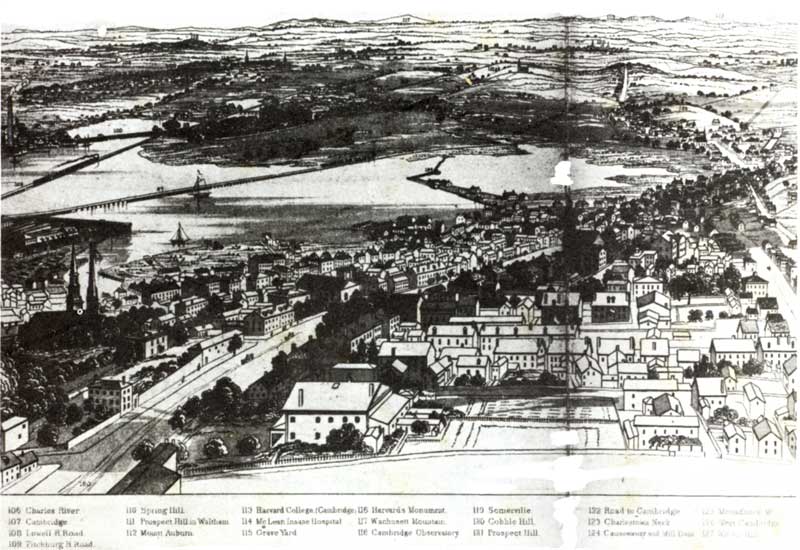
Boston, early 1850s, partial panoramic view

 Partial view of Boston and Cambridge from the Bunker Hill Monument, early 1850s*

1852

Friday April 23d  Went to Boston with Mrs S Ames

Called on Mrs Stevens did not stop with

her more than 15 minutes. Went to Mr Orrs

at night  Julia is there with her babe she

grows nicely and Julia is quite smart

I was about a great deal and was very

much fatigued but had a good […]

comfortable day

Evelina had not been out of Easton for more than two months.  Her last trip to Boston had been in the middle of February, when she’d traveled in with her son Oliver (3) and shopped for prints for the parlor.  That was before the fire at the shovel shop. With so much time having elapsed, she must have been eager to get to the city again.

She traveled into town with her sister-in-law, Sarah Lothrop Ames. They may have called together on family friend Mrs. Stevens, but they likely went their own ways afterwards. As usual, Evelina stayed with the family of Robert and Melinda Orr, where she visited their daughter Julianne Orr Harris (Mrs. Benjamin Winslow Harris) and her new baby, Mary, at whose birth Evelina had been present. Both mother and daughter seemed healthy.

Boston was probably bustling at this time of year, trees at the bud and the air cold but promising. The partial view of the city in the illustration above, made about this time, shows a city that was growing west and south. Between 1840 and 1850, its population had grown from 93,383 people to 136,881. By 1860, the count had reached 177,840. In this vista, railroads are visible, and a Back Bay sits ready to be completely filled..

The view was captured from the top of the Bunker Hill Monument, itself a recent feature of the landscape. Replacing an earlier monument also dedicated to the Revolutionary War battle in Charlestown, it was completed in 1842 and dedicated in 1843. Antiquarian Samuel Gardner Drake (and one of the founders of the New England Geneaological Society) published the panorama in his The History and Antiquities of Boston  in 1856 .


*Partial image of Panorama of Boston and Cambridge from top of Bunker Hill Monument, from The History and Antiquities of Boston, published in 1856 by Samuel Gardner Drake

April 22, 1852

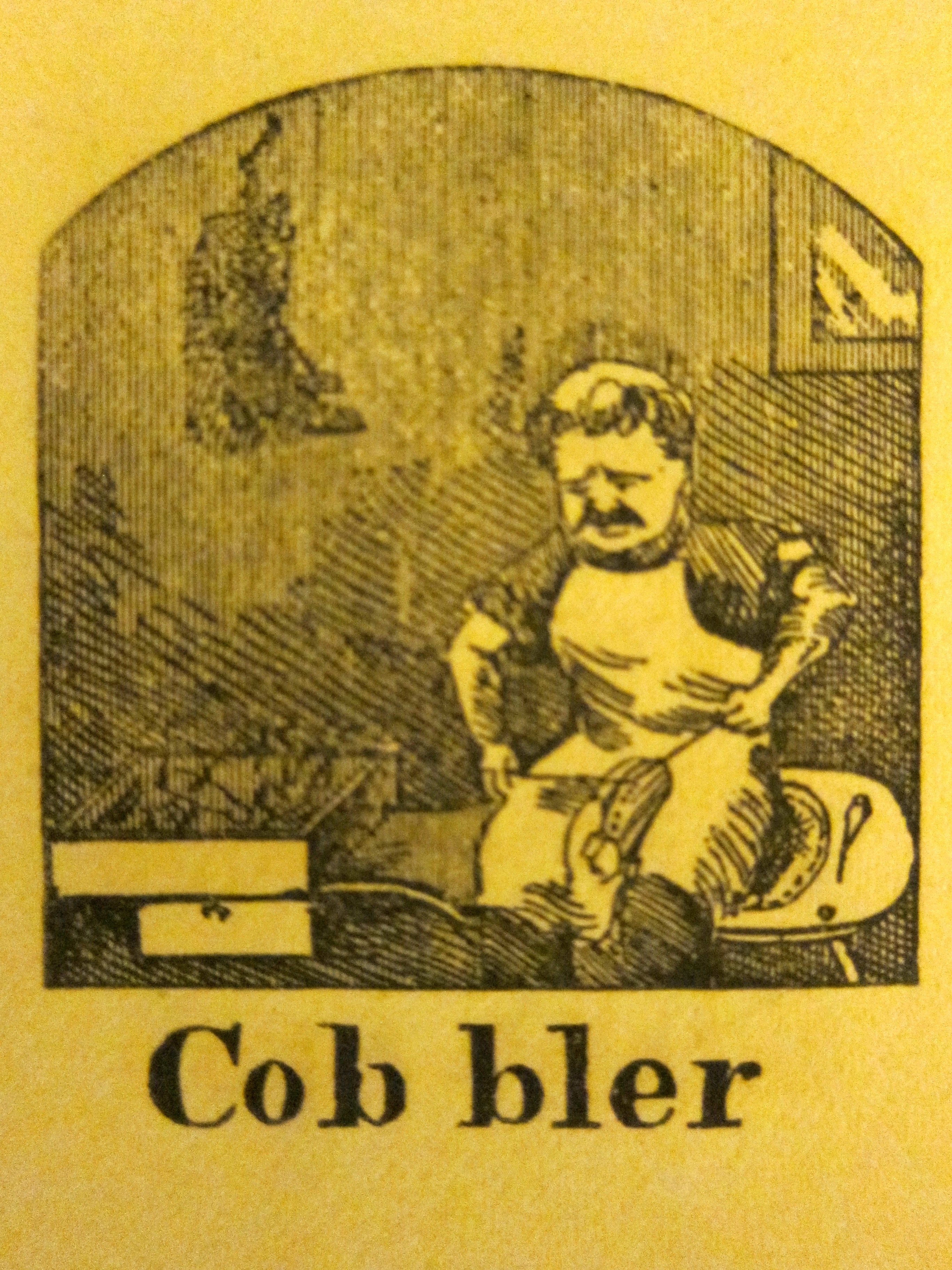
Cobbler

1852

Thursday April 22  Worked a very little in the garden

not very pleasant but looks more like fair weather

Sewed a little on my black silk dress

Called with Augusta on Hannah & her sister

Sarah, Abby and at Willard Lothrop, Sampsons

A Pratts Holmes and at the store.  afterwards at

Olivers & Edwins carried a pr shoes to mend

A little sewing, a little gardening, and a great deal of socializing filled the hours of Evelina’s day today. After being pretty well pent up by several days of stormy weather, Evelina was ready to go out.

With her niece-in-law, Augusta Pool Gilmore, she called on another niece-in-law, Hannah Williams Gilmore. There they met Hannah’s sister, Sarah Lincoln, who was visiting from Hingham. They went on to see yet another niece, Abby Torrey, then to the homes of Willard Lothrop (one of Easton’s most active spiritualists), Joel and Martha Sampson, and others.

The Sampsons were a younger couple from Maine with five little children aged eight and under, including three-year-old twins. Joel Sampson worked at the shovel shop and was evidently devoted to Oakes Ames. Twenty years later, on hearing of Oakes’ death, “Joel Sampson, teamster and farmer of the company came home when he heard the sad news, threw himself upon his sofa and announced to his wife that the head and soul of the business was dead, that every thing would go to smash now, and told her to make ready to go back to their old farm and home in Maine, as it was no use to live here any more.”**

Throughout her travels today, Evelina carried a pair of shoes to be mended. In an area of the country well known for its shoe manufacturing, there must have been a good cobbler somewhere in town.


* Oliver Ames, Journal, Stonehill College Archives, Arnold Tofias Collection
**William Chaffin, “Oakes Ames,” p. 2

April 21, 1852

01-01_full

Examples of 19th c. lunch pails*

1852

Wednesday April 21st  It still continues to rain through not as

hard as yesterday  Have been to work on

Susans dresses altering them  Went with

Mrs S Ames to the store  Susan has carried

her dinner to school three days and thinks

it something nice  Swept my chamber and put

it in order

The heavy rain of the past two days wasn’t giving up easily. Old Oliver wrote that “it raind considerable last night + the wind blew hard and it is cloudy + rainy this morning + the water is verry high.”**

Despite the weather, the Ames women continued many of their usual routines: sewing, of course, and housework, but errands, too. Evelina and her sister-in-law Sarah Lothrop Ames went to the company store in the village. Little Susie Ames went to school, as she had even during the worst part of the storm. Instead of coming home for dinner in the middle of those rainy days, however, she carried her meal to school and ate there.  No school cafeteria or hot lunch program in those days! She thought it “something nice” to stay at school for the midday meal.

Courtesy of the National Museum of American History, Smithsonian

** Oliver Ames, Journal, Stonehill College Archives, Arnold Tofias Collection
April 20, 1852

Freshet

Tues April 20th

1852  Storms again to day and nearly as hard

as yesterday.  rained poringly last night

Mr Packard came at half past three and Mr Ames

went to the hoe & knife shop to raise planks 

the water being very high  The highest that

has been known for years  Augusta spent

the afternoon  Worked all the forenoon cleaning

out grease from the buttery

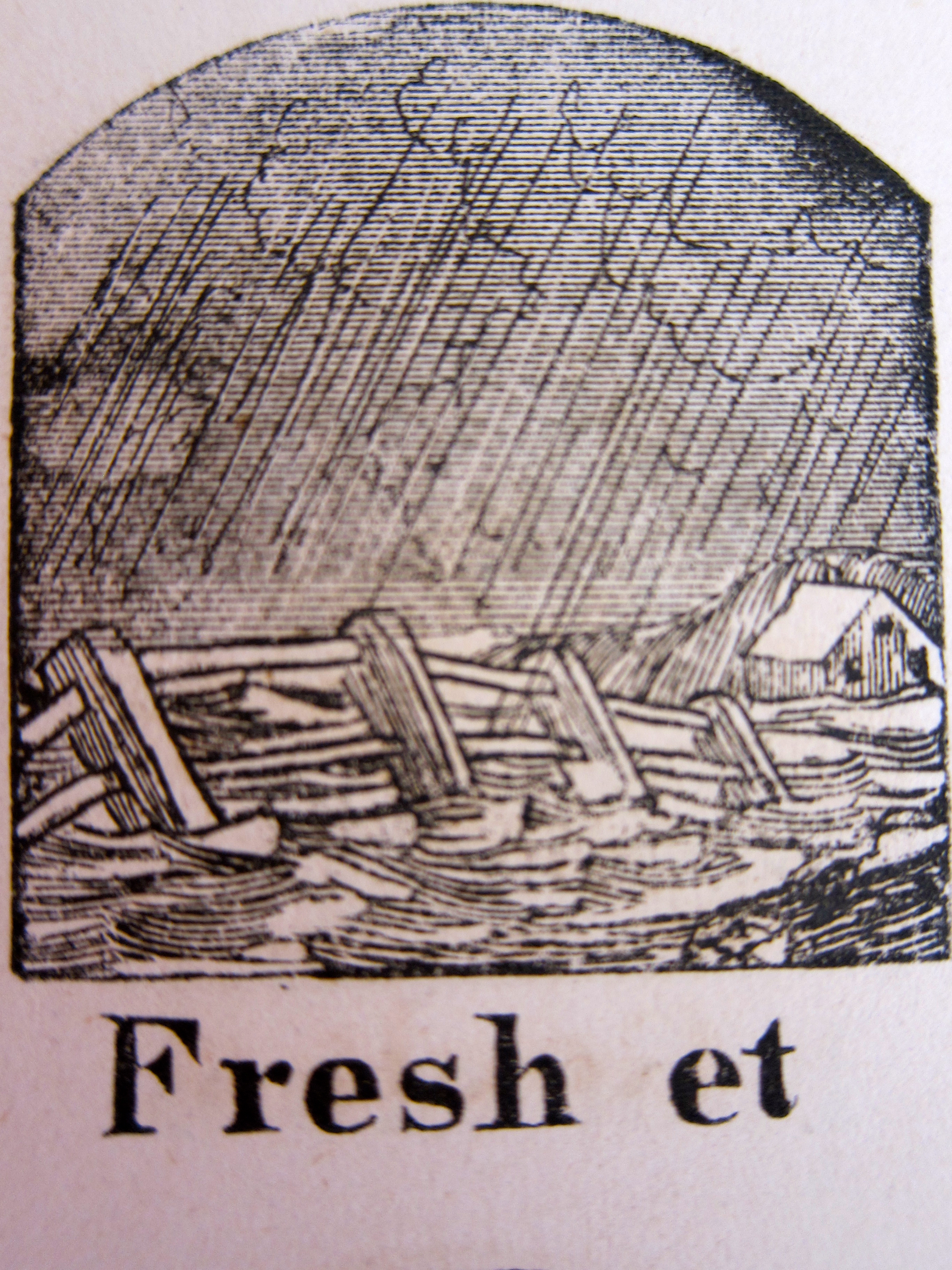
The Nor’easter continued.  The Queset Brook, which ran behind the Ames compound, the Shovel Shop Pond and other local bodies of water threatened to overflow under the deluge of rain. The water came down “poringly” and, according to Old Oliver, “it raind about all day.”* To use a word that is not often encountered in the 21st century, a freshet was imminent.

A freshet is a sudden overflow of a creek or stream brought on by a heavy rain and/or the sudden melting of snow. It was a potential hazard that people who lived near waterways worried about every spring, and on this day the fears of such folks in Easton came close to being realized.

The water rose “the highest that has been known for years,” threatening to flood the hoe and knife shops. The men, led by Oakes Ames, responded quickly to adjust the wooden planks at the site of the dams on the pond. Local historians Dwight MacKerron and Frank Mennino corrected this editor’s initial misinterpretation that raising planks meant lifting machinery off the floor, the latter suggesting instead that:

“raising the planks referred to actually allowing water to leave the ponds under a controlled flow via a secondary sluiceway that was employed in most dams just for that purpose. In the case of the hoe shop there was a man made canal that would serve that purpose. It takes pressure off the dam, and might avert a catastrophic failure which would certainly have severe consequences.”

Sydney Packard may have been the man who came to assist Oakes. He was a 40 year-old father of eight and long-time employee of O. Ames & Sons.  Some twenty years later, Packard would be one of the pallbearers at the funeral of Oakes Ames.

So far in 1852, the Ames family had endured first fire and now flood, and their troubles were not over.

Thank you, Dwight MacKerron and Frank Mennino for your input on the workings of waterways of North Easton.

April 19, 1852

 March_2014_nor'easter_2014-03-26Satellite image of a Nor’easter

1852

April 19th Monday  It rained very fast all day and 

about noon the rain beat in the side lights 

of the entry, and parlour windows   had to take

back the carpet a little from our window put

dishes under the windows and caught a good

deal of water.  Have cut down my Verbenas

and Petunias fixed a skirt of a dress for

gardening

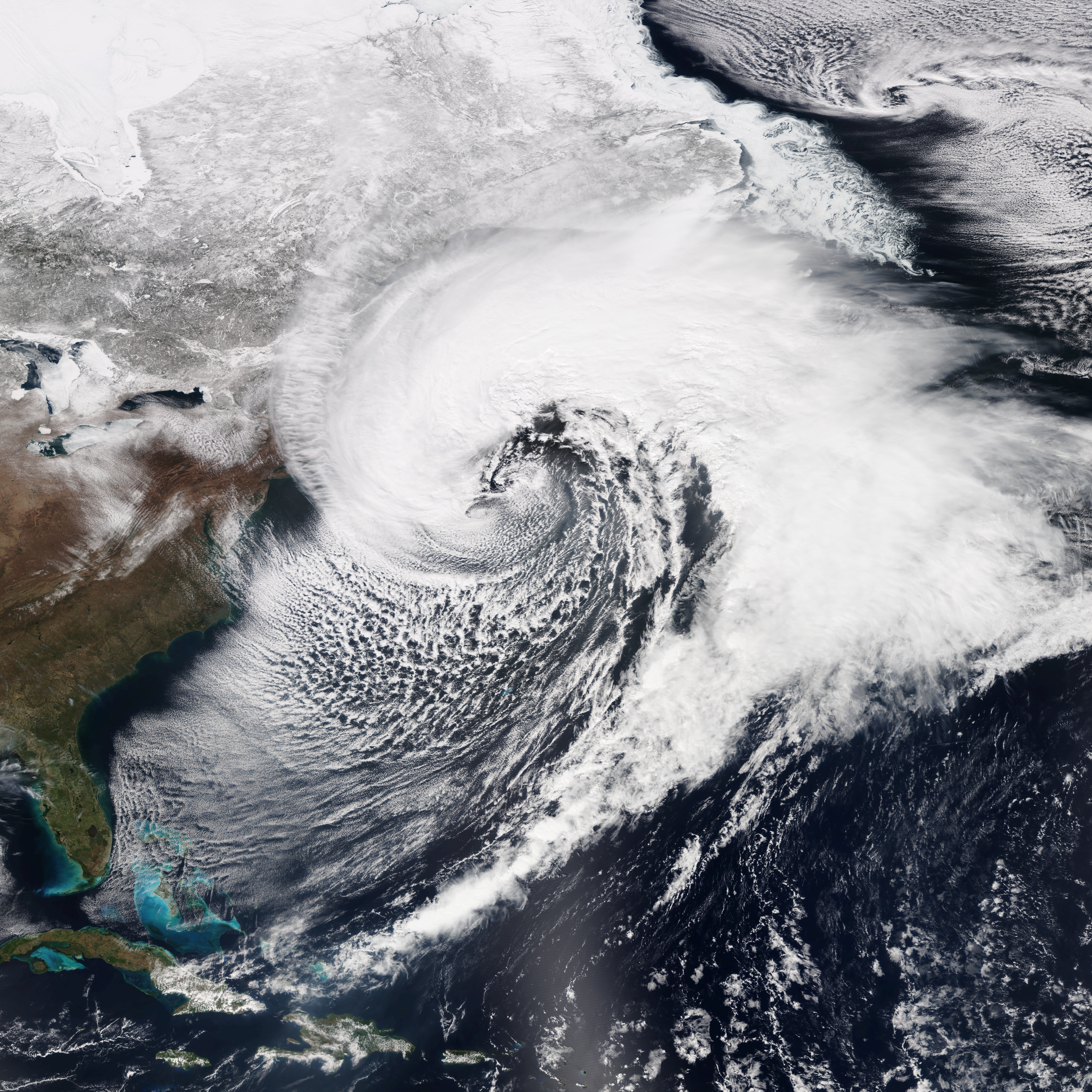
A powerful Nor’easter storm beat into New England this day.  Both Evelina and her father-in-law described the rain as “fast,” Oliver further elaborating that the rain came in sheets, “not in drops.”*  Evelina (and Jane McHanna, most likely) had to deal with water coming in through the side light panels on either side of the outside door. They scurried, too, to pull back the carpet from the windows and put dishes on the floor to catch some of the water beating into the house.

The wind howled and “[t]he storm continued all day , a part of the time pritty fast,” reported Old Oliver. Everyone stayed indoors, no doubt, yet Evelina reports cutting back some of her plants, which suggests outdoor work. That couldn’t have happened on a day such as this, however, so perhaps the verbenas and petunias had wintered-over in pots inside the house, and it was those that she cut down.

Gardening was on her mind, of that much we can be sure. She prepared a skirt to wear outside when she was in her flower beds, probably “repurposing” an old dress for the task. Her handwriting was rushed and incomplete when she wrote the last sentence of today’s entry; she inadvertently omitted to cross the “x” in fixed, leading this editor to conclude that she had “fired” a skirt.  Not so, thanks to a sharp reader who came up with the correct version.

Image courtesy of Wikipedia, April 18, 2015

April 18, 1852


paul-revere-1

1852

April 18 Sunday.  Another unpleasant sabbath but we have

all been to meeting.  Oliver & wife staid at home

this afternoon.  Mr Whitwell gave us two short but

good sermons of about 20 minutes  At intermission

went into Mrs J Howards with Mrs E Howard

Mrs L Howard & Mrs Dr. Deans    called a few moments

on Mrs Whitwell.  Have finished Night & Morning

As was their custom, the Ameses attended church today en masse, at least in the morning. They drove separate carriages to the meeting house through the “cloudy, cold + misty”* morning. Oliver Jr. and his wife Sarah Lothrop Ames rode home at noon, but Evelina and her family, presumably, busied themselves at intermission with various opportunities to socialize.

Oakes Ames most likely slept through the sermons, even though they were “short.” Evelina, however, liked Reverend Whitwell’s sermons today, as she often did. Would he have made any allusion to the historic date?  April 18 was the anniversary of the 1775 ride of Paul Revere and William Dawes to warn “every Middlesex village and farm” of the approach of British forces.  It was a date that American schoolchildren once had to memorize.

Less than a decade later, poet Henry Wadsworth Longfellow would immortalize the historic date in Paul Revere’s Ride:

Listen my children and you shall hear

Of the midnight ride of Paul Revere,

On the eighteenth of April in Seventy-Five;

Hardly a man is now alive

Who remembers that famous day and year…

Longfellow, one of the most popular American poets of the 19th century, wrote Paul Revere’s Ride some eighty-five years after the dramatic events in Concord and Lexington that opened the Revolutionary War. It was published in The Atlantic Monthly in January, 1861, on the eve of the Civil War.  Many believe that the poet, an adamant abolitionist, wrote the piece to remind American citizens of the historic principles and great bravery that shaped the formation of the United States.


Oliver Ames, Journal, Stonehill College Archives, Collection of Arnold Tofias


April 17, 1852

Village

1852

April 17  Saturday  Julia was at work here a year ago to day

has improved very much in dress making since then

I have my black silk nearly finished.  The Delaine

all done except the sleeves & buttons, am waiting

to go to Boston to get the trimmings.  This afternoon 

have been altering some old dresses for Susan

Hannah called to get me to go up by the school

house and select a place for a house for them

Mrs Witherell went with me  A beautiful pleasant day

Sewing continued today, with Julia Mahoney again on hand to assist with Evelina’s new dresses, one of black silk, the other of a light wool they called delaine. The finished projects would have to wait for trimmings to be fetched from Boston. Evelina meanwhile refashioned some old dresses for her daughter, for “[e]very season there was a great remaking of old garments to bring them up to date.”*

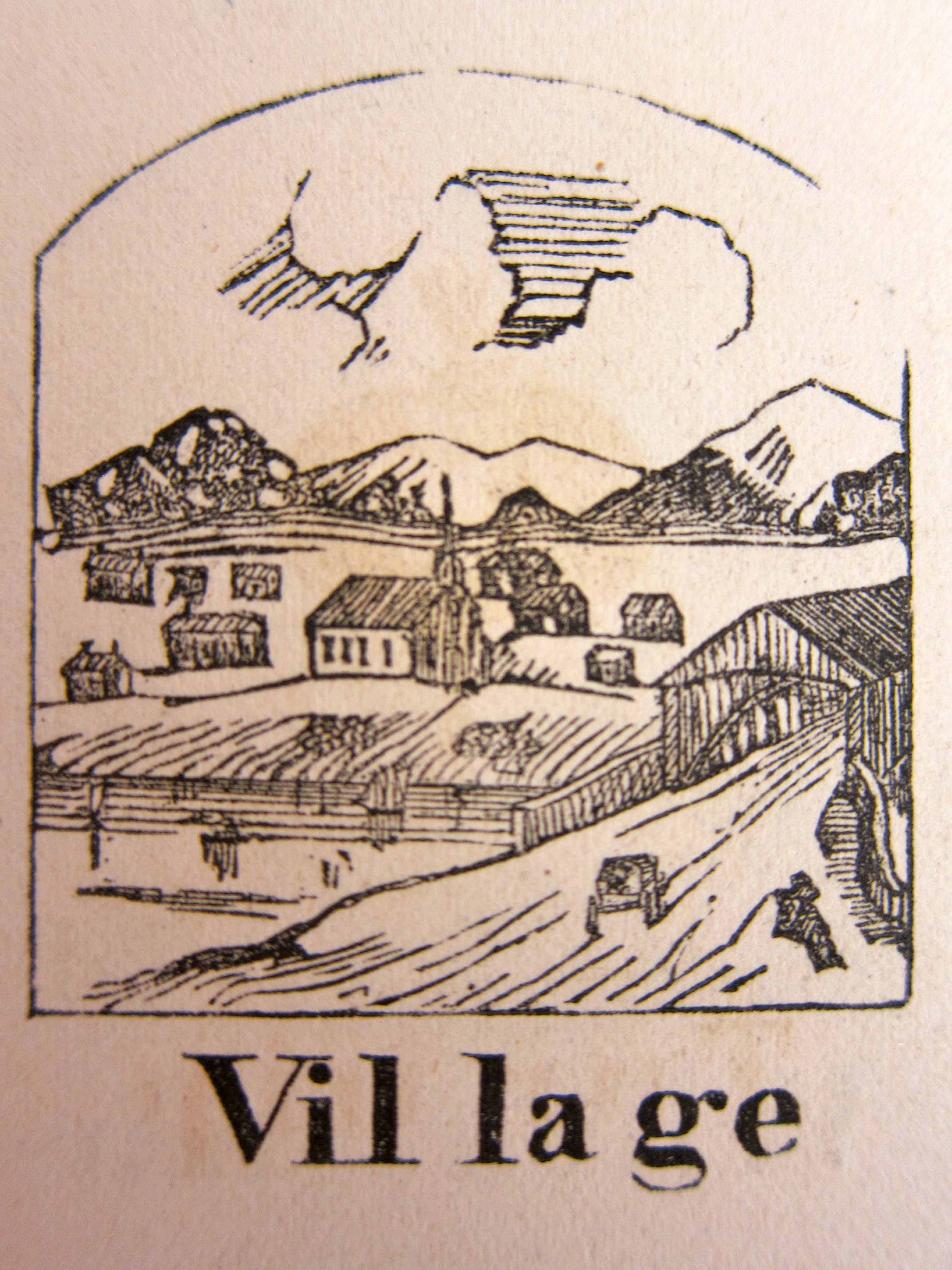
The bad weather of the past two days disappeared and was replaced by fair skies. Despite continued cold temperatures, Evelina was finally drawn outside on a fun errand. Invited by her niece, Hannah Lincoln Gilmore, and accompanied by her sister-in-law, Sarah Ames Witherell, she went to the local school house to look at some property that her nephew, Alson Augustus Gilmore, and Hannah, his wife, were considering.  They had been renting rooms from Col. John Torrey, but now were planning to build a house.

Everyone in North Easton lately seemed to be wielding a hammer. It was spring.


*Winthrop Ames, The Ames Family of Easton, Massachusetts, p. 127


April 16, 1852

 women sewing*

1852

April 16th Friday.  Julia here again to day and we have

been to work on my dresses  Mrs S Ames & Witherell

helped some time this afternoon and we have

got along nicely  Hannah & Augusta called

Augusta brought her work and Hannah finished

Susans stocking.  Susan has the other stocking about

half done.  The first pair that she ever attempted to knit.

Stormy again to day.

The day before had rained “pritty fast” all day long, and today opened in much the same vein, with “snow squals + rain + a high wind.”***  The women stayed indoors and focused on fashion.  Dressmaker Julia Mahoney came over to work on new outfits for Evelina. Sisters-in-law Sarah Ames and Sarah Witherell helped for a time, too, both of them as accomplished at sewing as Evelina. They all “got along nicely,” a phrase that suggests good progress was made on Evelina’s dresses, although the women’s sociability quotient was also probably pretty high.

Others joined the hum.  Nieces-in-law Hannah Gilmore and Augusta Gilmore, a younger set of eyes and hands, arrived with work in hand. Hannah helped her little cousin, Susie Ames, knit a pair of stockings.

The sewing of new dresses – as opposed, say, to the mending of men’s shirt fronts – was the favorite expression of the women’s collective talent with needle and thread. As Winthrop Ames noted, “An immense amount of sewing went on in every family.”** We’ve certainly learned that from Evelina’s diary.  In 1852, they still made their own dresses. “[T]he materials and trimmings, after much consultation about their style and quality, were made up in the house with the help of the town seamstress and pictures from the fashion magazines.”

Things would change. By the start of the Civil War, the Ames women began to have their dresses made up in Boston. But on this day in North Easton, needles flew.


*Image courtesy of nhdsewingmachine.weebly.com

** Winthrop Ames, The Ames Family of Easton, Massachusetts, p.126

*** Oliver Ames, Journal, Stonehill College Archives, Arnold Tofias Collection