August 4, 1852

Thread

1852

Wedns Aug 4th  Sewing circle met at the other part

of the house  Had an unusually large number

About 30 beside the gentlemen that came

to the second table.  My family all had tea

there  After tea all went into the gardens

and into Olivers to hear Helen play

Horatio and another man came from Salisbury

Sarah Witherell hosted the monthly Sewing Circle, to which people turned out in “an unusually large number.” Everyone would have known about the death of Sarah’s son back in May, and by showing up on this occasion, they likely were paying respect to a woman they probably admired. In her quiet, dignified way, Sarah had done so much for others that others now wanted to do something for her.  They may also have been demonstrating respect for her father, Old Oliver. Sarah was probably grateful for the outpouring and for the hostessing assistance she would have gotten from her visiting cousin, Almira Ames.

Old Oliver may or may not have been on the premises for tea. According to his daily record, on “the 4th Horatio + Mr Morse his traveling agent came here + went away the next day.”* Evelina doesn’t mention Horatio (Sr., probably) but as we know, they weren’t close.

After the busy gathering at Sarah Witherell’s, family and guests toured the gardens – of both houses, presumably – and then moved into the house next door to hear Helen Angier Ames, only daughter of Sarah Lothrop Ames and Oliver Ames Jr., play piano. Perhaps even Old Oliver, Horatio and Mr. Morse were part of the appreciative crowd.

This is the first entry that tells us that Helen Angier Ames played the piano, and it’s significant. Owning a piano or, more likely, a pianoforte was “the ultimate ‘badge of gentility’.”** Because “less than one in a hundred” households in the country owned such an instrument, those that did could be reckoned to be high up on the social scale. Owning a piano distinguished “‘decent people’ from the lower and less distinguished”, according to the standards of the time.


*Oliver Ames, Journal, Stonehill College Archives, Arnold Tofias Collection

**Jack Larkin, The Reshaping of Everyday LIfe: 1790-1840, New York, 1988, p. 143


August 3, 1852

Hpr HaravrdTraining-s

Harvard Crew Training on the Charles River, ca. 1869*

August 3d 1852

Tuesday  Cut out a linen & moire skirt for Catharine

to make and Susan a night gown  I have

at last got my travelling dress done  I believe

cape and all.  How provoking it is to have

to alter so much  Julia Mahoney has been

to work for Mrs Witherell making a Borage Delaine

Augusta & Mrs McHanna were here this afternoon

For Evelina, this was a fairly ordinary day of sewing and socializing. Her big news was that she “at last” completed her new traveling outfit.

In the annals of American sports, however, this was no ordinary day.  In a two-mile regatta on Lake Winnipesaukee, New Hampshire, under a bright blue sky, Harvard beat Yale in the very first intercollegiate athletic competition ever held in the U.S.A. Harvard’s  Oneida beat both of Yale’s boats, Shawmut and Undine. The first prize, a pair of black walnut oars, was presented to the Crimson team by one of the six judges, soon-to-be-president Franklin Pierce. Today, those oars are the oldest intercollegiate athletic prize in North America**. The contest itself has since moved to New London, Connecticut. It recently celebrated its 150th anniversary (not having been held in consecutive years in its earliest iteration.)

The contest was initiated by Yale, who “issued a challenge to Harvard ‘to test the superiority of the oarsmen of the two colleges.'”* According to the written recollection of James Morris Whiton, Yale Class of 1853 and bow oar of Undine, “[t]he race was supposed to be a frolic, and no idea was entertained of establishing a precedent.”*** The enthusiasm of the participants and the entertainment of the spectators, however, insured that a tradition had been born. Anticipation for the event had been high, so much so that the Boston, Concord and Montreal Railroad footed the bill for the event, believing it would attract visitors to the area. The excursion trains it set up arrived loaded with visitors.

The oarsmen themselves were so enthused about the occasion that they tried to arrange a dance at the inn where they were staying. According to Whiton, “Many of the College boys stayed at the Pemigewasset House, Plymouth, and it occurred to them it would be pleasant to give a ‘hop’, and invite the rural beauties of the town to the festivities. With this end in view, they applied to the landlord of the hostelry and received this reply: ‘Ye can hav the hall, young men, if ye want a gander dance, but ye won’t get no gal timber there, I tell ye.'”

No doubt the failure to dance with some of the “rural beauties” was a disappointment, but otherwise the race and its aftermath were entirely successful. By 1875, thirteen eastern colleges offered crew.


Image from Harper’s Weekly, 1869

**Harvard Athletic Association, Courtesy of http://www.gocrimson.com

*** Wikipedia, accessed July 30, 2015

****James Morris Whiton, “The Story of the First Harvard-Yale Regatta by a Bow Oar,” published in The Outlook, June 1, 1901 and privately printed with photographs of Lake Winnipesaukee and of the course of the race.


August 2, 1852

Rain

Aug 2d 1852

Monday  Was about house most of the forenoon and this

afternoon have been to work on my traveling

dress again had to let out the front & widen

the arm it was so tight  Helen spent the

afternoon here  Mrs G & Mrs S Ames called

in the furnace neighborhood and coming home 

got caught in a heavy shower

Evelina and her father-in-law, Old Oliver, had a different perspective on the afternoon’s rainfall. She called it “a heavy shower,” while he wrote that it was “a small shower.”* Because her female relatives, Almira Ames and Sarah Lothrop Ames, “got caught” in it and probably arrived home soaked, Evelina would have seen the rainfall as torrential. Old Oliver, on the other hand, would only have considered the rain in terms of the measure of water it delivered, whether he was indoors or out. From his dual position as farmer and shovel manufacturer, he considered today’s rainfall as modest. As often happened, the two in-laws differed on details.

While the rain fell in Easton, important politics were getting underway about a thousand miles to the west. In Iowa and Missouri on this date, elections to the 33rd session of the U.S. House of Representatives were being held. It was the beginning of the campaign season, something that might sound familiar to today’s readers. Between them, these two states (which, except for California to the far west and Texas to the far south, were perched on what was then the frontier between the eastern states and the western territories) would send nine representatives to Washington, the majority of them Democrats.

As we have mentioned previously, this 1852 election would be won by the Democrats, in sufficient strength to sound the death knell of the old Whig party. From its ashes would rise the new Republican party.


*Oliver Ames, Journal, Stonehill College Archives, Arnold Tofias Collection


August 1, 1852

SerffLedger1


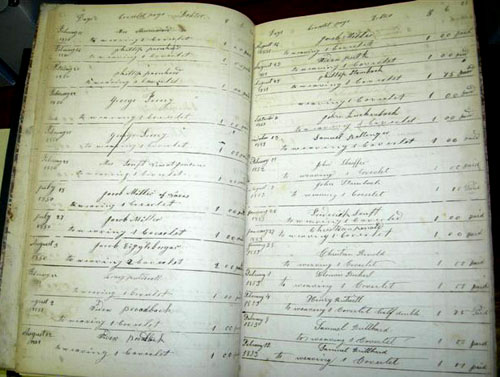
Example of anonymous, old cash ledger

1852

Sunday Aug 1st  Went to meeting this forenoon

but was very sleepy and had a head

ache came home at noon & did not

return, was writing and looking over my

accounts untill the rest returned from 

meeting, good business for the Sabbath

I think. Mr Ames & self went to see Augustus

since meeting.  Alson & wife came after Mary

Evelina was plagued by a headache, so didn’t return to the afternoon service at the Unitarian church. As she had done before on a Sunday afternoon, she went over her household accounts. Like many a competent householder, she kept a ledger of cash transactions that detailed the weekly or monthly expenses of running the house. It’s highly unlikely that she had any money of her own; everything would have been paid for by her husband, Oakes, who either saw that she had a regular allowance or gave her funds as needed. She would have been careful with every penny, probably more careful than he was.

On this Sunday, she describes the review of her accounts as “good business for the Sabbath,” but in an earlier entry she had hesitated to do it, fearing that it was inappropriate. Accounting was quiet work, certainly, but it was still work, and that was forbidden on Sunday. By defending the activity in her own diary, she shows us that she was still feeling a little guilty for doing it.

Socializing wasn’t forbidden, however, and when her husband, Oakes, came home from church, the two went out to see Evelina’s nephew, Alson Augustus Gilmore, who had been quite sick with fever. Her brother, Alson, and his wife, Henrietta, meanwhile, “came after” the maid, Mary, and, evidently, took her home with them.


July 31, 1852

images

Women making potash soap, circa 1900*

1852 July 31st  Saturday  Have made two barrels

of potash soap and have had very good luck  This 

afternoon have been mending  Catharine Murphy came

this afternoon to sew for me and Im sure I hope she

will be worth something for it  Mary has been to work

on her own dress this afternoon   Susan &

self have been to Augustus this evening

and staid until ten  He is getting quite smart

This was a full Saturday for Evelina. She made a large batch of soap and was quite pleased with the result. Soap-making is an art, and Evelina was good at it. She knew enough about it, indeed, to be grateful for her own success. Of course, she could have purchased soap in the city or, perhaps, even in the Ames’s general store, but the farm girl in her resisted spending money on something she could make herself.

Lydia Maria Child, author of The American Frugal Housewife, devotes a whole page of her slim volume to making soap. “In the country,” she states unequivocally, “I am certain, it is good economy to make one’s own soap.” She offers various measures of ingredients: “To make a barrel of soap, it will require about five or six bushels of ashes, with at least four quarts of unslacked stone lime,” after which “[t]hree pounds of grease should be put into a pailful of lye.”** The trick to making soap depended on the sequence in which the ingredients were mixed, and at what temperature. It was a backyard chemistry experiment.

After the hard work of soap-making, in which Evelina was no doubt assisted by a servant, and an afternoon of mending, Evelina and her daughter Susan went to see her nephew. Augustus had fallen quite ill two weeks earlier with fever, but was now on the mend.


Image courtesy of http://www.wildernessarena.com

** Lydia Maria Child, The American Frugal Housewife, 1841

July 30, 1852

381-1233891708GdW7

July 30th  Friday  Came home from Dr Wales at half

past four and slept untill half past

eight left her quite comfortable

Have cut out another sack night dress

and Susan a waist  Alson & Lavinia Edwin

and wife were here to tea  Mr & Mrs Kinsley

called just at night for a few moments.  We

all went into the other part of the house for

ice cream this evening   Horatio here to dine

When Evelina came home at 4:30 in the morning, was the moon still up? Did she realize that this night would offer the second full moon of the month, familiarly known as a blue moon? She would be able to see it, too, as the skies were clear.

We use the term blue moon to identify a second full moon within a calendar month.  An earlier definition – one that may have been in effect when Evelina could gaze at the night sky – was that of being the third full moon within a season that has four full moons. So say various almanacs. Tracking the lunar cycle to define the passage of time has gone on as far back as human history can record. The Christian ecclesiastical calendar, for one, is built around moon phases. According to one modern source,

Some years have an extra full moon—13 instead of 12. Since the identity of the moons was important in the ecclesiastical calendar (the Paschal Moon, for example, used to be crucial for determining the date of Easter), a year with a 13th moon skewed the calendar, since there were names for only 12 moons. By identifying the extra, 13th moon as a blue moon, the ecclesiastical calendar was able to stay on track.”*

The terrestrial events of Evelina’s day included sewing (of course), her nephew Horatio Jr as a guest at lunch, company for tea and, as a special treat at the end of the day, ice cream. Despite her lack of sleep, a pleasant day overall.

*Courtesy of http://www.infoplease.com/spot/bluemoon (accessed July 26, 2015)


July 29, 1852

stock-illustration-20625662-woman-on-death-bed-friend-at-bedside-1862-magazine

Thursday July 29th  Julia has been here again

to day worked for me untill about

three and cut Mary a dress  Mrs G

Ames Mrs S Ames Helen Emily & self

have passed the afternoon at Mr B

Algers coming home  Dr Wales stoped

the carriage & asked me to go there and watch with his wife

Evelina and her dressmaker sewed for hours today, presumably working on Evelina’s new traveling outfit but also cutting out a dress for the maid, Mary. In the late afternoon, Evelina joined the visiting Almira Ames, sister-in-law Sarah Lothrop Ames and two nieces, Helen Angier Ames and Sarah Emily Witherell at the home of the Algers in Easton.

Ephraim Wales, a young doctor in town, evidently crossed paths with Evelina as she, and probably some of the other ladies, traveled home after their call on the Algers. Dr. Wales wanted Evelina to watch with his wife, Maria. Maria must have been ill or possibly even in labor.  Subsequent records don’t reveal why a doctor wanted Evelina to tend to his wife. But it does seem that Evelina was becoming the go-to care-giver in various homes. She was clearly generous with her time, and her bedside skills must have been excellent.

July 28, 1852

Sharps

Sharp’s Pistol, 1848-1850


July 28th, 1852

Wednesday Julia Mahoney has been here

to work to day on my travelling dress

but I have sewed but very little

Was about house all the forenoon 

making cake & pies &c &c  Mrs Ames &

Witherell have been to Dover  Horatio

Ames Jr came last night & I expected

him & father to dine but they went to

Olivers  Horatio went with Mr Ames

to Canton this afternoon & was here to tea

Horatio Ames Jr., a grandson of Old Oliver and nephew of Oakes, had come to the other part of the house for a short visit. By contemporary accounts, he was a troubled young man. The second child of Horatio and Sally Ames, he was born in Albany when his father was working there, but grew up in Connecticut.  In 1849 and 1850, he attended Rensselaer Polytechnic Institute in Troy, New York, but evidently left after just one year.

Early in 1853, Horatio Jr. was in Boston where he married Sophronia Eliot Hill of Salem. He worked as an iron monger at that time, but by 1858 was working as a clerk. On October 27, 1858, he killed himself.

What happened between his year in college and his suicide less than a decade later may pivot on the scandalous divorce of his parents, proceedings for which got underway late in 1852. His mother cited her husband’s multiple infidelities and harsh treatment to herself and her children. Horatio Jr. sided with his mother during and after the breakup. A 20th century account reports that Horatio Jr:

left home shortly after his parents’ divorce and so was out of touch with his father for some years. But he returned home in 1856 following his father’s remarriage. During an argument, he fired at his father in an attempt to kill him. Newspaper accounts of the incident, based on Horatio Sr.’s version of the events, depict him winning a heroic struggle for his life, but then magnanimously letting his son leave. Only after further warnings from his younger son, Gustavus, did Horatio finally have his son arrested. Horatio called his son ‘the worst hardened villain I have ever seen’, but then dropped the charges once Horatio Jnr. became contrite, begging forgiveness.*

The newspaper accounts on which this summation is based present only Horatio Sr.’s side of the story. We simply can’t know exactly what transpired between father and son, but we can know that the son eventually took his own life.  According to some 19th century records, Horatio Jr. is buried in Salem.

*John Mortimer, Zerah Colburn the Spirit of Darkness,2007


July 27, 1852


Asleep

Tuesday July 27th  Mrs Savage had quite a

comfortable night & I came home a

little before 5 Oclock & went to bed

did not rise untill nearly nine

Elizabeth Pool & Augusta came

in this forenoon with their work

Mrs Whitwell Reed Howard & Miss

Jarvis called on us all & Alsons wife

was here to tea & Mother at Augustus’

Evelina’s all-nighter at the bedside of Mrs. Savage didn’t seem to impinge on her day.  After a catch-up sleep in the early morning, she was back on her feet.  Augusta Gilmore and her young sister Elizabeth came over “with their work,” meaning that they brought some sewing with them, and the women sat, sewed, and visited. Later in the day, several ladies from her Unitarian circle of friends “called on us”.  Her brother Alson’s wife, Henrietta Williams Gilmore, came by for tea. A most sociable day, it was.

In the other part of the house, “Horatio Ames Jun r came here to day.”* Horatio was, obviously, the eldest son of Horatio Ames, who was the brother of Oakes, Oliver Jr., Sarah Witherell, Harriet Mitchell and William Leonard Ames. Repeating previous posts, Horatio ran a forge in Connecticut, far from the shovel shop in Easton, but still connected to it financially and emotionally. He and his son were not on friendly terms, and it’s hard to determine just what had brought Horatio Jr to Easton.  He arrived in the evening and for some reason Evelina didn’t mention it in her diary.


*Oliver Ames, Journal, Stonehill College Archives, Arnold Tofias Collection


July 26, 1852

imgres-1

Monday July 26th  Hannah & Mary washed and I

have been sewing most of the day but have

a head ache  Have engaged to watch with

Mrs Savage, but do not feel like sitting 

up all night  We have had a rainy

day which was very much needed and

I hope it will make my garden look

better

“[I]t was cloudy this morning wind south east and it raind during the day half an inch or more,” reported daily chronicler Oliver Ames. He had been looking for rain all summer and hadn’t seen enough of it. Today’s rain was most welcome; parlor gardens would be perkier and vegetable patches here and there would be improved.  Evelina hoped her garden would “look better.”

What was blooming in Evelina’s garden at this time of year? So many flowers had gone by by this point in the summer, having peaked between May and early July, yet perennials like Black-eyed Susans and Coneflowers would be in full presentation. If Evelina had geraniums, or other annuals, they too might still be stretching toward the sun – and grateful for the day’s rain. The fact that Evelina was able to gather a “boquet” to take to a friend at church the day before proves that flowers were alive and well in her garden.

Evelina, unfortunately, wasn’t feeling at the top of her game. Nonetheless, she agreed to sit up over night with her ailing neighbor, Hannah Savage. Perhaps Evelina was conscious that her acute headache couldn’t compare with Mrs. Savage’s ongoing battle with tuberculosis. Evelina would get over her ailment but Hannah would die from hers.