October 21, 1852


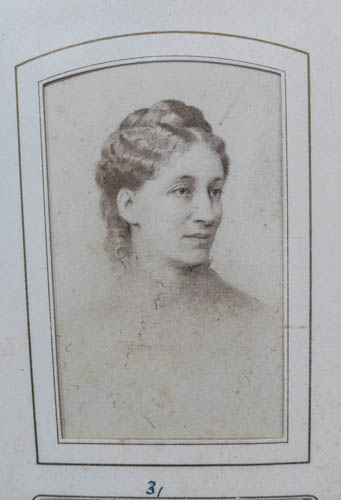
Sarah Emily Witherell                                           Susan Eveline Ames French

Emily Witherell                                                                                   Susan Ames


1852

Thursday Oct 21st  Miss Alger came to day to give

her fifth lesson and Susan is now as far

as Emily but unless she takes more

interest it will be very hard for her

to keep up with her.  Mrs Witherell feels

to blame Miss Alger that she does not

give Emily longer lessons


Relationships among the females who lived under the roof of the Ames homestead were becoming strained. Susie Ames wasn’t much interested in learning to play the piano, while Emily Witherell was. Yet the cousins took their lessons together, yoked into learning side by side. Emily was facile and wanted more challenging fare, but was slowed down by Susie’s reluctant participation. The disparity in the girls’ interest and ability was no doubt challenging for poor Miss Alger. The situation wasn’t helped by the mothers hovering over the girls as they took their lessons.

The two mothers had their own set of expectations. Sarah Witherell, who had endured so much loss in her life, had nourished hope that her daughter would develop a taste and talent for music. Evelina probably felt the same way, hoping to see her daughter become “accomplished.” Sarah was unhappy that Miss Alger wasn’t giving Emily enough to do, and, also, was surely displeased with Susie holding Emily back. Evelina had to be disappointed by Susie’s disinterest, nervous, perhaps, that she had made an expensive mistake in buying a piano. Evelina was learning, probably not for the first time, that a parent can have aspirations for a child that the child doesn’t share or follow.

All was not lost, however. For all the initial struggle, both girls eventually learned to play piano with some credibility, yet neither grew up to be a great pianist. They never outshone their older cousin, Helen Angier Ames, who had started earlier and, evidently, concentrated harder on perfecting her skill. Family historian Winthrop Ames, who was a first cousin once-removed of the three pianists, noted that by 1861, at the “Unitarian meeting-house […] Helen, Emily and Susan took turns in playing the reed organ, though Helen was acknowledged to be the best performer.”*


Winthrop Ames, The Ames Family of Easton, Massachusetts, 1938, p. 130


October 20, 1852

piano_voice_guitar_lessons

Wednesday Oct 20th  Have been expecting Miss Alger

all day but she has not come  Have been

trying to assist Susan some about her

music lessons and it hinders me about

my work very much  I wish it was not

such an effort for her to practice.

A gentleman here to dine from New York.


It’s easy to imagine the affable Oakes Ames inviting visitors to dine. He was a sociable man, for all his competitive spirit, and had a fine sense of humor.  He knew that his wife took pride in her home, that she could act the hostess and that she – or her servants – prepared a midday meal hearty enough to feed him and his grown sons. How much warning he might have given her that he was bringing someone over from the shovel office for dinner, we can’t know. But Evelina seemed prepared to feed guests as well as her own family, and she no doubt welcomed the gentleman from New York.

The meal preparations were usually left to the servants, of course, although Evelina supervised. Today, however, her focus was on her daughter and the new piano. She was unhappy with Susan’s evident disinterest in the instrument. The girl wasn’t practicing her scales and lessons as she should have been.

When Evelina and her sister-in-law, Sarah Witherell, purchased the pianos and arranged for Susan and Emily to take lessons, Evelina likely had imagined that she was doing her daughter a favor, giving her a gift that she herself had never gotten. But Evelina was disappointed, as things didn’t turn out the way she expected. Susan wouldn’t practice so, for now, Evelina had to intervene and “assist.”


October 19, 1852


Gentiana-crinita-Fringed-Gentian-plant

Fringed gentian (Gentiana Crinita)

Oct 19th Tuesday  Have been sewing on Susans

fall de Laine that I bought last summer

and it appears to me that it will never

be finished  I get along so slowly on it

Ann has ironed the coloured clothes

Catharine sewing

“[P]ritty fair,”* today was. Evelina spent much of the day – more time than she wished, in fact – working on a dress for her daughter Susan. The material was delaine, a light wool that should have been easy to sew, but for some reason Evelina was going along “so slowly” that she just couldn’t see the end of it. Perhaps she wished she could be outdoors, instead. Her servant Catharine Murphy was also sewing, most likely on a project that Evelina would have assigned her to do. Evelina occasionally gave material to her girls to sew their own aprons or simple dresses with.

Another diarist, not far away, definitely preferred to be outdoors. In Concord, Henry David Thoreau went for a walk and found the very last flowers of the season:

“I see the dandelion blossoms in the path. The buds of the skunk-cabbage already show themselves in the meadow […] I found the fringed gentian now somewhat stale and touched by frost […] It may have been in bloom a month. It has been cut off by the mower, and apparently has put out in consequence a mass of short branches full of flowers. This may make it later. I doubt if I can find one naturally grown. At this hour the blossoms are tightly rolled and twisted, and I see that the bees have gnawed round holes in their sides to come at the nectar. They have found them, though I had not. “Full many a flower is born to blush unseen” by man. An hour ago I doubted if fringed gentians were in Concord now, but, having found these, they as it were surrender […] It is too remarkable a flower not to be sought out and admired each year, however rare. It is one of the errands of the walker, as well as of the bees, for it yields him a more celestial nectar still. It is a very singular and agreeable surprise to come upon this conspicuous and handsome and withal blue flower at this season, when flowers have passed out of our minds and memories; the latest of all to begin to bloom, unless it be the witch-hazel, when, excepting the latter, flowers are reduced to the small Spartan cohort, hardy, but the most part unobserved, which linger till the snow buries them, and those interesting reappearing flowers which, though fair and fresh and tender, hardly delude us with the prospect of a new spring, and which we pass by indifferent, as if they only bloomed to die. Vide Bryant’s verses on the Fringed Gentian. […] It is remarkable how tightly the gentians roll and twist up at night, as if that were their constant state. Probably those bees were working late that found it necessary to perforate the flower.”**

Much as Evelina enjoyed flowers, we might doubt that she would have been as eloquent about seeing the late-blooming gentian in the meadow as Thoreau.

*Oliver Ames, Journal, Stonehill College Archives, Arnold Tofias Collection

*Henry David Thoreau, Journal, 1852, courtesy of http://hdt.typepad.com/henrys_blog/2010/10/october-19-1852.html

October 18, 1852

apples-easy-stewed-lrg


Monday Oct 18th  Ann Shinkwin commenced working

for wages this day, and she does very well

got the washing out with Catharines help

quite early not much past ten. This afternoon

she has been putting some apples to stew

I have been puttering about house and 

sewing some but my work does not amount

to much any way.

The new servant, Ann, was going right to work. She and Catharine Murphy did the laundry, of course, it being Monday. The two women then presumably cooked and served the midday meal, and did the washing up, while Evelina was “puttering about the house.” In the afternoon, Ann began to pare and slice apples to cook.

Evelina says that Ann was going to stew the apples, which sounds like a sensible way to process some of the surfeit of apples that she clearly had on hand. Sarah Josepha Hale, ever ready to advise women on sensible practices in the kitchen, offers the following recipe for stewing fruit:

The best way to stew any kind of fruit is to put the quantity you wish to cook into a wide-mouthed jar, with enough brown sugar to sweeten it; then cover the jar close, set it in a kettle of cold water, and boil it till the fruit is tender. This preserves the flavor of the fruit.

Evelina or her servant may have followed their own recipe for cooking sliced apples. But there’s no question that along with applesauce, apple butter, dried apples and apple pies, stewed apples was one more way that the nineteenth century housewife could serve fruit to her family now and over the winter and spring.

*Sarah Josepha Hale, The Good Housekeeper, 1841, p. 91


October 17, 1852

The knife and fork. Old with white bone handle.

Sunday Oct 17th  

Went to church all of us.  Came home

at noon with Mr Ames and had a cup

of tea and lunch in the buttery

Catharine Middleton left this evening

and I paid her five dollars for the

three weeks that she has been here now

and one week some time since

This may be the first time that Evelina uses the word “lunch” in her diary. Usually, the meal in the middle of the day was dinner, and it was the big meal. But on Sundays, the routine was changed because, ostensibly, housewives didn’t cook. It was a Day of Rest. The women were at church and had no time to prepare a hot meal between services. Instead there was a cup of tea and a piece of cake at the parsonage or, in good weather, there might be a bread and fruit picnic on the lawn of the church, near the carriages. Early tail-gating, if you will. If a housewife were at home on a Sunday, as Evelina sometimes was, she might end up cooking, especially if she had houseguests. But the norm was no cooking.

Lunch, per se, was something different. The word itself was a shortened version of “luncheon,” which was generally accepted to be a small meal that might be held at any time of day, in between two larger meals. For most of the 19th century, luncheons were considered to be the province of middle- to upper-class ladies – hence the phrase, “ladies who lunch.” Cold meats, fruit, pastries and tea might make up the menu for the female meal.

Yet as industrialization of the workday took over, replacing the former agrarian practice of a substantial meal in the middle of the day, lunch as we know it became more accepted. Men took their cold meals to work, or warmed up a can of something over a stove or a radiator at the workplace. By the 20th century in America, lunch happened in the middle of the day and dinner moved to the evening.

In her diary, Evelina was only suggesting that the meal she and her husband shared at a scrub-top table in the pantry was no regular dinner. Little did she know that this simpler midday meal would one day be the norm.


October 16, 1852

darning-egg-designs

Darning Egg Designs, from Godey’s Lady’s Book

Sat Oct 16th Have made more barberry sauce to day

have three girls here now Ann came

Wednesday night but I am not to commence

paying her wages untill Monday and Catharine

Middleton is to leave to night  I have been

mending to day


Bad weather kept Evelina and her servants indoors. As Old Oliver recorded, “the ground froze some last night and it is verry cold to day for the season wind high from north west and some cloudy.” It was a good day for making barberry sauce, especially with three young women to help. The shelves in Evelina’s pantry – or buttery – and cellar must have been nearly full of jars of preserved fruit. There would be plenty to go around come winter. And winter was coming.

It was a good day, too, to catch up on mending. At least some of the mending consisted of darning the holes in the socks – or hose – worn by everyone in the family. Darning eggs, such as the ones in the illustration from Godey’s, were found in most homemakers’ sewing kits or work baskets. They were held on the inside of a sock to keep it firm while the stitching was done on the outside. Some intricate darning eggs also held needles, thimbles, and other tiny sewing utensils on the inside.

The prosaic simplicity of the day’s chores would not have raised any suspicion on Evelina’s part that seven years from this day, John Brown and a band of cohorts would lead a raid at Harper’s Ferry, Virginia. The incident would shock and alarm the nation as it realized that even in the civilized “Old Dominion” – as opposed to places on the wild frontier, like Kansas or Missouri – arms would be raised to eradicate slavery. None of the Ameses knew, of course – no one could – but a civil war between the states of the North and South was drawing near.


October 15, 1852

9378923_3

Friday Oct 15th  We had a very stormy forenoon and

I presume Mrs Mower did not start for home

Miss Alger came this afternoon to give her

fourth lesson and Mother returned home

with her Emily got ahead of Susan fast of 

a lesson but Susan now got up with her


North Easton and its environs had crummy weather for the middle of October. After a night of steady rain, along came “a little snow there was an inch.”* Everyone would have been wet and cold, and forced to reckon with the approach of winter.

Evelina was probably correct that her friend Louisa Mower was unable to depart for Maine, whether by rail or ship. Despite the weather, however, Miss Alger, the piano teacher, slogged up from her home in southeastern Easton to give Susie Ames and Emily Witherell their lesson. On her trip home, Miss Alger took old Mrs. Gilmore back to the family farm.

How did the girls do on the fourth lesson? Evelina wrote an observation, then crossed it out. Why? Despite that strike through the writing, we can still read that Emily was pulling ahead of Susan in her scales and overall skill. Did Evelina write that in a fit of pique, perhaps, and change her mind later? Was she disappointed in her daughter, or annoyed at her niece?


*Oliver Ames, Journal, Stonehill College Archives, Arnold Tofias Collection

October 14, 1852

fig05

Cambridgeport, ca. 1854*

Thursday Oct 14th Mrs Mower left for Maine this

morning or rather she is to stop over night in 

Cambridgeport and home tomorrow  Mrs Witherell &

Mrs S Ames came in for an hour or two this afternoon

I feel that I have not seen Mrs Mower as much

as I wish  I have given her my winter bonnet

3 dollars in Cash and other things & paid her

passage from Boston

Louisa Mower, an old friend of Evelina, left for home. Evelina bought Louisa the ticket from Boston to Maine, gave Louisa some cash and her own old bonnet.  Evelina was often generous to friends and family this way – to the females, at any rate. She looked after the women she cared about and in her entry today, she sounds a bit sad to see this particular friend depart.

“[T]his was a cloudy cool day wind north east and some misty just at night”* wrote Old Oliver in his journal; he doesn’t suggest it, but the sky and wind portended a winter storm, the first of the season. Louisa’s travel to Maine would be delayed on account of it.

Cambridgeport, where Louisa was staying while waiting, is a neighborhood within the city of Cambridge that today borders the Charles River east from Massachusetts Avenue to Central Square. In the 19th century, it was part wetlands, part residential, and part transportation hub. It was the site of the relatively new Grand Junction Railroad and Depot Company, which connected trains heading west and north – a line that’s still active in our 21st century. A few years later, Cambridgeport was also the location of the F. A. Kennedy Steam Bakery, where Fig Newtons and Lorna Doones were born.


*Image courtesy of http://www.mit.edu

**Oliver Ames, Journal, Stonehill College Archives, Arnold Tofias Collection


October 13, 1852


Blackstrapmolasses

Molasses

Wednesday Oct 13th  Baked this morning in the brick oven

Went with Mother & Lavinia over to Edwins

to get her receipt for making molasses ginger

snaps  left them to see over the house and came

home to have Susan ready to take her third

music lesson  Miss Alger came about nine.

Mother & Lavinia & self rode over to call on Mrs

E Keith. Augustus & wife  Mr Torrey & Abby spent the 

evening  Malvina spent the night with Susan

Ginger snaps came out of the old brick oven this morning and, although Evelina had baked them countless times before, she was trying out a new recipe borrowed from Augusta Pool Gilmore. No doubt the lovely fragrance of baking wafted into the parlor where Susan was taking her piano lesson from Miss Alger.

Although the recipe was different, the use of molasses was not. Molasses was a staple in most American kitchens and had been from colonial days onward. Molasses is the residue from the evaporated sap of sugar cane, available in varying degrees of sweetness and hue. In the days before refined sugar granules gained preference, molasses was the definitive sweetener in most homes.

Molasses was also the substance from which rum was made and, as such, was a primary factor in the historic “Triangular Trade” that went on in England, Africa, and the West Indies. It involved slavery. England sold rum in Africa in return for slaves, whom they took to the West Indies to work on the sugar plantations to produce molasses and unrefined sugar. The sugar stuffs then came to America so the colonies could make rum. On top of that, England established a tax on the colonies for the imported sugar which was one of the many grievances that led to the American Revolution.

Botanic historian Judith Sumner writes:

[T]he early American economy was deeply tied to sugar production; in eighteenth and early nineteenth century New England, the sugar trade promoted shipbuilding and spawned a rum industry with serious social ramifications.  Colonies also traded lumber, grains, meat, livestock and horses to supply the sugar plantations in the West Indies, where the owners concentrated exclusively on sugar production.”*

The connection of sugar cane to slavery did not go unnoticed. By the nineteenth century, “sugar was avoided by those who abhorred slavery because of the complex trading triangle that revolved around slaves, molasses, and rum […] Antislavery pamphlets illustrated cruel sugar plantation practices, where slaves were tethered to weights to prevent their escape and prevented from eating sugar cane by wearing heavy head frames.”* Some abolitionist households boycotted the use of sugar.

As we see, sugar processing and molasses production have an often unhappy history in the United States. And we haven’t even touched on Boston’s Great Molasses Flood of 1919.

*Judith Sumner, American Household Botany, 2004, pp. 206-207

October 12, 1852

DSCF1683small

Gravestone of George Oliver Witherell

Tuesday Oct 12th  Mother & Louisa dined at Mr Torreys

and I went there to tea I was ready to go

when Mrs Roland & Miss Louisa Howard & Mrs

Dunham from N. Bedford called and stopt

some time  Mrs Witherell & Ames were gone

to Norton to see about Georges grave stone

Augustus & wife & her mother were at Mr Torreys

also

It could be that excitement over the new steam engine that was installed yesterday in the Long Shop continued, but Evelina tells us nothing about it. As usual, she maintains a disinterested distance from business matters. Not that she didn’t care, perhaps, but the business was up to her husband, his brother and her father-in-law. Commerce was in their sphere, the running of the household was in hers, and neither she nor her husband crossed the line between the two. So it was in most households in the middle of the 19th century.

“[I]t was foggy this morning but cleard of[f] warm before noon wind south west,”* reported Old Oliver. Sarah Ames Witherell and Sarah Lothrop Ames rode together to Norton to select a gravestone for Mrs. Witherell’s son, George, who had died at age fourteen the previous spring of rheumatic fever. The task could not have been pleasant, but perhaps Sarah Witherell found solace in marking her son’s passing in such a permanent way. The gravestone – if it is the one that she picked out, as the grave site was eventually moved – can be seen in the Village Cemetery behind the Unitarian Church in North Easton.

*Oliver Ames, Journal, Stonehill College Archives, Arnold Tofias Collection