February 18, 1852

Hoof


1852

Wednesday 18 Feb  Augusta Emily Susan & self have

spent the day at Rachels.  Mother Henrietta & Lavinia

were there  Had a pleasant visit.  Went to

carry mother home with Charley had some trouble

with him about starting it was so cold.  Mrs Solomon

Lothrop & son Willard came to Alsons this afternoon 

Made two dickeys for Mr Ames and cut out two more


Just like the day before,”this was a fair day wind north west + cold”* as Old Oliver, family patriarch, noted in his daily journal. It was so cold that one of the family horses, Charley, didn’t want to leave the premises. But Evelina needed to take her elderly mother, Hannah Lothrop Gilmore, back to the family farm, so Charley was harnessed up and made to trot out. Evelina and her mother probably didn’t enjoy the frigid temperatures, either, but at least they could cover themselves with blankets or robes.

Evelina spent most of the day in the company of female relatives at the home of her niece, Rachel Gilmore Pool, who lived near the Gilmore farm.  Her daughter, Susan, and niece, Emily Witherell, were with her, as was new bride Augusta Pool Gilmore.**  Rachel’s unmarried sister, Lavinia, was there, along with their mother, Henrietta.  It was a multi-generational gathering of women from ages 9 to 79.

The women must have spent some time sewing as they all sat together, for Evelina managed to complete two dickeys, or shirt fronts, for her husband. The companionship would have made the handiwork fun to do.

*Oliver Ames, Journal, Stonehill College Archives, Arnold Tofias Collection

**Rachel Gilmore Pool was married to Augusta’s brother, John Pool, while Augusta Pool Gilmore was married to Rachel’s brother, Edwin Gilmore. One family’s sister and brother married a neighboring family’s brother and sister.
February 17, 1852

imgres

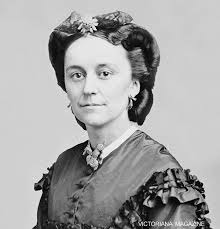
Example of mid-19th century headdress*

1852

Tuesday Feb 17th  This forenoon made me a headdress of Satin

ribbon of the colour of my hair and lace  Alsons

wife came to Augustus this forenoon and to Edwins this

afternoon  Called here awhile after dinner

Mrs Witherell S Ames & self spent the afternoon & evening

at Mr John Howards with Mr & Mrs Whitwell

Mr & Mrs Reed & Mrs Elizabeth Lothrop  Frederick

carried us down & [came] after us this evening

Bonnets may have been the most common covering for the heads of well-dressed mid-century females, but head gear of other persuasions was not to be ignored.  A fore-runner of today’s fascinators, light, decorative headdresses such as the one in the illustration above were very popular for certain indoor or evening outfits. Evelina must have enjoyed sewing one for herself, taking extra pleasure in how well it matched her own coloring.

Evelina’s father-in-law, Old Oliver, noted that this “was a fair day wind north west + cold.” The wind would have been somewhat behind them when the three sisters-in-law, Sarah Ames Witherell, Sarah Lothrop Ames, and Evelina were driven south in the afternoon by Fred Ames. The women visited a group of friends at the home of fellow Unitarians John and Caroline Howard.  The tea they must have been served there perhaps helped stoke them up for the cold drive back home into the wind.


*Courtesy of Library of Congress

February 16, 1852

Picture frame

Monday Feb 16th

1852

Susan washed the dishes this morning and I was

at work about the house most of the forenoon

Mrs Mary Williams came about eleven Oclock and 

staid to dinner  Called into Olivers and Edwins

with her  She returned to Joshua C Wm about three

and went home in the stage  Oliver tried to get

the coloured engraving smooth in the frame but could 

not  Mended Oakes Angier a vest


The new week opened with the usual domestic arrangements: Jane McHanna doing laundry, Susie Ames washing dishes and Evelina choring “about the house” in the morning.  A visitor, Mary Williams, arrived and stayed for midday dinner, then departed mid-afternoon on the local stagecoach .

With her son Oliver’s help, Evelina finished hanging the prints she had bought the week before in Boston. The new pieces of art were quite au courant; etchings, lithographs, and engravings were appearing on parlor walls across the country.  New printing technology – the same that promoted the appearance of so many new periodicals and serial novels – made the production and distribution of art prints easy. The subject matters varied from historical (like the famous image by Emanuel Gottlieb Leutze of Washington Crossing the Delaware, first painted in 1851) to religious to geographical to sentimental.  They were decorative and affordable, and the middle class flocked to buy them.

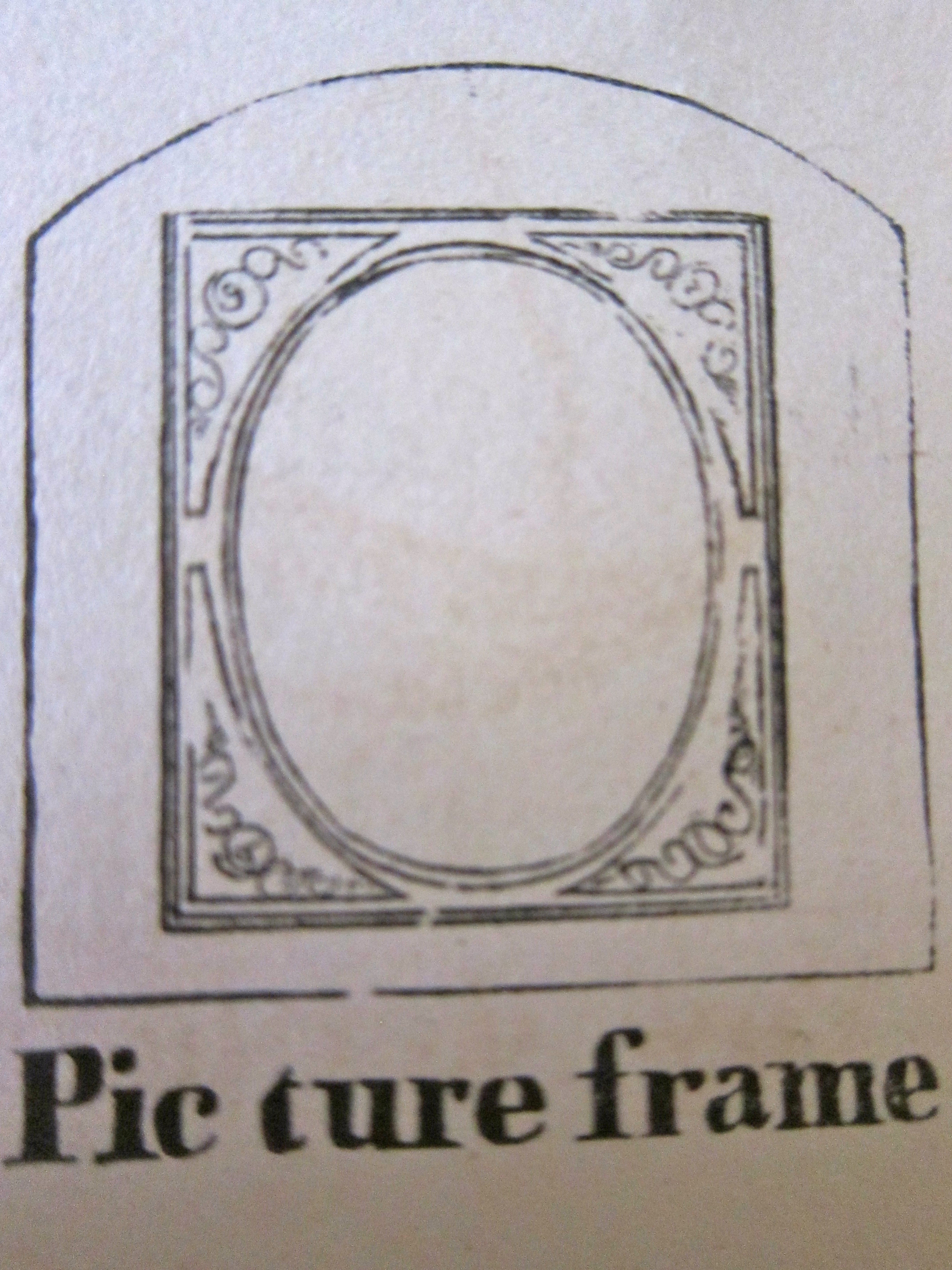
Subject matter, of course, was important; Evelina had purchased one print about Halloween (or All Hallows Eve as it was known). The prints had to be attractive and look handsome on the wall. But the decorative frames that went around the art work counted, too, and “were often considered more important than the prints themselves.”* It’s too bad that Oliver was having difficulty making one new print fit properly in its frame.

* Pierre-Lin Renie, The Image on the Wall: Decoration in the Nineteenth Century Interior, Nineteenth Century Art Worldwide

February 15, 1852

 lilliam_wald2

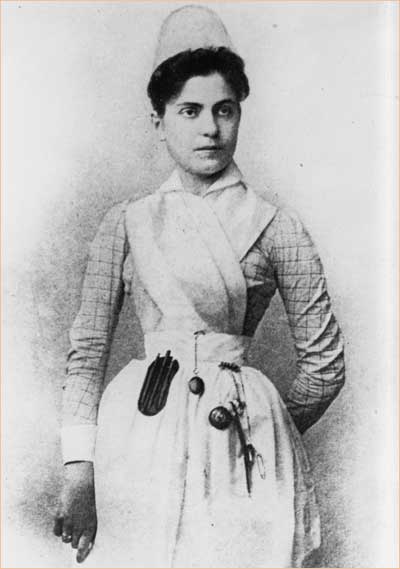
Nursing uniform from the late 19th c.*

1852

Sunday Feb 15th  Have been to church and at

noon went to Mr Baileys to see sister Amelia

who is nursing there  Mother went with me

Have been reading since meeting  Edwin & wife came

in to spend the evening but Mr Ames & self were

just going to Mr Swains and they would not let 

us stop for them so they went to Augustus  Had a 

pleasant call or rather visit at Mr Swains  came away

about nine Oclock  Very pleasant

The sun came out today, so despite it being “pritty cold,”** the Ames family went to church. During the intermission between morning and afternoon services, Evelina and her elderly mother, Hannah Lothrop Gilmore, rode out to visit Amelia Gilmore.  Amelia was the widow of Evelina’s brother, Joshua Gilmore, Jr. Joshua had died three years earlier, at age 35, leaving Amelia with two sons to raise.

In order to support herself and her boys, Amelia hired out as a nurse.  In this instance, she was looking after a Mr. Bailey, who must have lived near the Unitarian church. He may have lived alone, been ill and needed paid help; otherwise the convention of the day would have meant his female relatives looked after him. When Amelia wasn’t working, she and her youngest son, Samuel, lived with the Alger family near the Gilmore farm. The older son, Charles, had hired out somewhere but would soon come to reside with his uncle Alson Gilmore.

In 1852, nursing was not a formal profession.  Women (nursing was considered the exclusive province of women at the time) undertook nursing because they needed to work and this was one of very few avenues open to them. They based their protocol on personal experience in caring for ill members of their own families. There were no training programs or certification venues available, in no small part because there were so few hospitals. People were cared for at home. It would take the Crimean War in Europe and the Civil War in the U.S. to change attitudes and formalize medical care.

*Courtesy of http://www.nursinglink.monster.com

**Oliver Ames, Journal, Stonehill College Archives, Arnold Tofias Collection


February 14, 1852

 history

Detail of Cover of Gleason’s Pictorial, February, 1852

Sat Feb 14th  Finished Olivers shirt before dinner and did

some mending  About three went into Edwins and trimmed

a black silk cravat for Oliver  Mrs S Ames & Frederic

returned from New Bedford to night where they have been

since Tuesday  I spent most of the evening there

Evelina’s favorite periodicals, such as Gleason’s Pictorial, Godey’s Lady’s Magazine, and Graham’s, were full of allusions to Valentine’s Day this week. Gleason’s featured a valentine on its cover, in fact.  And while commercial Valentine cards hadn’t yet developed in the United States – that would happen in the 1870s – special letters and personal poems were popular on February 14. Yet Evelina makes no mention of receiving or sending a valentine, nor does she suggest that any of her children did, either.

Perhaps when Evelina went over to see Augusta Pool Gilmore, young bride of Evelina’s nephew Edwin Williams Gilmore, she found evidence of a valentine exchange between the newlyweds. Besides being in love and – presumably – open to sentimental expression, Augusta and Edwin were young enough to adopt new approaches to holidays that older Yankees like Evelina and Oakes ignored.

Meanwhile, winter was still very much present. As Old Oliver noted: “there was about half an inch of snow last night and it is cloud[y] + cold to day wind north west”

February 13, 1852


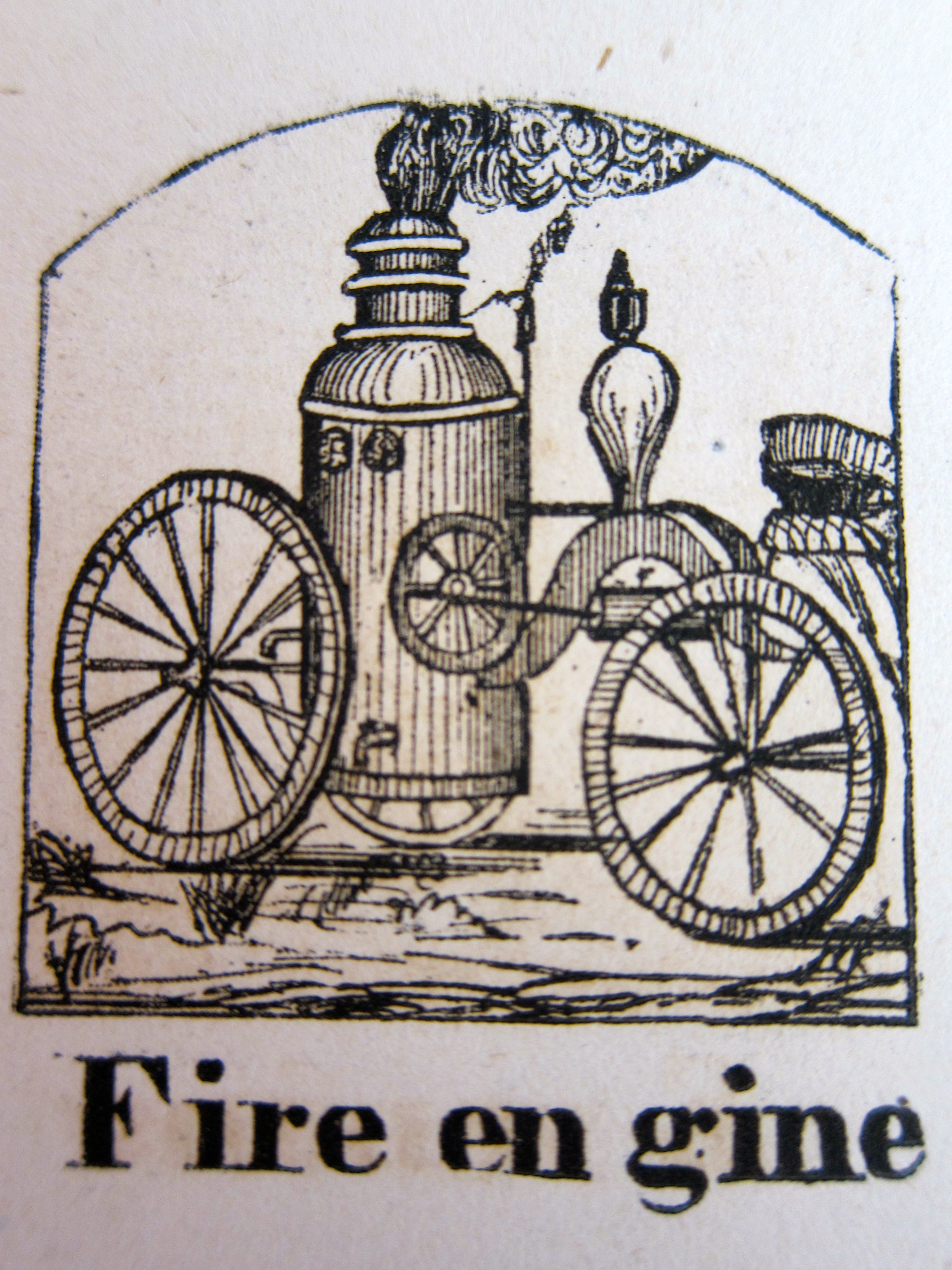
Fire engine

1852

Feb 13th  Friday  Have been to work on Olivers shirt

that I was intending to finish last week and have not

got it done yet  have scarcely got over my

Boston jaunt.  Carried my sewing into the other

half of the house awhile  Brother Oliver returned

from Boston to night & says the large machine

shop just back of Mr Orrs was burned last night

Mrs Witherell here about two hours this evening

A serious fire happened in Boston, as Oliver Ames Jr. reported when he got home. The family probably read about it in the city newspapers, including The Boston Atlas:

“FIRE. – Firemen Injured. – About 10 o’clock last night a fire was discovered in the upper part of a five story brick building, in the rear of No. 24 Kingston street. The fire broke out upon the upper floor, used for chair painting. The flames spread rapidly, and in a few minutes the roof fell in, pressing portions of the walls over the sides, the falling bricks injuring five firemen who were upon ladders directing the streams upon the fire, two of them very badly indeed. The third story was improved by the “Boston Laundry,” and was burnt out. The second story, occupied as Fox’s machine shop, and the first by Horace Jenkins, mason, were thoroughly drenched with water. The building, a sham built concern, is owned by Willard Sears. The wind was quite high and the weather freezing cold at the time, and the firemen deserve great credit for their well directed and energetic efforts in subduing the devouring elements, – and it is with pain and regret that we have to record injury to so many of their number: – John Smith, of Hydrant No. 2, very severely in the back and shoulders; Christian Karcher, Engine C. No. 1, badly bruised; Abraham Ross and James McCullis, of Hydrant Co. No. 3, bruised. Charles Ricker, of same company, received a severe injury in the back. It was reported that Smith’s and Ricker’s injuries are of a very serious nature. They were all carried into houses nearby, and medical aid procured.”

Then as now, fire was deadly serious.  John Smith died of his injuries three days later, Boston’s first modern fireman to suffer a Line of Duty Death.**

*The Boston Atlas, February 12, 1852

**http://www.bostonfirehistory.org, accessed Feb. 11, 2015

February 12, 1852

Abraham_Lincoln_by_Byers,_1858_-_crop

Abraham Lincoln (1809 – 1865)

ca. 1858

Feb 1852

Thursday 12th Had a number of calls quite early

Augustus Edwin & August[a] came to look at

the engravings and I began to think I never

should get the room in order.  This afternoon Oliver

hung the pictures.  Augusta came in and we called 

on Mrs J Wms about Olivers shirts that she is making

and at Augustus.  Mrs Lake called.  William returned home.

William Leonard Ames, brother of Oakes and Oliver Jr., “went home to day”*after a ten-day visit. William had most likely stayed with his sister Sarah Ames Witherell and father, Old Oliver, in the other part of the house. Yet today was the first day that Evelina mentioned his presence, suggesting, as before, that relations between Oakes and William were cool.  The men had had a parting of the ways over the demise of William’s iron company, and William had migrated to Minnesota.

Another person considerably west of North Easton was former U.S. Representative Abraham Lincoln who turned 43 today. He was practicing law. He had recently declined the offer of the Governorship of Oregon, and was beginning to settle back into a life away from politics. Future events – most notably, the passage of the Kansas-Nebraska Act in 1854 and his ongoing opposition to slavery – would reinvigorate his interest.

Evelina, meanwhile, concentrated on hanging her new engravings in the parlor, and showed them off to her nephews. She also checked on the status of some shirts she had ordered sewn for Oliver (3).

*Oliver Ames Journal, Stonehill College Archives, Arnold Tofias Collection


February 11, 1852

Rain

Feb 11th Wednesday  Returned from Boston to night very

much fatigued  It has rained poringly all

day and I was out shopping and most horrible

walking in the streets  Went to Doe & Hazleton

and bargained for a looking glass  bought an

all wool Delaine of Mr Norris  Mrs Witherell

was here some time this morning

Boston in February is subject to terrible weather, as Beantown residents in 2015 know all too well from recent record-breaking snow.  In 1852, heavy precipitation was also the rule, although on this particular day it didn’t snow, but “rained poringly.” Shopping suddenly wasn’t as much fun as it had been the past two days. Evelina found the going “most horrible,” but still managed to chase down some good buys.

She treked to an area of the city known as Cornhill – not Cornhill Street, or Lane, or Road, but just plain Cornhill.  This area of the city is now irrevocably altered, having been turned into Government Center, a modernistic architectural complex, in the 1970s.  Only a small portion of the original Cornhill known as Sears Crescent now remains. In the 1840s and 1850s, Cornhill was known as a center for Boston’s intelligentsia. Writers, poets, and book publishers gathered there.

In 1852, at number 42 to 48 Cornhill, there were also several retail shops, including one called Doe & Hazleton. Owned by Joseph Doe and J. M. Hazleton, the store specialized in “Decorative Furniture.” It was there that Evelina went and “bargained for” a mirror, to be delivered to North Easton in the near future.  She also bought some wool cloth from another Orr son-in-law, Caleb Norris, and probably had that delivered, as well.

By day’s end, Evelina was back in North Easton, “much fatigued” from her shopping.

February 10, 1852


thetouc2

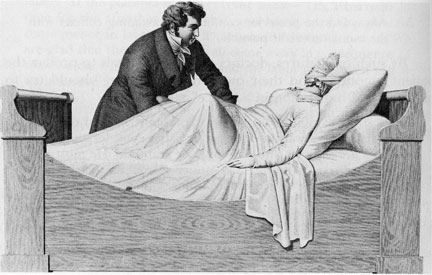
Physician-assisted childbirth, mid-19th century

Feb 10th, Tuesday

1852  Went out shopping about 11 Oclock staid untill

that time with Mrs Harris who was confined with

a daughter born about two Oclock.  looked at engraving

again today purchased Allhalloween  Oliver returned 

home to night but I did not get through with my

shopping and concluded to stop another night

Mr Harris came in the cars this afternoon heard of her

sickness just in time to take them  Oliver Jr called at Mr Orrs

While shopping for art in Boston with her son Oliver (3), Evelina had another memorable day. Per usual, she stayed with the Robert Orr family in the city. While there, one of the Orr daughters, Julianne Orr Harris, went into labor and gave birth to a girl.  Evelina stayed with Julianne for a time, which would have been normal in the older tradition of a “circle of women” being present at childbirth. Evelina’s timetable is a bit confusing, but it sounds as though she was there for much of the labor – or “sickness” –  if not at the actual delivery.

It’s likely that a male doctor presided at the birth, because by this period, especially in urban areas, physician-assisted births had become the rule rather than the exception. Midwives were phased out, although they never entirely disappeared. One result of this change was that strict propriety in the birthing room prevailed over medical accuracy, at least in the 19th century. Modern historian Jack Larkin notes:

“Embarrassment and constraint became part of the birth process; physicians were greatly hindered, as midwives had never been, by firmly established canons of female modesty. Men could not look directly at their patients’ genitals, but had to examine them only by touch while they remained fully clothed.Often deeply uncomfortable with a bedchamber full of women looking on – sometimes critically – doctors tried to persuade expectant mothers to clear them out of the birthing room.”

Julianne’s husband, Benjamin Winslow Harris, was away when his wife went into labor, but got a message, somehow, and just made the train home. He would not have participated in the birth itself, but he may have had a hand in the naming of his first child: Mary Harris, after his own mother.


*Jack Larkin, The Reshaping of Everyday Life,New York, 1988, p.97.


February 9, 1852


Boston_art_club_design_wm_emerson

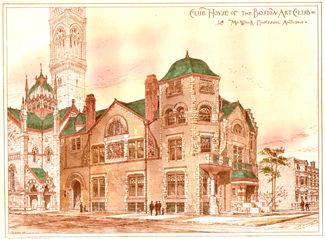
Architectural Rendering of Boston Art Club, ca. 1882

Feb 9th  Monday  Went to Boston with Oliver  spent

the forenoon in looking at pictures.  dined at

Mr Orrs.  Afternoon Mrs Stevens & Mrs Morse

went with us to look at pictures.  purchased 

two engravings one of them painted  returned to

Mr Orrs and spent the evening in playing 

cards  Very fine weather

Evelina’s boring Sunday in North Easton gave way to a few fun days of shopping in Boston. Leaving Jane McHanna to manage the house in her absence, she traveled into the city accompanied by her middle son, Oliver (3), the only son who wasn’t working. The two of them spent the day looking at “pictures” – prints and paintings, probably – and ended up buying two engravings. That one was “painted” meant that it had been hand-colored.

Where did they shop? At a gallery? At an artist’s studio? Amory Hall on Washington Street was one facility that accommodated artists at the time.Who was selling engravings in 1852? Readers, do you know?

It’s hardly arbitrary that Oliver (3) was the son who shopped for art with his mother. Besides being the only male in the family at liberty to take his mother into town, Oliver (3) loved art. He would collect paintings, prints and sculpture all through his life, in fact, especially after he and Anna C. Ray had married and built their large homes in North Easton and Boston. Before becoming governor, Oliver (3) traveled a great deal as a salesman for O. Ames and Sons and, in the process, bought art for himself at galleries in New York City and elsewhere. In the 1880s, he was also president of the Boston Art Club, an artists’ consortium begun in 1854 – 1855 that expanded to include wealthy patrons such as Oliver Ames.