November 10, 1851

255px-George_Sewall_Boutwell_by_Southworth_&_Hawes,_c1851_restored

George S. Boutwell, Governor of Massachusetts, 1850 – 1852

Daguerreotype by Southworth & Hawes, circa 1851


Monday Nov 10th  Election day and the whigs have got

whiped and look rather down.  It has been very

stormy.  Our new horse came home sick from town

meeting.  Oakes A, Mr Barrows & Augustus went to Taunton

this evening to carry & get the news.  Jane came home

from Mansfield to night.  Bridget is better to day

she has done the housework and I have cleaned

the shed chamber &c &c  Passed the evening at Olivers

There were full-bore politics in Massachusetts today, with the Whigs getting “whiped,” much to the disappointment of the Ames men and others. The politics of the era were untenable as the country cantered toward civil war. The Fugitive Slave Act and the Compromise of 1850, a misguided legislative expression of an unsustainable gulf between north and south, had resulted in upheaval and disarray among the existing political parties.

According to George S. Boutwell, then governor of Massachusetts, the Whigs – a pro-business, market-oriented group – had fallen into two camps over slavery: the Conscience Whigs and the Cotton Whigs.* The Conscience Whigs generally supported, and many eventually became, Free-Soilers (those who opposed the extension of slavery into new states or territories), while the Cotton Whigs held with the pro-slavery policies of the south. By 1855, a new Republican Party had risen from the ashes of the old Whigs, bringing along a few disenchanted Democrats and advocating many of the issues that Conscience Whigs had stood for. Oakes and Oliver Ames, Jr. became Republicans.

Although less well known today than fellow Massachusetts politician Charles Sumner, George Boutwell would go on to have a distinguished career, one that often involved interaction with the Ames brothers. A crackerjack lawyer by profession, an abolitionist by passion, he spent most of his life as a statesman. Besides being governor, he was, over time, the first head of the Internal Revenue Service, a member of the U.S. House of Representatives and the U.S. Senate, and Secretary of the Treasury under President Grant.  While in Congress, he would spearhead the impeachment of Andrew Johnson.

Also while in Congress, Boutwell would be approached by Oakes Ames to buy shares in the Union Pacific but, according to several period sources, he would turn the offer down because he thought it a poor investment. He left Congress in 1869 to serve as Secretary of the Treasury, a position he held during the Credit Mobilier scandal in 1873.  Ten years later, at the dedication of the Oakes Ames Memorial Hall in North Easton, Boutwell would speak in memory of Oakes, describing him as “tolerant of hostility, forgetful of injuries, and persistent in his friendships.”**

All this was ahead for the Ames men, Boutwell, and the nation.

*George S. Boutwell, Reminiscences of Sixty Years of Public Affairs, 1900

**Oakes Ames, A Memoir, 1883


November 9, 1851

Nurse


Sunday Nov 9th  Did not go to meeting to day on account of

Bridgets being sick.  Expected Mr Ames home at noon to carry

me this afternoon but he went off electioneering and 

forgot all about it.  This evening have been to Mrs

Swains with Mr Ames & Susan  Her nurse is there

and her brothers wife and daughter of about Susans

age  Mr & Mrs Meader returned home about a week since


Not only did Oakes Ames stop in Canton for a Whig meeting on Saturday, but he spent Sunday afternoon “electioneering” and forgot to go home at noon to take Evelina to church for the afternoon service.  In personal terms, this was not an auspicious beginning to his political career, but it was certainly indicative of the wholeheartedness and zeal with which he approached politics.  If Oakes and Evelina had, in fact, reached an understanding about his getting into politics – about which we can only conjecture – we have to wonder if that understanding had already been violated.  Yet Evelina’s diary is not particularly dispirited; she writes matter-of-factly and without obvious annoyance.  Perhaps she already understood and forgave her husband’s capacity for preoccupation.

After missing church in the morning because of a sick servant and in the afternoon because of an absent-minded husband, Evelina must have been pleased at last to go out in the evening. She, Oakes and their daughter Susie paid a call on Ann and John Swain, a younger couple who were relatively new in town.  New parents, their infant son was being tended by a nurse, while two relatives, the last remainders of a crowd who had arrived to tend at the birth, were still visiting.  Ellen Meader, a little girl about Susie’s age, was there with her mother, Sarah Bliss Meader, wife of Ann Swain’s brother, Reuben Meader.

November 8, 1851

Vegetables

Sat Nov 8th  Jane is still in Mansfield and Bridget

sick consequently I have to do the housework and

I have scarcely sat down for one moment  Alson

came up with a load of vegitables and Hannah

called and I left my work while they stopped

Mrs Witherell came home this evening and I have been

in there  Mr Ames went to Boston stopt at Canton to a

whig meeting.  Oakes & Frank brought him home.

Not only was the dependable Jane McHanna away, but the Ames’s second servant, Bridget O’Neil, was sick.  Dr. Ephraim Wales had checked in on Bridget the previous evening but she was still laying low.  Evelina, capable if disinclined, was faced with doing her own housework. She spent most of the day choring, as she called it.

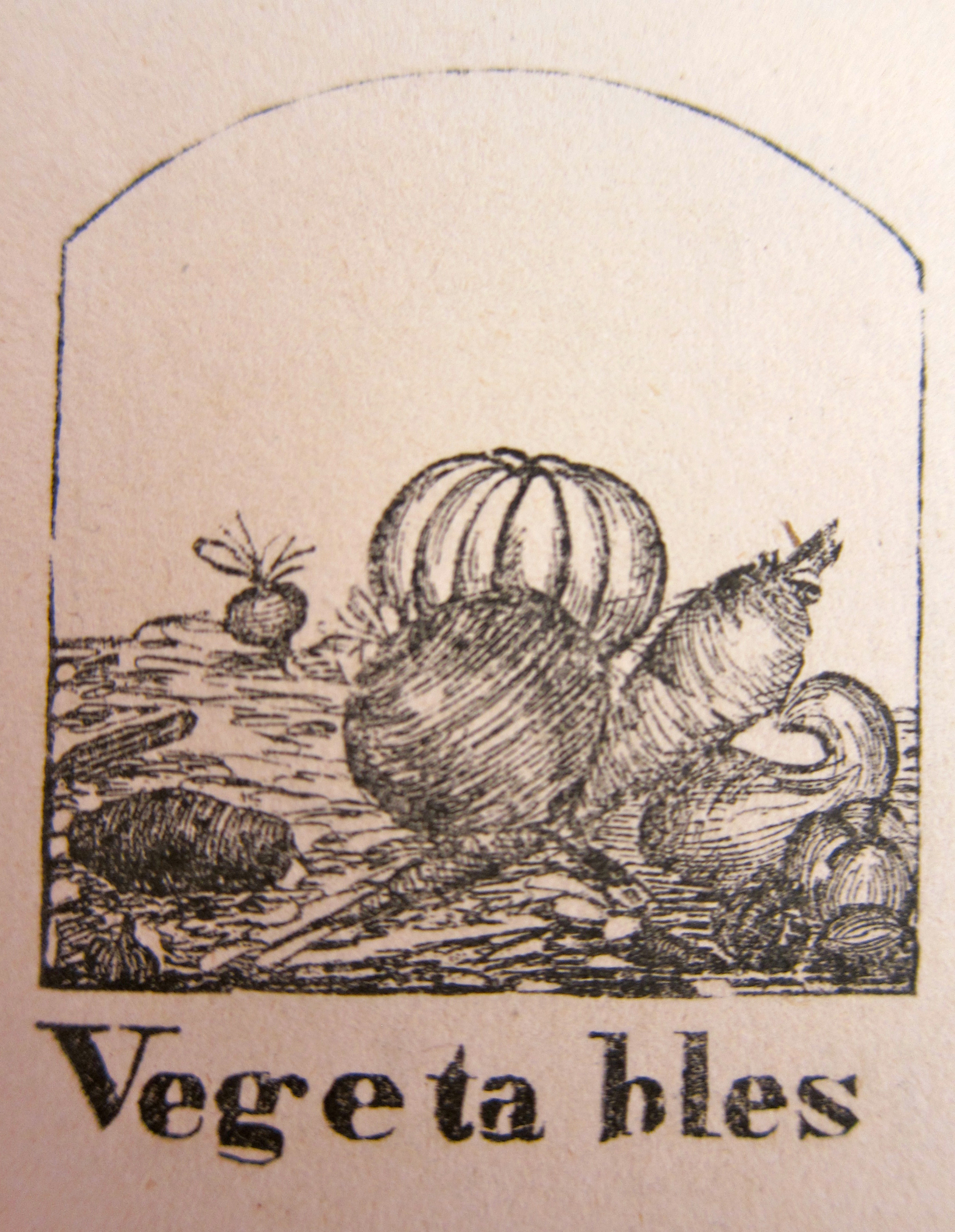
Her brother, Alson Gilmore, drove a wagon up from the Gilmore family farm to deliver a “load of vegitables” to the Ameses. His daughter-in-law, Hannah Lincoln Gilmore, who lived right in the village, came to call and for those visits, Evelina paused to chat.  Once they left, however, she must have plunged into sorting and storing the vegetables that Alson had brought. By this time of year, they would most likely have been root vegetables such as turnips, parsnips, carrots and potatoes. She would have stored them somewhere cool, dry and varmint-free: the cellar, if it wasn’t too wet, or the buttery or even the shed. Sharp-eyed housewife that she was, Evelina would have made sure everything was put away safely.

Oakes Ames, meanwhile, went to Boston as usual on this Saturday, but also “stopt at Canton to a whig meeting.”  The following Monday was Election Day and the party faithfuls were gathering in anticipation. This is the first mention in Evelina’s diary of Oakes’s participation in local politics. Their son, Oakes Angier, had shown interest earlier in the year, running unsuccessfully for the Easton school superintending committee, and attending the Whig convention in Springfield.  But her husband’s interest, although it had probably existed prior to this moment, had not drawn comment. Evelina mentions the meeting most likely because of the impending vote, but the statement coming so close on the heels of an undisclosed agreement she and Oakes had made only one week earlier gives creedence to the possibility that their agreement had something to do with Oakes’s waxing interest in politics.

November 7, 1851

330px-Quince


Friday Nov 7th  Mr Bartlett left in the stage this morning

and George & Mrs Witherell went to Boston I have made

13 lbs Quince preserve 4 lbs jelly and a lot of marmalade

and painted my leaf for the table and it has

kept me busy all day.  Jane went to Mansfield

yesterday with Mrs H & Ames. Bridget is here yet

was taken with a bad pain in her stomach this

evening & sent for her husband & Dr Wales

Mr. Bartlett of Maine departed the house this morning, and Sarah Ames Witherell rode into Boston with her fourteen-year old son, George Oliver Witherell. Her guests, too, had departed, and she was free to go into town.

Without assistance from servants Jane McHanna, who was away, or Bridget O’Neil, who was sick, Evelina stood over her stove today turning at least a peck of quinces into preserves, jelly and marmalade. The store of fruit would be an important addition to the Ames’s dinner table over the winter.  A period recipe for making quince preserves, from The Young Housekeeper’s Friend; Or, A Guide to Domestic Economy and Comfort reminds us of the challenges 19th century cooks faced when preserving food:

“Weigh a pound of best sugar for a pound of fruit, pared and cored.  Boil the fruit in water until it becomes so soft that care is necessary in taking it out. Drain the pieces a little as you take them from the water, and lay them into a jar […] Stone jars will do very well, but if glass is used, it is easy to see whether fermentation commences, without opening them.  Quinces done in this way are very elegant, about the color of oranges, and probably will not need scalding to keep them as long as you wish.  If any tendency to fermentation appears, as may be the case by the following May or June, set the jar (if it is in stone) into the oven after bread has been baked, and the quince will become a beautiful light red, and will keep almost any length of time.” *

Quince is a fruit that we Americans don’t see much of in the 21st century, but it was commonly used in the 19th.  A poor eating fruit, too sour to consume raw, it was high in pectin and kept well, once cooked.  In fact, quince was one of the earliest fruits to be made into marmalade; the word marmalade derives from marmelo, the Portuguese word for quince.**


Mrs. Cornelius, The Young Housekeeper’s Friend; Or, A Guide to Domestic Economy and Comfort, New York, 1845.

** “Quince,” Wikipedia, November 5, 2014


November 4, 1851

450px-Caraway_seed_cake


Tuesday Nov 4th  Put down the parlour carpet this

forenoon baked some cake &c &c  Mrs Buck &

Mrs Drake (formerly Lucy Reed) called about half

past eleven.  Mrs Hubbell & Ames & Mrs Witherell

Father were here to tea  They all dined

at Olivers.  Mrs Hubbell commenced knitting

me a hood. I have put the trimming on the sleeves

of Susans Delaine dress


The day was “cloudy […] + cold + chilly,”* according to Old Oliver, meaning that baking “cake &c &c” in the shared brick oven at the Ames compound might have been pleasurable.  At least it was one way to stay warm. It may still have been in the oven when Polly Buck and Lucy Drake, the former Reed sisters, came for a short call.  Local women, Polly was married to Benjamin Buck, who lived in the village; Lucy was the wife of Ebeneezer Drake.

In all likelihood, Evelina baked the cake – seed cake, perhaps – to serve at tea later in the day. She invited Mrs. Hubbell and Almira Ames, visitors from New York, as well as Sarah Witherell and “Father Ames” to join the family in their newly redecorated parlor. How happy Evelina must have been to show off the recent refurbishments.

Mrs. Hubbell and Almira Ames had midday dinner earlier in the day next door, at Sarah Lothrop and Oliver Ames Jr., a gathering to which Evelina and Oakes don’t appear to have been invited. In turn, Oliver Jr and Sarah Lothrop didn’t appear for tea at Evelina and Oakes’s. It may be that Evelina and Sarah Lothrop Ames agreed to split hospitality responsibilities for the day. Almira Ames was a favorite cousin who often came to visit; she had even lived with family for a period after Old Oliver’s wife, Susannah, died.


* Oliver Ames, Journal, Courtesy of Stonehill College Archives


November 5, 1851

Thread

Wednesday Nov 5th  This forenoon I painted the water pails and 

several kegs or butter firkins  Looked over my sheets

and put them in order.  Afternoon went to the sewing 

circle at Mr Horace Pools our last meeting for the 

season  Mrs Elijah Howard had the bag and we

had no work  We were invited to Mr Sheldons Mrs

Hubbell Ames & Witherell went  Father has

changed Dominic for another horse of Nelson Howard

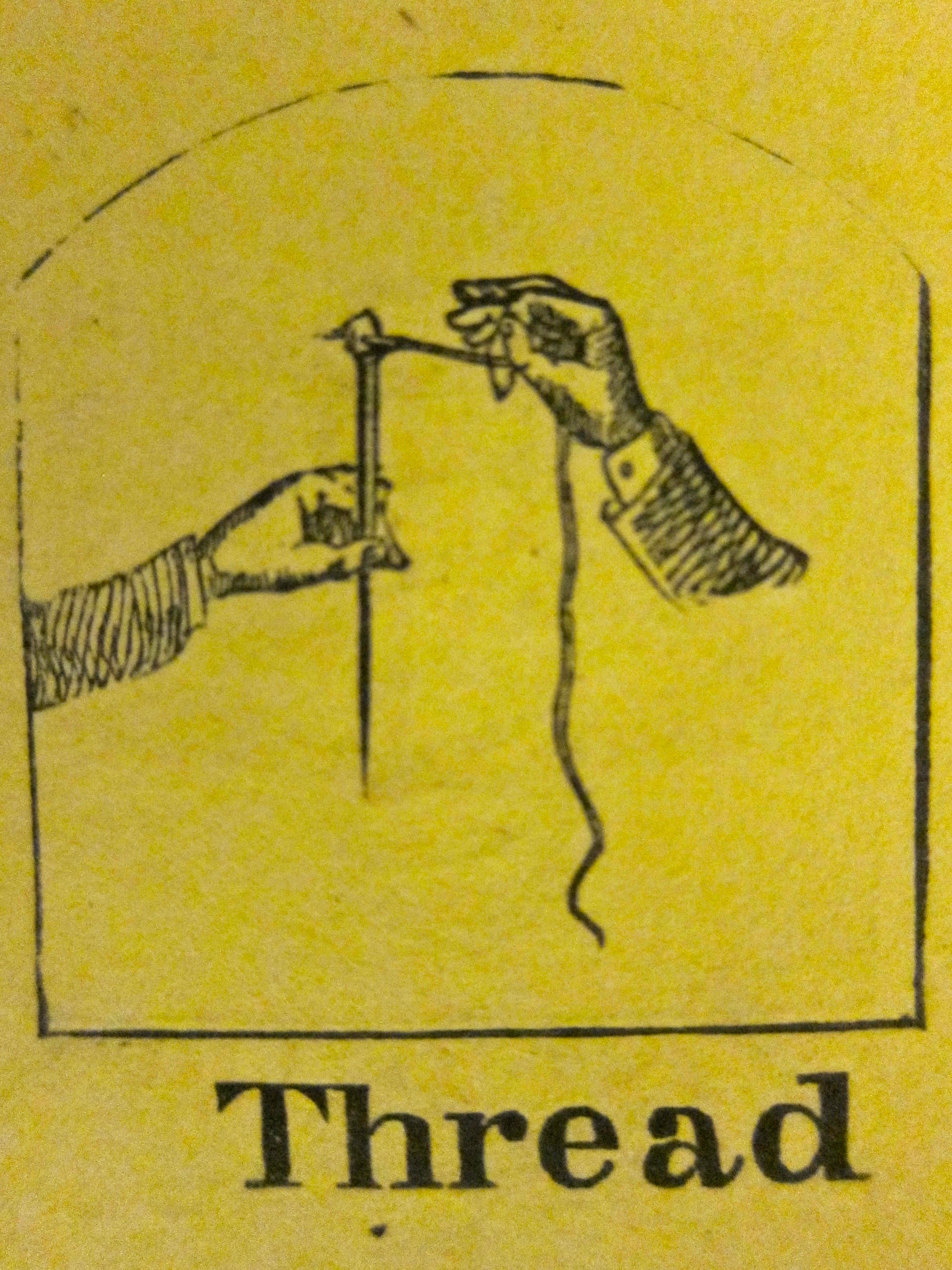
Evelina demonstrated her range of housekeeping skills today.  She put fresh paint on wooden pails, kegs and firkins for her pantry, cellar and shed, and organized her linen closet.  Her house was in order for the coming winter.

The last Sewing Circle of the year met this afternoon at Abby and Horace Pool’s house.  As always, the Unitarian ladies gathered in fellowship to sew and have tea, probably in the company of Rev. William Whitwell.  Today, however, they had no shared sewing to do, as Nancy Howard, whose turn it was to bring “the bag” of work, failed to deliver it.  No matter; the women seemed to cope.  Some went on to visit Luther Sheldon and, presumably, his wife Sarah.

The Reverend Luther Sheldon was the minister of the local Orthodox Congregational Church. A conservative and devout man in his mid-sixties, Sheldon had been involved two decades earlier in a controversial schism within Easton’s Congregational Church that resulted in the splitting off of a new congregation of Unitarians – including the Ameses.  Old Oliver and his sons had taken a leading role in encouraging Unitarianism, and made some enemies in the process.  Rev. William Chaffin, who came to town many years later, included an extensive examination of the controversy in his 1866 town history.

What did Old Oliver think of his daughter, Sarah Witherell, and their houseguests paying a call on the Sheldons? Or did he pay any attention at all to their socializing?  He may have been too busy horse-trading.


November 6, 1851

OLYMPUS DIGITAL CAMERA

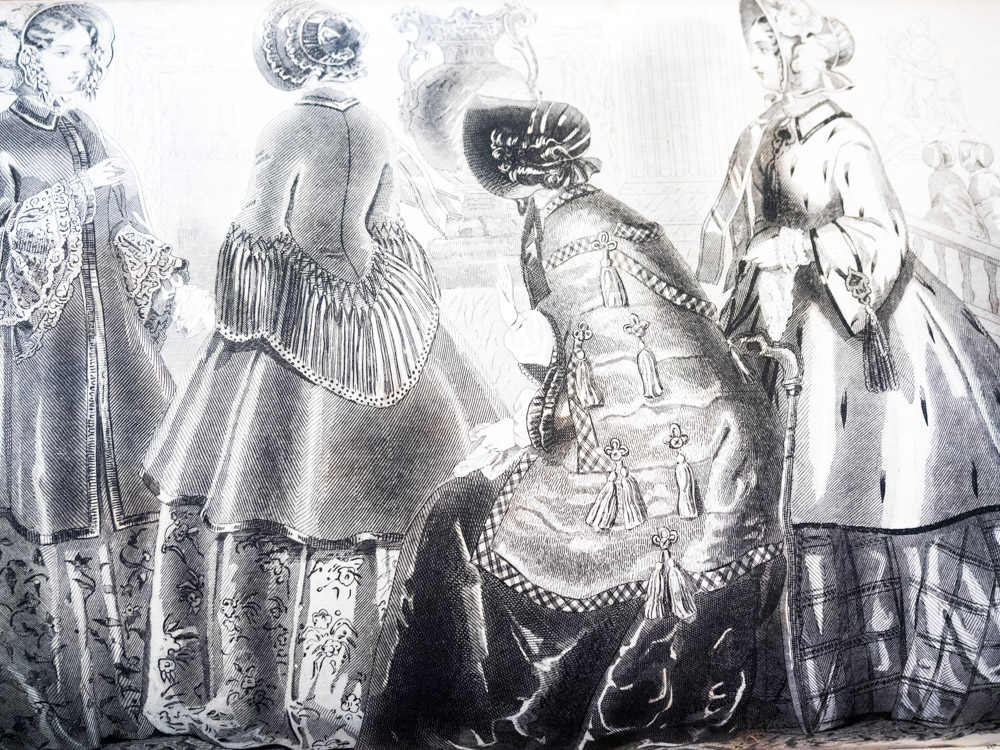
Winter wear from Godey’s Lady’s Book, November, 1851


Thurs Nov 6th  Worked about the house awhile this

morning and about eleven went into the

other part of the house to sit with the ladies

sewed the shirt onto my delaine dress.

Mrs Hubbell & Mrs Ames returned to New York

this afternoon  After they left Mrs S Ames &

self called on Mrs Swain & we went

to Augustus  Mr Bartlett is here will spend the night


After a morning of choring, sewing, and visiting, the Ames women were out and about this afternoon under fair skies. Houseguests Mrs. Hubbell and Almira (Mrs. George) Ames were carried to Mansfield to catch the train for New York.  No doubt they had on their best traveling dresses for the journey. They had been visiting Sarah Witherell and Old Oliver for better than a week.  Servant Jane McHanna traveled with them as far as Mansfield.

After midday dinner, Evelina joined another sister-in-law, Sarah Lothrop Ames, to pay a call on their young friend, Ann Swain.  Mrs. Swain, the wife of the new Ames clerk, John Swain, was a new mother already doting on her first-born son. There would be many visits to ooh and aah over the infant.  Similar oohing and aahing might have been dispensed at their second afternoon call, this one to Augustus Gilmore, his wife Hannah, and her three month old son, Willie.  Even if obligatory, surely these visits were preferable to the calls that the Ames women also made on the sick and the dying.


November 3, 2014: We interrupt this service!

No Evelina for a few days, folks. So sorry! A windy,wintry storm has knocked out many power lines in our coastal town,meaning that we have no electricity, one fireplace and no ready access to the internet. This quick message is being typed out on a laptop in a crowded internet cafe two towns away from our cold house.  It took us thirty minutes to drive here and another fifteen minutes to cadge a table where we now sit in short-lived communication with the cloud. We can watch other patient folks in wool caps standing in line waiting for their mochas and cafe lattes, eyeing the occupied wooden tables – including ours – hoping one will become available just as they pick up their steaming mugs.

So, quickly, look for Evelina again on November 6, when we hope our internet will be back up.

While we wait for our normal life to resume, we contemplate and discuss how accustomed we are to 21st century life, even though I, for one, spend everyday thinking and writing about life in the 19th. I think about what it must have been like to live without electricity, or electronic communication, or cappuccino on demand. I think how unaccustomed we are to acknowledging nature’s power over us. We played backgammon by candlelight last night – that wasn’t all bad!

I think Evelina was smarter than we are in many ways.  She and all the 19th century Ameses were much closer to the weather, and certainly lacked the 21st hubris that wants to control it. If she were to come back today, I wager she’d be one of the first to notice climate change. I imagine how she would cope with a stormy day and its inconveniences, and suspect she’d just pick up her sewing and get on with her work.

November 3, 1851

OilCloth

*

Monday Nov 3d  I have been working about the house all day

Varnished all the strips of oilcloth and put

down the stair and the bedroom carpets painted

and varnished some of the sills of the doors

Mrs Hubbell & Ames Father & /Sarah W were at

tea in Olivers  I did not get a chance to go untill

this evening.  Made Susans waist larger by putting

a piece in front


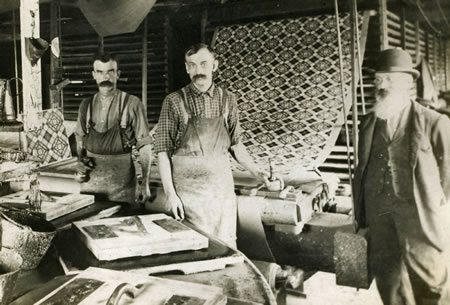
It was Monday, so servant Jane McHanna washed the laundry. By herself, meanwhile, Evelina worked on the floors.  She varnished oilcloth – presumably to go on the floors – and laid it and other carpet on the stairs and in the bedrooms, also painting the sills in process. She was on her knees for most of the day although she did find time for a bit of sewing.

Oilcloth was relatively waterproof, and thus a favorite protection for floors in areas, like an entryway, that were apt to get wet.  It was a common household item, even well into the twentieth century when it was used for table coverings as well, although its composition altered over the years. In 1851, oil cloth was made from close-woven cotton duck or linen that was coated of boiled linseed oil to make it waterproof.** It was generally purchased already coated, but some enterprising householders could have coated it themselves.  The linseed oil carried lead, however, not that that would have worried people in 1851 the way it would worry people in 2014.


Oilcloth Factory, 19th c., Hallowell, Maine, Courtesy of Hubbard Free Library Collection

** Wikipedia, October 30, 2014

November 2, 1851

IMG_0540

1851

Sunday Nov 2d  This has been a stormy day, but this evening

has cleared off pleasant  I have been to meeting all

day & went to Mrs John Howards at noon with

Lavinia & Mother  Mr Ames came home at noon and it rained

so hard that he did not go back.  Mr Whitwell

gave us two fine sermons.  Mr Ames & self passed

the evening at Augustus.  Have made an agreement

which I hope we shall both be careful to keep.

At the end of this rainy, chilly Sunday at the start of November, “the most disagreeable month in the whole year,” according to the fictional Margaret March, eldest of Louisa May Alcott’s four sisters in “Little Women,” our non-fictional Evelina and her husband, Oakes, reached an important decision.  Unfortunately, we don’t know what that decision was.

Surely this entry is one of the most tantalizing in Evelina’s diary. She and Oakes “made an agreement” that she hoped they’d “both be careful to keep.”  What did they decide? What promises did they exchange? Oakes had been away from home a great deal lately; did their discussion stem from that? Was this the moment when Oakes determined to become involved in regional politics? Would he have needed Evelina’s approval?  If this was the case, what might he have asked of her, or offered her in exchange?

Or was the decision less historic and more pedestrian? Did their discussion have anything to do with domestic arrangements or the recent spending on the house? Were they going to exercise more prudent care of their “accounts,” as Evelina calls them? Did their agreement have something to do with their children? Did it stem from something Reverend Whitwell said in one of his “fine sermons”? What was this agreement?

And were they able to keep it?