August 21, 1851

PINEAPPL-h

*

Thurs 21st Aug  This morning sat down to work quite early

finished my purple morning dress and 

Susans pink print that was made over

Pauline is not willing that I should work

much  She has had the offer of marriage

from a Mr Stowe of Concord Mass & the same

is an offer from John Reed, an old man of

70 years  She is very fascinating  Mrs Witherell

& Mitchell went to Boston for paper for parlour

Evelina had a houseguest who wasn’t interested in sewing, but that didn’t prevent her from finishing two dresses she’d been working on. She was caught up with the romantic dilemma of her friend, Pauline Dean, who was considering two offers of marriage. Evelina’s daily life was so far from being romantic that she found Pauline’s tales “very fascinating.”

We don’t know much about Pauline Dean, except that she corresponded with Evelina and visited periodically. We don’t know where or how Pauline lived, but we can surmise that she was originally from the Easton area. She was familiar with the town and several of its inhabitants; perhaps she was related to one of the Dean families in the area.

While Evelina and Pauline visited, sisters Sarah Witherell and Harriett Mitchell went into the city in search of wallpaper. Sarah was looking to replace the wallpaper she had only recently put up in her parlour; she didn’t like it or the way it had been hung. The wallpaper in the illustration above is circa 1845 and demonstrates the prevailing ornate taste of the time.

Adelphiapaperhanging.com 

August 20, 1851

Scales

Weds 20th Aug  Rachel, Lavinia and Augusta Pool spent

the day here  Mr Ames and Augustus went to Boston

Pauline Dean came to night in the stage

appears the same as she did when she left

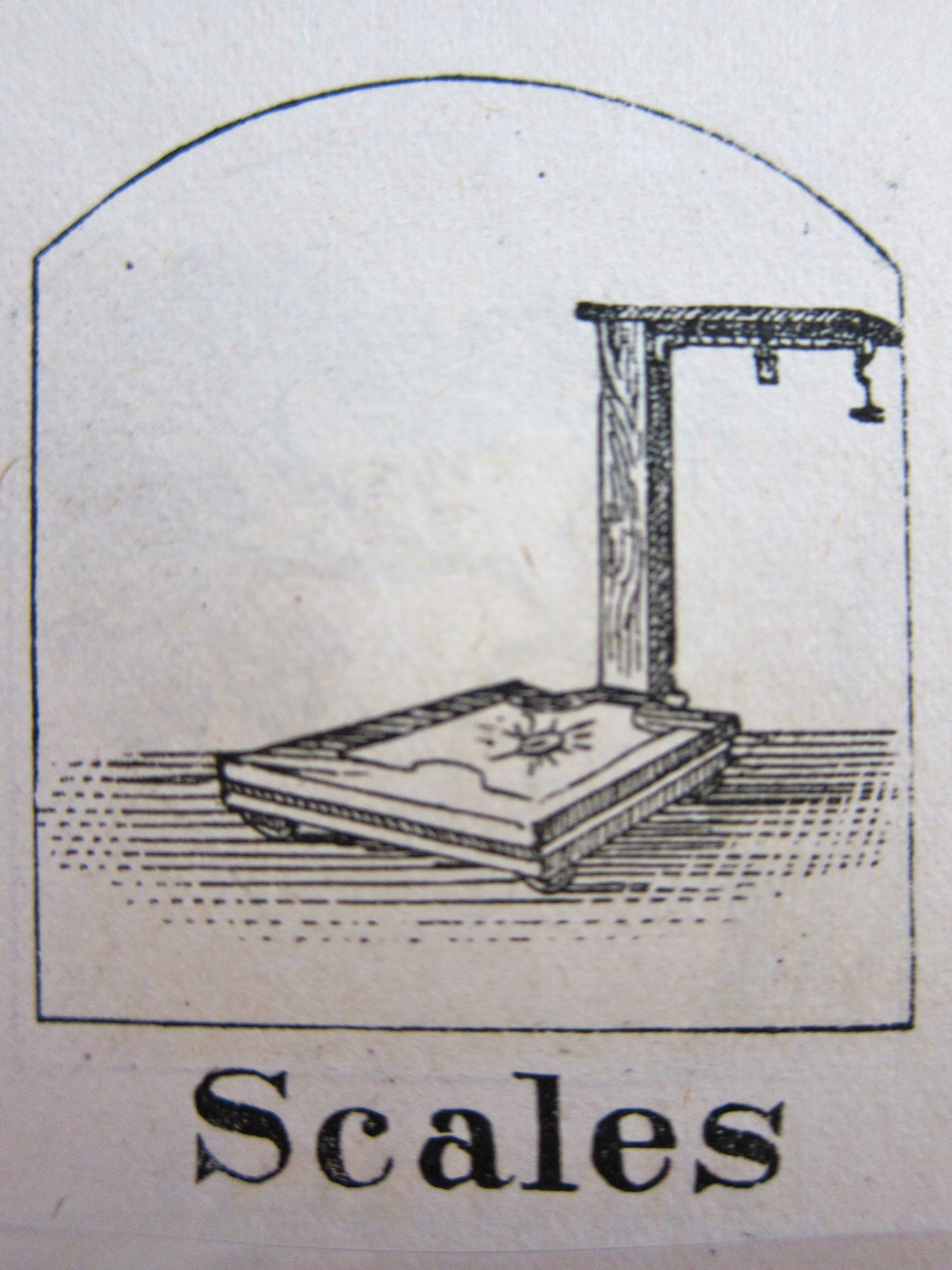
Went to the store & was weighed  148 lbs

called at the factory to see Edwin work and he came to

tea  Mr Whitwell called while we were gone

Not shy, Evelina stepped on the scale at the company store.  Fully clothed in the voluminous fashion of the day, she weighed 148 pounds. Given that her dress was full-skirted and worn over a chemise, undersleeves and petticoats, and that she wore a bonnet and most likely kept her hose and shoes on, her actual weight was probably several pounds less than she reported.  She likely weighed closer to 140.

Evelina missed a visit from Reverend Whitwell today, as she was out and about with young female company.  Two nieces, Lavinia Gilmore and Rachel Gilmore Pool, came over with Rachel’s sister-in-law, Augusta Pool.  They were ages 19, 21, and 22, respectively. They visited the store, shopped, perhaps, and watched their aunt get weighed. Perhaps they got weighed themselves. It might have been a lively time as they chatted and moved back and forth.

From the store the group traipsed to the shovel factory to watch Evelina’s nephew and Lavinia and Rachel’s brother, Edwin Williams Gilmore, work – an unusual visit to say the least, and one that could only have been accomplished in the company of the boss’s wife. What did the workmen think?

Edwin, nearly 23, would not work at the shovel shop for long. By 1854 he would be manufacturing hinges along with business partners Oakes and Oliver Ames Jr., whom he would eventually buy out. All that was in his future; today he would join his sisters and their friend Augusta for tea at his aunt’s.

August 19, 1851

4gbhistory


*

Tues 19th Aug  Sat down quite early to fix some work for

Ellen, about 11 Oclock Mrs Norris and a Mr Young from

Bridgewater came  Dined here and left about three

they wanted the boys to go Fishing Thursday but Clinton Lothrop

is not expected to live through the day and they

thought it best to defer going untill Monday

Mrs Witherell & Mitchell & myself went into

school this afternoon  Very warm

Melinda Orr Norris and a Mr. Young had midday dinner with the Ameses, during which they invited the Ames sons to go fishing. The boys accepted but deferred the trip to the following week.  Clinton Lothrop, their Aunt Sarah Lothrop Ames’s younger brother, was deathly ill and they wanted to wait until after his anticipated passing.

It was a hot summer day, with no such thing as air conditioning or window fans. In their full-skirted dresses, the Ames women surely were hot as they chored around the house or sat with visitors. They possibly opened their parlor windows to let in some air, but would have let in the insects, too, if they did so.  “Wove wire” had appeared here and there on the market as an alternative to horsehair weaves, but wouldn’t be commonplace until the Civil War. Around 1861, Gilbert & Bennet, a sieve-making firm in Georgetown, Connecticut, lost its southern customers and began to manufacture window screens as a way to use its surplus wire mesh cloth. Window screens took off. Before then, how did people cope?

Evelina and her sisters-in-law, Sarah Witherell and Harriett Mitchell, left the closed air of their homes and went to the local school house in the afternoon. Evelina doesn’t explain the purpose of the trip. Surely the hot sun beat down on them outdoors, but their bonnets kept their heads protected, at least.

* Gilbert & Bennet’s Red Mill on the Norwalk River where woven wire cloth was first developed as a commercial substitute for horsehair. Photo from historyofredding.com.  

August 18, 1851

Churn

Monday Aug 18th  Jane washed this morning and had Ellen

to assist so I sat down quite early to sewing

cut out a chimise for Ellen to make

This afternoon went to Mr Whitwells to tea

Mr Ames was going to Bridgewater and I

rode there with him.  Called at Mr Harveys

to try to get some butter but she had none

to spare.  Hurried home expecting Pauline she did

not come  Mr & Mrs George Lothrop came to Olivers 

The new servant, Ellen, helped Jane McHanna with the laundry today. Evelina stayed out of the way and concentrated on her sewing, setting work aside for Ellen to do later. She needed another chemise.

In the afternoon Evelina went to the Whitwells’ for tea.  She had just been there the day before during the intermission between church services. Today Oakes accompanied her and the two went on from there to Bridgewater.  Evelina was hoping to buy some butter from a Mr or Mrs Harvey, but had no luck. Evidently no longer producing butter herself, she’s had to travel this summer to find it. Oakes, meanwhile, was on his way to Bridgewater on shovel business – or Whig politics.

Not yet alluded to in Evelina’s diary is the illness of one of Sarah Lothrop Ames’s brothers, Dewitt Clinton Lothrop. Clinton, as he was known, was deathly ill with typhus fever. Another Lothrop brother, George Van Ness Lothrop and his wife, Almira Strong Lothrop, had come back to town from Detroit on Clinton’s account.


August 17, 1851


Marriage

Sunday 17 Aug  Went to meeting all day  At noon I went

with Henrietta to Mr Whitwells passed a very

pleasant intermission  Mother was at meeting

went home with Mrs Curtis  Orinthia came

home having a severe toothache  Frank carried

her back to Mr Howards and staid untill

nearly ten  It is very dark & stormy to night

has stormed all day.  Margaret Norton married.

As on so many other Sundays, the Ames family went to church.  Evelina stayed for both services and spent the intermission with her sister-in-law, Henrietta Williams Gilmore at the parish house. Eliza Whitwell, the minister wife, no doubt offered them a cup of tea and other refreshments. Evelina’s mother probably sat with them, too, before leaving for the Gilmore farm.

Old Mrs. Gilmore and her daughter-in-law, Henrietta, may have been privy to a marriage ceremony later in the day, when a servant of the Gilmores named Margaret Norton was married. Before the Civil War, it was customary for marriages to take place at home. As historian Jack Larkin has noted, “Most American couples were wed by a clergyman at the home of the bride, in […an] informal ceremon[y] of republican simplicity.”* But Margaret, besides having no home of her own, was from Ireland and thus probably Catholic. She may have been obliged by Catholic practice to marry in the church, possibly the new church that had just been built.

Orinthia Foss did not have such a pleasant day. She came down with a “severe toothache” and had to go home.  Frank Morton Ames offered his services as driver and stayed out late, his mother noted. Lively young man that he was, he wasn’t inclined to turn in early. Was it the stormy weather or the company of Ellen Howard and Orinthia that held him at the Howards’s house? Did Evelina wait up for him?  Or did his father wait up for him?  How did that go?

*Jack Larkin, The Reshaping of Everyday Life: 1790 – 1840, New York, 1988, p. 63.


August 16, 1851

Tub

Sat 16th Aug  Have been to work on my white loose dress

that Julia cut out some time since and it is ready for

the washtub  Frank and Oliver came from Bridgewater about

three and brought home Charles Mitchell & Sister Harriet

Mr Brett two Miss Tolmans from New Bedford Jane & William

Howard & Orinthia came & went to the shop about 5 Oclock

The party at Robbins Pond in Bridgewater may have ended, but the festive mood continued.  Oakes Angier Ames headed into Boston, but his brothers Oliver (3) and Frank Morton returned from Bridgewater with their Aunt Harriett and her brother-in-law, Charles Mitchell and, perhaps, others. At the same time or maybe just a short while later, Orinthia Foss and a spill of friends to whom Evelina had been introduced only a few days earlier arrived and went to the factory.

Why this sociable group visited the shovel factory at the end of the day is a mystery. Were they delivering the Ames brothers back to work? Were they visiting someone else there? Did Oakes or Oliver Jr. find it amusing? Was Old Oliver privy to this after-party?

Evelina, meanwhile, was working on her wardrobe and was ready to put a new dress into the washtub.  She might have looked up from her sewing to see the young people drive by.


August 15, 1851

Vintage Ames Shovel

Vintage Ames Shovel

Friday 15th Aug  Julia here to work to day cutting me

a purple loos dress & cutting a pink french

calico for Susan.  Made a childs waist to it.

Oakes Frank & Oliver went this afternoon

to Robbins pond in E Bridgewater to a party.

Oakes A is to go from there to Boston tomorrow

I have passed the afternoon at Mr Peckhams

had a pleasant visit

Robbins Pond, where the Ames sons and their Aunt Harriett went today for a party, is in Bridgewater and is known today for its bass fishing.  Who hosted the party there in 1851 isn’t known, but all the Ameses, including Evelina, were invited.  Evelina declined, however, suggesting yesterday that she might enjoy herself too much if she went. She went to call on the Peckhams instead.

On a much more serious note, today marks the one year anniversary of a terrible accident at the shovel factory. According to Old Oliver, an employee named William Loftis “was hurt so bad yesterday by leting a shovel catch in the polishing wheel that he dyed.” Loftis was an illiterate laborer in his late twenties. Like the Middleton and Maccready families with whom he lived, he had immigrated from Ireland.

Old Oliver seemed to blame Loftis for getting caught in the machinery, perhaps through inattention or carelessness. He doesn’t suggest that the factory was at all at fault, or that the machinery could be reconfigured in a way to make it less dangerous. As far as Old Oliver and most factory owners at the time were concerned, employment carried a certain level of risk, risk that was assumed by any man who received a pay check.

It’s doubtful that the Ames family was indifferent to the fate of William Loftis, however. It’s likely that Evelina or one of her sisters-in-law sewed a shroud for the body for a proper burial. Knowing Oakes Ames’s instinctive kindness to strangers and employees, he probably would have reached out to Loftis’s family. The absence of a widow and children, however, suggests that Loftis was simply buried and simply forgotten.


August 14, 1851

IMG_2478

Thursday 14th  Worked about house awhile and then went

to sewing & fixing some work for Ellen cut a 

chimise for self &c. Charles Mitchell brought

Sister Harriet and Johnny from Bridgewater

Harriet has gone back to attend a party 

at Robbins pond tomorrow.  We all have an

invitation but I think I had best not go though

it would give me pleasure

Evelina put out some fabric today for the new girl, Ellen, to cut into pattern pieces. She noted that her sister-in-law, Harriett Ames Mitchell, came over briefly from Bridgewater with her middle child, John Ames Mitchell, but soon went back to prepare for a party.

Although his birthday went unmentioned in the diary, Frank Morton Ames, the third child of Evelina and Oakes Ames, turned 18 today. Taking his place in a patriarchal society behind two bright older brothers, Frank had to vie for recognition almost from the beginning. Like Oakes Angier and Oliver (3), Frank attended local and boarding school, in the latter case Andover, and had just completed his schooling the year before Evelina took up her diary.

Unlike Oakes Angier and Oliver (3), Frank was a troublemaker “who needed more discipline.”  According to historian William Chaffin, Frank and a friend once sneaked out of their respective homes, took a horse and buggy to a dance in Canton, and returned “very late.” When Oakes Ames learned about it, he and the other father, William S. Andrews, took their sons down to the shop where they “were horsewhipped in the presence of the workmen.”  As Chaffin notes, “Discipline was apt to be severe in those days.”*

One of the pleasures of Frank’s life was his participation in the local militia, a company of which was formed in 1852.  Again he had to stand behind a brother, in this case Oliver (3), who was made captain while he was appointed quartermaster, but eventually Frank made major. He resigned that position in 1860, by which time he was married and living in Canton.  Neither he nor his brothers served in the Civil War.

Frank would go on to have checkered success in several fields away from the shovel factory. With his brothers, he worked to rebuild his father’s reputation.  Despite the severity of treatment he had experienced from his father, he remained devoted to Oakes’s memory.

* William Chaffin, “Oakes Ames 1804-1873”, private publication


August 13, 1851

OLYMPUS DIGITAL CAMERA

Wednesday 13th  Went to Mrs Holmes early this morning to

make her bed & tie her hair and was there most

of the forenoon.  Passed the afternoon at Major

Seba Howards with Mrs S Ames.  Met a Mr & Miss

Howard from Philadelphia two Miss Tolmans from

New Bedford & Henrietta & Mrs Lewis Keith.  Mr & Miss

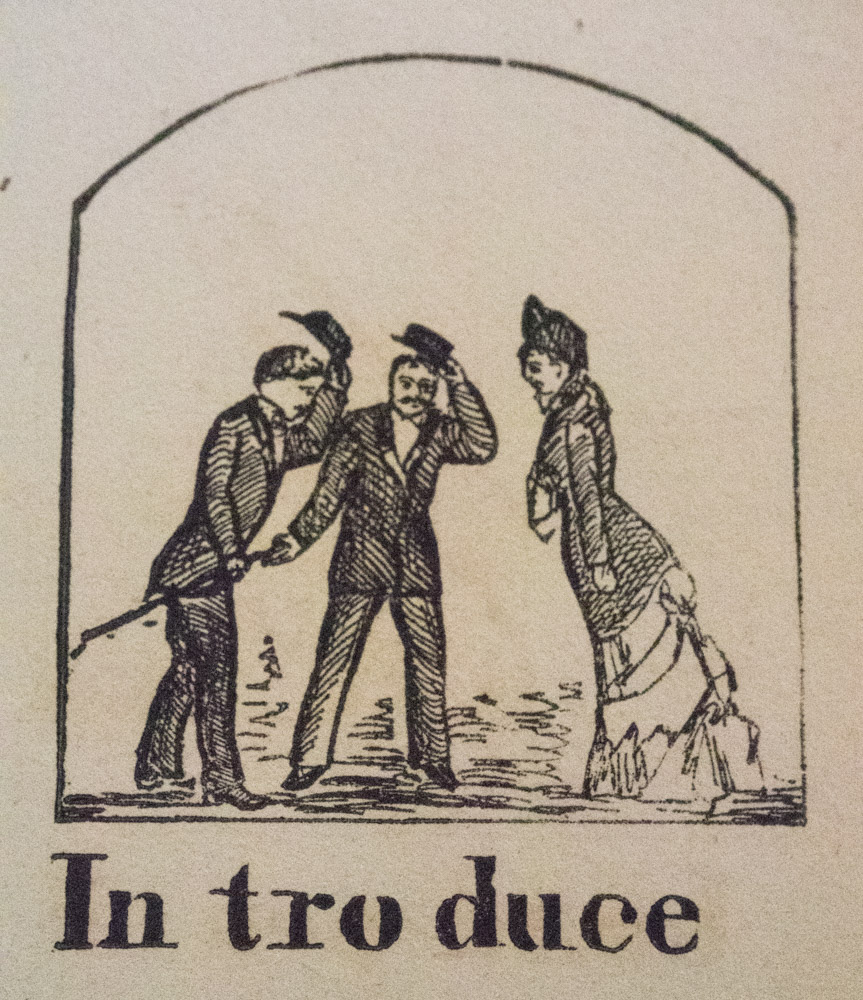
Howard are very pleasant.  Had an introduction

to Mr Brett

First thing after breakfast, Evelina went to see Harriet Holmes, a neighbor who was seriously ill.  As she had done on other days, she made Harriet’s bed and tied up her hair. She spent the morning there, probably giving others in the household – specifically Harriet’s mother-in-law, Mrs. Holmes – some time off.  Presumably Mrs. Holmes or her son, Bradford, had kept watch the night before.

Everyone’s vigilance was rewarded, as Harriet Holmes began to improve. Whatever it was that had made her sick began to abate. This would be the last visit that Evelina made to the house or, at least, the last one she made note of. Harriet would recover.

Evelina must have been relieved. She was certainly optimistic enough to set aside her care-giving and dedicate the afternoon to socializing.  She and her sister-in-law, Sarah Lothrop Ames, called on Major Seba Howard and his wife, Eleutheria. There they were introduced to several guests, some of whom were “very pleasant.”  The afternoon was a much needed change of pace after the worry of the past several days.


August 12, 1851

Write


Tues Aug 12th  Mrs Thompson & Mrs Holmes his mother are at Mrs Holmes

and I did not stop long this morning but about

three they sent for me to come as quick as I could

She was much worse but by the time I got there

she was better and I stoped untill night & left

her very comfortable.  came home & wrote a letter

to Abby Eaton for her to come there

Harriet Holmes had been bedridden for a week with an acute, unnamed illness.  She was sick enough to require regular care by friends and neighbors, including, most recently, her mother-in-law, Mrs. Holmes, who was brought over from Canton.  Mrs. Holmes, along with a Mrs. Thompson, became worried enough about Harriet’s condition to send for Evelina around three o’clock..

Evelina responded quickly, it would appear, but the crisis was over by the time she got to the Holmes’s. She stayed, however, to be certain that Harriet was, indeed, better.  She returned home after dark and wrote to someone – another relative, perhaps – named Abby Eaton to come and help.

Evelina, Bradford Holmes, and others – with the exception yesterday of an “unfeeling” aunt – had all acted as carefully and expeditiously as possible in tending to Harriet. Mr. Holmes drove a team of oxen to fetch help for his wife and Evelina wrote a letter to summon a relative, which was the best they could do. Their options were slow and terribly limited.

Today we see medical care, especially emergency care, in terms of how quickly a condition may be addressed, or how many minutes it takes for help to arrive. In 1851, it was a matter of hours,even days sometimes, before help could arrive.  How skilled the help was and how effective the treatment was another big question. In Harriet Holmes’s case, no one tending her was professionally trained. They were caring but powerless. Harriet Holmes would get better, or she wouldn’t; modern medicine and first responders would have nothing to do with the outcome.