April 10, 1851


photo

1851

April 10th Thursday  This day is Fast but no one would

think it by the way I have spent it.  I have

moved the bed from the dark bedroom and 

put it in Franks chamber and moved his

cot into Oakes & Olivers chamber for a few

weeks Oakes A Lavinia Orinthia & Susan went

over to the Methodist meeting house to a sing & called

on Ellen H took her with them.  Weather Pleasant

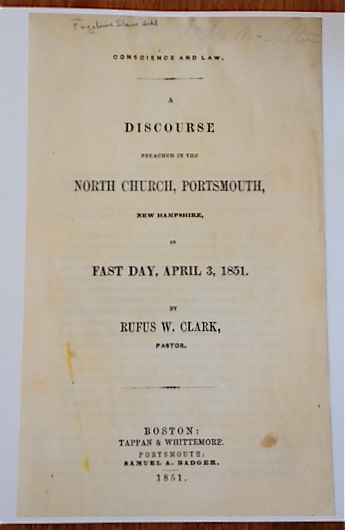
For nearly 275 years, Fast Day was a published holiday in Massachusetts and other New England states (like New Hampshire, above, which celebrated Fast Day on April 3.)   A religious practice brought over from England by the Puritans, the original Fast Days were pious rites of repentance and supplication marked by abstinence and day-long prayer in church, “a day set apart that all might join in the prayer to the Almighty for strength and wisdom”.*  Any calamity, misfortune, drought or disease, regardless of season, might prompt a church leader to call for fasting.

Dating from about 1622, the earliest Fast Days were under the purview of the local clergy, but the practice eventually became widespread enough to become the domain of the state governments.  And where once they were observed on an ad hoc basis as the need for divine intervention arose, Fast Days gradually became a single, annual holiday, usually observed in early April right before spring planting. Over the years, it became a more secular observance and by the latter part of the 19th century, “Not much fasting is done and less praying.”*  In 1894, the governor of Masschusetts abolished the practice of Fast Day and substituted a new holiday, “Patriots’ Day,” in honor of the 1775 Battles of Lexington and Concord and the anniversary of the first bloodshed of the Civil War at a skirmish in which four Massachusetts militiamen died.

Evelina’s entry in her diary proves that Fast Day was anything but a day of prayer and supplication at the Ames’s. Instead, this temperate day in early April marked the start of spring cleaning. Evelina and Jane and perhaps others began upstairs, moving furniture around in order to clean and refurbish two or three of the bedrooms. Much would be disrupted before they were through.

The temporary upshot was that Frank Morton Ames moved into the bedroom shared by his two older brothers. This rearrangement of their sleeping quarters brought the three brothers together in dormitory fashion, yet each maintained his own personal agenda. Tonight, Oakes Angier headed out to a sing at the Methodist meeting house right in the village, taking along a small coterie of females: Cousin Lavinia, sister Susie, the boarding teacher, Orinthia and their mutual friend, Ellen Howard.  Spring was in full swing.


*New York Times, April 20, 1896


April 9, 1851

Wagon

1851

April 9th Wednesday  This day has been a busy one but I can

scarcely tell what I have done but have been about

many things.  Lavinia came this afternoon with her

father He was going to North Bridgewater and

came this way to bring her.  They were here […]

to tea They have all gone to the assembly to

night at Lothrops Hall I believe it is the last

dance for the present A[u]gustus gone to Boston. Pleasant

We all have days that zoom by unaccountably; we get to the end of them and wonder what we did.  Evelina had one of those days today; she could “scarcely tell” how she passed the time.  She probably dealt with various household chores: mending, sweeping, overseeing Jane McHanna, perhaps stirring something on the stove or straightening up a clutter of periodicals in the sitting room.  With three sons and a daughter under her roof, she certainly passed part of the day tending to their needs and conversing with them over small matters. She saw her husband out the door and perhaps urged him not to forget to come home for tea. She may have popped next door to check on Sarah Lothrop Ames, who remained ill in bed.

Her niece Lavinia Gilmore stopped over, having been carried from the Gilmore farm to the village by her father, Alson Gilmore. Did they travel in a farm wagon or a carriage? After tea, Lavinia and her male cousins went to the dance at Lothrop Hall, the last of the season.  Formal socializing for the young set would have to wait until next fall.


April 8, 1851

images-3

1851

April 8th Tuesday  Have been looking over some of Susans

clothes for summer mended & let the tucks down

to her skirts & finished the shirt for Mr Ames

that was cut out a week ago Monday.  Ironed

some collars cuffs &c.  This afternoon have had

a powerful rain  Jane has starched her fine

clothes and got them ready for Ironing and has

ironed some of the coarse clothes

Tucks are pleats. They were sewn into little girls’s dresses by design so that the dresses could be let out as the girls grew taller. Tucking was preferable to lengthening the hems because pleats required less fabric, were easier to put in and take out, and less obvious when changed.  The object of the whole exercise was to make the dresses last as long as possible.

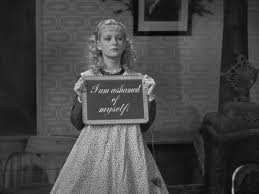
Anyone who has read Little Women or seen the 1933 film version of Louisa May Alcott’s classic tale of the March family will probably recognize the image of Amy March (played here by Joan Bennett). In this scene Amy is being punished by her schoolteacher for bringing pickled limes to class. She is so mortified that she never returns to the school again. The only worse “deggerradation”  she can imagine would be having her clothes shortened by tucking: “Mother doesn’t take tucks in my dresses whenever I’m naughty, as Maria Parks’s mother does […] it’s really dreadful, for sometimes she is so bad her frock is up to her knees and she can’t come to school.”

Most young girls had tucks in their dresses, whether they were the fictional Amy March or the bona fide Susie Ames. And so today, as Evelina got Susie’s summer wardrobe in order, she “let the tucks down” to accommodate her daughter’s new height.  There’s no instance of her taking the tucks back up in order to punish Susie when she was naughty.

This image of Amy March also illustrates the aprons or shifts that little girls wore over their dresses to protect the outfits from soiling.


April 7, 1851

large-1060

“Dress – The Maker” illustration from Godeys, 1851

1851

April 7 Monday  Have had a dress maker to work for Susan

She has cut a new waist to her gingham and fitted

the waist of a light purple dress  I think she has

done very well for Irish.  She appears to be a pleasant 

girl  This evening Orinthia and I have been to Mr

Barrows & Torreys to make a call.  Abby was

very lively & has improved very much in her appearance

within a year or two


After weeks of sewing shirts and mending coats for the men of the family, Evelina turned her attention to outfitting her daughter who, at nearly nine years old, had probably outgrown the previous year’s dresses.  It was time to rework Susie’s old dresses and perhaps make some new.  For this task, Evelina brought in help: a new, young dressmaker named Julia Mahoney.

Like many young women in the village of North Easton, Julia was Irish.  Like many of the older women in the village, Evelina held the Irish in some disdain.  Without necessarily meaning to be unkind, but clearly feeling some superiority, Evelina expressed her prejudice in a backhanded compliment of surprise at Julia’s fine work and pleasant demeanor.  Julia did “very well for Irish.”

Evelina had imbibed some of the Yankee resentment against the Irish immigrants who had moved into Massachusetts, and elsewhere, so rapidly and in such numbers.  While her husband Oakes seemed free from the prejudice, other Ameses, particularly Old Oliver, were not.  His displeasure with the Irish employees at the shovel shop was legendary and the bias came through at home as well.  The old Yankee ways were threatened by the new foreign residents, and antipathy thrived accordingly.

April 6, 1851


800px-Martin_W._Carr_School_-_Somerville,_MA_-_DSC03412

*

1851

April 6 Sunday.  Have been to meeting all day, and 

as usual heard two excellent sermons from

Mr Whitwell.  It rained very hard while

we were going and has rained fast all day.

Edwin called after meeting & Martin Carr &

a Mr Davenport from Attleborough.  Oakes & Oliver

called at Mr Bisbees with them

The Ames family went to both church services today and, as Evelina had come to expect, heard “two excellent sermons” from Rev. Whitwell. Despite the rain, the Ameses had visitors this afternoon. Friends of Oakes Angier and Oliver (3) called: cousin Edwin Williams Gilmore, and friend Martin Carr, who brought a Mr. Davenport with him. The young men all went out together.

Martin W. Carr was the son of “Uncle Caleb” Carr, a long-time employee of the shovel shop, and brother of Lewis Carr, the young man who died back in January from consumption. The family was descended from Robert Carr, an early governor of Rhode Island.

Martin would find his own claim to fame.  A jeweler by profession, he went on to found M. W. Carr and Company, maker of knick-knacks and souvenirs, including “gold and silver jewelry, hairpins, belt and shoe buckles, button hooks and garter belts […] matchbooks, cigarette cases, ashtrays, hatpin holders, letter openers, souvenir spoons, ink stands, magnifying glasses, lamp shades, bud vases, napkin rings and trays with imprints of the homes of American authors such as Emerson, Longfellow and Hawthorne.”**  The factory was a mainstay of Davis Square in the City of Somerville, and Carr himself a prominent citizen involved in many civic activities.  The city honored him in 1898 by naming an elementary school after him. The Easton boy made good.

* Martin W. Carr School, 1898, Somerville, Massachusetts, National Register of Historic Places, now condos.

**Somerville Journal, 1894/Coldwell Banker

April 5, 1851

Store

1851

April 5th  Saturday  Was choring about the house an

hour or two this morning and then went to sewing

on a shirt for Mr Ames.  Mrs S Ames is quite

sick to day has not been able to sit up much.

This afternoon called to see her but did not stay

long as Mrs Connors came to get some butter.  I then

went to the store & got Susan a dark print dress.

Have returned it again.

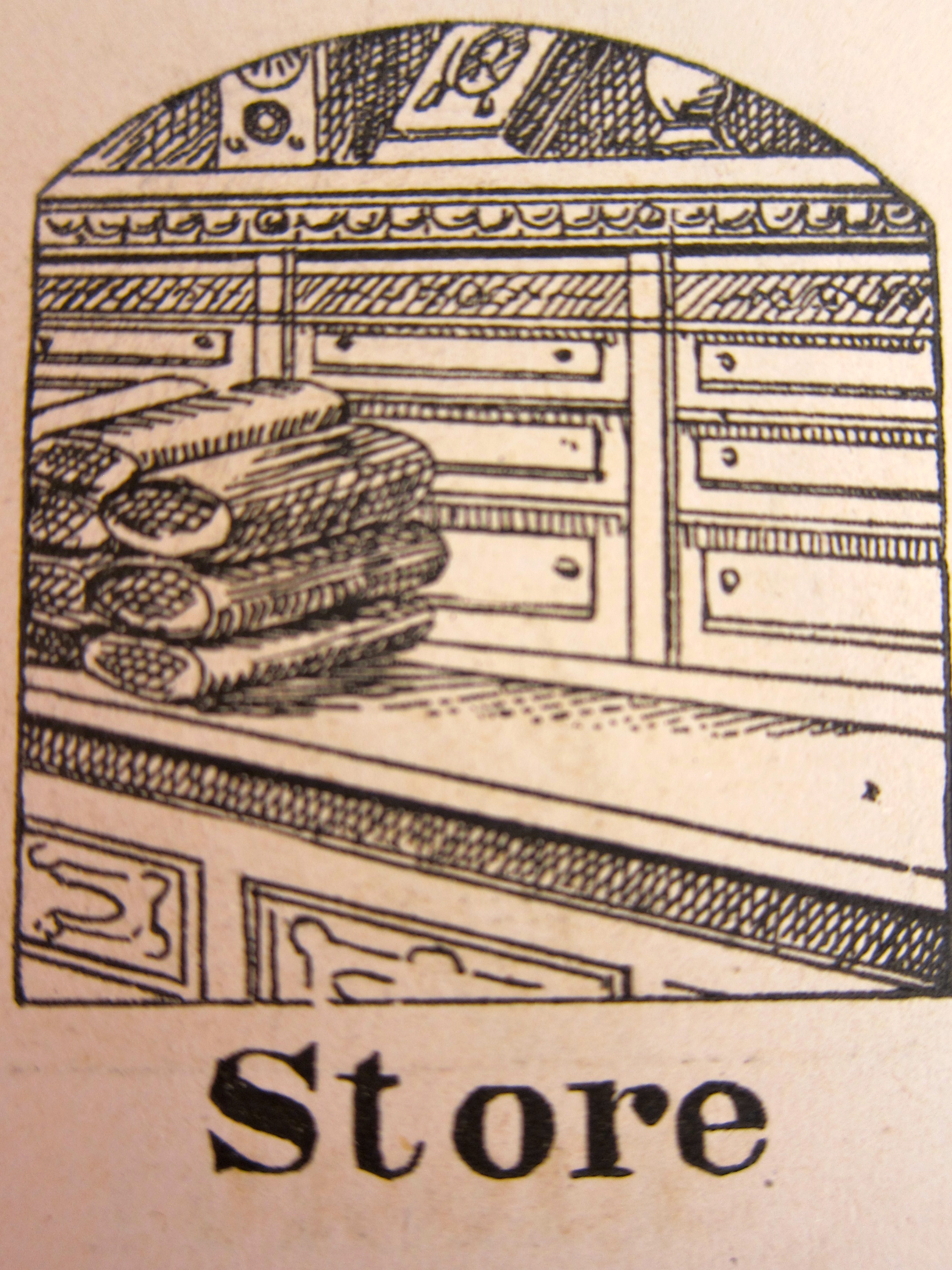
Sarah Lothrop Ames was sick today; perhaps she caught Evelina’s cold of the week before.  Evelina went to sit with her but was called home to parcel out some butter to a Mrs. Connors.  Although we never hear of Evelina or Jane McHanna churning it, Evelina evidently made household money through the sale of butter. The making of butter was probably one more chore on Jane’s plate.

The Ameses didn’t just sell butter, or just make shovels, for that matter. They also ran a dry goods and general mercantile store in the village, as we have mentioned before. Evelina sometimes shopped there, although it’s uncertain whether or not she had to pay for items she selected.  Today she found a dress for her daughter that she took home and then promptly returned.   Did Susie try the dress on only to find that it was too small?  Or did Evelina want to examine the dress to see how it was made?  And once having captured the overall style and pattern, did she return it?  Had Evelina already determined that she wasn’t going to keep it? Was she, perhaps, treating the store a little bit like a personal closet?

This was a period, too, when “ready-made” clothes were barely on the market. What was this little dress?  Was someone in the village making dresses and selling them there?

April 4, 1851

fc63da74a7d83ab723f4be9af9db4c70

1851

April 4th

Friday  Have been working about house this forenoon

Gave my parlour a thorough sweeping & bedroom

& stairs &c  Have not been at all well and had

hard work to sweep.  Jane finished the ironing

We have had a hard weeks work  This afternoon

I mended the stockings  Called at Olivers awhile

Mrs Peckham called here.  Very Pleasant

Evelina was feeling the effects of a laborious week of domestic duties. Over the past several days, she and Jane McHanna had really turned to in the kitchen, preserving a pig, trying lard, making sausage and doing the bi-weekly baking. On top of that the women had seen to their regular chores, which included ironing and sweeping the rooms free of the spring dust. Evelina managed all this while recovering from the cold of the weekend before. Sitting down to do some mending must have felt good.

She found some compensation by briefly visiting her sister-in-law, Sarah Ames, next door. And at home, Susan Peckham came to call. Mrs. Peckham was the wife of John Peckham, the Ames’s head clerk and bookkeeper. What was the purpose of her call? Susan may simply have desired to be sociable, or she may have had something she needed to communicate. At a time when today’s instantaneous ability to telephone or text someone was unimagined, even the simplest request or slightest inclination to talk to a friend, a relative, or, in this case, the boss’s wife took time and effort. Susan Peckham, whatever her purpose was, had only two options open to her: writing Evelina a note, or calling on her.  She chose the latter.

What might the women have discussed?  Evelina didn’t say.


April 3, 1851

pork-pie_2180207b

1851

April 3  This morning went quite early to baking in the brick

oven made mince & dried apple pies two custards brown

bread three large pork pies & ginger snaps. Alson here

to dine.  Henrietta & the two little girls dined at Mr Torreys

& were all here to tea  This Evening we all went to the 

dancing school.  Mr Whitwell called a few minutes

this afternoon & Mrs S Ames  Quite Pleasant

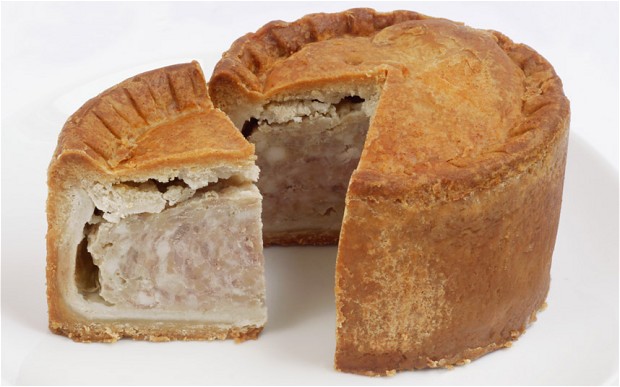
Small wonder that pork pies were on the menu, after Evelina and Jane McHanna spent all of yesterday processing a freshly-“kild” pig. Once again in the kitchen with her apron on, Evelina turned today to baking. As usual, she baked a large quantity of goods in the brick oven that she shared with her sister-in-law, Sarah Witherell. About every ten days or two weeks – or every fortnight, as they might describe it – one or both women would bake up a storm of pies, cakes, bread and cookies, enough to last until the next big baking.

Mince meat pies, brown bread and ginger snaps regularly featured in Evelina’s baking. These are the first pork pies to appear, however.  New, too, are the dried apple pies. Gone by now are the apples in the barrel that was delivered in January from the Gilmore farm, the one that was kept locked in the cellar so that the sons of the house wouldn’t eat up the fruit. Any apples that remained were from a group that must have been dried the previous fall for just this purpose, to provide a little fruit in an otherwise barren season.  By this time of year, housewives had to rely on preserves and dried fruit for variety in the family diet.

The Ames had company for tea: another sister-in-law, Henrietta Gilmore, and her two youngest children, little Henrietta and little Helen, made a rare visit from the Gilmore farm. These two youngest nieces of Evelina are about the same age as little Susie, yet they don’t get much mention in the diary.  They probably lived too far away for regular play time. Mr. Whitwell, the highly-regarded Unitarian minister, paid a call today, too.  Pleasant spring weather was bringing people out of the houses to visit.


April 2, 1851

Ham

1851 Wednesday

April 2nd  Jane & myself have been taking care of a hog

that was killed yesterday.  Have the lard tried

sausages made  fat back & hams salted and the whole

hog already for cooking.  This afternoon Jane ironed

seven fine bosom shirts.  This evening have been reading

being to[o] much fatigued to work.  Augustus went to 

Boston

It was a busy day in the Ames kitchen as Evelina and her servant, Jane McHanna, set about preserving one of the pigs that Evelina’s father-in-law, Old Oliver, had slaughtered the day before.  He sold some of the pork, but held back at least one of the animals for his own household.  Evelina and Jane had a long day’s work processing the animal, which had weighed about 300 pounds when slaughtered.

As the women broke the animal down into workable pieces, they “tried the lard,” which meant that they boiled much of the pork fat in water on the top of the stove, taking care to avoid the spattering as the fat popped and the water drew down. The resulting lard was cooled and stored, probably in stoneware jars, for future household use.

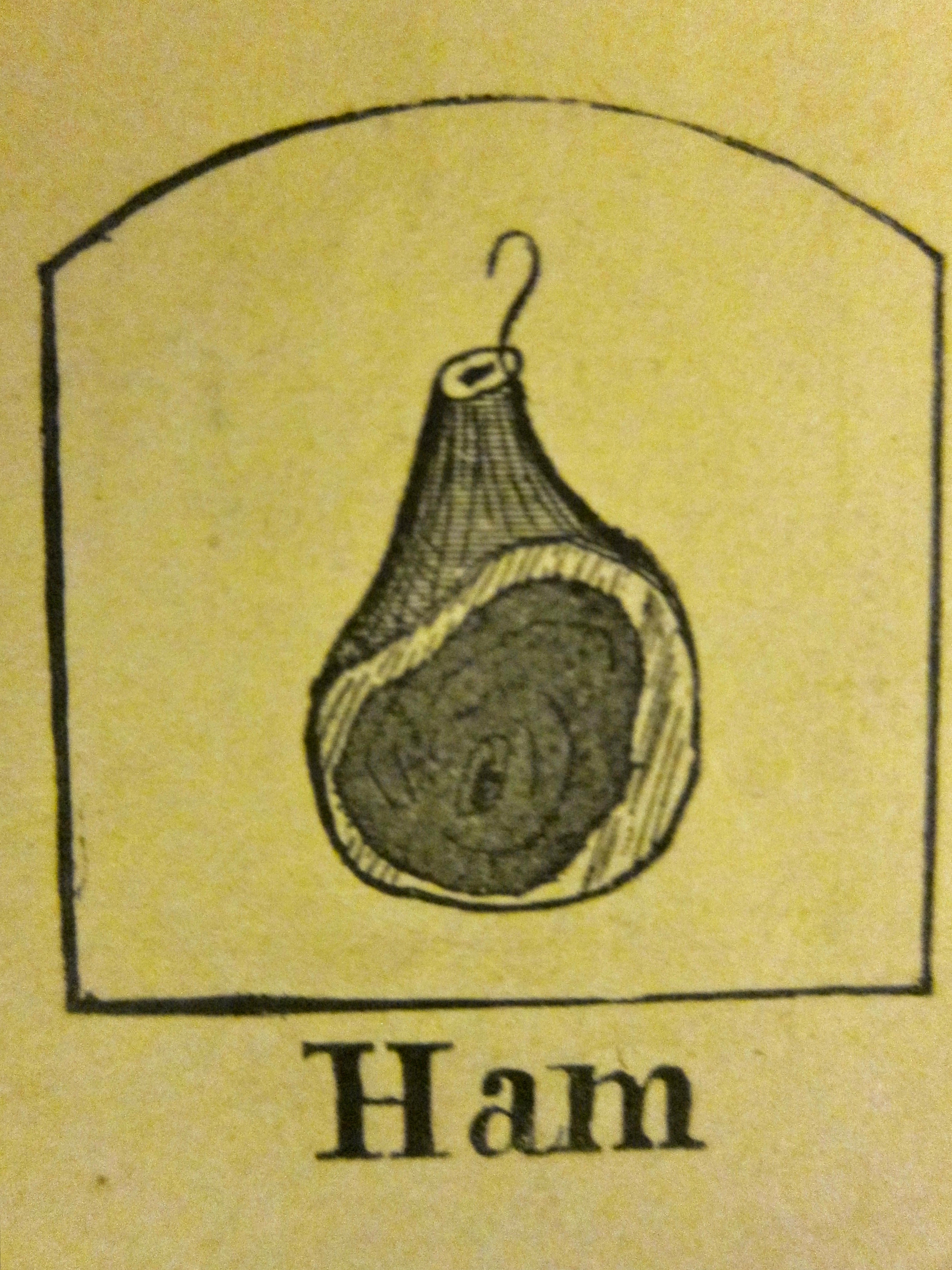
Also to be cooked in the future were the big hams, ribs, hocks and more.  The large hams were salted and hung in a safe place like the cellar or a smokehouse until ready to be baked or boiled and eaten, while smaller pieces like the ham hocks would have gone into glass jars or stoneware. Everything got prepared, even sausages, which was a process unto itself, what with grinding the meat, mixing in the herbs and spices, and packing the mixture into the intestinal casing.

In addition to all this, Jane found both time and energy to iron “seven fine bosom shirts.” The cookstove, which had been heated for trying the lard, must have been hot enough to heat up the flatirons.  Perhaps not wanting to waste that good energy, Jane set up the table to iron.

Those two women must have slept well this night.


April 1, 1851

Swine

1851

April fool day  Have had some sport this morning

with Mrs Witherell, Mrs Ames & Orinthia, making

April fool of them,  Jane heard something at

Mr Bartletts yesterday, which has made her cry

& about sick so that she had to go to bed.  Susan has

begun to work on card board that Mrs S Ames got at

N Bridgewater yesterday  Orinthia, Susan & self passed the 

afternoon at Mr Torreys  Weather Pleasant

April Fool’s Day is a holiday of uncertain parentage, in part because the very nature of the day has generated multiple false versions of its origin. The most credible genesis dates back to Roman times and the festival, Hilaria, which, in simplest terms, honored the vernal equinox. The departure of winter and the arrival of spring was cause for celebration and spirited fun.

Although Evelina may have had little interest in the history of April Fool’s Day, she loved the practice of it.  After a winter of icy weather, muddy roads, illness and sewing, sewing, sewing, the innocent levity of a practical joke or two delighted her. She did have a sense of humor. Whether the relatives and friends she played tricks on enjoyed the day with equal humor remains unknown. Her sisters-in-law, Sarah Witherell and Sarah Ames, may have known her well enough to expect a joke from her on this day.

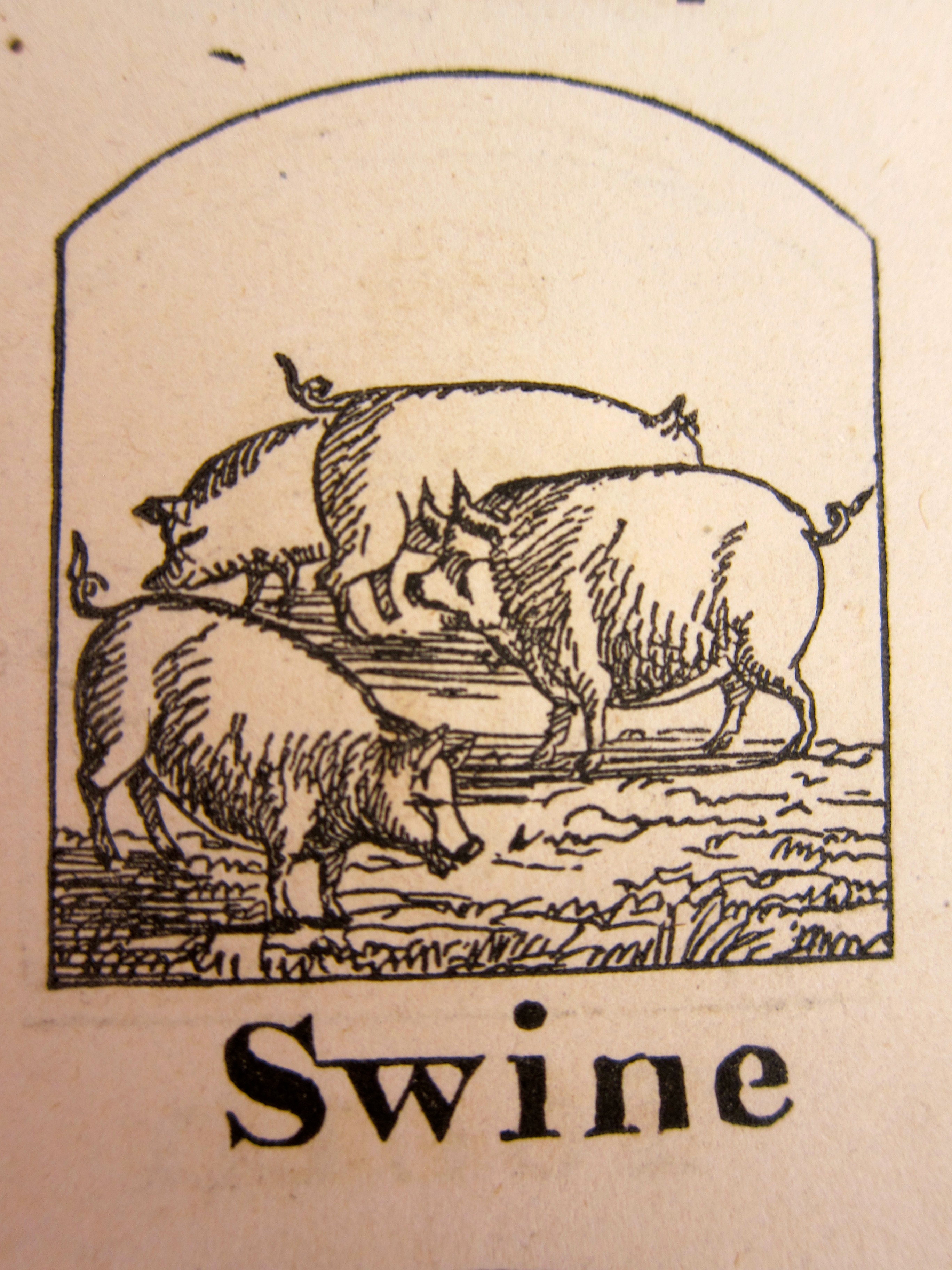
No April Fool’s nonsense for Old Oliver, however. Ever the farmer, he practiced his own rite of spring with the slaughter of pigs:

“4 shoats kild to day and the 4 weighd 1205 pound  I sold them for 7 1/2 cents a pound.”

No laughing today for Jane McHanna, either. She was distressed and “about sick” over something she heard the previous evening. She took to her bed, most likely leaving Evelina to prepare evening tea.

What was the card board project that little Susie Ames began today?  Any idea, readers?