February 24, 1852

img_0630-copy

A modern version of a mid-19th century specialty: Kossuth cakes*

Feb 24 Tuesday

1852  Heat the brick oven twice & baked Kossuth

plain & currant cake ginger snaps, mince &

dried apple pies  Afternoon Mrs Homan &

Ann Clarke came to the other part of the house

I went in to see them and staid to tea.  Spent

the evening at Willard Lothrops.  Called at Mr

Torreys & Augustus

It was a big baking day, with Evelina preparing a typical selection of pies, cakes – “plain and currant” –  and ginger snaps.  New to her repertoire was a Kossuth cake, a baked sponge cake with a creme center.

The Kossuth cake was named after the Hungarian political figure (and, briefly, president,) Lajos Kossuth, who was then taking refuge in the United States while trying to raise support for a return to power. During Kossuth’s visit to Maryland, a street vendor in Baltimore named a new baked confection after the hero, who was much feted as a champion of freedom.

The dessert became popular but is largely forgotten today, though the confection can still be found in parts of the south. Naturally, additions and variations to the recipe arose almost immediately, most involving the addition of chocolate poured over the top. A typical modern recipe looks more like a double sugar cookie filled with whipped cream and chocolate frosting than a creme-filled loaf cake.


*http://dwellinginmiddleburg.com/2014/05/06/kossuth-cakes/

 

February 2, 1852

grhog

1852

Monday Feb 2d  Worked about house untill about twelve

and went into Olivers to dine with my whole family

and mother.  Alson came this afternoon & carried

mother home.  All took tea at Olivers.  Mrs S Ames

Oliver Fred & self passed the evening at Mr Swain

Worked some on flannel skirt this afternoon […]

carried Susans stocking to Mr Swains.


We know about February 2; it’s Groundhog’s Day.  In 1852, it was no such thing, at least not in New England. In the Pennsylvania Dutch communities of the mid-Atlantic states, however, some folks had begun to claim that the behavior of a groundhog on this date could prognosticate the weather for the remainder of the winter. This practice was first formally celebrated in 1887, in Punxsutawny, Pennsylvania, and continues today.

More common for this date was the celebration of Candlemas, a holy day in the Christian Church that honored the presentation by Mary of Jesus at the temple. Roman Catholics called it the fourth Joyful Mystery of the Rosary. Unitarians had no name for it because Unitarians, like some other Protestant sects, didn’t acknowledge ecclesiastical feast days.

Yet there was a saying regarding this time of year that New England farmers – Old Oliver, a Unitarian, included – would have been familiar with:

“Half your wood and half your hay, You should have on Candlemas Day”

Candlemas falls between winter solstice and vernal equinox. It’s a day that turns the corner on winter, and heads for spring. It’s a day to take stock and hope you have enough wood left to keep warm and enough hay remaining to feed your animals for the rest of the winter.


January 31, 1852

500

Jan 31st  1852

Saturday  have been choring about house & mending most

all day.  Made a robe for Mitchell Willis child with

Mrs S Ames assistance  Edwin & wife here to tea  Mrs S

Ames has been here about three hours with her work

Mrs Witherell here awhile this afternoon.  Mr Frank

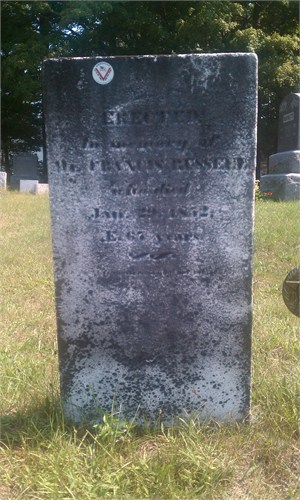
Russell was buried this afternoon.  My three sons went

to the funeral.  Quite a hard snow storm  Mr Ames to Boston

Inclement weather didn’t keep the Ames men from moving around today. Oakes Ames traveled into Boston on business, as he usually did on Saturdays. His sons, Oakes Angier, Oliver (3) and Frank Morton, rode to Easton Center for the funeral of Frank Russell, a 67-year-old blacksmith and veteran of the War of 1812. Russell had died two days earlier from pleurisy, and, despite the “hard snow storm,” he was buried at the Seth Pratt Cemetery with friends and family in attendance.  What had been his connection to the Ames’s sons? Had he worked for the shovel company?

Evelina, too, was tending to a death outside the family.  She and her sister-in-law, Sarah Lothrop Ames, sewed a burial robe for Luella Willis, the two-year old daughter of Mitchell and Amanda Willis.  Like Frank Russell, little Luella would have to be buried in cold ground during snowy weather. Once the services were over, the living would carry on with their chores, their commitments and their lives.  Evelina would turn to “mending most all day.”

January 30, 1852

Chess

Jan 1852

Jan 30th  Friday  Have commenced making a flannel

skirt for self & finished Susans dark print apron.

Mother [and] self passed the afternoon at Edwins.  Mr

Ames came to tea. Mrs S Ames called there with Mrs

Holmes. Mrs Witherell and the others returned to 

night  She has not her teeth but is to send for them

Oliver & Fred went to James Mitchell and called at

several other places  had a fine time Oliver played

chess with Judge Mitchell

Oliver Ames (3), Evelina’s middle son and a future governor of Massachusetts, was still home from college, as was his first cousin, Frederick Lothrop Ames.  The two young men were having “a fine time” on their winter break.  Chess was just one of the games they might have played to while away the dark evenings, another being whist.

Chess had been around for centuries, having first developed in India and the Islamic world.  It had evolved over time; dark and light squares on a chessboard were first introduced in the 10th century, for instance, rules for a stalemate or draw in the 15th, and so on.

By the nineteenth century, chess was really coming into its own.  In 1802, one J. Humphreys published a book called Chess Made Easy.  In 1830, the first known female chess player was acknowledged (though probably not encouraged.)  The first international chess tournament was held in London in 1851, won by Adolf Anderssen, and in 1852, the year we find Oliver Ames (3) playing the game on a winter’s night in Bridgewater, Massachusetts, sandglasses were first used to time a game.

Before the decade was finished, an American prodigy name Paul Morphy came to fame, winning nearly every game he played and defeating most of the older expert players. In the United States, a chess “epidemic” was born.

January 9, 1852

Cake

1852 Friday Jan 9th

[…]Have had about 30 here this evening and

quite a pleasant time though the weather not

pleasant.  Lavinia came here with Augustus last

night and we ladies have had a nice time making

cake and getting ready for them  Helen & Lavinia

made the bed in the front chamber to suit themselves

Oakes and Evelina Ames hosted a wedding reception at their house for newlyweds Edwin and Augusta Pool Gilmore, attended by members of the extended Gilmore and Pool families who traveled through inclement weather to get there. The celebration, complete with cake and tea – but no wine – was “quite a pleasant time.” What a special occasion for a cold, dark time of year.

The preparations for the party had been fun, too.  Lavinia Gilmore, sister of the groom, had been driven back to Evelina’s, carried by her brother Augustus Gilmore, to help with the cake. More cake! Helen Angier Ames had walked over from next door, again. The two young unmarried women had a sleep-over at their Aunt Evelina’s.

What might the cake have been made of? Sarah Josepha Hale offers up quite a recipe for a wedding cake in her 1841 The Good Housekeeper:

Take two pounds and a half of dried and sifted flour, allow the same quantity of fresh butter washed with rose water, two pounds of finely pounded loaf sugar, three pounds of cleaned and dried currants, one pound of raisins stoned, one nutmeg grated, half a pound of sweetmeats cut small, a quarter pound of blanched almonds pounded with a little rose water, and twenty eggs, the yolks and whites separately beaten.  

The butter must be beaten by hand till it becomes like cream; then add the sugar, and by degrees the eggs; after these, the rest of the ingredients, mixing in at last the currants, with nearly a tea-cupful of rose or orange flower water.  This mixture must be beaten together rather more than half an hour, then put into a cake-pan, which has previously been buttered and lined with buttered paper; fill it rather more than three quarters full.  It should be baked in a moderate oven for three hours, and then cooled gradually, by at first letting it stand some time at the mouth of the oven.

If you fear the bottom of the cake may burn, put the pan on a plate with saw-dust between.”*

*Sarah Josepha Hale, The Good Housekeeper, 1841, p. 100

January 2, 1852

Tea


1852

Jan 2d Friday  Seated myself quite early this morning to work

on Susans hood & finished item about ten Oclock

then ripped my old blue hood and washed the

lining & turned the outside have got it nearly done

We all went into the other part of the house to tea

Mr & Mrs Oliver & Helen there  Frank has a sore

ankle as [sic] does not go to the shop  Dr Swan called there

to see Helen & left Jane some medicine

The family gathered for tea today in “the other part of the house,” meaning that Evelina, Oakes, and their children, Oakes Angier, Frank and Susan went into the southern half of the shared house where Old Oliver and his widowed daughter, Sarah Witherell, lived with her two children, George and Emily. Joining them was the family next door: Oliver Ames, Jr, his wife Sarah and their daughter, Helen Angier Ames, who made an appearance despite being home from school with a cold. Other than missing Oliver (3) and Frederick Lothrop, the sons who were off at college, the group was a normal configuration for a gathering at the homestead.

Evelina’s grandson, Winthrop Ames, would one day describe such a family gathering from less than a decade later, by which time daughters-in-law and grandchildren had arrived:

“Supper, always called Tea, at seven, was the sociable occasion. It usually consisted of cold meats, hot biscuits, preserves and cakes – an easy menu to expand for unexpected guests.  Every week at least, and usually oftener, one household would invite the others and their visitors to tea; and the whole Ames family might assemble, even infant children being brought along and tucked into bed upstairs.  Fifteen or twenty was not at all an unusual gathering.”*

The family was as tightly-knit as any of Evelina’s knitted worsted hoods.

One other note about today’s entry: Dr. Swan left some medicine off for Jane McHanna, the servant, who had been ailing for much of the fall and winter. What did she suffer from?

* Winthrop Ames, The Ames Family of Easton, Massachusetts, privately printed, 1937, p.128


December 10, 1851

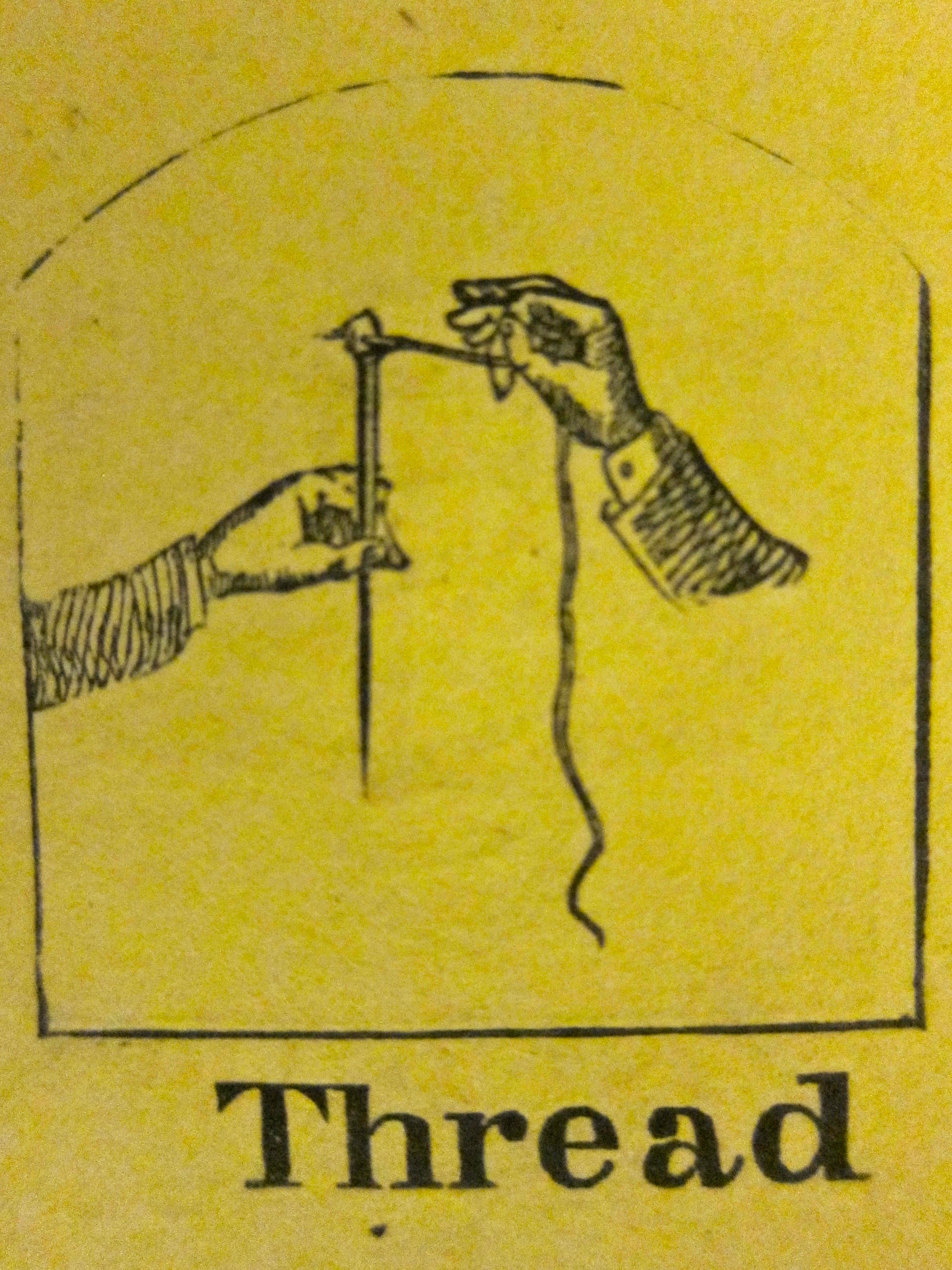
Thread


Dec 10th  Wednesday.  Mrs S Witherell S Ames and

self have spent the day quilting at Mrs Reeds

on a quilt that belongs to the sewing circle  Have

had a fine time.  Met quite a number of

ladies there. Had a taste of Mrs Howards mince

pie  We stopt the evening.  Mrs Witherell

J R Howard & Mr Harrison Pool came  We carried

Mrs Elijah Howard home

Although Evelina had reported the conclusion of the Sewing Circle season on November 5, today “quite a number” of Unitarian women met again to work on a quilt. They worked all day and into the evening, making the event even more sociable than usual.  Caroline Howard and Nancy Howard were among Evelina’s friends who attended and enjoyed tea and mince pie.

In New York City, meanwhile, Oakes Ames would have been wrapping up his business affairs and preparing to return home, having been away since the 3rd of the month.  Surely, not every moment of his trip had been devoted to shovels. He was no drinker, so the bartenders in the city wouldn’t have poured him any whiskey, but, like his wife, he was sociable.  He might have joined friends or clients for dinner. He also might have done favors for family or friends from home.

Rev. William Chaffin tells us that Oakes once searched out some socks in New York for his father’s coachman, Michael Burns, whom Chaffin described as “an Irishman of the old style.” Not long after Michael had emigrated to Massachusetts, “his mother, still alive in Ireland, knit him several pairs of socks, and sent them over by a friend of Michael’s.  She supposed that anyone coming over would necessarily ‘see my son Michael.’ But the friend found on landing at New York that he was two hundred miles away.  He wrote Michael telling him that he would leave the socks at a certain address.”

Michael approached Oakes “and asked him if he wouldn’t hunt up the socks and bring them home. It was just the sort of kindness Mr. Ames delighted in, and so when he went to New York he hunted up the socks with some difficulty and brought them to the overjoyed Michael.”*

*William L. Chaffin, “Oakes Ames 1804/1873”, Easton Historical Society, North Easton, 1996, pp. 6-7


December 5, 1851

tumblr_mbsy6tKaeV1r5pmqlo1_r1_1280

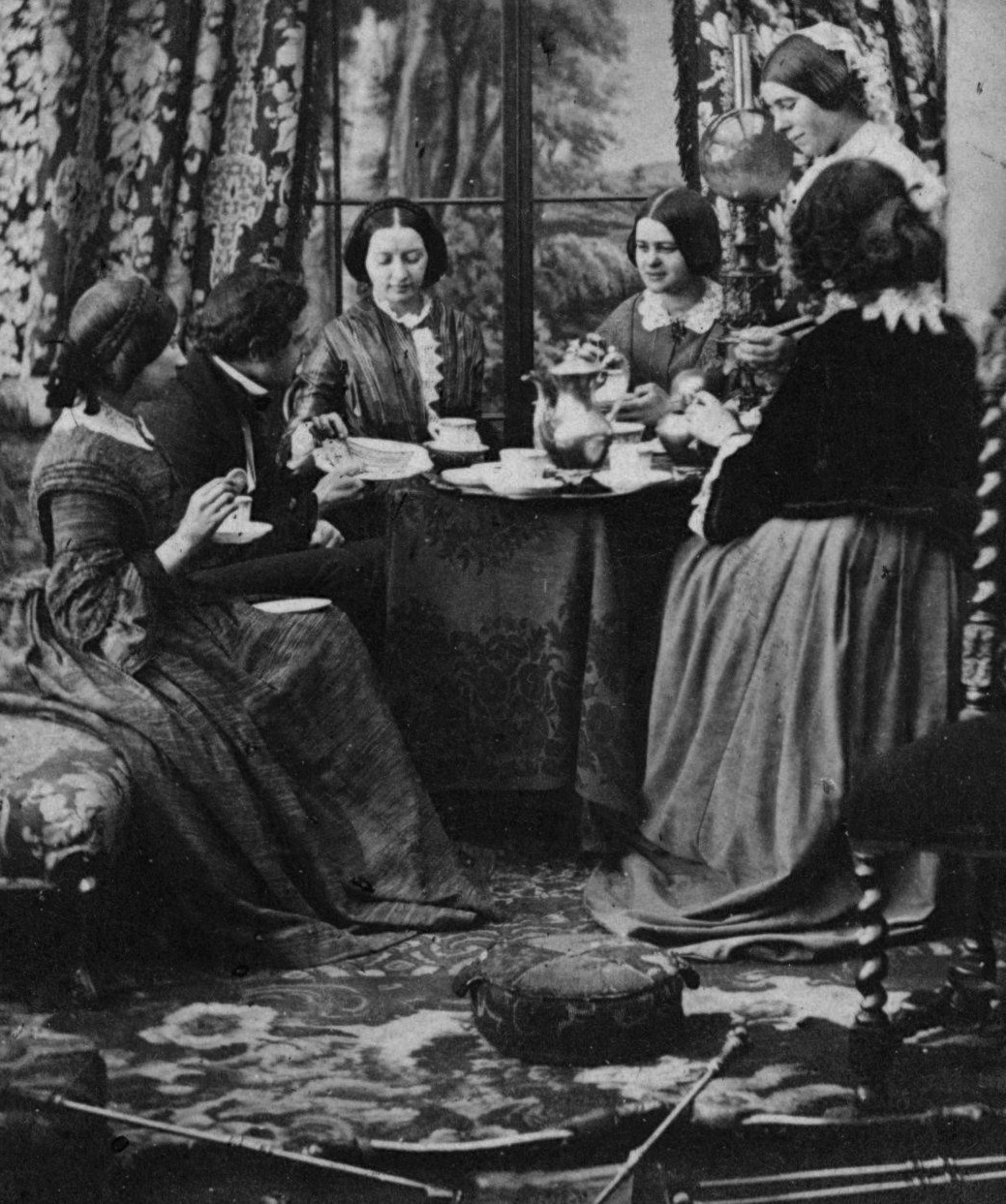
Unidentified group having tea


Dec 5th Friday  As usual this morning after being in

Boston felt tired & lazy did not get my

room in order very early.  Before it was

cleaned Mrs S Ames came in and we chatted

awhile.  Went into Edwins to get Mr Scott

to paint the porch & thus the forenoon passed

Have passed the afternoon in father Ames

with Mrs J R Howard her sister & Mrs Whitwell

With her husband away, and only her four nearly-grown children to look after, Evelina chose to relax this morning rather than make her bed, tidy up and get to her chores and sewing. “As usual,” she felt lethargic after her Boston shopping trip, but uncharacteristically, she didn’t try to overcome this lazy spell. An early morning visit from Sarah Lothrop Ames gave her some excuse to take it easy and hang out, as we might say today.

Most of the rest of her day was spent socializing.  In the afternoon Evelina went to the other part of the house to visit with sister-in-law, Sarah Ames Witherell, and other ladies who had gathered: Eliza Whitwell, Caroline Howard and the latter’s sister.  The women may simply have sat and chatted, teacups in hand, but Evelina, perhaps, had some sewing or mending at the ready as she visited.

The one piece of business that Evelina managed to do today was walk down the street to the new house being built by her nephew, Edwin Williams Gilmore, to track down Mr. Scott, a painter who was working there. He and another painter, Randall Holbrook, came over in the afternoon and began working for her. The presence of painters at Edwin’s house suggests that it was nearing completion.  Perhaps Edwin was getting ready to move in, if he hadn’t already.


October 9, 1851

IMG_1057

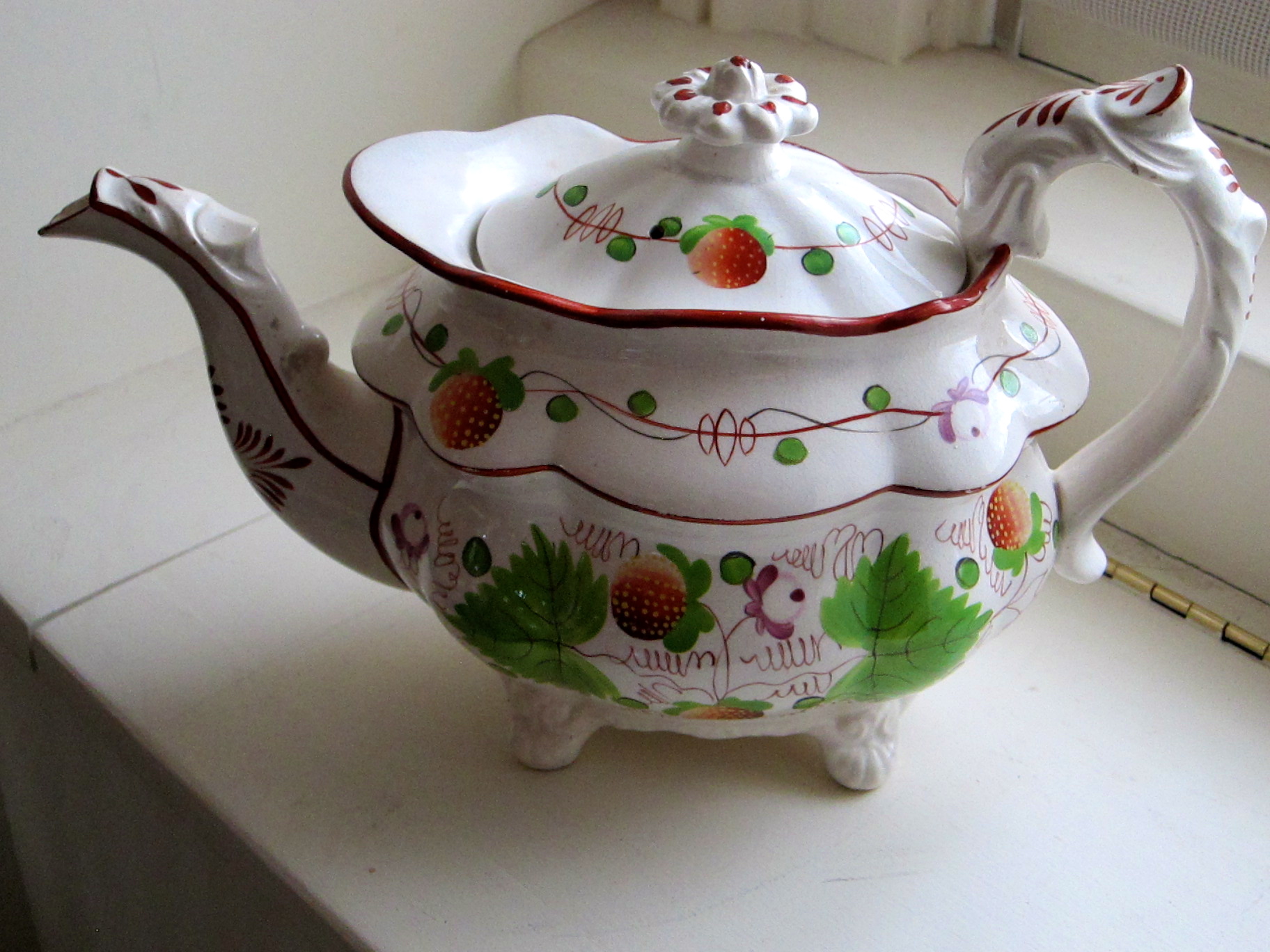
Thursday Oct 9th  Jane has been sick to day went to bed directly

after washing the breakfast dishes and I had to get

dinner  After dinner she was much better and was

able to […do] the dishes  This afternoon I have passed

in Olivers with Miss S. Orr.  Mrs Witherell & Mitchell

Mr Ames & William there to tea Have trimmed

Susans bonnet with dark ribbon


Jane McHanna was sick.  The domestic team at the Oakes Ames house was barely operational, what with Evelina herself still feeling the effects of a mean case of nettlerash. But between them, the two women, servant and mistress, managed to make meals appear on the dinner table in a timely fashion. Did the men of the house appreciate the extra effort going on behind the kitchen door?

Tea was a special event today, served next door at Oliver, Jr. and Sarah Lothrop Ames’s. Present were five of Old Oliver’s six surviving children: Sarah Witherell, Harriett Mitchell, Oakes Ames, William Leonard Ames, and the host, Oliver Ames, Jr. William was visiting, if not from New Jersey, then from his current way station on his journey to Minnesota. Harriett, too, held visitor status;  she and her children were about to return to her husband in Pennsylvania. Only Sarah Witherell, Oakes, and Oliver Jr. lived in North Easton and saw one another regularly.

Missing from the group was Horatio Ames, who lived down in Connecticut. No one’s favorite sibling, some – Oakes, particularly – may even have appreciated his absence. Interesting that Old Oliver himself isn’t mentioned as being present.

Another guest who was also there at this rare gathering of the clan was Miss Susan Orr, a long-time family friend (or relative?) who had known the group when they were children. She could remember Oakes Ames as a baby. Susan had been staying with Sarah Witherell and Old Oliver for about ten days. Meanwhile, a different Susan, only nine-years-old, got her bonnet trimmed with a new ribbon.


September 8, 1851

1856_tea_BostonAlmanac


Monday Sept 8th  Mother Mrs Stevens & self sat down

to work in my chamber  The weather is very

hot  After dinner we went into the other

part of the house awhile it being so much

cooler  Abby came here to tea. Oakes A

Frank & Mrs Mitchell went to a party to Mr

Cushing Mitchells this Evening & are to spend the night

Tea had been on the serving tray very much of late, with or without short biscuits. Evelina served tea to her niece, Abby Torrey, today while yesterday she took tea at the parsonage during intermission. Three days ago, she hosted a small tea party for a guest, Mrs. Latham, her sister-in-law, Sarah Ames Witherell, and others. Evelina’s grandson, Winthrop Ames, described the importance of tea time some eighty years later:

“Supper, always called Tea, at seven was the sociable occasion.  It was usually consisted of cold meats, hot biscuits, preserves and cakes – an easy menu to expand for unexpected guests. Every week at least, and usually oftener, one household would invite the others and their visitors to tea; and the whole Ames family might assemble…”*

Although the Ameses grew and raised much of their own food, tea was a commodity that had to be purchased. Coffee and sugar, too.  As the above advertisement from 1856 indicates, tea and coffee could be purchased in bulk in Boston (not surprisingly, given Boston’s long history of importing tea into its harbor!) Black tea was the general favorite and, as the ad suggests, could be obtained in different grades of excellence.  Did the Ameses order in bulk?  Did they acquire a chest of tea at the family rate? Their careful use of money would imply that whichever Ames did the purchasing got the best product for the lowest price possible.

The weather, meanwhile, continued to be very hot. It didn’t prevent brothers Oakes Angier and Frank Morton and their youngest aunt, Harriett Ames Mitchell, from traveling to Bridgewater for a party and an overnight. Social goings-on continued.  No doubt, tea was served.

*Winthrop Ames, The Ames Family of Easton, Massachusetts, 1938, p. 128