November 2, 1852

490px-William_Rufus_DeVane_King_1839_portrait

William R. King

(1786 – 1853)

Tuesday Nov 2d  Sewed on cambric sleeves for

Susan this forenoon very quietly with

Miss Alger  It has rained since Saturday

morn but this afternoon has cleared 

off Mrs Ames & self have been to Mr

Swains & called at Doct Wales & Augustus

Miss Alger & O Angier took tea in Olivers


Back from her quick day trip into Boston, Evelina spent the morning “very quietly” in her sitting room, sewing. The piano teacher, Miss Alger, was still visiting.  Outside, “it rain[ed] by spells […] wind north east it stormd all the forenoon and was cloudy about all day – there has bin one inch + a quarter of water fell since Sunday”*

After midday dinner, when the storm had stopped, Evelina and her sister-in-law, Sarah Lothrop Ames, went out to check on Ann and John Swain, whose infant son had died on Saturday. Evelina would have taken with her the mourning accoutrements she had purchased for Ann in the city. No doubt the Ames women continued to comfort the forlorn parents. From the Swains they paid other calls in North Easton, to the home of Ephraim and Maria Wales and to see Evelina’s nephew, Alson “Augustus” Gilmore and his wife Hannah. Hannah had lost her infant son Willie back in the summer. The women would have had much to talk about.

On the national scene, the day was momentous. As we have read previously in this blog, General Franklin Pierce, a Democrat, was elected President of the United States, defeating Whig candidate General Winfield Scott (incumbent Whig Millard Fillmore hadn’t been renominated) and Free Soil candidate John P. Hale. Easton historian William Chaffin writes: “In 1852 the vote for President was one hundred and seventy-one for Winfield Scott, one hundred and forty-three for John P. Hale, forty-nine for Franklin Pierce, and four for Daniel Webster, who was dead. This vote shows the political complexion of the town, and confirms the statement of the adoption of the Free Soil position by many Democrats.”**

The vice-president-elect was William R. King, a senator from Alabama who believed strongly in the Union. He had helped draft the Compromise of 1850. Unfortunately, King was suffering from tuberculosis and would soon die in office, one of the shortest-termed vice-presidents and the only Alabaman. He was also the only vice-president to take the oath of office on foreign soil; he was in Cuba taking the cure when he was inaugurated.


*Oliver Ames, Journal, Stonehill College Archives, Arnold Tofias Collection

**William L. Chaffin, History of Easton Massachusetts, 1886, p. 630
 

October 26, 1852


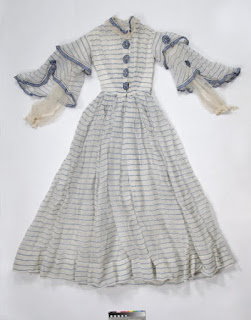
1860s blue striped muslin dress from St. Albans Museums

Dress with undersleeves, mid-19th c.*

Tuesday Oct 26  We have had a large washing

done to day and not finished untill

after dinner  Miss Alger & self spent

the afternoon in Olivers  Mr Ames

& all the children there to tea  Mr & Mrs 

Whitwell was there an hour or two

I made Susan a pair of undersleeves

and she is delighted with them


Because of all the company that had visited over the weekend, the servant girls were unable to launder clothes on Monday. Today, extra sheets and towels were added to the usual load and the washing went on into the afternoon. Not that Evelina rolled up her sleeves; after the midday meal, she and her remaining houseguest, Miss M. J. Alger, went next door to visit with Sarah Lothrop Ames and stayed for tea. All the family partook.

At various points during the day, Evelina had her work box open as she completed a pair of undersleeves for her daughter. Susie was “delighted” with them. Were they a peace offering from mother to daughter, perhaps to make up for Evelina’s insistence on Susan learning to play piano?

We’ve seen Evelina sewing undersleeves before. In the 1850’s and into the Civil War, undersleeves were an essential component of any woman’s dress, fitting independently but securely under the looser outer sleeve of the dress proper. Like the collars of the day, a good pair of undersleeves could be worn with different dresses. Susie must have felt rather grown-up with her new pair.

On the industrial side of American life, meanwhile, today was the 27th anniversary of the opening of the Erie Canal. The technological wonder of its day, it was already becoming obsolete. Railroads had arrived and, through their own capacity for moving freight, would soon obviate commercial use of the canal for many (though not all) industries. Shipping would change – was changing. The very word “shipping” derives from the fact that, initially, more goods moved by water than by land. This would no longer be true in this country or elsewhere in the developed world.

We should remember that Harriet Ames Mitchell, Old Oliver’s youngest daughter, was living in Erie at the time with her husband Asa and their three children.  Did they mark the day?


*Image of striped blue muslin dress with undersleeves courtesy of St. Albans Museum, England


October 17, 1852

The knife and fork. Old with white bone handle.

Sunday Oct 17th  

Went to church all of us.  Came home

at noon with Mr Ames and had a cup

of tea and lunch in the buttery

Catharine Middleton left this evening

and I paid her five dollars for the

three weeks that she has been here now

and one week some time since

This may be the first time that Evelina uses the word “lunch” in her diary. Usually, the meal in the middle of the day was dinner, and it was the big meal. But on Sundays, the routine was changed because, ostensibly, housewives didn’t cook. It was a Day of Rest. The women were at church and had no time to prepare a hot meal between services. Instead there was a cup of tea and a piece of cake at the parsonage or, in good weather, there might be a bread and fruit picnic on the lawn of the church, near the carriages. Early tail-gating, if you will. If a housewife were at home on a Sunday, as Evelina sometimes was, she might end up cooking, especially if she had houseguests. But the norm was no cooking.

Lunch, per se, was something different. The word itself was a shortened version of “luncheon,” which was generally accepted to be a small meal that might be held at any time of day, in between two larger meals. For most of the 19th century, luncheons were considered to be the province of middle- to upper-class ladies – hence the phrase, “ladies who lunch.” Cold meats, fruit, pastries and tea might make up the menu for the female meal.

Yet as industrialization of the workday took over, replacing the former agrarian practice of a substantial meal in the middle of the day, lunch as we know it became more accepted. Men took their cold meals to work, or warmed up a can of something over a stove or a radiator at the workplace. By the 20th century in America, lunch happened in the middle of the day and dinner moved to the evening.

In her diary, Evelina was only suggesting that the meal she and her husband shared at a scrub-top table in the pantry was no regular dinner. Little did she know that this simpler midday meal would one day be the norm.


October 12, 1852

DSCF1683small

Gravestone of George Oliver Witherell

Tuesday Oct 12th  Mother & Louisa dined at Mr Torreys

and I went there to tea I was ready to go

when Mrs Roland & Miss Louisa Howard & Mrs

Dunham from N. Bedford called and stopt

some time  Mrs Witherell & Ames were gone

to Norton to see about Georges grave stone

Augustus & wife & her mother were at Mr Torreys

also

It could be that excitement over the new steam engine that was installed yesterday in the Long Shop continued, but Evelina tells us nothing about it. As usual, she maintains a disinterested distance from business matters. Not that she didn’t care, perhaps, but the business was up to her husband, his brother and her father-in-law. Commerce was in their sphere, the running of the household was in hers, and neither she nor her husband crossed the line between the two. So it was in most households in the middle of the 19th century.

“[I]t was foggy this morning but cleard of[f] warm before noon wind south west,”* reported Old Oliver. Sarah Ames Witherell and Sarah Lothrop Ames rode together to Norton to select a gravestone for Mrs. Witherell’s son, George, who had died at age fourteen the previous spring of rheumatic fever. The task could not have been pleasant, but perhaps Sarah Witherell found solace in marking her son’s passing in such a permanent way. The gravestone – if it is the one that she picked out, as the grave site was eventually moved – can be seen in the Village Cemetery behind the Unitarian Church in North Easton.

*Oliver Ames, Journal, Stonehill College Archives, Arnold Tofias Collection

September 29, 1852

Thread

Wednesday Sept 29th  Mrs Witherell & Ames came in

& helped me about my baking and this

afternoon I have had the sewing circle  Not

one of the Pools here and had but very few

numbers. about a dozen or fifteen including 

my own family at tea  It is a beautiful moon 

light night and they spent part of the evening


With help from her sisters-in-law, Evelina prepared for the arrival of Sewing Circle members. It was a “fair cool day,”* so weather could not deter attendance. In the afternoon, the women came. Well, some came.  “[V]ery few numbers” arrived for the meeting, but at least it wasn’t the zero attendance of her previous gathering. There were enough ladies in the parlor to make the event a success.  Some of the group stayed until after dark, able to find their way home by the light of the moon.

Still, members of the Pool family didn’t show, which vexed Evelina. The Pools were a family she had grown up with in the south-eastern section of town. A Pool daughter, Augusta, had married Evelina’s nephew, Edwin, and now lived nearby. Evelina felt a connection to the family, although it may be that the family did not feel a connection to her. She never mentions Augusta’s mother, Lavarna, for instance, in the roll of ladies who call on her, though she did host the Pool family at tea in January when Augusta and Edwin were married. It’s possible that the Pool women disliked her. Perhaps they were jealous of her social success in marrying Oakes Ames. Your thoughts, readers?


*Oliver Ames, Journal, Stonehill College Archives, Arnold Tofias Collection

September 11, 1852

DSCF1590small

Sat Sept 11th  Mother had a sick night and is very unwell

to day not able to sit up but very little.

Orinthia Miss E Burrell Alice Ames came

about ten and spent the day.  Abby Torrey

passed the afternoon and Emily & Mrs Shepherd

Hannah went to bed sick about two and

I had to get tea for them to go home early


Evelina invited several female friends to spend the day, but her plans were thrown into disarray by her mother’s indisposition during the night and her servant, Hannah Murphy, falling ill after the midday meal. Orinthia Foss and others had gathered and instead of sitting in the parlor with them while Hannah made and served the tea, Evelina had to be in the kitchen herself preparing the meal. Not what she had planned. She must have been reminded of times past when her previous servant, Jane McHanna, was often ill and unable to cook or serve.

According to Old Oliver, “the 11th was rainy part of the day and cloudy all day wind south east + warm there was half an inch of rain”* Perhaps the women were grateful to be in the parlor and not out in the weather, however welcome the rain might have been.  The Alice Ames who came to visit may have been married to a George Copeland in Plymouth, although her name would have been Copeland, not Ames. Are any readers out there versed in the wider reaches of the Ames (or Eames) name in Massachusetts?


*Oliver Ames, Journal, Stonehill College Archives, Arnold Tofias Collection

August 7, 1852

Wagon

Sat Aug 7th  Was sewing part of the forenoon made

some pies & cake  Went into Olivers about four,

Started to go to Augustus in a waggon and

got caught in a shower turned back at the

school house got completely wet  My sons & Mr Ames

were at tea at Olivers  Edwin & wife Lavinia & Abby

there Catharine & I have done some sewing this week

two nightgowns for self one for Susan & one cotton & 

moire skirt & c &c  Susans waists are finished


“[T]he 5, 6 + 7th were pritty warm day[s] + there was some rain,”* wrote Old Oliver in his journal. Evelina was out in that rain and “got completely wet.” Late afternoon showers are part and parcel of August weather in New England. The showers can come up quickly, too, so it’s small wonder that folks moving around the countryside in horse-drawn wagons could get caught in the rain.

While Evelina was getting soaked, her husband Oakes and sons Oakes Angier, Oliver (3) and Frank Morton Ames had tea next door with the Oliver Ames Jr family. How was Oakes Angier feeling, now that he was coughing so much? Perhaps he and his brothers got to hear their cousin Helen play piano again, or perhaps they just ate and conversed. Various Gilmore relatives, including Edwin and Augusta Gilmore, Lavinia Gilmore and Abby Torrey were there as well.  As previously noted, Lavinia and Helen were particularly friendly.

And speaking of friends, fans of Sherlock Holmes might enjoy knowing that August 7, 1852 is the purported birthdate of the fictional Holmes’ steady, tolerant and equally fictional sidekick, Dr. John Watson.

*Oliver Ames, Journal, Stonehill College Archives, Arnold Tofias Collection


August 4, 1852

Thread

1852

Wedns Aug 4th  Sewing circle met at the other part

of the house  Had an unusually large number

About 30 beside the gentlemen that came

to the second table.  My family all had tea

there  After tea all went into the gardens

and into Olivers to hear Helen play

Horatio and another man came from Salisbury

Sarah Witherell hosted the monthly Sewing Circle, to which people turned out in “an unusually large number.” Everyone would have known about the death of Sarah’s son back in May, and by showing up on this occasion, they likely were paying respect to a woman they probably admired. In her quiet, dignified way, Sarah had done so much for others that others now wanted to do something for her.  They may also have been demonstrating respect for her father, Old Oliver. Sarah was probably grateful for the outpouring and for the hostessing assistance she would have gotten from her visiting cousin, Almira Ames.

Old Oliver may or may not have been on the premises for tea. According to his daily record, on “the 4th Horatio + Mr Morse his traveling agent came here + went away the next day.”* Evelina doesn’t mention Horatio (Sr., probably) but as we know, they weren’t close.

After the busy gathering at Sarah Witherell’s, family and guests toured the gardens – of both houses, presumably – and then moved into the house next door to hear Helen Angier Ames, only daughter of Sarah Lothrop Ames and Oliver Ames Jr., play piano. Perhaps even Old Oliver, Horatio and Mr. Morse were part of the appreciative crowd.

This is the first entry that tells us that Helen Angier Ames played the piano, and it’s significant. Owning a piano or, more likely, a pianoforte was “the ultimate ‘badge of gentility’.”** Because “less than one in a hundred” households in the country owned such an instrument, those that did could be reckoned to be high up on the social scale. Owning a piano distinguished “‘decent people’ from the lower and less distinguished”, according to the standards of the time.


*Oliver Ames, Journal, Stonehill College Archives, Arnold Tofias Collection

**Jack Larkin, The Reshaping of Everyday LIfe: 1790-1840, New York, 1988, p. 143


July 30, 1852

381-1233891708GdW7

July 30th  Friday  Came home from Dr Wales at half

past four and slept untill half past

eight left her quite comfortable

Have cut out another sack night dress

and Susan a waist  Alson & Lavinia Edwin

and wife were here to tea  Mr & Mrs Kinsley

called just at night for a few moments.  We

all went into the other part of the house for

ice cream this evening   Horatio here to dine

When Evelina came home at 4:30 in the morning, was the moon still up? Did she realize that this night would offer the second full moon of the month, familiarly known as a blue moon? She would be able to see it, too, as the skies were clear.

We use the term blue moon to identify a second full moon within a calendar month.  An earlier definition – one that may have been in effect when Evelina could gaze at the night sky – was that of being the third full moon within a season that has four full moons. So say various almanacs. Tracking the lunar cycle to define the passage of time has gone on as far back as human history can record. The Christian ecclesiastical calendar, for one, is built around moon phases. According to one modern source,

Some years have an extra full moon—13 instead of 12. Since the identity of the moons was important in the ecclesiastical calendar (the Paschal Moon, for example, used to be crucial for determining the date of Easter), a year with a 13th moon skewed the calendar, since there were names for only 12 moons. By identifying the extra, 13th moon as a blue moon, the ecclesiastical calendar was able to stay on track.”*

The terrestrial events of Evelina’s day included sewing (of course), her nephew Horatio Jr as a guest at lunch, company for tea and, as a special treat at the end of the day, ice cream. Despite her lack of sleep, a pleasant day overall.

*Courtesy of http://www.infoplease.com/spot/bluemoon (accessed July 26, 2015)


July 28, 1852

Sharps

Sharp’s Pistol, 1848-1850


July 28th, 1852

Wednesday Julia Mahoney has been here

to work to day on my travelling dress

but I have sewed but very little

Was about house all the forenoon 

making cake & pies &c &c  Mrs Ames &

Witherell have been to Dover  Horatio

Ames Jr came last night & I expected

him & father to dine but they went to

Olivers  Horatio went with Mr Ames

to Canton this afternoon & was here to tea

Horatio Ames Jr., a grandson of Old Oliver and nephew of Oakes, had come to the other part of the house for a short visit. By contemporary accounts, he was a troubled young man. The second child of Horatio and Sally Ames, he was born in Albany when his father was working there, but grew up in Connecticut.  In 1849 and 1850, he attended Rensselaer Polytechnic Institute in Troy, New York, but evidently left after just one year.

Early in 1853, Horatio Jr. was in Boston where he married Sophronia Eliot Hill of Salem. He worked as an iron monger at that time, but by 1858 was working as a clerk. On October 27, 1858, he killed himself.

What happened between his year in college and his suicide less than a decade later may pivot on the scandalous divorce of his parents, proceedings for which got underway late in 1852. His mother cited her husband’s multiple infidelities and harsh treatment to herself and her children. Horatio Jr. sided with his mother during and after the breakup. A 20th century account reports that Horatio Jr:

left home shortly after his parents’ divorce and so was out of touch with his father for some years. But he returned home in 1856 following his father’s remarriage. During an argument, he fired at his father in an attempt to kill him. Newspaper accounts of the incident, based on Horatio Sr.’s version of the events, depict him winning a heroic struggle for his life, but then magnanimously letting his son leave. Only after further warnings from his younger son, Gustavus, did Horatio finally have his son arrested. Horatio called his son ‘the worst hardened villain I have ever seen’, but then dropped the charges once Horatio Jnr. became contrite, begging forgiveness.*

The newspaper accounts on which this summation is based present only Horatio Sr.’s side of the story. We simply can’t know exactly what transpired between father and son, but we can know that the son eventually took his own life.  According to some 19th century records, Horatio Jr. is buried in Salem.

*John Mortimer, Zerah Colburn the Spirit of Darkness,2007