October 24, 1851

pantry-shelves-vintage-650-225x300

*

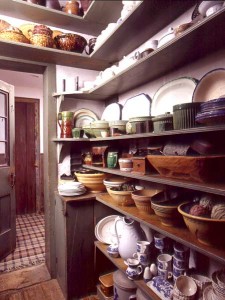
Friday Oct 24th  Jane & Bridget have cleaned the buttery

and I have had some paint put on the 

shelves  Mr Smiley worked here about three

hours, he went to Mansfield and came here 

about two Oclock.  Scott & Holbrook have finished

the first coat to the sitting room & parlour

I have been about house most of the day.  Sit awhile

with Susan Orr.  Capt Isaac Lothrops wife buried this P. M.

Much cleaning was going on at the Ames’s house in tandem with major redecorating. Evelina the housewife was impelled to tidy everything up before and after various workmen came through to scrape, dismantle, build, paint and/or paper the downstairs rooms. Her servants, Jane McHanna and Bridget O’Neil, scurried around with her, clearing shelves so that the men could follow and do their work.

The buttery that Evelina mentions was, in fact, a shelved area off her kitchen that served pretty much as a pantry.  She had food storage “down cellar”, of course, but the buttery, being close by and on the same floor as the kitchen, would have been more accessible for daily use.  She would have stored everyday items like coffee or tea there, for instance. If the Ameses had kept dairy cows, milk would have been poured into pans there, to be skimmed for cream.  Yet the term buttery derives not from its use for dairy products, but from an archaic British term for the room where large caskets of wine, known as butts, were stored. (One butt was the equivalent of two hogsheads or four barrels of wine.) There was no storing caskets of wine at the Ames’s.

Oakes Ames was away during yesterday and today’s disruption, though sons Oakes Angier and Frank Morton and daughter Susan Eveline were home and had to sidestep the disarray. Oakes was away on shovel business, most likely.  No one from Evelina’s household appeared to attend the funeral of Isaac Lothrop’s wife.


* 19th century pantry, courtesy of http://www.oldhouseonline.com, photo by Gross & Delaney

 

October 20, 1851

Cheese

Monday 20th  Susan washed the dishes again this

morning and I took up the parlour carpet and cleared

the room  Mr Healy has taken out the door

where the closet used to be and getting it ready for

the masons  I have been to work getting of[f] the 

paper and to night feel quite lame.  Mr Smiley

has varnished the chairs that he painted last week

Received 6 cheeses and a tub of butter from Mrs Mower

The calendar may have said it was October, but the domestic commotion at the Ames’s suggested spring cleaning.  In order to redecorate, Evelina pulled up the carpet (which had been laid down in pieces), emptied the parlor of furniture, and spent the better part of the day scraping off the old wallpaper. A local carpenter, Henry R. Healy, was also in the house, removing a closet door and preparing a wall for masonry. Were they putting in a new fireplace?  A coal stove would be more likely. Further, another worker, Mr. Smiley, finished varnishing some chairs.  All this went on over and around the usual Monday washing of clothes by servant Jane McHanna.

Scraping wallpaper off of horsehair plaster is hard work and by night time, Evelina was smarting from the day’s exertion. She couldn’t have been unhappy, though. Much had been accomplished and, moreover, her housewifely self must have been pleased to add “6 cheeses and a tub of butter” to the larder.  Louisa J. Mower, a friend from Maine, sent the dairy items to her.  As gifts? As a purchase?

It was a day of accomplishment for Evelina.


October 9, 1851

IMG_1057

Thursday Oct 9th  Jane has been sick to day went to bed directly

after washing the breakfast dishes and I had to get

dinner  After dinner she was much better and was

able to […do] the dishes  This afternoon I have passed

in Olivers with Miss S. Orr.  Mrs Witherell & Mitchell

Mr Ames & William there to tea Have trimmed

Susans bonnet with dark ribbon


Jane McHanna was sick.  The domestic team at the Oakes Ames house was barely operational, what with Evelina herself still feeling the effects of a mean case of nettlerash. But between them, the two women, servant and mistress, managed to make meals appear on the dinner table in a timely fashion. Did the men of the house appreciate the extra effort going on behind the kitchen door?

Tea was a special event today, served next door at Oliver, Jr. and Sarah Lothrop Ames’s. Present were five of Old Oliver’s six surviving children: Sarah Witherell, Harriett Mitchell, Oakes Ames, William Leonard Ames, and the host, Oliver Ames, Jr. William was visiting, if not from New Jersey, then from his current way station on his journey to Minnesota. Harriett, too, held visitor status;  she and her children were about to return to her husband in Pennsylvania. Only Sarah Witherell, Oakes, and Oliver Jr. lived in North Easton and saw one another regularly.

Missing from the group was Horatio Ames, who lived down in Connecticut. No one’s favorite sibling, some – Oakes, particularly – may even have appreciated his absence. Interesting that Old Oliver himself isn’t mentioned as being present.

Another guest who was also there at this rare gathering of the clan was Miss Susan Orr, a long-time family friend (or relative?) who had known the group when they were children. She could remember Oakes Ames as a baby. Susan had been staying with Sarah Witherell and Old Oliver for about ten days. Meanwhile, a different Susan, only nine-years-old, got her bonnet trimmed with a new ribbon.


October 6, 1851

OLYMPUS DIGITAL CAMERA

*

Monday Oct 6th  Went down to Dr Swans before 7 or 8 Oclock

so that I might find him at home and he has given

me some powders  When I came back found the

dishes washed and put away  Jane has been remarkable

smart  I have finished my striped french print

and have worn it this afternoon  Mr Brown

commenced school again to day  Passed the evening

at Mr Holmes with Susan


Evelina sought help today from Dr. Caleb Swan, who gave her “some powders” for her nettlerash. She would have mixed a dosage with water and swallowed it.  What was the actual medicine that she ingested? Did it contain the laudanum that was often dispensed to women in that era? Whatever it was, it seemed to make Evelina feel a bit better.

Jane McHanna, the Ames’s servant, washed the breakfast dishes for Evelina while she was at the doctor’s. Jane usually did the cooking and Evelina typically did the washing up, but in this case Jane must have recognized how sick Evelina was.  Evelina was grateful for the assistance and praised Jane for being “remarkable smart.”

The day progressed well afterwards. Little Susie returned to school where Eratus Brown was her teacher. Did she miss her old teacher, Orinthia Foss? Evelina sewed and finished making a “striped french print” dress. Stripes were in fashion that fall, as the illustration above from Godey’s Lady’s Book shows. The illustration also shows that distortion of the female figure for advertising purposes was every bit as popular in 1851 as it is in 2014. The length of the woman’s legs in the drawing is improbable, unless she is standing on stilts under that full skirt. Look at her tiny foot sticking out from the hem!

Evelina even felt well enough to go out in the evening with her daughter.  They went over to the Holmes’s where they probably visited with Harriet Holmes, the neighbor who had been so ill earlier in the summer. The Holmeses had a daughter, Mary, who was about Susie’s age.


Fashion plate from Godey’s Lady’s Magazine, September 1851

October 5, 1851

Letter

Oct 5th Sunday  Mr Whitwell has gone to Philadelphia and

we have no meeting and Mr Ames self & Susan

staid at home  Oakes A & Charles Mitchell went

to N Bridgewater to meeting  Wm & Mr B Scott

came to the other part of the house this morning.

Mrs Latham & Aaron Hobart this afternoon.  I have

been writing most all day  Am not at all well

It has been a beautiful day.

Feeling as poorly as she did, Evelina was probably grateful not to attend church. Her rash was so irritating that she had trouble sitting still, yet lacked the vigor to move around much. Too, she had worked hard the day before putting up fruit preserves and may have felt tired from the effort. She wasn’t “at all well.”

Letter writing occupied her, and probably helped take her mind off her discomfort, just as playing with dolls had distracted little Susie when she was ill. Evelina often corresponded with several female friends and relatives, like Louisa Mower and Orinthia Foss in Maine, cousin Harriet Ames in Vermont and Pauline Dean, whose home address we don’t know. Which friends did she write to today?

Other family members were more active, despite the cancellation of the usual church service. Son Oakes Angier Ames rode over to North Bridgewater with Charles Mitchell (a younger brother-in-law of Harriett Ames Mitchell) to attend meeting there. Old Oliver and Sarah Ames Witherell, in the other part of the house, received several visitors, including Aaron Hobart.  Susan Orr was still visiting there, and may have been the draw for some of the new visitors.

September 28, 1851

149

*

Sunday, Sept 28  Having a bad cold and headache I did not attend church

to day have not read as much as I should had I been

well  Susan has got quite smart and has been

reading the wide wide world  It has been very 

quiet here all day  I have been looking at

my accounts book have neglected it sadly

of late but hope to do better for the future


The excitement and strain of the last week or so – the return from Boston, the plunge into redecorating and her daughter’s sudden and demanding illness – may have taken their toll. Evelina came down with a cold and was too ill to go to meeting.  That she was too sick to “read much” indicates just how crummy she must have felt. She generally enjoyed reading on Sundays after church. The only activity that seemed to interest her today was looking at her “accounts book,” but that didn’t cheer her up much. Perhaps she suddenly reckoned with the money she and Oakes had recently spent.

Little Susie Ames, who had been so sick with nettle rash, was definitely on the mend.  She may not have gone to church either, but she was deep into reading The Wide, Wide World, a popular, famously sentimental novel by Susan Warner (published under the pen name of Elizabeth Wetherell.) This pious classic tells the story of little Ellen Montgomery, a girl about Susan’s age who is separated from her mother and sent to live with distant relatives. She struggles among strangers – kind and mean – to accept her fate and learn to trust God. A best-seller in its day, it clearly appealed to Susan, and Evelina, too, presumably.


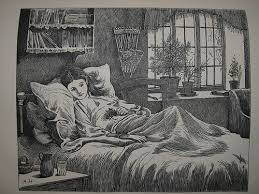
* Ellen Montgomery, the young heroine of The Wide, Wide World, is often in tears, as this period illustration from the popular novel shows.

September 25, 1851

DSCF1693small

Thursday Sept 25th  Julia has been here to day and has

cut two french print dresses.  She had but

very little trouble with them and I think they

sett very well  she also cut Susans doll a frock

Susan had a very comfortable night & appears

quite smart to day  The Dr came here to day

which makes the third visit says it is not necessary

for him to come again

Julia Mahoney, a young dressmaker who had recently immigrated from Ireland, worked at Evelina’s today.  She immediately set about cutting sections for two dresses to be made from the French print fabric that Evelina had just bought in Boston. Evelina was pleased with Julia’s work today, which wasn’t always the case.  To help keep little Susie Ames occupied as she recovered from a terrible case of nettle rash, Julia cut “a frock” for Susie’s doll.

The doctor – we don’t know which one in Easton had been called – visited today and confirmed Susie’s imminent recovery.  The little girl was appearing “quite smart,” a phrase that Evelina occasionally used to note marked improvement in someone’s appearance, health, or wits.

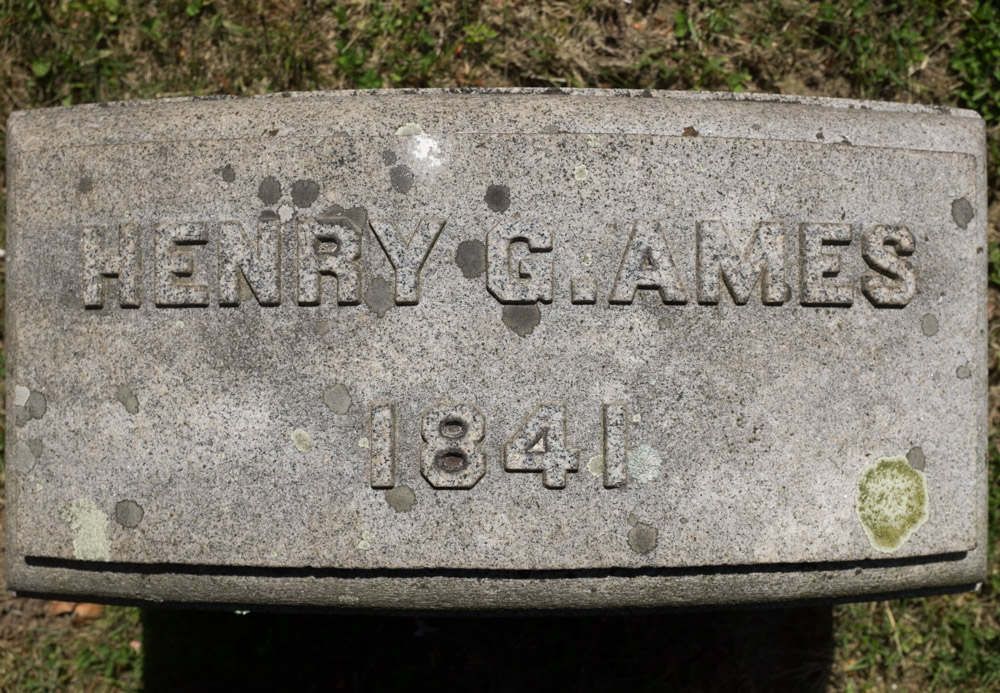
There was no question that fall had arrived.  Not only had the autumnal equinox occurred, officially ushering in the season, but Old Oliver had recorded several small frosts recently, including “a large frost last night.”  Daylight was shrinking slightly every day. As she quilted today, Evelina must have been turning her thoughts toward winter.  She may also have paused to remember that ten years ago on this date, her fourth son, Henry Gilmore Ames, had died at age 2 1/2.

September 24, 1851

imgres

Wedns Sept 24th  Susan has had another night of

suffering and has not slept but little if any but this

morning she appeared better and has had a more

comfortable day than I expected she would have  Helen

brought in her doll for her to play with and she

has had three to play with which has taken […] her

mind from her sickness in a great measure.

Francis dined here carried home Mr & Mrs Whitwell


The nettle rash, or hives, that had attacked Susie Ames began to subside this morning, surely bringing relief not only to the little girl, but to her mother and everyone else interested in her welfare. As Susie began to feel better, she became agreeably occupied with an extra doll brought in for her to play with by her older cousin from next door, Helen Angier Ames.

Helen’s mother, Sarah Lothrop Ames, and Harriett Ames Mitchell left Easton today to go into Boston and Cambridge for a night. Perhaps they visited Sarah’s sixteen-year-old son Fred Ames at Harvard, where he was a new sophomore. Fifteen-year-old Francis E. Gilmore, the youngest son of Evelina’s brother Alson Gilmore, came to the Ames’s for midday dinner.  Was he visiting the construction site of his older brother, Edwin Williams Gilmore, who was building a home close to Ames compound? Francis lived down on the family farm, and was able to give a ride south to William and Eliza Whitwell, who had been visiting Sarah Witherell.

Meanwhile, focused and persistent, Old Oliver continued to supervise construction of a new flume from Great Pond near Stoughton south to the waterflow in North Easton. He noted in his daily journal that “this was a fair day with a strong wind from the north west and pritty cold. we got on the top stone to our floom to day.”


September 22, 1851

OLYMPUS DIGITAL CAMERA

*

Mon Sept 22nd  This morning sat down to sewing and fixing some work

for Ellen cut the breadths for a bedquilt and was in 

hopes to have a quiet day & week to sew but it has 

not commenced very fair  About noon Susan was

complained of an itching & burning and on examination

I find her back was broken out in great blotches &

this evening she is completely covered & in great agony

A Mr Bronson is stopping here from Pennsylvania

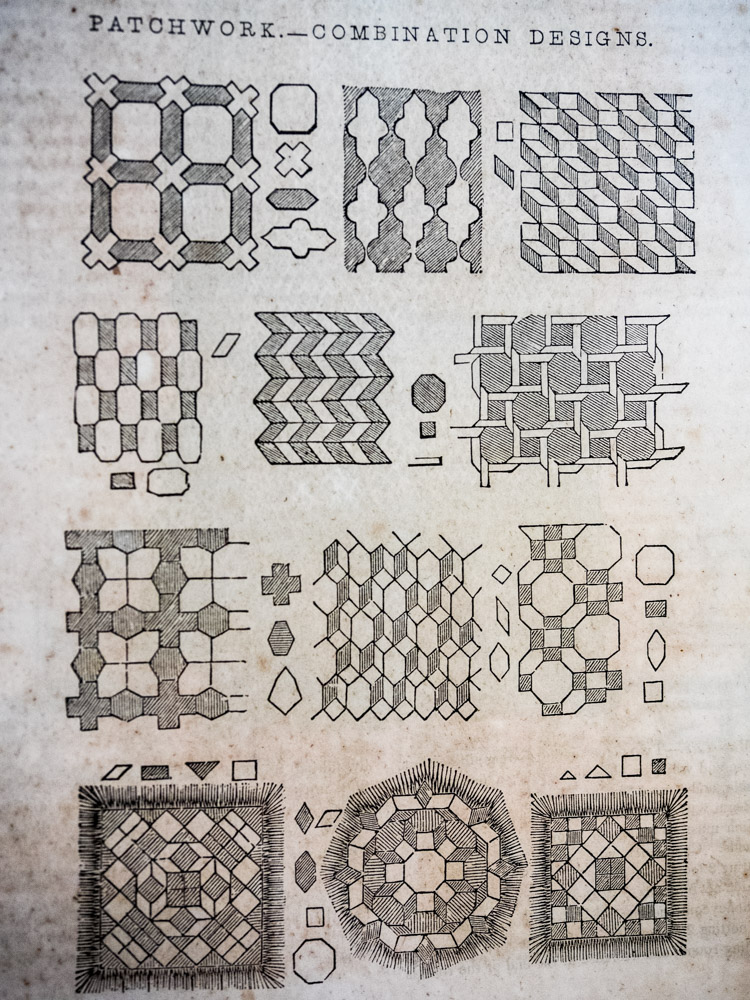
Monday morning at the Ames’s meant that after breakfast, Jane McHanna turned to doing laundry and Evelina, after doing dishes and other chores, sat down to sew.  She had in mind to make a quilt – perhaps she had liked one of the quilt designs featured in this month’s Godey’s Lady’s Magazine. She cut out some “breadths” of fabric and imagined she’d have most of the day to work on the project.

At midday, however, just at the time when dinner was usually put on table and the men returned from the shovel shop for the big meal of the day, nine-year old Susie reported not feeling well. Something on her back itched and burned. It got worse as the hours passed and by bedtime she was suffering. What was going on?

To complicate matters, the Ameses had a houseguest staying for the night, a Mr. Bronson who was most likely in town on shovel business.  How difficult it must have been for Evelina to give him proper attention and tend to her daughter at the same time. So much for sewing.

Quilt designs from Godey’s Lady’s Book, 1851

September 12, 1851

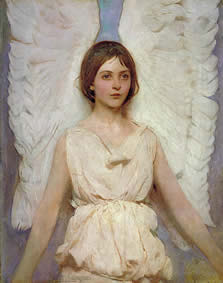
Abbott H. Thayer, Angel, 1887, oil Smithsonian American Art Museum Gift of John Gellatly

Abbott H. Thayer, Angel, 1887, oil
Smithsonian American Art Museum
Gift of John Gellatly

Friday Sept 12th  Mrs Stevens Susan & self have been to

Foxboro and a sad visit we have had.  Mr Edson

Carpenter buried this afternoon his only daughter

and we attended the funeral at the meeting 

house. Called there this morning & then

went to Mr Jones found Mrs Jones very unwell

and no help & Mr Jones away but about twelve

he returned & put up our horse.  Very hot

In 1851, an eight-mile road, give or take, ran north and west from North Easton to Foxborough by way of Mansfield. It was on that road that Evelina, her daughter Susan and guest Mrs Stevens traveled on this date to attend the funeral of a child, the only daughter of Edson and Mrs. Carpenter. After the hot journey, their horse – was it the speedy mare Kate? – needed to be stabled, and watered, presumably, while they attended the service.

Why they went and what the Ames’s attachment to Edson Carpenter was we don’t know.  Mr. Carpenter was a store-keeper in Foxborough, where he had built his own commercial block only four years earlier. Like other merchants in the town, he was affiliated with the straw industry, straw being a popular commodity for summer bonnets and the like. In fact, beginning in the 1840s, his store was “where straw braid and bonnets were received in payment for goods.”*

But as Evelina noted, he buried a child today, and it was “a sad visit” for all. The continuing hot weather wouldn’t have helped anyone’s spirits. The women must have had a solemn, hot drive back to Easton.

* Foxborough’s Centennial Records, 1878, p. 75