March 8, 1852

Carpenter

March 8th

1852 Monday  To day is town meeting.  George brought

sister Amelia here this afternoon  Have got

the carpet down in the front entry and 

the chamber carpet partly down

S Ames sent for the entry lamp for fear

I suppose that I should keep it but

she […] might not been alarmed

Carpenters have come to rebuild the shops

A new week signaled a fresh start. It had only been six days since the fire at the shovel factory, but the clean-up had gone quickly. The ruins were “dismal,” as Evelina noted yesterday, but the debris was mostly gone, hacked down, shoveled up and carted away. Carpenters had arrived to begin rebuilding, as Old Oliver, too, noted in his diary:  “some of the carpenters came on to day to build up our shops + Mr Phillips + his son came.”*

Life in the village was returning to normal.  Housewives, some with servants, tended to washing day. Children went to school and men went to town meeting.  As at church, the fire must have been part of the conversation as the men gathered to decide on town affairs and expenditures for the coming year. People must have wondered how soon the shovel shop would be up and running.

At the meeting, a new moderator, Alson Augustus Gilmore, presided. Not yet thirty years old, it was his first time holding the gavel; he would repeat the performance twenty-four times over the coming decades.  According to William Chaffin, Gilmore and his predecessor, Elijah Howard, Jr., “served with signal ability.”**

Evelina and her sister-in-law, Sarah Lothrop Ames, had a minor set-to over “the entry lamp,” which appears to have been a luminary that was shared by both houses. Sarah was evidently skittish about not having it, and Evelina was annoyed to have it commanded away.  No cause for alarm, she might have said. She wouldn’t have been annoyed for long, however, as a favorite family member, Amelia Gilmore, arrived for a visit. Amelia was the young widow of Evelina’s younger brother, Joshua Gilmore, Jr. She had lately been working as a private nurse.

*Oliver Ames, Journal, Stonehill College Archives, Arnold Tofias Collection.

**William Chaffin, History of Easton, 1886, p. 637
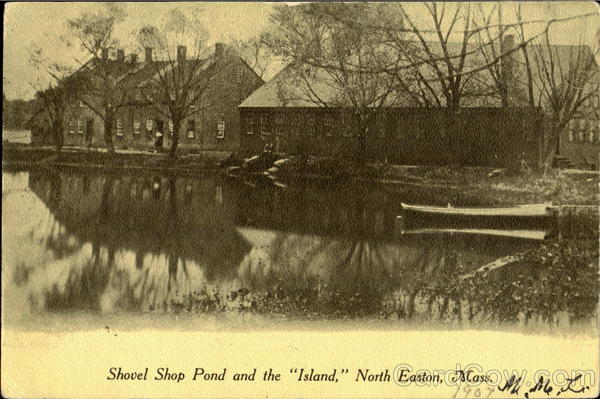
March 4, 1852

Shovel Shop Pond And The Island North Easton, MA

Replacement buildings on a section of the Ames shovel complex

1852

March 4 Thursday  Scott & Holbrook are setting glass at

the shop to day  They have the front entry partly

painted  I carried my work into Edwins this

forenoon  mended O Angiers shop coat  This afternoon

have been to Mr Torreys with Augustus & Lavinia

Called a few moments on Hannah  She has a 

sore mouth and is weaning her child

Evelina addresses her day calmly, as always keeping her distance from the goings-on at O. Ames & Sons. Most other residents of North Easton were still reeling, no doubt, from the huge fire that had burned down a majority of shovel factory buildings over the night of March 2. The sun was shining and the wind was out of the north west, pushing around remnant smoke still rising from the ruins of the complex of wooden buildings. Shovel shop employees had no regular job to go to and the owners had some serious decisions to make, fast.

Clean-up from the huge fire was underway, probably by the labor of the very men whose factory jobs had been temporarily eliminated. The men who had been painting and papering at the Ames’s house, for instance, were co-opted to set glass at the shop, suggesting that new panes of glass – the originals probably having been blown out by the fire – were going into the windows of the one or two buildings that had survived.

As town historian Ed Hands points out, “the Ames family and the neighborhood rebounded quickly.”*  Old Oliver and his sons Oakes and Oliver Ames Jr. made a two-fold decision. The first was to create temporary structures to house the manufacturing so that shovel making could resume as quickly as possible.  The second was to create “new, permanent stone shops,”* sturdy, nonflammable structures that could outwit any new fire.

There was insurance money to cover at least some of the rebuilding. Sources differ on the amount of damage that the fire inflicted, but suggest it was between $30,000 and $40,000. The amount of insurance coverage is also uncertain. Old Oliver “states that there was $3,000 worth of insurance on the buildings”** but, according to industrial historian Greg Galer, it’s likely that the Ameses had increased insurance coverage on the factory back in November, 1851. Whatever the actual dollar cost was, “[t]he company bounced back quickly from the devastation, and seemingly without significant financial trauma.”**

*Edmund C. Hands, Easton’s Neighborhoods, Easton, 1995, p. 163

** Gregory Galer, Forging Ahead, MIT, 1989, p. 249


March 3, 1852

Fire


1852

March 3  Wednesday  Last night the finishing shops

were burned to the ground by Quinns letting 

his lantern fall into the varnish  Oakes came

home from the fire about 4 Oclock much

more cheerful than I expected to see him and 

went to bed  OA and Frank came home to put

on dry clothes & went back and staid untill morning

Lavinia & Augusta were here awhile this afternoon


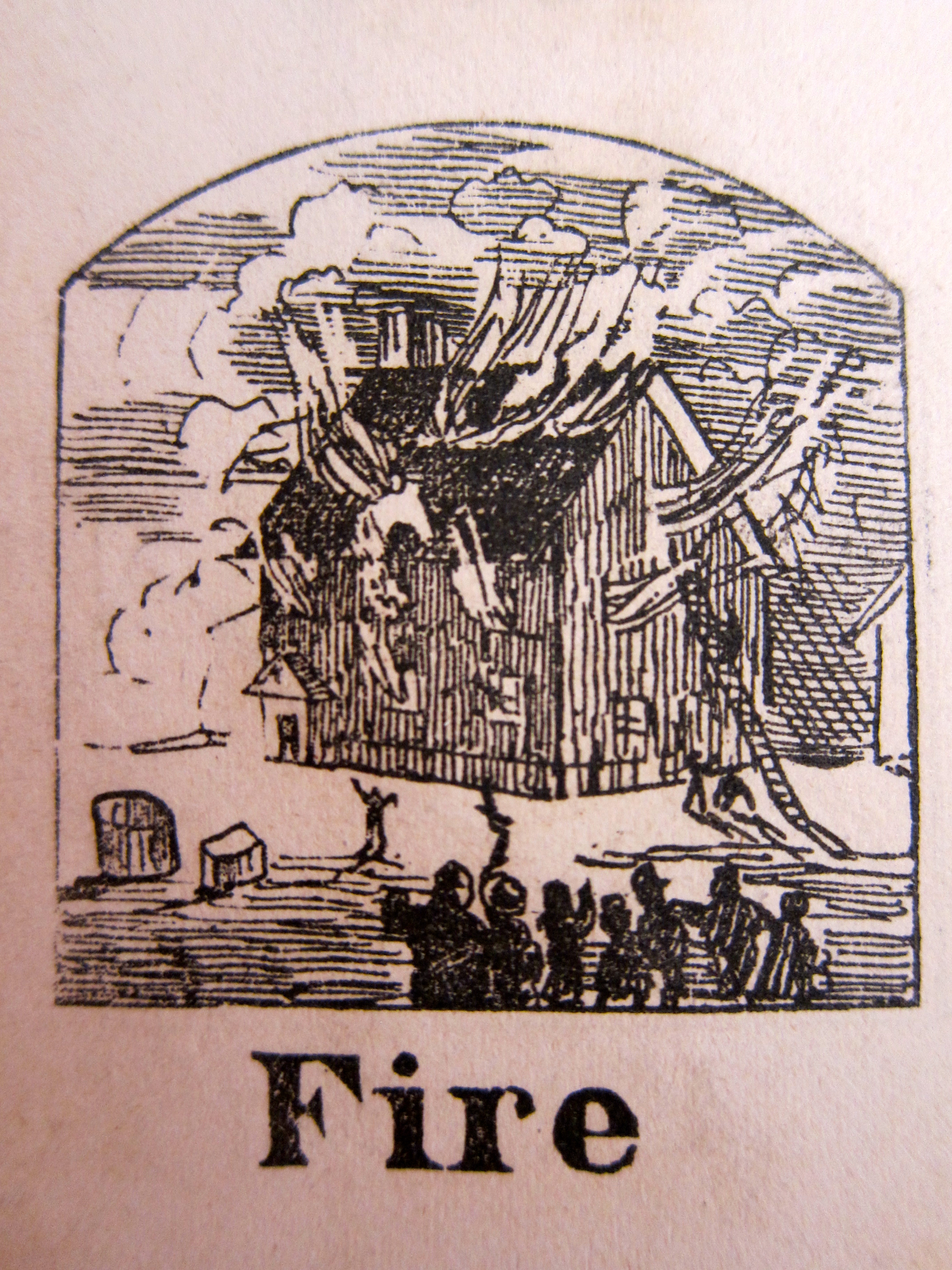
Fire! Most of the shovel company’s buildings, situated in”the most centralized areas of Ames production, ‘the island’ at the outfall of Shovel Shop Pond,”* caught fire and burned to the ground. On his nightly round, Patric Quinn, the watchman, dropped his lantern into the varnish. The subsequent explosion must have been quick and, given the nature of the combustibles, uncontainable from the outset.

Naturally, Old Oliver recorded the event as well: “last night about eleven O clock the finishing shop took fire and the shops adjoining it were burned down – Bisbes shop and the small one made out of the cole hous that was mooved from the hoe shop was saved – the fire took from the varnish …”**

O. Ames & Sons had caught fire before, once in 1844 and again in 1849.  After the 1844 fire, the family “had bought a used fire engine,”** which was brought to bear on the 1849 fire. In that case, Old Oliver credited the engine with saving the day, noting that “if we had have had no engoin I think it would have burnt up.” **

This latest conflagration was different. As modern historian Gregory Galer points out, “luck was not on their side…[the used fire] engine was no match for the blaze, fueled in part by 12,000 well-dried, ash shovel handles; oil and varnish used to protect completed shovels; and the wooden building itself.”*  The shovel shop was in ruins.

Evelina didn’t attend the fire, but she would have been able to see the flames from their front windows. The fire went on all night, her husband, sons and other townspeople present for most of it. There is no record of any injuries.


Gregory Galer, Forging Ahead, MIT, pp. 248-249

** Oliver Ames, Journal, Stonehill College Archives, Arnold Tofias Collection


The New Year

What is a diary as a rule? A document useful to the person who keeps it. Dull to the

contemporary who reads it and invaluable to the student, centuries afterwards, who treasures it.

Sir Walter Scott


January 1, 2015

Dear Readers,

If you’re like me, you have treasured the 1851 diary of Evelina Gilmore Ames. Some of you have even participated with comments that have added depth to the consideration of a time gone by. Your additions have enhanced the small tale of a Yankee housewife who marked her modest days with regular notations of dresses sewn, flowers planted and fruits preserved, who wrote of short trips into Boston, visits to the family farm, and errands of mercy into the homes of sick neighbors.

Without meaning to, Evelina preserved a picture of life from antebellum New England, a life that has disappeared and evolved into a world she’d be hard-put to recognize. Her children, grand-children, and great-grandchildren have lived and died. Her house itself is gone, though the grander dwelling of her in-laws, Oliver, Jr. and Sarah Lothrop Ames, still stands proudly next door. Automobiles drive where oxen carts and horse carriages moved, and the significant architecture of certain stone buildings in the center of the village memorializes relatives she loved. The very factory whose noisy production of world-famous shovels led the local economy for decades moved away more than sixty years ago. She couldn’t have imagined it.

Yet some things remain the same. People are still people, solicitous or mean, content or down-hearted, eager or indifferent. The true characters we read about in the pages of her diary are recognizable and familiar to us in their essential humanity. We can find ourselves and our own families somewhere in these pages; we all behave so similarly. In Easton, Massachusetts, many descendants of the people Evelina wrote about still live. Last names like Ames, Gilmore, Randall, Tisdale and others can be found in the local telephone book (which itself is in danger of becoming as obsolete as Evelina’s tin stove.)

Evelina continued to keep a diary after 1851, but only the 1852 diary is extant. Her journals from the Civil War period have been lost. We’ll just have to treasure the one that remains. And so, ahead of us is the last available year of Evelina’s tiny aperture on the Ames family of old.

Thank you for reading!


Sarah Lowry Ames

(wife of John S. Ames III, great-great-great-grandson of Oliver and Susanna Angier Ames)


December 10, 1851

Thread


Dec 10th  Wednesday.  Mrs S Witherell S Ames and

self have spent the day quilting at Mrs Reeds

on a quilt that belongs to the sewing circle  Have

had a fine time.  Met quite a number of

ladies there. Had a taste of Mrs Howards mince

pie  We stopt the evening.  Mrs Witherell

J R Howard & Mr Harrison Pool came  We carried

Mrs Elijah Howard home

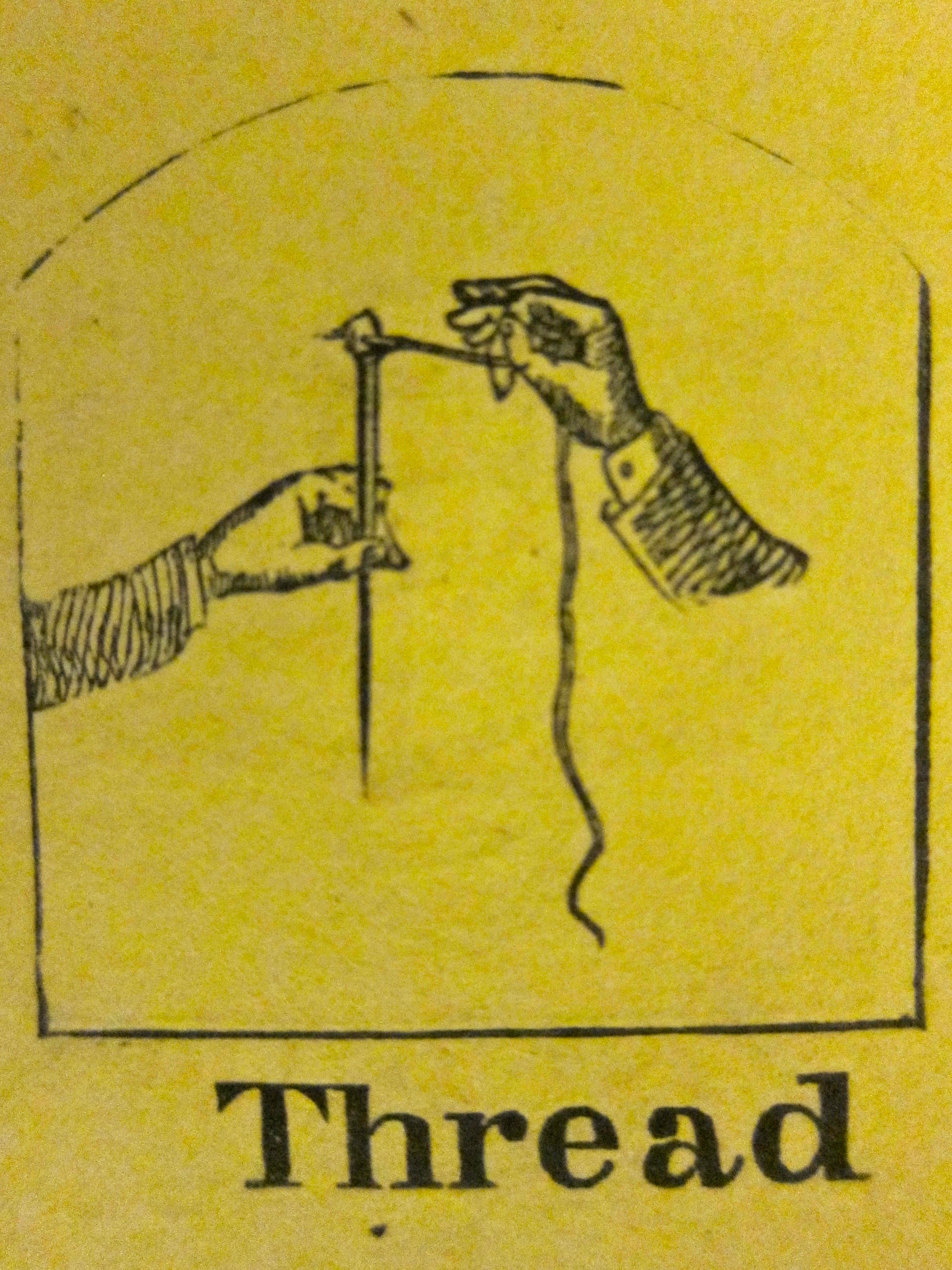
Although Evelina had reported the conclusion of the Sewing Circle season on November 5, today “quite a number” of Unitarian women met again to work on a quilt. They worked all day and into the evening, making the event even more sociable than usual.  Caroline Howard and Nancy Howard were among Evelina’s friends who attended and enjoyed tea and mince pie.

In New York City, meanwhile, Oakes Ames would have been wrapping up his business affairs and preparing to return home, having been away since the 3rd of the month.  Surely, not every moment of his trip had been devoted to shovels. He was no drinker, so the bartenders in the city wouldn’t have poured him any whiskey, but, like his wife, he was sociable.  He might have joined friends or clients for dinner. He also might have done favors for family or friends from home.

Rev. William Chaffin tells us that Oakes once searched out some socks in New York for his father’s coachman, Michael Burns, whom Chaffin described as “an Irishman of the old style.” Not long after Michael had emigrated to Massachusetts, “his mother, still alive in Ireland, knit him several pairs of socks, and sent them over by a friend of Michael’s.  She supposed that anyone coming over would necessarily ‘see my son Michael.’ But the friend found on landing at New York that he was two hundred miles away.  He wrote Michael telling him that he would leave the socks at a certain address.”

Michael approached Oakes “and asked him if he wouldn’t hunt up the socks and bring them home. It was just the sort of kindness Mr. Ames delighted in, and so when he went to New York he hunted up the socks with some difficulty and brought them to the overjoyed Michael.”*

*William L. Chaffin, “Oakes Ames 1804/1873”, Easton Historical Society, North Easton, 1996, pp. 6-7


December 6, 1851


Picking apples 1880

Farm hands fill an oxen cart with apples in the late fall

Dec 6th Saturday  Mr Scott & Holbrook have finished

the first coat of paint in the storeroom &

stairway and porch.  They commenced yesterday P.M.

Have been mending stocking pants &c &c

all day and waiting upon the painters   they have

varnished the graining in the dining room

and painted the inside windows for the sitting room

Yesterday Evelina had sought Mr. Scott to do some painting for her.  He and another workman, Randall Holbrook, had responded quickly, arriving at the Ames’s house by the afternoon.  They continued their work today, painting and varnishing various areas inside the house. The day being “fair”  if “cold,”*  the men were also able to paint a porch outside. One might have thought that Evelina had already gotten everything painted; this kind of work had been going on for months.

Old Oliver noted in his journal that “the ground is frozen hard + carting is good”  The unpaved roads in the village and beyond had hardened, enabling carriages, carts and wagons to move steadily around. There was no sinking into half-thawed, muddy ruts. As modern historian Jack Larkin has noted, “[W]henever it was cold enough to freeze hard, ‘winter was the time…for making journeys.’ The hazards of cold and storm were outweighed by leisure from farm work and greater speed.” **Pulled by teams of oxen, carts full of finished shovels could get moved to market to be shipped out, and raw material for the factory could be shipped in.


*Oliver Ames, Journal, Stonehill College Archives, Tofias Collection

** Jack Larkin, The Reshaping of Everyday Life,” New York, 1988, p. 221.


December 3, 1851


railnet1850

Dec 3d  Wednesday.  Mr Ames started for New York by

way of Boston.  I went to Boston with him dined

at Mr Orrs  Melinda went for Selina and

she passed the night there with me.  I was very

busy shopping all day  In the evening Mr & Mrs

Norris  Selina & self played cards  Past eleven

when we retired.  Mr & Mrs Byram were there


As Old Oliver wrote at one point in his journal, “Oakes went to New York the 3rd of this month to settle up our accounts.”  With his natural bonhomie and sharp talent, Oakes was the best salesman on the Ames team.  On this trip, he would be away for eight days, delivering invoices, collecting payments, checking on inventory and bringing new orders back home.

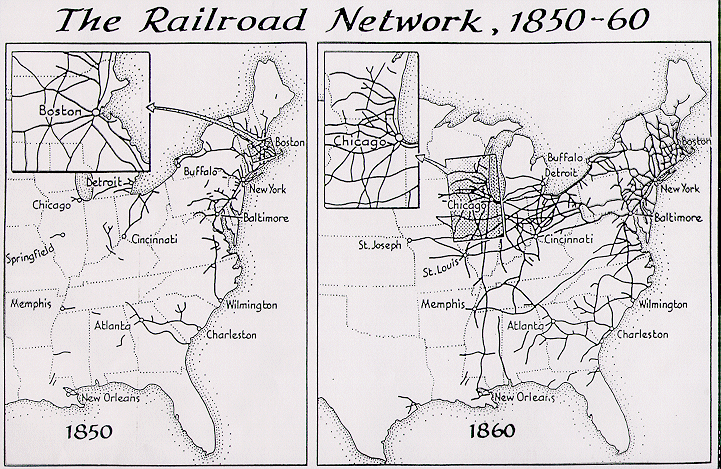
Evelina accompanied her husband into Boston, where they stopped for midday dinner at the Orrs’ before Oakes boarded his train. He would have traveled to New York by way of Springfield, or else taken the Old Colony line down to Fall River where steamboats picked up passengers to complete the trip to New York City.  Evelina, meanwhile, stayed in Boston to shop and enjoy a bit of socializing with the extended Orr family. She played cards past her bedtime.

Back in Easton, shovel making and farm work went on as usual.  Old Oliver, as always, noted the weather: “this was a fair day wind north west + cold. ”  He added that  “we kild 4 hogs to day everage wate 356 lb sold to the workmen at 7 cents a pound those we sent to boston sold for 7 ¼ cents”.  He sold some of the fresh pork to his workmen, probably through the Ames store, and sent the surplus to Boston to be sold.


November 28, 1851

Clock

Nov 28th Friday  Had rather of a late breakfast

Oliver did not rise untill past ten Oclock

Have been very busy to day making some

collars for Mr Ames & have been looking

over Olivers clothes some  Mr & Mrs Thom

Ames have spent the afternoon with Mrs Witherell

I have been to see them this evening

Like many middle-class families in 1851, the Ames family probably kept at least one clock against a wall or on a mantel. By its hands Evelina could tell that her middle son, Oliver (3), had slept exceedingly late on this morning after Thanksgiving. She might have looked up from her sewing to notice the minutes move by. Just home from his first term at Brown University, Oliver was keeping collegiate hours that were rather more elastic than the factory time by which the days usually ran. Tired from his studies and his journey home, Oliver slept in. Workers at the shovel shop were not accorded that luxury.

Absent a working clock in the house, how did people in the village and its close environs know what time it was?  Pocket watches were popular, certainly, but many in the village wouldn’t have owned one. The young, single immigrant men who lived in the Ames tenement, for instance, and the working families who lived in the factory houses around town needed temporal oversight. A bell at the factory guided them.

According to historian Gregory Galer:

“Life in North Easton in the 1840s was dominated by the Ames Company.  With the move to a more regular work schedule the company instituted the use of a bell, heard throughout the village, to be sure employees would keep a schedule which would allow them to fullfil their duties at the shovel shop.”*

Evelina’s grandson, Winthrop Ames, noted:

“Every week-day morning at ten minutes before five the shop bell warned the town to yawn itself awake; and at nine in the evening it rang a curfew (as it still does) to advise bedtime.  The factories started at seven, by lamplight in winter, and stopped at six, with an hour out at noon for dinner – a ten-hour day.”**

Winthrop was writing in 1937; in 1952, the Ames factory would close in Easton and move to West Virginia.  No curfew bell rings in North Easton today.


*Greg Galer, Forging Ahead, MIT, 2001, p. 240

*Winthrop Ames, The Ames Family of Easton, Massachusetts, privately printed, 1937, p. 128

November 12, 1851

IcePond-732701

*

Wedns Nov 12th  Painted the closets in the sitting

room chamber which with other things has taken

me most of the day.  Susan has passed the 

afternoon at Mr Swains  Mr Whitwell called

this afternoon. I felt very sorry to stop my work as

I was very much engaged at the time  Have not

sewed at all to day  This evening have felt too much

fatigued


According to Old Oliver, “this was a fair cold day wind north west. the factory pond was frozen over this morning”  It was a good day to stay indoors, which Evelina did.  She still hadn’t completed all the refurbishments on the house, so she spent the day painting the shelves in the closet in the sitting room; the shelves in the parlor were already finished.  By evening, she was “too fatigued” even to sew.

Daughter Susie spent the day at the home of Ann and John Swain, perhaps playing with Ann’s niece, Ellen Meader.  Reverend William Whitwell braved the north west wind and paid a call on Evelina.  Much as she liked him and admired his Sunday sermons, she was less than pleased to set aside her painting for his visit.

And “the factory pond” – probably Shovel Shop Pond – had skim ice, at least, all the way across it.  What did that do to shovel production?  How did the dams, flumes, and wheels work when the water began to ice up?


*Photo courtesy of Kenneth Aisawa, http://www.theboundsofcognition.blogspot.com

October 14, 1851


Corpse


Tues Oct 14th  Expected Julia here to work this 

morning but she sent word that she would not come

untill afternoon and it has put me back about my work.

Went to the store and got muslin for Mrs Willis robe,

and linings for dresses.  Helped Mrs Witherell & Mrs S

Ames make the robe  Julia came this afternoon & cut

the waist to my dress  Mr Ames has been to Boston &

Braintree

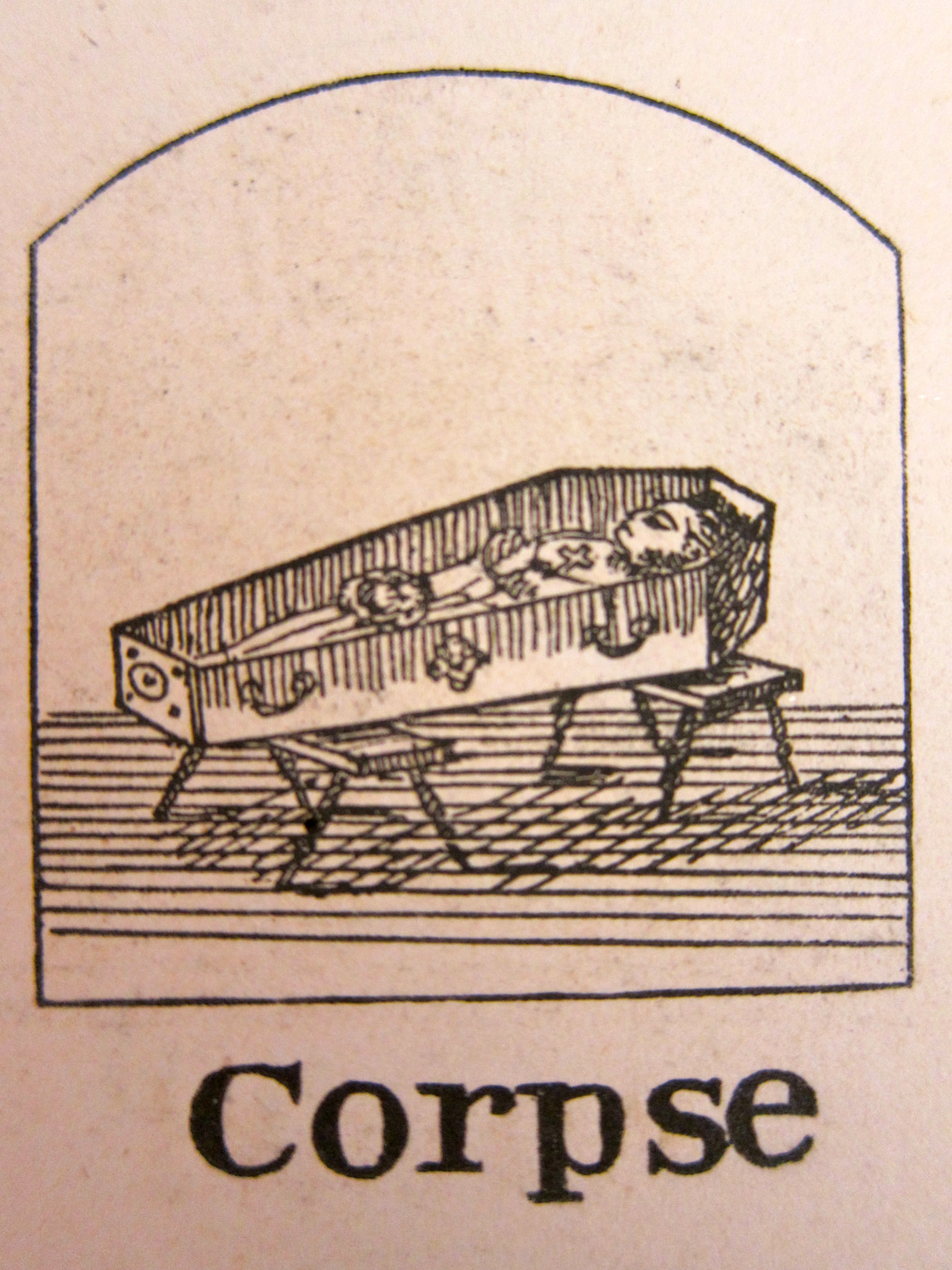
The sad business of sewing a robe, which is what the Ameses called a shroud, fell to Evelina and her sisters-in-law. The Ames women often were called on to make robes for the deceased, as they did today for a neighbor, Mrs. Willis. Mrs. Willis, who had died the day before, presumably had no family members who could otherwise sew the robe. Evelina herself picked up the muslin, the traditional material for a burial sheet, from the Ames store. The process of preparing the dead for burial tended to follow the existing customs:

“Before the Civil War, the care of the dead was largely the domain of the deceased’s family and neighbors. The corpse was customarily laid out on a board that was draped with a sheet and supported by chairs at either end. The body was washed, almost always by a female member of the household, and wrapped in a sheet for burial. A local carpenter or furniture maker […] supplied a coffin, a simple pine box with a lid. The undertaker, often the same carpenter or furniture maker […] took the coffin to the house and placed the body inside. With the family and friends gathered around, the minister performed the appropriate religious rituals, and then the undertaker conveyed the coffin to the graveyard.”*

Other sewing went on today as well. Evelina had spent the past several days piecing together a dress made of cashmere, and was waiting for the dressmaker of choice, Julia Mahoney, to work on the waist.  Julia was late, however, which threw a wrench into Evelina’s plans for the day. Evelina didn’t like tardiness, and was unhappy to have to rearrange her day. Eventually, however, Julia arrived and “cut the waist.”

Oakes Ames, meanwhile, went into Boston and Braintree, presumably on shovel business.  Saturday was his usual day to go into Boston; it being Tuesday, perhaps something beyond Oakes’s usual job of taking orders for shovels was called for.

*http://www.memorialhall.mass.edu/classroom/curriculum , “Death and Dying in the 18th and 19th Centuries”