January 29, 1851

Carpetbag

Carpetbag

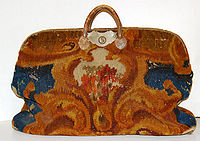
Jan 29th  Finished my carpet bag this morning and afterwards made

a long call on S Witherell and then she came here and sit awhile

with Mother.  This afternoon cut Susan 4 prs of pantletts

and finished a pr that was cut out a long time since.

S Witherell passed an hour with us this afternoon and 

then again this evening  The boys went to the shop awhile

Mr Ames came home at 1/2 past seven (wonderful to relate)

and has been reading in Mr Lovells paper  Very heavy rainfall

Pleasant tonight but very windy

Sewing the carpet bag was speedy work for Evelina, given her skill with a needle.   Carpetbags were fashionable travel bags from as early as the 1820s, in America and England.  They gained notoriety after the Civil War when they became symbolic of certain ruthless opportunists – “carpetbaggers” – from the North who flooded into the South to take advantage of the post-war confusion and economic disarray.  The negative symbolism of this small piece of luggage was unknowable in 1851, obviously, so we can imagine that Evelina carried her new carpetbag with pride.  Perhaps she used it on her next trip to Boston.

Oakes Ames didn’t linger in the office tonight as usual but came home for a quiet evening of reading the Olive Branch.  Evelina was pleased to have his company, which must have provided some variety for her elderly mother, too.  Sarah Witherell’s company would have added to the ease and sociability of the evening.  More often, Sarah stayed in her part of the house in the evening in order to be company to her father. And the boys – Oakes Angier, Oliver (3) and Frank Morton – went back to the shop, although the nine o’clock curfew was nigh.

The Ames house was divided into two living areas, with Old Oliver, Sarah Witherell and her two children on the southern side and  Oakes and Evelina’s family on the northern.  Old Oliver made this division back in 1827 when Oakes and Evelina first married, indicating then that Oakes, as his eldest son, would inherit the family  homestead.  The two families had lived side by side ever since, the house expanding and contracting as children grew up, occupants died or moved out, and grandchildren came into the world.

Some Ames family members of today who can remember the old homestead (it was torn down in 1951) shake their heads in wonder at this living arrangement, curious as to how everyone fit in.
January 23, 1851

Thread

23 Jan  Thursday.  Went again to Elisa Quinns this

morning to get another dolls dress cut & staid untill

about noon to work on it & left it to be finished.  This

afternoon have been to Mr Whitwells to the sewing

circle.  There were but few members present a part over

there yesterday  We carried a piece of striped shirting

and I cut out a part of it.  Abby came to pass the

afternoon but did not stop.  The boys all went to Canton

for an assembly.  Very pleasant

Evelina, and probably her sisters-in-law, made their way to the Whitwells’ home today for the monthly meeting of the Sewing Circle.  The gathering was smaller than usual, as some members had attended the original meeting, held the day before, despite the snow storm.

The Sewing Circle was a regular meeting of about twenty women from the congregation of the Unitarian Church.  Led by Reverend Whitwell, it moved each month from house to house, giving each member a chance to host the event.  The program itself consisted of sewing, each woman bringing her own work, or helping a friend with a project, or perhaps sewing together in concert for a purpose; Evelina is unclear on this.  Mr. Whitwell probably opened the meeting with a prayer, and may even have read to the women as they worked or rendered his  thoughts on topics either scriptural or secular.  The meeting may have been less formal than that, but the minister’s presence made it a sanctioned event.  Ordinarily, women didn’t gather regularly outside their homes for recreation. No book clubs!

In fact, Easton’s sewing circle was an iteration of a female benevolent society, such as ladies in towns and cities in many parts of the country were forming in the first fifty years of the 19th century.  The purposes of the societies varied.  Some, like the Fragment Society in Boston (which formed in 1812 and is still active today) provided clothing and bedding for poor women and children.  Some, like the Worcester Anti-Slavery Sewing Circle, were abolitionist,  while others focused on missionary work, or simply helped raise money for their local parish.  And though their purposes were quite specific, the consequences of the sewing circles were broader than their participants imagined.  These gatherings were a tiny but important early step toward allowing women to contribute to society outside their own homes.

By the time the Ames women returned home from their meeting, Evelina’s boys were on their way to Canton to another assembly.  Oakes Angier, Oliver (3) (even with his chillblains) and Frank Morton rarely missed an opportunity to go to a dance or a “sing” or a party.  They were lively young men.  All in all, a sociable day for the Ames family.

January 22, 1851

Chillblains

Chillblains

1851 Jan 22 Wednesday  Commenced working on the sack again this

morning quite early.  Went to Elisas about ten

to get her to make a dress for Susans doll staid

untill twelve and left her to finish it

Got ready to go to the sewing Circle at Mr Whitwells

But it commenced snowing very fast which prevented

our going.  This evening have finished Susans sack

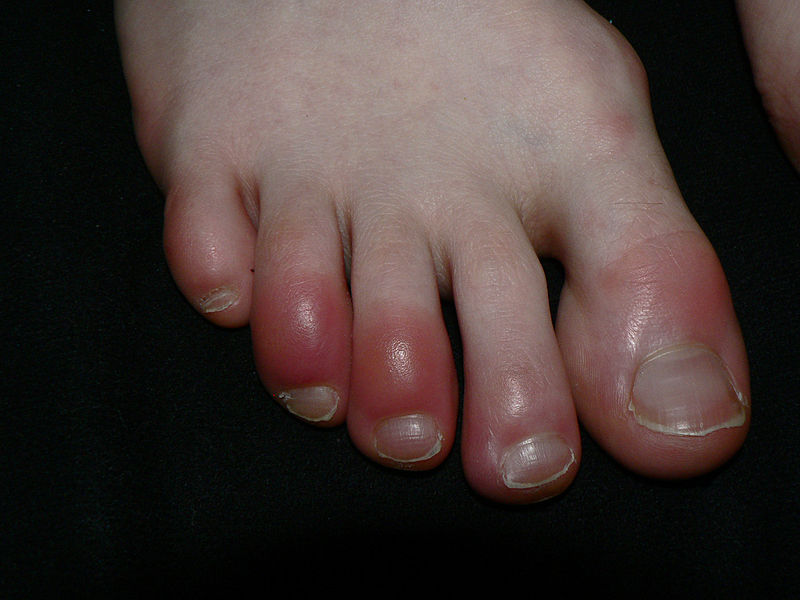
Oliver poor fellow sits here almost crying with the chillblains

Evelina finished sewing a sack (a kind of apron) for her daughter that she’d been working on for several days, and turned to another ongoing project, doll clothes.  At mid-morning she left the house and went to Elisa and Patric Quinn’s home along Stoughton Road (today’s Elm Street).  Elisa was a dressmaker while Patric was employed at the shovel factory.  Like so many employees in that period, they had emigrated from Ireland.  Elisa was going to help Evelina finish two dresses for Susie’s new doll.

Leaving the little dresses in Elisa’s capable hands, Evelina returned home for midday dinner, just before snow began to fall.  She and her sisters-in-law had planned to go to the monthly meeting of the Sewing Circle, held this afternoon at the parsonage where the Whitwells lived, but poor visibility put an end to their travel.  The ladies stayed home.

Oliver Ames (3), Evelina and Oakes’ middle son, was suffering from chillblains, an unsightly and uncomfortable affliction of extremities: toes, fingers and ears.  Cousin to frostbite, chillblains are an itchy, painful inflammation brought on by exposure to moist cold air.  Some say it’s caused by too-rapid warming of skin and tissue after exposure to cold.  Different treatments were offered: poultices, soaking or rubbing with salt.  Lydia Maria Child, author of The American Frugal Housewife, offered a specific remedy:

“The thin white skin, which comes from suet, is excellent to bind upon the feet for chillblains.  Rubbing with Castille soap, and afterwards with honey, is likewise highly recommended.  But, to cure the chillblains effectually, they must be attended to often, and for a long time.”

It appears that Oliver (3) was in for several days of discomfort.

January 21, 1851

Potato

Jan 21  Tuesday.  This morning commenced working on

Susans sack but had some things to do about house so

that I could not accomplish much.  Mrs. Holmes called

to get some potatoes for Miss Eaton  says she (Miss E) is

failing and the Dr had told her that he could not help

her  Mr Robinson came this afternoon to varnish the

chimney pieces & spilled the varnish over my carpet

which prevented me from going to have Susans doll

dressed

Harriet Holmes, a neighbor, came to the Ames house to fetch potatoes for the ailing Miss Eaton, the same Miss Eaton on whom Evelina and Sarah Ames called during the cold spell earlier in the month. The spinster lived with Harriet and Bradford Holmes, their children, Harriet’s mother and a shovel worker named Oliver Eaton – a relative, possibly.  Mr. Holmes was a teamster who probably worked with Old Oliver’s oxen. Many folks who lived in North Easton were connected to the shovel works in some way.

The potatoes that Evelina gave away would have been grown either by Old Oliver or by Alson Gilmore, Evelina’s brother, who owned the Gilmore family farm.  Potatoes were common fare at the dinner table, and particularly a favorite for winter use.  The Irish called them “pratties.” The challenge for a housewife lay in how to serve potatoes: mashed, roasted, and boiled were familiar variations, then and today.  Sarah Josepha Hale underscored the dietary importance of potatoes in her book, The Good Housekeeper.  “To boil Potatoes in the best manner, is a very great perfection in cookery,” she said.

In the Ames sitting room, hapless Mr. Robinson had to contend with a displeased housewife after he spilled varnish on the carpet.  He was already in Evelina’s bad graces from having taken too long to paint around the fireplaces. How do you suppose Evelina got the varnish cleaned up?

January 11, 1851

Workbox

/51 Jan 11 Saturday.  Made a haircloth back & cushion for one

of my rocking chairs.  Mrs Witherell brought in her work

and staid about two hours.  Willard Lothrop made

quite a long call.  Told Mrs W that he did think at one

time of coming to see her but she looked so dignified &c that

he could hardly muster courage &c &c  This evening have been

mending stockings & reading the papers.  Mr Ames has been

to Boston bought him a pr of Robbins.  Brought home watch

Very warm, pleasant but sloppy.  Bought 5 3/4 lbs Beef of C Lothrop

While Oakes made his usual Saturday trip into Boston, Evelina and Sarah Witherell sat together in the Ames’s front room, sewing. Evelina was completing a horsehair back and cushion for a rocking chair.  Horsehair upholstery was common in the 19th century, the haircloth being both durable and lustrous, plus relatively inexpensive.  Evelina, accomplished housewife that she was, would naturally have undertaken to do this work herself.

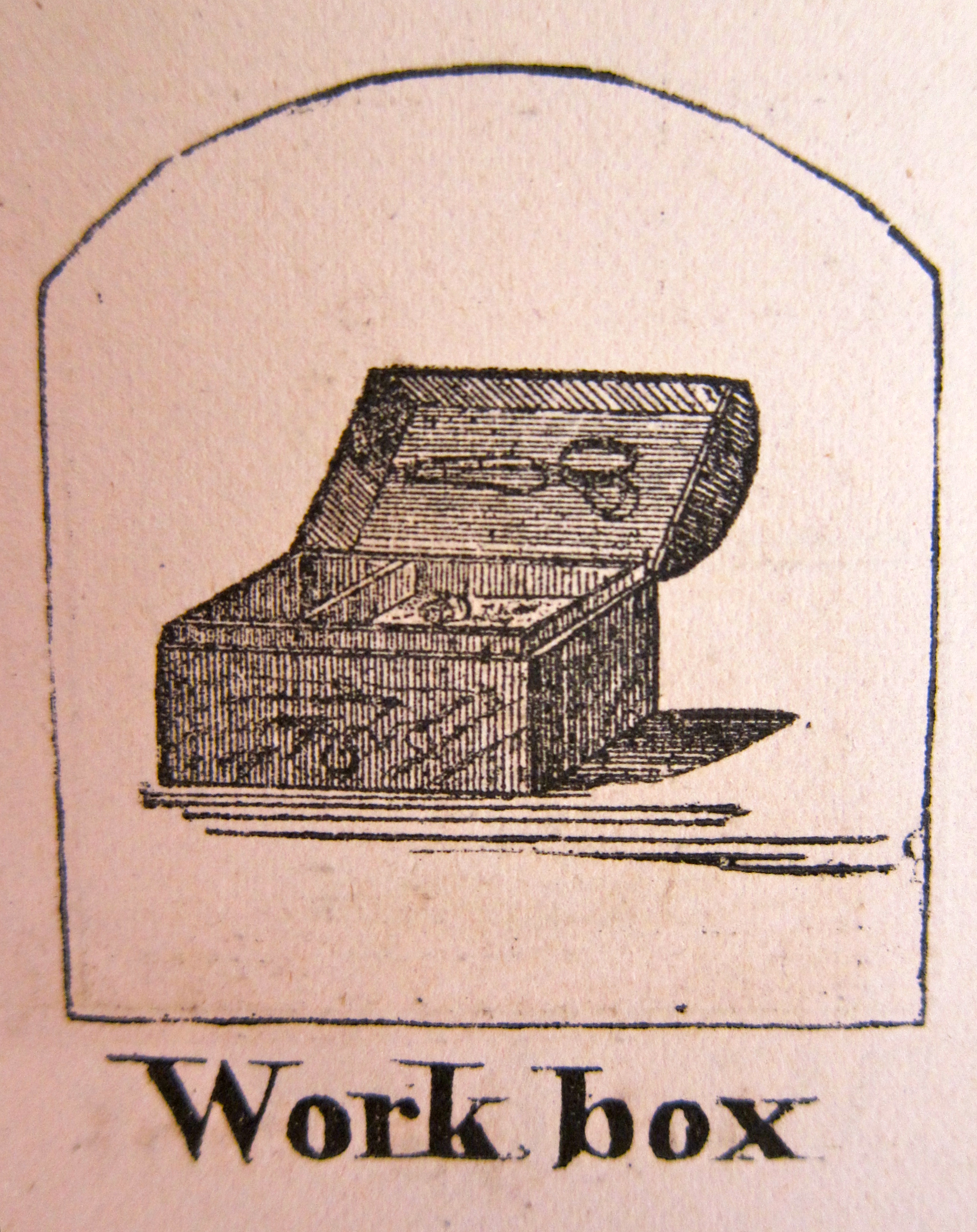
With their work boxes at hand, the two sisters-in-law sat, sewed and conversed until the arrival of a visitor, Willard Lothrop.  Mr. Lothrop, an employee at the shovel shop, was something of a character.  He was a self-declared medium and an impassioned advocate of spiritualism. (He may also have been related to both Evelina and her other sister-in-law, Sarah Lothrop Ames, through the Lothrop family line.  There were many Lothrops in the area.)

Spiritualism was a practice that claimed, in Reverend William Chaffin’s words, “that there is a vital connection between the seen and the unseen worlds by which communication between the two can be maintained.”  Though hardly a new concept, this American iteration took root in the mid-19th century and gained strength for a time after the Civil War.  Many in North Easton, especially those living along the Bay Road, were interested in it.

Lothrop, the purpose of whose call at the Ames house is not disclosed, focused his attention on Sarah Witherell, confessing that he found her unapproachable.  No mention of Evelina being inaccessible!  Lothrop offers us a rare, backdoor insight into the character, or the bearing at least, of the Ames sister of whom we know the least.  Except for her presence in Evelina’s diary, Sarah Witherell left almost no trace behind, no diary, no stories, no grandchildren, no legacy.  In a powerful, visible, active family, she may simply have been its most private member.

After Lothrop left, what did the ladies talk about?  And what are the “Robbins” that Oakes Ames bought in Boston?

January 8, 1851

Collar

/51

Jan 8th Wednesday

Made some cambric cuffs & collars and

starched & ironed some.  Worked on them most of the

day.  Jane ironed the coloured & coarse clothes

Head aches this evening trying to sew on fine work   gave

it up & went to reading a Thanksgiving story that

Mr Whitwell brought me to read.  Bought 25 cts worth Crackers

Settled with Sarah Ames she paid me for Cheese &c

Have been looking over my expense account  Pleasant

Evelina was an excellent needlewoman.  Like most women in the days before “ready-bought” apparel, she made her own clothes.  She made clothes for everyone in her family, in fact.  By. Hand.  No sewing machine was yet on the market; Isaac Singer and Elias Howe had each invented one but a drawn-out patent dispute was holding up its production.  By the advent of the Civil War, however, and the consequent need for mass production of uniforms, the sewing machine would come into its own, and the production of clothing would become an industry.  The three Ames sisters-in-law would eventually acquire a machine to share.

In the meanwhile, in the last decade before this change, Evelina sewed almost every day.  She occasionally relied on the help of a dressmaker – all the sisters-in-law did.  But Evelina easily made dresses, aprons, and underclothes for herself and her daughter, as well as work shirts and underclothes for her husband and sons.  Collars, handkerchiefs, sheets, linens and more were cut out, run together, fitted, taken up, untucked, hemmed, mended, refitted and re-mended.  The projects were endless, especially as the children were growing, but fortunately, sewing was an occupation that Evelina appeared to enjoy.  She spent more time at it than any other chore – certainly more than doing laundry, which she relegated to Jane McHanna, and probably more than cooking, which she typically undertook only when short-handed.  Sewing was her primary responsibility.

The “Pleasant” at the end of today’s entry describes Evelina’s take on the day’s weather, by the way, and not the prospect of looking over her expense account.  Other Ames diarists of this period followed the practice of describing the day’s weather, Old Oliver especially, but Oliver Jr, too.  Practiced agrarians, they all watched the sky.