March 26, 1851

Sweep

1851 March 26 This morning Orinthia & myself gave a thorough

sweeping & dusting to sitting room entry & then I 

went to mending stockings  Mother & myself passed

the afternoon at Olivers with Mr & Mrs Whitwell.

Mrs S Ames & Mrs Witherell spent the evening

here  I finished the shirt that I commenced 

for Oliver on Monday.  It has been a delightful day

Mud season, as they call it in New England, had arrived and thus a daily sweeping of the floor and carpet was essential. Dust and mud entered the house on the bottoms of boots and shoes when anyone came in the door.  Once this messy passage from winter to spring had safely passed, it would be time for spring cleaning.

Meanwhile, the ladies in the Ames compound on Main Street were socializing among themselves. Evelina took her mother next door to Sarah Lothrop Ames’s house in the afternoon and visited with William and Eliza Whitwell, who were calling.  In the evening, both sisters-in-law came over to visit with her.  The ladies sewed – Evelina still working on shirts, this one for her middle son – and chatted.

The men were not present for this girls’ night in.  Oliver Jr. was in New Jersey on business and, if Oakes were in town, he would have been over in the office, as was his wont.  Years later, Winthrop Ames, grandson to Oakes and Evelina, would note in his description of family life in Easton in 1861:

“Usually […] Oakes, Oliver junior and their sons went to the office in the evening to catch up with their correspondence (all letters were written and copied by hand), discuss business together and go over accounts with the head bookkeeper.”

Whether working or playing, the Ames family members spent this quiet evening en famille.
March 22, 1851

images-1

1851

March 22 Sat. Early this morning Mrs S Ames & Helen

called.  Helen likes her school & room mates

This forenoon I have been busy but cannot

tell of much that I have accomplished.

In the afternoon I put a new bosom into a

shirt for Mr Ames & Orinthia finished the 

fifth shirt that she has made since

she has been here.  A[u]gustus dined here

Sarah Lothrop Ames brought her daughter Helen over this morning for a visit, so Evelina could see and hear for herself that Helen was happy at boarding school.  Was Sarah Ames’s motive in bringing Helen by the house prompted by unalloyed familial affection, or did she also wish to show that she and her husband had been right to send Helen away? Did she want to share with Evelina some of the challenges – and gratifications – of raising a daughter?

Sarah herself had grown up as one of ten children, of whom she was the only girl.  It seems probable that Sarah had been doted on as a child. Now, as a mother of her own, she may have replicated – almost automatically – the singular attention with which she had been raised, and focused it on Helen.

More. Shirts. Orinthia Foss, by boarding at the Ames house in the middle of shirt-making March madness, had no easy escape from the chore.  And once she was pressed into service, the production of shirts sped up.  Did Orinthia mind all the sewing?  Did she wish she could get outside into the spring air to explore the town?    A dutiful young woman from the upcountry of Maine, she may have marveled at finding herself in North Easton and appreciated its novelty.  Orinthia seemed to look up to Evelina as her guide, a role Evelina fell into happily, enjoying, in her turn, the novelty of being looked up to.

March 20, 1851

photo

Shirt bosoms

/51

March 20 This morning at 1/2 past seven commenced 

a fine bleach shirt for one of my sons

and finished it about ten Oclock this evening

Made the whole but stiching the bosom

Mrs Witherell brought the 8th bosom that

she has stiched for me this forenoon and 

sat with me two hours  William left this 

morning.  Clothes dried and ironed.  Cloudy & snowy

A[u]gustus here to dine

Today Old Oliver wrote in his daily journal:

“it is a snowing moderately this morning  William left here this morni[n]g for New Jersey.  It did not snow long but it was cloudy all day wind north west but it thawed some.”

William went back to the family-financed foundry in New Jersey for a final time before making the momentous change of striking west.  He wanted to put distance between himself and the shovel operations in Easton.  With his older brothers Oakes and Oliver Jr. managing the family business, his only chance at success was to find his own niche somewhere beyond their reach. At age 38, he was about to begin a very different life.

As William rode off, Evelina, naturally, was wielding needle and thread.  After so many days of sewing shirts, she was adept enough to sew one entirely in a single day, beginning just after breakfast and finishing up right before bed.  Having her kind sister-in-law Sarah Witherell to sew with for part of the day was a pleasant diversion.  That Sarah contributed so many “bosoms” (detachable shirt fronts also known as dickies, false-fronts, and, in the 20th century, tux fronts) suggests that some of the shirts might have been destined for the men in her care, her father Old Oliver and her son, George Oliver Witherell.

March 19, 1851

Slaves

1851

March 19 Wednesday  This morning commenced another

shirt that was cut out last fall & the

sleeves finished & the body nearly ready for the

bosom. Made the bosom & collar and finished

it all off this evening. Mr Ames went to

Boston this morning The snow is not deep but

much banked Augustus here to breakfast & dinner

Orinthia finished the shirt that she worked on yesterday

The last days of winter in Easton appeared calm, with the final snowfall (they hoped) on the ground, nephew Augustus still pulling up a chair to the Ames dinner table, and Evelina and Orinthia sitting near the windows, sewing more men’s shirts. But all wasn’t well in the nation. Since the passage of the Fugitive Slave Act the previous fall, discord over the issue of slavery had increased.  In Boston, where Oakes Ames went today, passions ran high among abolitionists.

What did Oakes and Evelina think of the debate? The Ames men admired Daniel Webster, but the famous Whig senator had helped engineer the political compromise that led to the slave act and been roundly denounced for what many in Massachusetts saw as a sell-out. In the interest of preserving national unity, Webster urged his constituents to obey the federal law. If the story that historian William Chaffin tells is true, Oakes Ames disobeyed it. Writes Chaffin:

“Rev L. B. Bates was once here as Methodist minister.  He says that one night not long after the passage of the infamous Fugitive Slave Law a poor slave called him up at midnight for food and help. Rev. Bates fed him and then took him to Oakes Ames who gave him money and sent him on his way rejoicing.”

Lewis Bates was certainly a respected minister in North Easton, but he wasn’t appointed until 1859, so the timing in his recollection of Oakes Ames assisting a runaway slave close on the heels of the passage of the Fugitive Slave Act doesn’t jibe. Either Bates got it wrong in the telling or, because he was writing the story many decades later, Chaffin got it wrong in the remembering. The whole tale may be apocryphal, but two ministers believed it to be true. Helping a slave would have been in keeping with Oakes’s generous spirit.

March 18, 1851

imgres

1851

March 18th Tuesday  A very bad north East snow

and Orinthia did not keep school and we both

sit down to sewing quite early.  She to work

on a coarse shirt for Oakes Angier and I have

made a collar and finished the shirt that

I commenced yesterday  Wm Called for the 

first time since he came here.  A[u]gustus dined 

& spent the night

More snow, enough to call off school and prevent nephew Augustus Gilmore from departing to his lodgings at Mr. Wrightman’s.  Did it fall on any little crocuses in Evelina’s flower beds? Wasn’t it getting to be springtime?

Augustus, a man with a robust figure and evident appetite, continued to spend time with the Ames family, often joining them at dinner. Did he pay for his board, or did Evelina and Oakes give him free meals?  Evelina began to track his meals by underlining those occasions in her diary.  Why? Did she begrudge her nephew’s presence in the dining room, or did her tracking of his meals have some other purpose?

William Leonard Ames, youngest living son of Old Oliver, had been visiting in North Easton for ten days, yet today was the first time he called on Evelina and Oakes.  His avoidance of their parlor spoke loudly of the animosity between William and Oakes.  His pronounced delay in paying a call on his oldest brother might well have been his only way to retaliate for the financial distress that Oakes had caused him in the closing of the family ironworks in New Jersey, an operation that had been in William’s care.  For a deeply researched account of the particulars of the rift between the two brothers, in which the blame seems to lie more with Oakes, see Greg Galer’s thesis, Forging Ahead.  

March 17, 1851

images-1

*

March 17  Monday  A very cloudy windy morning  Jane could

not put her clothes out.  Orinthia washed the dishes

& I made the beds &c. Commenced working on a

fine unbleached shirt that was cut out

last Nov & partly finished.  It is all done but

[…] putting in the sleeves & making Collar and 

binding  Cut out some receipts for my scrap 

book from the Ploughman  A[u]gustus here to dine

The Massachusetts Ploughman was an agricultural newspaper published in Boston that provided reading material for a number of Ameses.  It was probably subscribed to by Old Oliver, who maintained an interest in farming that he couldn’t seem to pass on to any of his children. Although the Ames shovel business had helped turn once-rural North Easton into a productive, if small, industrial village, agriculture still ruled the show as the “largest single sector of the economy even in the highly commercial states of Massachusetts and Connecticut.”** Most people still farmed, raised livestock, worried about bringing in the hay, and looked for guidance from experts such as those behind the Ploughman masthead.  Evelina turned to the paper for recipes.

It may have been St. Patrick’s Day, but no celebrating would have gone on in the Ames compound.  At the factory, however, things might have been different. Thirteen years from this date, in the middle of the Civil War and less than a year after Old Oliver’s death, Oliver Jr. would note in his diary that on “St Patricks day did not run Engines in Shop.”  Was that also true in 1851, or did Old Oliver’s animosity toward the Irish preclude such an indulgence?

* A late-19th century copy of the Massachusetts Ploughman after it merged with the New England Journal of Agriculture.

** Jack Larkin, The Reshaping of Everyday Life, 1790-1840, 

March 15, 1851

Rein

1851

March 15th Saturday  This morning Orinthia & myself gave the sitting

room &c a thourough cleaning & afterwards sat down to 

sewing.  Mended a number of articles  Orinthia put some

new sleeves into an old shirt of Franks that were small

This afternoon Orinthia Susan & I went down to Mothers with Charley,

called at Mr Guilds & Howards to see about her school and at Major Sebas & Mrs R

Howards.  Mr Ames brought from Boston Velvet chalk.  Pleasant

Charley was a horse, one of several that the Ames family owned.  Today Charley was put to work pulling Evelina, her daughter Susan and the new teacher, Orinthia Foss, in a carriage along the rough road from North Easton to the Gilmore farm near the Raynham town line. This, after Evelina’s mentioning only the day before the “bad traveling” on the local roads. They must have had a bumpy ride.  The weather was nice, though, so on they went.

Coming back from the Gilmore farm, they made several calls, the first two at Mr. Guild’s and at Elijah and Nancy Howard’s on school matters.  Evelina continued to act with or for Orinthia Foss “about her school.”  The ladies were on a roll with their visiting and stopped in at Seba and Eleuthera Howard’s farm.  Their last stop was a visit to Mrs. Roland Howard, a widow who was also a member of the Sewing Circle.

Evelina, Orinthia and Susan weren’t the only travelers out this day.  Oakes Ames made his usual Saturday trip into Boston on shovel business and brought back some “Velvet chalk” for dressmaking.

March 14, 1851

Hose

March 14 Friday  Quite early this morning sat down to 

mending the stockings.  Jane had mended them for two

or three weeks & they were very much out of order.  At

ten Oclock comenced working on the new pattern shirt

& finished it before eight the bosom was ready to put in.

made the button holes & helped Orinthia finish a

a coarse shirt of Oakes Angier.  Very pleasant

but bad traveling

Jane McHanna, the Irish servant who did the laundry and cooking for Evelina and Oakes Ames, was not much of a seamstress.  She had recently been assigned the task of mending everyone’s stockings, or hose as they were also known, but evidently, Jane’s mending did not pass muster. Evelina had to see to the work herself.  This explains why we’ve never heard of Jane sewing any of the shirts that Evelina had been working on for weeks.

Orinthia Foss was around to rely on, however.  When not teaching her little classroom, she seemed to help Evelina in various ways, sewing and choring.  Evelina must have been grateful not just for the assistance, but also for the company of another adult female in a home usually filled with the sounds and sights of four grown men and one little schoolgirl.

“Bad traveling” meant that the roads were in transition from winter to spring.  Roads weren’t paved, of course, so by this time of the year they were rutted, rough and still patchy with snow or wet with puddles. Sleighs no longer worked, so wagons, carriages and carts had to bump and rock along the byways.  Hard to say who had tougher going, the animals pulling or the passengers riding.

March 13, 1851

mens_fashion_1856

1851  March 13  Thursday  This forenoon worked on an old pair of 

pants for Oliver  They needed a great deal of 

repairing and I worked on them untill two Oclock

This afternoon & evening spent at Alsons with Oliver 

& wife, Wm Reed & wife, Mrs Whitwell, A[u]gustus & J. Pool

& wife passed a very pleasant afternoon.  I knit on

Susans Angola yarn stocking.  It has stormed

quite hard all the afternoon, got there about five Oclock

Did the Ames men dress like the gentlemen in this 1850’s illustration?  Oakes Ames, as we know from stories his appalled friends told, did not dress so well. But his sons might have aspired to be fashionable. Certainly Oliver (3), whose old pants Evelina mended today, might have wished for such an outfit, one that befitted a man with his eye on college.

It’s doubtful that the pants Evelina sewed today came out looking like those in the fashion plate.  As accomplished a seamstress as she was, the men’s pants she was most familiar with were working pants, the ones her sons wore to the shovel shop everyday. It took her several hours to repair this pair. Then, not willing to let her hands be idle, she carried a knitting project to her brother Alson’s, perhaps traveling there with her brother-in-law, Oliver Jr. and his wife Sarah Lothrop Ames. The Gilmores were having a little gathering.

Alson and Henrietta Gilmore seemed to be socializing a great deal this month.  Last week they held a dance that the Ames sons attended, this week they had friends in for tea, and sometime before that they had sent their nineteen-year-old daughter, Lavinia, into town to stay with the Ames family for a week. What was going on? Did this increased social activity stem from cabin fever or was it mere coincidence? Were the Gilmores working to find a husband for Lavinia?

The Angola yarn that Evelina knitted into a stocking for little Susie is something of a mystery ingredient. Does any reader know about this yarn?

March 11, 1851

photo*

/51

March 11  Tuesday.  Orinthia & myself each finished a coarse shirt

this morning before school  I then went to mending

shirts and worked on them all the forenoon & untill

about two Oclock & went to cutting out shirts.  Cut three

coarse ones for Oakes Angier & one fine one from the pattern

I had of Sister Sally.  Cut out some stories for my scrap

book.  This evening commenced the sleeves of a shirt.

Augustus dined at Mr Peckhams  Pleasant but windy

The ladies continued sewing on shirts.  Evelina sewed for so long that her eyes must have hurt by the end of the day, yet she was still working with her needle when the lamps were lit. She mended many shirts, finished sewing one and cut out four more. Orinthia Foss, the young schoolteacher who was boarding with the Ameses, helped her.

Of the four shirt patterns Evelina cut, one was a new design from “Sister Sally,” most likely the wife of Horatio Ames. Horatio was the second son of Old Oliver and brother to Oakes, Oliver Jr., William, and Sarah Witherell. The black sheep of the family, he lived in Connecticut where, like his brother William, he ran an ironworks operation.  He and his wife Sally had begun their married life in North Easton; his father had built them a home there and their first child, another girl named Susan, was born only a few months after Oakes Angier.  As the two earliest grandchildren of Old Oliver and Susanna, the two cousins had certainly played together.

Evelina did take one break from sewing.  She cut out some items for her scrapbook, which up to now had been filled mostly with “receipts” or recipes.  That, or Evelina was creating two scrapbooks, one for keepsakes and favorite readings, the other filled with recipes for the kitchen.

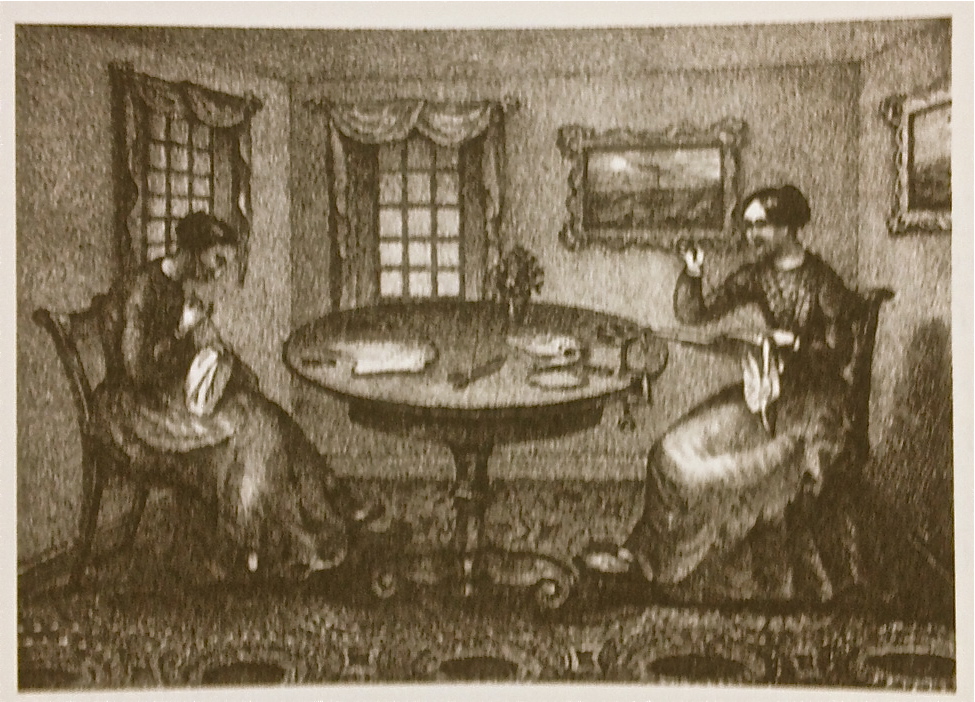
*Illustration “Ladies Sewing Birds,” advertising broadside of C. E. Stearns, Middletown, Connecticut, 1851. Connecticut Historical Society, Hartford