April 24, 1851

Slave_kidnap_post_1851_boston

1851 Thursday  April 24th  Julia here to finish Susans dresses

She is very slow We have got the waist done

to her Delaine & finished the print dress & cut

the lining to my dress This afternoon called 

at Augustus’ & Mr Whitwell with Mrs Peckham

A[u]gustus returned from New York this morning

and is here again to dine Hannah went to

Alsons while he was gone Pleasant weather


Evelina and Julia Mahoney sewed today, perhaps trying to make up for time lost yesterday. Evelina’s nephew, Augustus, returned to the Ames’s dinner table after a business trip to New York. Meanwhile, his expectant wife, Hannah Lincoln Gilmore, and son Eddie were staying out at the Gilmore farm with his parents, Alson and Henrietta.

Had Augustus run into any abolitionist fervor while in New York?  Probably not as great as in Boston, where controversy continued in the aftermath of the Fugitive Slave Act and the capture and rescue of Shadrach Minkins. While some of the most prominent abolitionists of the day, like William Lloyd Garrison, lived in Boston, the city was nonetheless home to many citizens who were less adamant about the issue.  They might not have liked slavery, but they feared the radicalism of the anti-slavery rhetoric more.  They were law-abiding, and the law said that slaves were property and had to be returned to their owners. Daniel Webster had decreed it, and they supported the law accordingly. The controversy pulled at everyone.

When another escaped slave, Thomas Simms, was caught in Boston, the Mayor of Boston, John P. Bigelow, ordered him sent back south. The aldermen and the police supported the move, and the black population of the city became even more nervous than before, as the poster above illustrates. Have TOP EYE Open!

April 22, 1851


images

1851

Tuesday April 22d  This morning it is quite pleasant & I went

to the store & got the print for Susans dress

that I returned last week have made the 

skirt & cut the sleeves called into the other part

of the house awhile & have staid three or four

hours in Olivers, she is quite sick so that

she does not sit up at all.  Mary Middleton buried

in Canton 17 carriages went to the grave

A[u]gustus went to New York last night with Henry Gilmore

Evelina spent several hours today in the bed chamber of Sarah Lothrop Ames, who was so sick in bed that she did “not sit up at all.”  That kind of illness was worrisome, especially as Sarah had been sick for several days and wasn’t getting better.

Sewing wasn’t forgotten amid her concern for her sister-in-law.  Evelina picked out some printed cloth for a new dress for Susie, the same print or dress at the company store that she had rejected previously.  She began cutting and sewing and had the skirt finished and the sleeves underway while otherwise occupied with checking in on both sisters-in-law. She was speedy with the needle.

Meanwhile, a local woman named Mary Middleton was buried in Canton.  Evelina was quite impressed at the number of carriages that followed the casket to the cemetery.  Miss or Mrs. Middleton must have been a personage of some importance, or someone with countless relatives. Evelina could have no way of knowing that when her own husband Oakes would die in 1873, a crowd of 3,000 people would attend his funeral. How many carriages would he draw to his service?


April 17, 1851

imgres-1


1851

April 17th Thursday.  Julia has been here to finish

my Foulard Silk it does very well now & looks

very well indeed after washing It has taken

her two days to cut & make the waist baste

the sleeves & sew on the skirt She is very

slow. Orinthia did not keep school yesterday

or to day on account of the storm It has been

a driving storm to day but not as bad as yesterday

The storm that took down Minot’s Light still raged today.  Safely indoors, Evelina and Orinthia tended to sewing, joined by dressmaker Julia Mahoney, who finally finished the alterations on a silk dress for Evelina. Foulard silk was a popular, lightweight fabric – good for the coming warm weather – that typically featured a small print pattern. Used today for scarves, it could and can be hard to sew because it’s so thin.

Julia took longer to complete the outfit than Evelina thought she should, yet as Julia was probably paid by the piece and not by the hour, Evelina’s annoyance wasn’t based on monetary concerns. Perhaps her exasperation at the dressmaker’s deliberate pace stemmed from her own seasoned agility with needle and thread; perhaps she thought she could do the work faster. But Julia may still have been more skilled in the finer needlework required for high-end ladies’ dresses.  Certainly the end result proved pleasing.

According to Godey’s Lady’s Magazine, “One might as well be out of the world as out of the fashion”.  While North Easton, Massachusetts would never be in the running as a fashion center, some of its citizens cared about style and appearance.  Evelina and her sisters-in-law did. They followed the fashions, via various periodicals and on trips into Boston, and dressed themselves as modishly as they could. As Evelina’s grandson Winthrop Ames later pointed out, “Every season there was a great remaking of old garments to bring them up to date.”

The remaking of garments didn’t preclude the production of entirely new dresses, either.  But older clothes were made and remade to last as long as possible.


April 14, 1851

Coffin

1851

April 14 Monday  Julia Mahoney has been here to day

to work on my foulard silk It is bad to 

work on and she has not succeeded very well

but is coming again to finish it. Jane has

done the washing and her clothes dry

Orinthia has finished the shirt for Oliver that

was cut out March 31st Weather Pleasant

Mrs Witherell Mrs G Ames & Mrs S Ames called evening

In his journal today, Old Oliver noted that his son, Horatio Ames, was visiting. Although Horatio would have been, literally, under the same roof as Evelina and Oakes, Evelina didn’t mention his visit. She might not have seen him, of course, although she must have known he was in town and probably staying in the other part of the house.  Horatio, like their brother William, was on poor terms with Oakes and it appears that neither wanted to encounter the other.

Another heartfelt topic that found no tongue today was the anniversary of the birth of Henry Gilmore Ames, the son of Evelina and Oakes who did not survive childhood.  Henry would have been twelve years old today, but died at age two-and-a-half of an unrecorded cause.

In the future – 1876 in fact – family graves would be disinterred from their original locations and moved to a dedicated family cemetery behind the new Unitarian church on Main Street. Oakes Angier would oversee the relocation; among the graves moved would be the small one for Henry.  At the time, Oliver (3) made a few observations about the relocation, including one of the little brother they had lost: “Bro Henry was moved to day and his hair was as perfect as when he was buried. His hair was smooth and parted.”  Oliver (3) also noted that his father’s coffin was so heavy that it took seven men to lift it from its original resting place.

If Evelina remembered today’s date, she indicated nothing.  She was busy with overseeing laundry day (not that Jane McHanna needed any direction on what needed to be done,) as well as Orinthia Foss’s completion of one last men’s shirt, and Julia Mahoney’s sewing on her silk dress.  Many needles at work.


April 8, 1851

images-3

1851

April 8th Tuesday  Have been looking over some of Susans

clothes for summer mended & let the tucks down

to her skirts & finished the shirt for Mr Ames

that was cut out a week ago Monday.  Ironed

some collars cuffs &c.  This afternoon have had

a powerful rain  Jane has starched her fine

clothes and got them ready for Ironing and has

ironed some of the coarse clothes

Tucks are pleats. They were sewn into little girls’s dresses by design so that the dresses could be let out as the girls grew taller. Tucking was preferable to lengthening the hems because pleats required less fabric, were easier to put in and take out, and less obvious when changed.  The object of the whole exercise was to make the dresses last as long as possible.

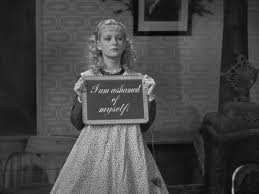
Anyone who has read Little Women or seen the 1933 film version of Louisa May Alcott’s classic tale of the March family will probably recognize the image of Amy March (played here by Joan Bennett). In this scene Amy is being punished by her schoolteacher for bringing pickled limes to class. She is so mortified that she never returns to the school again. The only worse “deggerradation”  she can imagine would be having her clothes shortened by tucking: “Mother doesn’t take tucks in my dresses whenever I’m naughty, as Maria Parks’s mother does […] it’s really dreadful, for sometimes she is so bad her frock is up to her knees and she can’t come to school.”

Most young girls had tucks in their dresses, whether they were the fictional Amy March or the bona fide Susie Ames. And so today, as Evelina got Susie’s summer wardrobe in order, she “let the tucks down” to accommodate her daughter’s new height.  There’s no instance of her taking the tucks back up in order to punish Susie when she was naughty.

This image of Amy March also illustrates the aprons or shifts that little girls wore over their dresses to protect the outfits from soiling.


April 7, 1851

large-1060

“Dress – The Maker” illustration from Godeys, 1851

1851

April 7 Monday  Have had a dress maker to work for Susan

She has cut a new waist to her gingham and fitted

the waist of a light purple dress  I think she has

done very well for Irish.  She appears to be a pleasant 

girl  This evening Orinthia and I have been to Mr

Barrows & Torreys to make a call.  Abby was

very lively & has improved very much in her appearance

within a year or two


After weeks of sewing shirts and mending coats for the men of the family, Evelina turned her attention to outfitting her daughter who, at nearly nine years old, had probably outgrown the previous year’s dresses.  It was time to rework Susie’s old dresses and perhaps make some new.  For this task, Evelina brought in help: a new, young dressmaker named Julia Mahoney.

Like many young women in the village of North Easton, Julia was Irish.  Like many of the older women in the village, Evelina held the Irish in some disdain.  Without necessarily meaning to be unkind, but clearly feeling some superiority, Evelina expressed her prejudice in a backhanded compliment of surprise at Julia’s fine work and pleasant demeanor.  Julia did “very well for Irish.”

Evelina had imbibed some of the Yankee resentment against the Irish immigrants who had moved into Massachusetts, and elsewhere, so rapidly and in such numbers.  While her husband Oakes seemed free from the prejudice, other Ameses, particularly Old Oliver, were not.  His displeasure with the Irish employees at the shovel shop was legendary and the bias came through at home as well.  The old Yankee ways were threatened by the new foreign residents, and antipathy thrived accordingly.

April 5, 1851

Store

1851

April 5th  Saturday  Was choring about the house an

hour or two this morning and then went to sewing

on a shirt for Mr Ames.  Mrs S Ames is quite

sick to day has not been able to sit up much.

This afternoon called to see her but did not stay

long as Mrs Connors came to get some butter.  I then

went to the store & got Susan a dark print dress.

Have returned it again.

Sarah Lothrop Ames was sick today; perhaps she caught Evelina’s cold of the week before.  Evelina went to sit with her but was called home to parcel out some butter to a Mrs. Connors.  Although we never hear of Evelina or Jane McHanna churning it, Evelina evidently made household money through the sale of butter. The making of butter was probably one more chore on Jane’s plate.

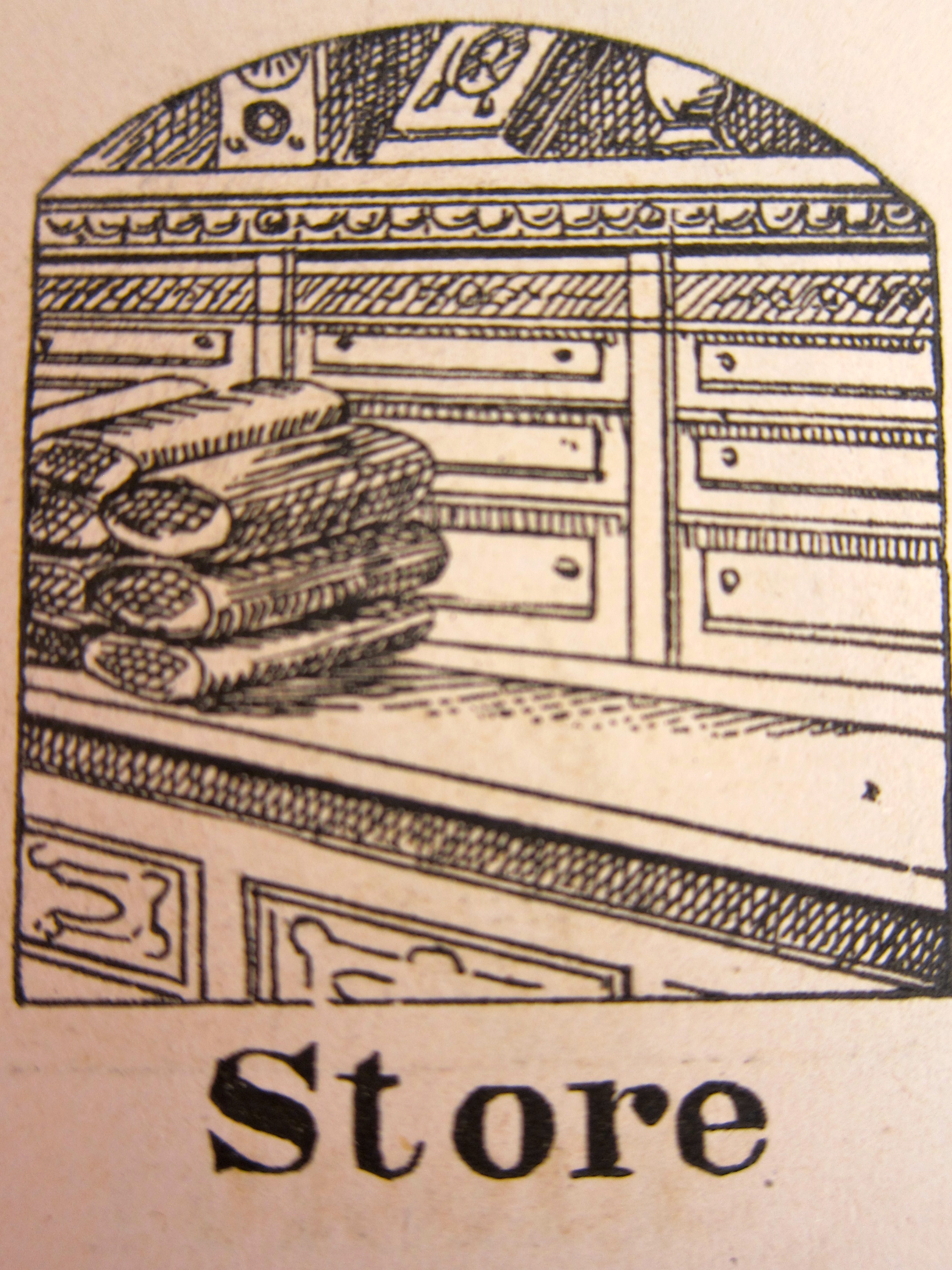
The Ameses didn’t just sell butter, or just make shovels, for that matter. They also ran a dry goods and general mercantile store in the village, as we have mentioned before. Evelina sometimes shopped there, although it’s uncertain whether or not she had to pay for items she selected.  Today she found a dress for her daughter that she took home and then promptly returned.   Did Susie try the dress on only to find that it was too small?  Or did Evelina want to examine the dress to see how it was made?  And once having captured the overall style and pattern, did she return it?  Had Evelina already determined that she wasn’t going to keep it? Was she, perhaps, treating the store a little bit like a personal closet?

This was a period, too, when “ready-made” clothes were barely on the market. What was this little dress?  Was someone in the village making dresses and selling them there?

March 31, 1851

Shears

1851

March 31st Monday  This morning after doing my chores about

house, cut out a shirt of rather coarse unbleached

cloth for Mr Ames, am going to put a linen

bosom into it.  Also cut a coarse shirt for 

Oliver, have been mending some, but have not

sewed any on the shirts.  Called this afternoon

on Mr Holmes & at Bridgets to see the dress

maker, Worked awhile on my scrap book.  Orinthia

& I spent the evening at Olivers, Jane at G. Bartletts P.M.

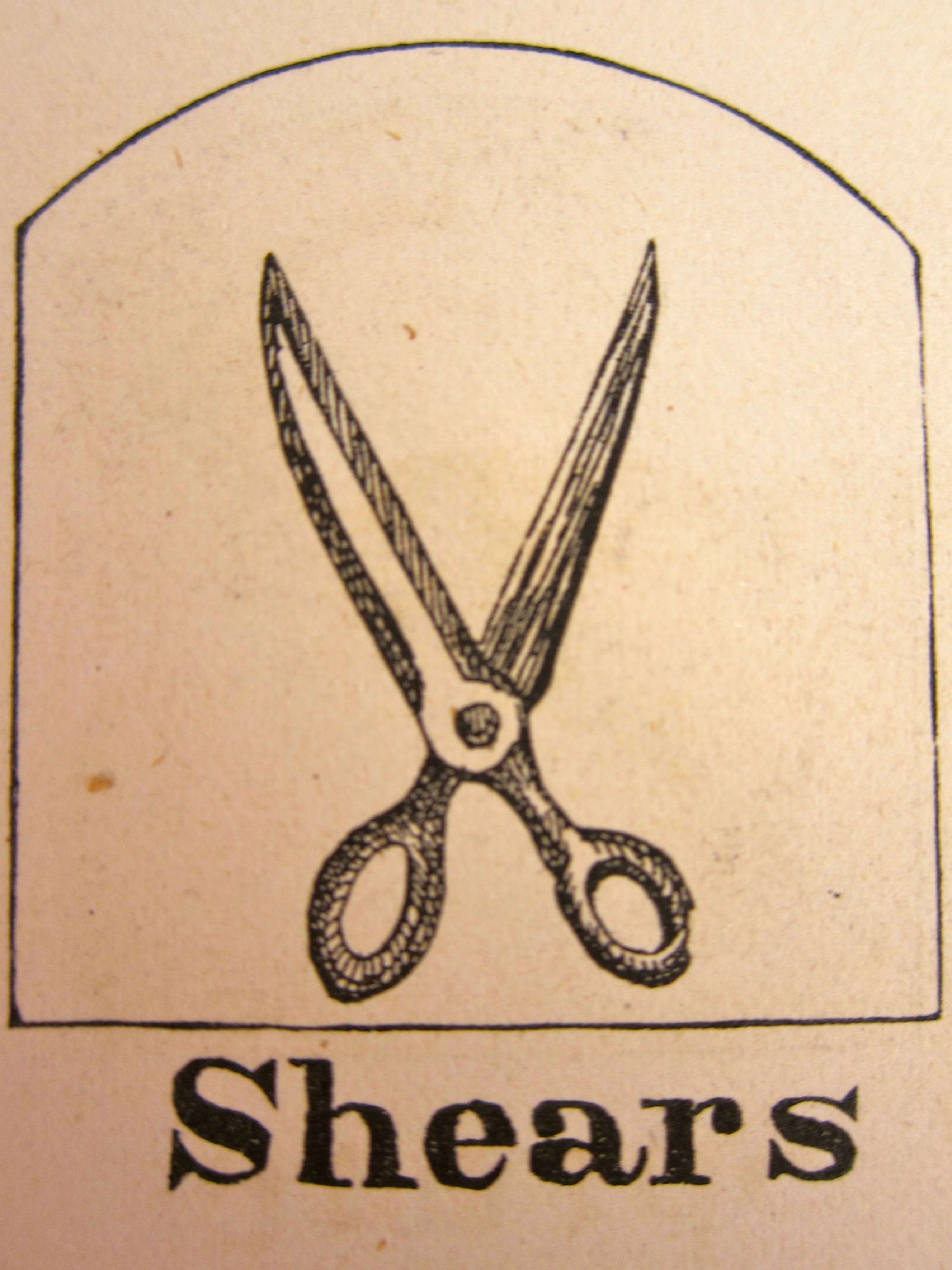
After her morning chores on this last day of March, Evelina cut out more shirt parts. Any reader who has been following this blog on a daily basis has seen Evelina’s prodigious production of shirts for her husband and three sons. This particular project is soon to end. After one or two more mentions, Evelina will leave behind the cuffs, bosoms, and coarse and fine cloth of men’s shirtmaking and move into dressmaking for herself and her daughter, Susan.  And when fair weather truly arrives, she will head for her flower garden.  She will never completely stop sewing – there was always mending to be done – but she will relax her grip on needle and thread.

Today being Monday, Jane McHanna was busy with the weekly laundry, washing the family linens and clothes and hanging them out to dry.  In the evening – after preparing tea for the family, no doubt – Jane left to go to a Mr. Bartlett’s.  The call was probably a social one, but we don’t know whom she visited.  Because so many of the servants in the village had recently immigrated from Ireland, they tended to know one another and often visited each other when they had time off.  Meanwhile, Evelina and the young boarder, Orinthia Foss, headed next door to visit Sarah Lothrop Ames.  It was a sociable evening for all the women in the Ames household.


March 29, 1851

483a

1851

March 29 Sat  Have a very bad cold and cough some

but it has not increased with my cold which is unusual

Have taken Wisters Balsam  This afternoon mother

Orinthia & self called awhile in the other part of the 

house  Abby came here about four & stoped one

hour or two, but did not stay to tea  I finished Mr

Ames bleached shirt and Orinthia finished a

coarse shirt for him  Pleasant and fine traveling

Evelina caught a “very bad cold,” her second one since the start of the year.  The first cold she treated by concocting a time-honored home remedy of which her Puritan ancestors would have approved. It included honey, a little horehound from her own garden, and more. The new cold, however, she dosed with a commercial product, Wistar’s Balsam. This bottle of patent medicine was something she purchased “over-the-counter,” as we would say today, with the expectation that a commercial product offered an improvement over what she might have made for herself.  Such a transition from home-made to manufactured goods was very much part of the mid-19th century world in which she lived.

Dr. Wistar’s Balsam of Wild Cherry was the most popular of many patent medicines available in the marketplace for the self-treatment of various ailments. With its “heady melange of cherry bark, alcohol and opiates,” it claimed to have “‘effected some of the most astonishing cures ever recorded in the History of Medicine!'”* With no regulatory oversight or standards to adhere to, it and other nostrums could and did claim curative powers over everything from colds to consumption. A consumer like Evelina could be completely taken in.

How Wistar’s Balsam helped Evelina’s cold is uncertain, but she temporarily felt better for the drugs she imbibed. She was able to sit up with her mother, Orinthia and Sarah Witherell, visit with her niece Abby Torrey, and finish sewing a fine shirt for her husband.


*footnotessincethewilderness.wordpress.com/2010/07/13/henry-wister-and-the-nations-leading-patent-medicine-dr-wistars-balsam-of-wild-cherry

March 28, 1851

Egg

1851

March 28 Friday  After making my bed &c went to

mending Mr Ames coat which kept me busy till past

nine Oclock.  A[u]gustus brought me 50 eggs

for which I paid 50 cts  Mother returned from 

Mr Torreys about ten Oclock.  Mrs Witherell

came in at 4 Oclock and staid untill 5 Oclock and 

finished stiching the ninth bosom  Mrs Buck

and Sarah called the Evening  Weather very pleasant

A penny an egg, or 12 cents a dozen.  Not so today.

That Evelina bought her eggs tells us right away that the Ameses didn’t keep chickens.  If they had, Evelina would never have paid for something she could get for free.  These eggs came by way of the Gilmores, either from Augustus who may have been living on a property that had chickens or, possibly, from Augustus’s father, Alson, out on the family farm.

Poultry seldom appeared at the Ames’s dinner table, or at least Evelina didn’t mention it if and when it was served. Beef and pork were the mainstays of their diet, not chicken. Turkey and goose was served, but only on special occasions. The larger animals, once slaughtered, could be preserved in multiple ways, and could stretch to feed more people. Chicken didn’t offer as much variability, although it was acknowledged to be “generally healthful” and for the sick, “a most agreeable and nutritious diet.”*

In the winter, particularly, chicken as a meal was in short supply all over New England. Chickens were vulnerable to the harsh winter of Massachusetts and many people simply didn’t keep any. Come spring, however, they were a welcome change. A “spring chicken” was something young and fresh. An old laying hen, on the other hand, once past her prime, was something to be put in a pot and stewed.

It follows that eggs, which were important in cooking and baking, were in demand. Thus we find Evelina procuring several dozen for her kitchen.

*Sarah Josepha Hale, The Good Housekeeper, 1841.