February 17, 1851

Hem

Feb 17th  Monday  Washed the dishes and worked about

house most of the forenoon  This afternoon cut out some

work for Susan & set her to hemming, counted

stiches with her.  Helen came home from

New bedford.  Spent the evening at Olivers with

Sarah W.  Worked on an apron of Susans but

had so much talking to do that […] I accomplished

but a little sewing  Pleasant but cold

Sewing was a necessity, but it was also a sociable occupation, which is perhaps one of the reasons that Evelina enjoyed it so. Her visit next door with her two sisters-in-law, Sarah Lothrop Ames and Sarah Witherell, turned into an evening of conversation with “but a little sewing,” which she didn’t seem to mind.  What did the women discuss?  Did they revisit the tender issue of the failed Sewing Circle meeting?  Or did they steer toward safer topics like Helen’s return from New Bedford? What had the fourteen-year-old been doing there?  Had she been in school? Why did she return home at the start of a week?  Susie Ames was home from school this week, too.  Was mid-February a typical time for schools to close?

At this time in our history, almost every woman knew how to sew. Sewing was a skill handed down from one generation to the next. Evelina, Sarah Ames and Sarah Witherell had each learned their stitches from their mothers or grandmothers; now it was Susie Ames’s turn to learn.  How could the women know that sewing was about to be transformed by the arrival of the domestic sewing machine, and that a forthcoming civil war would introduce mass-produced, “ready-made” clothing on an unimagined scale?  They, who in their youth had probably watched a elderly relative work a spinning wheel, would experience a dramatic trajectory in the making of apparel.  By the time Susie reached adulthood and became a housewife, some of what she was being taught would be obsolete.  But not all: hemming, mending, quilting, and neat hand-sewing would always have a place in the domestic arts, even though few women today practice the skills.

Young girls of the antebellum period like Susie and Helen and Emily Witherell  sat by their mothers’ sides and struggled to manage a needle and thread, basting or hemming or working cross stitches.  Some of them created the hand-wrought samplers that hang now in textile collections, featuring alphabets or numbers or biblical quotations with colorful, tiny stitches painstakingly wrought by stubby little fingers at age eight or twelve or fourteen. Sewing was a necessity, but it was an art form as well.
February 14, 1851

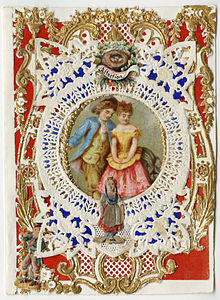
Valentine from the 1870's by Esther Howland

Valentine from the 1870’s by Esther Howland

Feb 14th Friday  Mended a pair of pants for Oakes Angier & 

cut out some work for Susan.  Went to the store for a

pair of shoes for self & Susan.  Called on Miss Eaton

on my return met the Dr there.  He thinks she will 

live into March.  Has failed very much since I saw her

Passed the afternoon with Mrs Wales & Miss Lothrop in

the other part of the house.  Mr Jackson called here this eve.

Pleasant this morning, afternoon cloudy & a little rain

The 19th century descendants of the Puritans weren’t known for their celebratory spirit, so we shouldn’t wonder that Valentine’s Day went unrecognized at the Ames’s house.  Although the practice of sending a sweet message to one’s beloved had thrived in England for several decades, the concept was just gaining traction in the United States. Personal Valentine greetings in the form of hand-written poems were familiar to many young people, but nothing was mass-produced until mid-century when a graduate of Mount Holyoke named Esther Howland, whose father was a stationer in Worcester, Massachusetts, developed and sold a lacy Valentine card, America’s first.  The idea took off and shortly thereafter, Graham’s American Monthly noted that “Saint Valentine’s Day […] has become, a national holyday.”   The idea hadn’t caught on at the shovel works, though; if it had, Oakes Ames probably would have seized the opportunity to buy one for his wife.

Evelina took a small step back into her social life today.  Not only was she able to call on Miss Eaton at the Holmes’s house, but she also got an update from the doctor, who confirmed that Miss Eaton was dying.  Miss Eaton did not yet have a “watch” on her, but the time would come when different friends and relatives would take turns sitting with her until she passed.

After her visit with Miss Eaton, Evelina relaxed into a sociable afternoon in “the other part of the house.”  With her sister-in-law Sarah Witherell, she chatted with two female acquaintances while rain returned outside.  In the evening, Mr. Jackson came to call.  He was probably the school master whose teaching had “lacked energy” last week when Evelina visited the local school.  Why was he calling?  Had he learned that Evelina was involved in the establishment of a private school?

February 6, 1851

Dance

Dance

Feb 6th Thursday  This forenoon was working about house & did

a little mending  Prepared some mince pie meat for baking

Have been into school this afternoon  There were but

about 50 schollars.  Mr Jackson appears to lack energy

Miss Lothrop appeared the best of the two.

There is a ball at Lothrop Hall to night for the first

time.  Oakes Angier & Frank have gone & Helen

Sarah A & Sarah W spent the evening here.  Pleasant but cold.

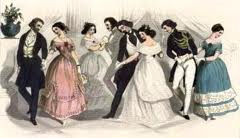
Thursday night seemed to be the night for dancing in southeastern Massachusetts. The Ames sons had already attended at least two Thursday evening assemblies in Canton during January and now in February they’re attending a gathering at Lothrop Hall (the location of which is uncertain: Eastondale, perhaps?  Does any reader of this blog know?) Tonight Oakes Angier and Frank Morton went. (Where was Oliver [3]?)  Evelina’s diary is unclear on whether their cousin Helen went with them or, more likely, stayed home with her mother and aunts – the latter option being more typical for shy Helen.

Earlier in the day, Evelina was evidently still involved with looking into local schooling, getting the lay of the land, perhaps, for the incoming Orinthia Foss.  By mid-century in Easton, there were four school districts, or “ricks” as they were known, in four different geographic areas of town.  Paid for by the occasionally reluctant Easton taxpayers, the schools taught local girls and boys up to grade eight or so.  Massachusetts, and New England as a whole, led the nation in its emphasis on education and, in Evelina’s time, Massachusetts had boasted a 96% literacy rate.

Susie was the only Ames child still attending school.  Oakes Angier, Oliver (3) and Frank Morton as boys had each attended school locally before being sent away to nearby private schools such as Leicester Academy.  On this night, however, dancing, not schooling, was foremost on their minds.