March 12, 1851

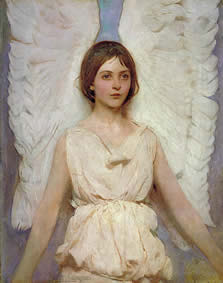
Abbott H. Thayer, Angel, 1887, oil Smithsonian American Art Museum Gift of John Gellatly

*

March 12th  Wednesday.  This morning commenced the new pattern shirt

but got but very little time to work on it.  Miss Eaton

died about eight Oclock  Mrs Witherell & Mrs S Ames laid

her out & this evening I went with Mrs Witherell to 

help her put on the robe which she made this afternoon

Mrs S Ames & myself went to the sewing circle at

Daniel Reeds  There were about twenty of us.

worked on striped shirts.  Very pleasant

A[u]gustus here to dine

This must have been an emotional day for Evelina.  Miss Eaton, a neighbor, died after a lingering illness. Sarah Ames and Sarah Witherell prepared Miss Eaton’s body, and Evelina helped put a shroud, or robe, on the corpse.  For months now, the three sisters-in-law and others had been looking after Miss Eaton. Everyone had anticipated her demise, but still, it must have been hard when she finally passed away.

After the Ames women had prepared Miss Eaton’s corpse for burial, two of them, Sarah Ames and Evelina, rode out to a meeting of the Sewing Circle.  This was the first meeting since Evelina’s own ill-attended meeting back in February.  The gathering was held at the home of Daniel and Mary Reed and about twenty women attended.  If Evelina felt awkward, she didn’t say so in her diary.  Perhaps there were women there she had been hurt by, perhaps not. Perhaps people apologized for not having shown up at Evelina’s, perhaps not. Whatever exchanges or pleasantries took place as the ladies worked on striped shirts, the mood of the afternoon must have been tinged with the sorrow of the morning and the loss of Miss Eaton. Death in the neighborhood put things in perspective.

Abbot H. Thayer, Angel, 1887, oil, Smithsonian Museum of American Art, Gift of John Gellatly

February 25, 1851

Helen Angier Ames

Helen Angier Ames

1851

Feb 25  Tuesday  This morning Helen left home for school

at Dorchester.  She felt so bad when she left

that I did not go in to see her.  Her Father & Mother

went with her and returned to night, they went into

Boston and stoped an hour or two.  Mr Jennings

& Crommet called this evening to see Orinthia

I have been to work on a bosom of shirt putting

a new one into an old shirt of Oakes Angiers.  Very windy.

A[u]gustus here

Under some duress, the teenaged Helen Ames was taken to boarding school today, clearly not wishing to go.  Her parents insisted and accompanied her to see her settled.  Their stop in the city on the way home might have been a lift of spirits for a mother and father who had just driven away from a disconsolate child.

The children of both Oakes and Oliver Jr. each went away to school for a portion of their education.  Oakes and Evelina’s boys had already gone and returned home; Susan still had her boarding school ahead of her.  Oliver Jr. and Sarah’s two children, Fred and Helen, were at this stage both away at school.  Oliver Jr. and Sarah were empty-nesters, to use a term they wouldn’t have recognized.  They might have recognized the emotion, however.  Strange to think of them in their separate house, just the two of them now, quiet, (although Sarah’s younger brother, Cyrus Lothrop, sometimes lived with them) while right next door in the old homestead lived a whole commotion of relatives.

Schooling seemed to be the theme of the day.  A Mr. Jennings and a Mr. Crommet called to see Orinthia Foss, presumably on matters of her employment as a schoolteacher. Does any reader out there know either of these names?

His wife and son still living elsewhere – Bridgewater, perhaps – while he set up their rented lodgings in North Easton, Augustus Gilmore was staying temporarily with his aunt Evelina and her family.  He would soon bring Hannah, who was expecting, and little Eddie to town.

February 17, 1851

Hem

Feb 17th  Monday  Washed the dishes and worked about

house most of the forenoon  This afternoon cut out some

work for Susan & set her to hemming, counted

stiches with her.  Helen came home from

New bedford.  Spent the evening at Olivers with

Sarah W.  Worked on an apron of Susans but

had so much talking to do that […] I accomplished

but a little sewing  Pleasant but cold

Sewing was a necessity, but it was also a sociable occupation, which is perhaps one of the reasons that Evelina enjoyed it so. Her visit next door with her two sisters-in-law, Sarah Lothrop Ames and Sarah Witherell, turned into an evening of conversation with “but a little sewing,” which she didn’t seem to mind.  What did the women discuss?  Did they revisit the tender issue of the failed Sewing Circle meeting?  Or did they steer toward safer topics like Helen’s return from New Bedford? What had the fourteen-year-old been doing there?  Had she been in school? Why did she return home at the start of a week?  Susie Ames was home from school this week, too.  Was mid-February a typical time for schools to close?

At this time in our history, almost every woman knew how to sew. Sewing was a skill handed down from one generation to the next. Evelina, Sarah Ames and Sarah Witherell had each learned their stitches from their mothers or grandmothers; now it was Susie Ames’s turn to learn.  How could the women know that sewing was about to be transformed by the arrival of the domestic sewing machine, and that a forthcoming civil war would introduce mass-produced, “ready-made” clothing on an unimagined scale?  They, who in their youth had probably watched a elderly relative work a spinning wheel, would experience a dramatic trajectory in the making of apparel.  By the time Susie reached adulthood and became a housewife, some of what she was being taught would be obsolete.  But not all: hemming, mending, quilting, and neat hand-sewing would always have a place in the domestic arts, even though few women today practice the skills.

Young girls of the antebellum period like Susie and Helen and Emily Witherell  sat by their mothers’ sides and struggled to manage a needle and thread, basting or hemming or working cross stitches.  Some of them created the hand-wrought samplers that hang now in textile collections, featuring alphabets or numbers or biblical quotations with colorful, tiny stitches painstakingly wrought by stubby little fingers at age eight or twelve or fourteen. Sewing was a necessity, but it was an art form as well.

February 12, 1851

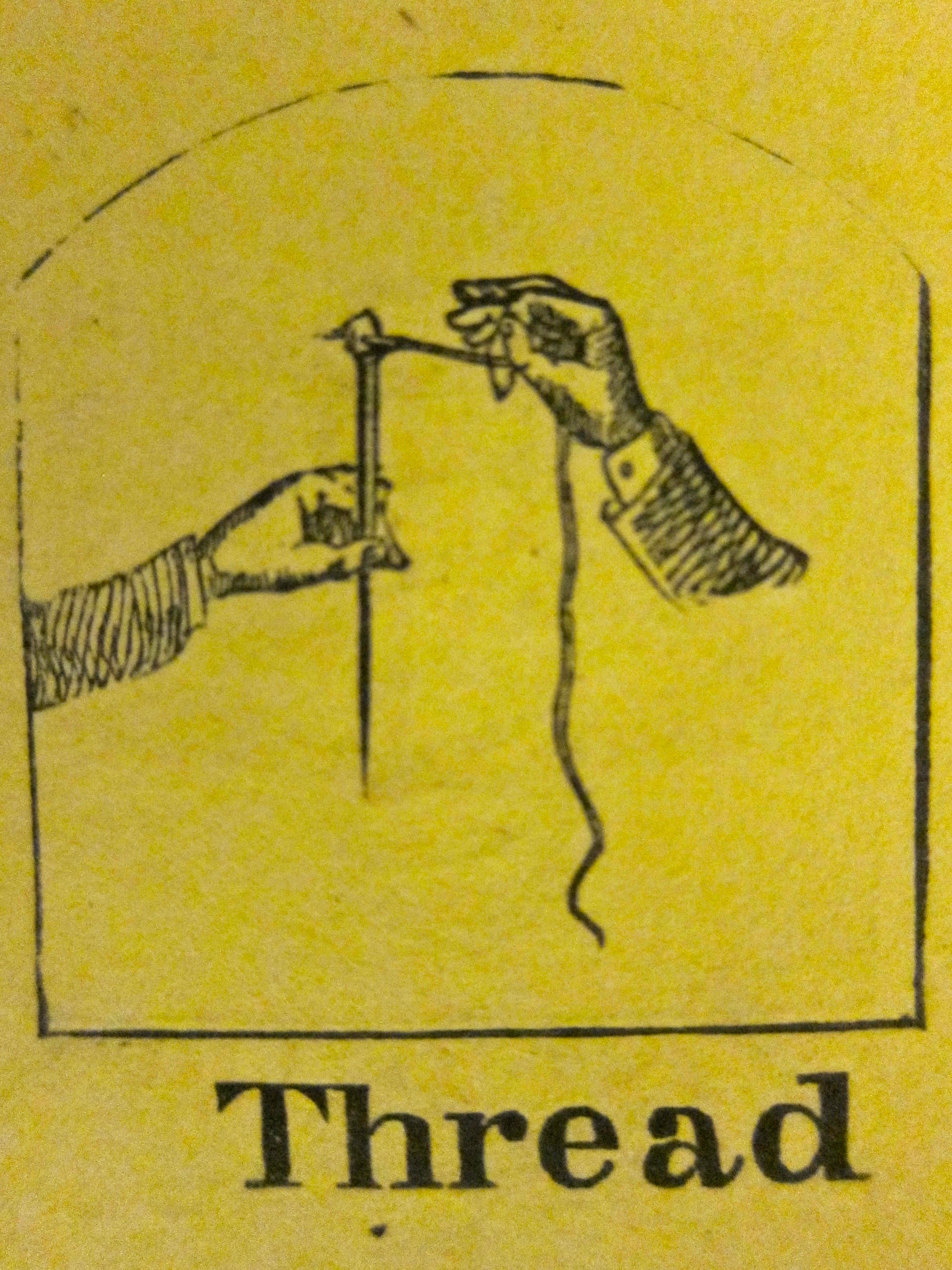
Thread

1851

Feb 12th This was the day for the sewing circle & what a crowded

house! Not one here except Mr Whitwell and our own

families  Father Ames came in to tea & Sarah W

George, Emily & Oliver & wife  Poldens boy was buried

to day  Isabell & Ann went to the funeral & took tea

with Jane after they came back.  I prepared enough

for 40 and think it is very provoking to have none

 of the members  It is a delightful day.  Letter from Miss Foss

No one came to Evelina’s party.

“Very provoking,” indeed.  Mortifying, even, that not a single member of the Sewing Circle attended today’s meeting, unless you count Reverend Whitwell.  All the preparations, the baking, the cleaning, the spools of thread from Boston, all in vain.

Evelina took the rejection with a lacing of humor: “What a crowded house!”  Although disappointed and upset, she must have been grateful for the way the Ames clan filed in to partake of the feast. From Old Oliver (who almost never came to tea) and all three Witherells to Oliver Jr and Sarah Lothrop Ames to her own children and husband, presumably, the family closed ranks around her and filled her parlor with warm bodies.  Even the Irish servant girls on their way home from a wake partook of the spread of food – in the kitchen with Jane McHanna, of course.

So what happened?  Evelina said the day was delightful but her father-in-law, a dependable chronicler of the daily weather, described “the going” that day as “rough + bad” even though the weather itself was “fair”.  After days of terrible weather that had swung from rain to ice and back again, some of the absentee members probably couldn’t drive their wagons out of their own yards.  Bad roads might account for some, if not all, of the truancy.

Nevertheless, the incident raises questions about Evelina’s popularity and social standing.  She was married to one of the most important men in town, and she and Oakes enjoyed the friendship of many.  Is it possible that some of the women in the Unitarian Circle resented her, or felt themselves superior to her?  Where were the women she had grown up with? Were they jealous of her? Did she fail socially in comparison to her sisters-in-law, each whom had a more refined upbringing? Sarah Ames and Sarah Witherell never failed to attract a lively turnout for their Sewing Circles.

All these possibilities must have swirled in her mind.  The true test would come when the Sewing Circle met again at Evelina’s, many months from this day, this awkward day that Evelina surely hoped to forget.

February 6, 1851

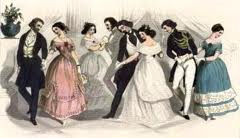
Dance

Dance

Feb 6th Thursday  This forenoon was working about house & did

a little mending  Prepared some mince pie meat for baking

Have been into school this afternoon  There were but

about 50 schollars.  Mr Jackson appears to lack energy

Miss Lothrop appeared the best of the two.

There is a ball at Lothrop Hall to night for the first

time.  Oakes Angier & Frank have gone & Helen

Sarah A & Sarah W spent the evening here.  Pleasant but cold.

Thursday night seemed to be the night for dancing in southeastern Massachusetts. The Ames sons had already attended at least two Thursday evening assemblies in Canton during January and now in February they’re attending a gathering at Lothrop Hall (the location of which is uncertain: Eastondale, perhaps?  Does any reader of this blog know?) Tonight Oakes Angier and Frank Morton went. (Where was Oliver [3]?)  Evelina’s diary is unclear on whether their cousin Helen went with them or, more likely, stayed home with her mother and aunts – the latter option being more typical for shy Helen.

Earlier in the day, Evelina was evidently still involved with looking into local schooling, getting the lay of the land, perhaps, for the incoming Orinthia Foss.  By mid-century in Easton, there were four school districts, or “ricks” as they were known, in four different geographic areas of town.  Paid for by the occasionally reluctant Easton taxpayers, the schools taught local girls and boys up to grade eight or so.  Massachusetts, and New England as a whole, led the nation in its emphasis on education and, in Evelina’s time, Massachusetts had boasted a 96% literacy rate.

Susie was the only Ames child still attending school.  Oakes Angier, Oliver (3) and Frank Morton as boys had each attended school locally before being sent away to nearby private schools such as Leicester Academy.  On this night, however, dancing, not schooling, was foremost on their minds.

February 2, 1851

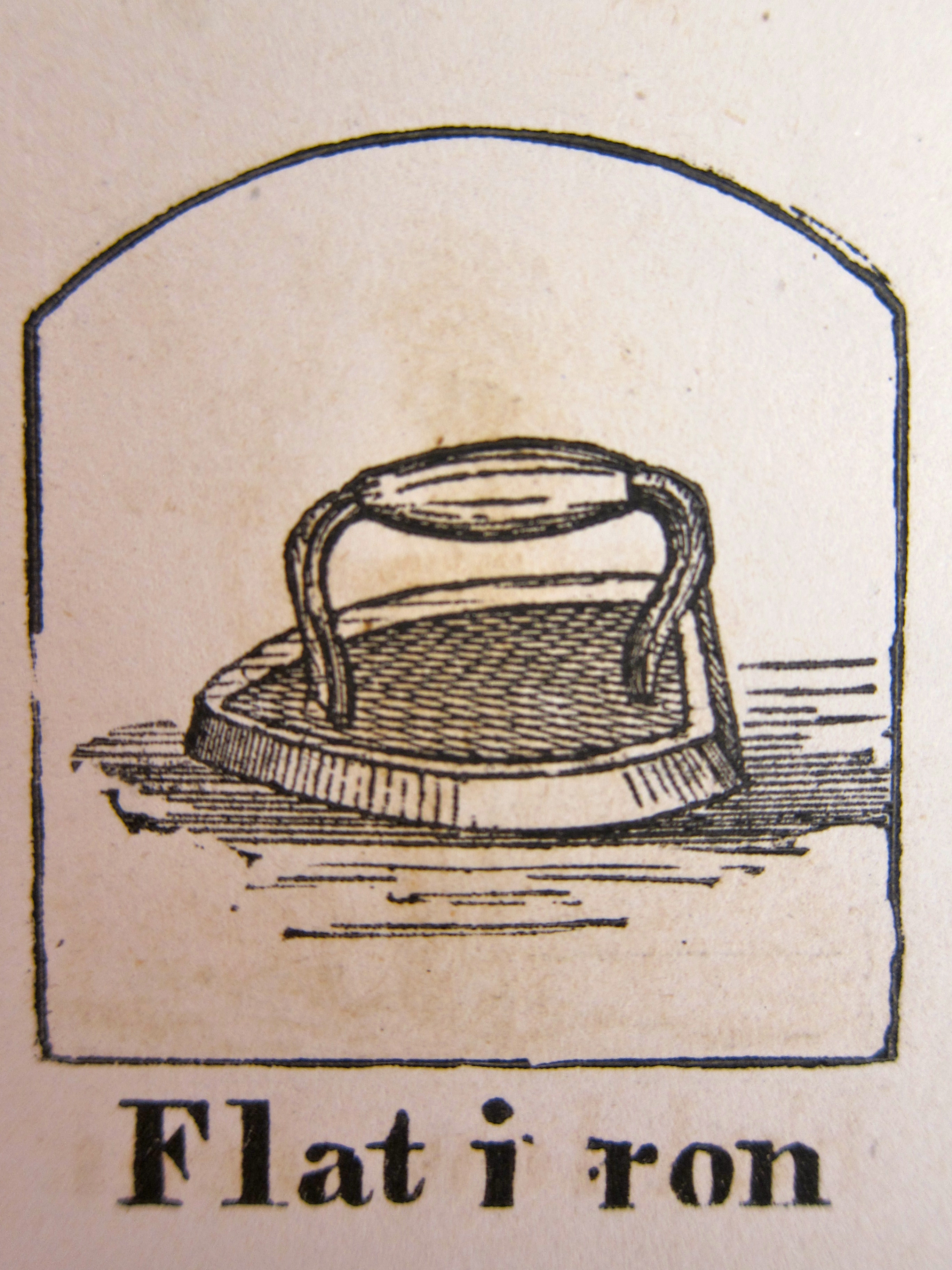
Flatiron

Sunday Feb 2d  It snowed very hard this morning but we

all went to meeting to hear Mr Brigham of Taunton

He gave us two very good sermons  he is very quick in his motions

& very independent in his manner  Mother went to meeting & home.

Since meeting have been reading in David Copperfield

Sarah A & Helen came in and stoped an hour or two.

This evening have hurt my foot quite badly by letting a

flatiron fall on it  It has cleared of[f] quite pleasant.

Snowy weather didn’t prevent attendance at meeting, and the Ames family stayed for both morning and afternoon service.  A visiting minister, Reverend C. H. Brigham, replaced Reverend Whitwell in the pulpit.  Mr. Whitwell, meanwhile, presumably officiated in Taunton.  This kind of swap was accomplished every month or so when ministers in the area switched places.  A Congregational practice that had been in place for years, the swap gave ministers the test of different congregations while, with fresh voice, it reiterated church dogma among a broad population.  Both congregations and ministers benefited however “quick in his motions” a visiting parson might be.

After church, Evelina’s brother Alson Gilmore carried their mother, Hannah, back to the farm in southeastern Easton.  Evelina had a little more time to herself, which she spent with Charles Dickens, at least until her sister-in-law Sarah Ames and daughter Helen stopped by.  Evelina has been reading David Copperfield – an 800 page book – for a week now.  But somehow in the course of the afternoon or evening – perhaps getting prepared for laundry day tomorrow? – Evelina dropped a flatiron on her foot.  Ow.  That took her out of commission for the rest of the day, perhaps allowing even more reading.

February 1, 1851

Ames Home and Office, North Easton, Massachusetts ca. 1852 - 1862

Ames Home and Office, North Easton, Massachusetts
ca. 1852 – 1862

Feb 1st  Saturday  Sit down to mending again this morning

Mended a pr of kid gloves and a number of other things

Went into the other part of the house with mother

to tea  worked on panteletts finished two prs.  Mrs Packard

and Mrs Rhoda Fuller called there  Mr Ames has been 

to Boston & brought home Ladys Books Grahams & Harpers

& International Magazines & 1/4 lb Angola yarn.  Have been

reading in the magazines this evening.  Cloudy & warmer

Evelina often mentions going into “the other part of the house,” which was a section of the house on the southern side in which Old Oliver, a widower, lived with his widowed daughter Sarah Witherell and her children.  This section was created when Old Oliver turned the original (ca. 1812) dwelling into a duplex in 1827 on the occasion of the marriage of Oakes and Evelina.

In 18th century New England, family custom often dictated that the eldest son inherit the family homestead and, in order to effect that, houses were sometimes renovated to allow two families to live side by side until the transfer of property came to pass.  That this practice was becoming less prevalent in the 19th century meant nothing to Old Oliver who, independent and conservative, still had his feet in the 18th century in certain ways.  His home would go to his eldest son, and he would eventually provide homes for his other children as well.

In the above photograph of the Ames House on Main Street, we can see the original home in the center, a building that is divided in two on the inside, with Old Oliver’s doorway facing toward the camera (behind the middle tree).  The entryway for Oakes and Evelina faces the street.  To the left of the house is the attached office, where Oakes and Oliver Jr and others kept track of business matters.  It was known as the Counting House.

In the background to the right is the house Old Oliver built for Oliver Jr and wife Sarah Lothrop Ames on the occasion of their marriage in 1833.  In 1863, they would tear this down and rebuild a more modern and formal abode, one that still stands today. The old homestead, which housed generations of Ameses in its time, was torn down in 1951, approximately 100 years after this photograph was taken.

January 30, 1851

Flames

Jan 30th  Thursday  Mended Mr Ames pants which

took me most of the forenoon, read some to Mother.

Spent this afternoon at Olivers with mother & Mr

Whitwell.  They sent the carriage for Mrs Whitwell

but it was so cold that she did not come.  Mr Ames

took tea with us & Mr Ames Oliver Jr C Lothrop & 

Helen played cards I commenced a stocking of the yarn

Mrs Foss gave me.  A bitter cold day & quite windy.

A great fire in Taunton

“A verry bad day to go out in,” noted Old Oliver in his journal today.  Eliza Whitwell refused to leave her home several miles away to join the Ames ladies in the afternoon, even though her husband was there.  The carriage – did it belong to Old Oliver, or Oliver Jr, or to the family in general?  Whoever owned it, its likely driver was Michael Burns, an employee of Old Oliver who looked after the horses and carriages.

While Michael drove to and from the parsonage in the howling cold, various family members gathered next door at Oliver and Sarah Lothrop Ames’s house for tea. Oakes and his son Oliver (or possibly his brother Oliver – unclear) played cards – probably whist – with Cyrus Lothrop and Helen Ames.  Cyrus was an unmarried brother of Sarah Lothrop Ames who lived with Sarah and Oliver, Jr. for many years. Helen was their only daughter; their son, Fred, was probably away at Phillips Exeter Academy on this occasion.  Evelina knitted and kept her mother company.

In nearby Taunton, Massachusetts, Evelina reported, the furious wind contributed to a “great fire.”  The histories of that period don’t mention this fire, so perhaps it was not as great as Evelina thought.  That, or it paled in comparison to the larger fires that Taunton suffered in 1838 and 1859.*  Fire, naturally, was the dread of every homeowner and municipality; towns and cities in the 19th century (and before) were pock-marked by periodic burnings, its citizens haunted by the loss of life and property that fires engendered. The fire on this day in Taunton would have been made especially difficult by the frigid air and icy wind.

*Information obtained from Old Colony Historical Society, Taunton, Massachusetts

January 17, 1851

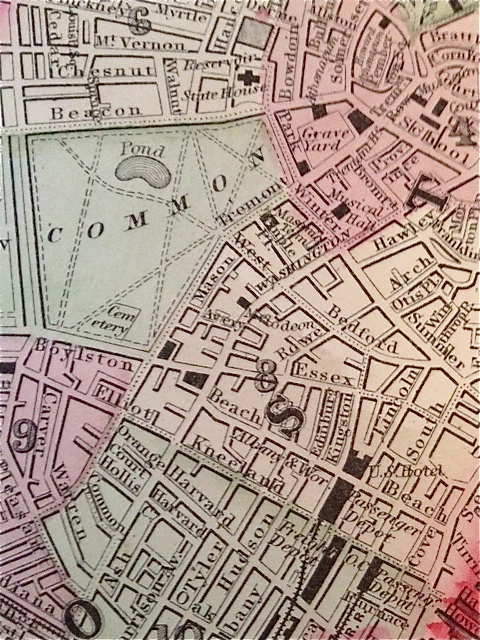
Map of Boston, ca. 1865, detail

1851

Jan 17 Friday  Spent last night at Mr Orrs.

S A at H Mitchells.  We met at Essex St

about ten Oclock and went shopping  I did not

purchase as much as I usually do when I go to Boston

We dined at Mr Orrs on Turkey & oysters.  Mrs Mary

Hyde was there under Dr Reynolds care.  Her eyes are

very painful but the Dr thinks he can cure them  On our

way to the cars we called at H Mitchells  Mr Orr is at

Plymouth building some kind of factory.  Beautiful 

weather.

Evelina and her sister-in-law, Sarah Lothrop Ames, stayed overnight in Boston after missing the train to Stoughton.  Sarah stayed with someone named H Mitchell  (probably not the youngest Ames sister , Harriett Ames Mitchell, who was reportedly in Pittsburgh at this period, but rather a cousin named Harriet Lavinia Angier Mitchell.  At this writing, difficult to know for sure.)  Evelina, however, stayed with the Orr family.

The Orrs and Ameses were friends of many years standing.  Like the Ameses, the Orrs originally hailed from Bridgewater, where they, too, had been involved in the making of tools.  Old Hugh Orr was a decade or so older than Old Oliver.  Hugh’s son, Robert, had moved into Boston with his wife, Melinda Wilbur Orr, of Raynham.  Melinda and Evelina were friends, and Evelina usually stayed with the Orrs when she spent the night in Boston.

More shopping today, at least for Sarah Ames; Evelina appeared to be shopped out.  Still, she was happy enough to trudge along Essex and Washington Streets with Sarah (on the map detail, Essex and Washington Streets meet near the “8”, to the right of the Boston Common) dipping in and out of shops. The “beautiful” weather boosted their spirits and more oysters – and turkey – bolstered their stamina.  This time, they caught the cars and returned home.

January 16, 1851

Muff & Tippet B & W

1851

Jan 16 Thursday  Went to Boston with S Ames.  Oakes A carried 

us over to the stage.  We found it very bad walking 

could scarcely cross the street without going over

shoe in snow & water but otherwise a delightful day

We bought some druggett & Sarah a muff & tippet

for herself & cuff & tippet for Helen.  We got us some

oysters at Vintons.  Called at Mr Orrs about four thirty

that we should have time to reach the cars but we were left.

Boys went to an assembly at Canton

Alson & Augustus dined here.

O, joy, a trip to Boston, an event that Evelina typically finds “delightful” no matter what the weather.  After two days of sadness about the death of Lewis Carr, Evelina and Sarah Lothrop Ames headed into the city via stage coach on a shopping excursion.  The railroad, which they called “the cars,” did not yet reach North Easton, but did stop in Stoughton.  The women intended to return by train at nightfall, and be carried home from Stoughton by one son or other, but missed the train and had to stay overnight.  They may not have been disappointed to have to stay in town.

Sloppy weather didn’t prevent the successful acquisition of goods.  Evelina bought some drugget, or carpeting, while Sarah found accessories for herself and her daughter.  Muffs and tippets, naturally, were very much in fashion for winter wear.  Dining on oysters was another highlight, as was a visit to an old family connection, Mr. Orr.

The homefront in Easton was busy, too.  Evelina’s brother, Alson, and his oldest son, Augustus, took midday dinner with Oakes and his children.  Little Susie would have been the only girl at the table.  In the evening, Oakes Angier, Oliver (3) and Frank Morton headed to Canton to a dance.  Everyone’s spirits seemed brighter today.

Photo of muff and tippet, ca. 1840,  from Minnesota Historical Society