April 19, 1851


rail_travel_leslies

*

1851

April 19  Harriet and her children came from Pittsburgh this

morning, came by the way of Stonington to Mansfield

and got someone to bring them.  It s too bad we did

not send for them, but Father thought the storm

might prevent their coming  Called in to see them this

afternoon.  Harriet does not look near as well

as she did before she went.  Augustus went to Boston

& Mr Ames  Tolerably pleasant


The youngest offspring of Old Oliver and Susannah Ames came back to town today.  Harriett (Ames) Mitchell, all of 31 years old, traveled by rail from Pittsburgh to Easton, finding her own way from the station in nearby Mansfield. (The railroad had not yet been built to North Easton.) In tow were her three children, Frank Ames Mitchell, John Ames Mitchell, and Anna Mitchell, aged 9, 6, and not quite 4, respectively. Given the rigors of traveling a long distance on a train with small children, it’s little wonder that Harriett did “not look near as well as she did before she went.”

Weather and travel conditions aside, the question is why Harriett returned home and left her husband, Asa Mitchell, behind. We know only a little about Asa Mitchell. He was a member of the well-regarded Mitchell family of Bridgewater. A coal dealer, he had recently moved west from Cambridge to Pittsburgh, Erie or someplace in Pennsylvania.  His employment seemed unsettled, and perhaps was driven by the vagaries of the coal industry.

Asa and Harriett had been married for eleven years and, like any of the Ames marriages, we can only conjecture what their relationship was like. We do know that Harriett and their children spent many months away from Asa, eventually staying in a house in Bridgewater that Old Oliver obtained for her. Asa spent some time there, too, but by 1867 he was an inmate at the Taunton Insane Asylum, where his expenses were met by Oliver Jr. We don’t know what his mental illness was; it may have been as debilitating as senility, as sudden as brain trauma or as complicated – and untreatable then – as schizophrenia or bipolar disease.  His condition would erase him from Harriett’s life and, by extension, the lives of his children. He died in June, 1877 in Taunton.

So on this cloudy day, with the “wind north east and cold,” and an uncertain future in front of her, Harriett brought her children home and was made welcome. She and her older sister Sarah Witherell were close and, no doubt, were glad to see each other.

* Leslie’s, 1878

March 26, 1851

Sweep

1851 March 26 This morning Orinthia & myself gave a thorough

sweeping & dusting to sitting room entry & then I 

went to mending stockings  Mother & myself passed

the afternoon at Olivers with Mr & Mrs Whitwell.

Mrs S Ames & Mrs Witherell spent the evening

here  I finished the shirt that I commenced 

for Oliver on Monday.  It has been a delightful day

Mud season, as they call it in New England, had arrived and thus a daily sweeping of the floor and carpet was essential. Dust and mud entered the house on the bottoms of boots and shoes when anyone came in the door.  Once this messy passage from winter to spring had safely passed, it would be time for spring cleaning.

Meanwhile, the ladies in the Ames compound on Main Street were socializing among themselves. Evelina took her mother next door to Sarah Lothrop Ames’s house in the afternoon and visited with William and Eliza Whitwell, who were calling.  In the evening, both sisters-in-law came over to visit with her.  The ladies sewed – Evelina still working on shirts, this one for her middle son – and chatted.

The men were not present for this girls’ night in.  Oliver Jr. was in New Jersey on business and, if Oakes were in town, he would have been over in the office, as was his wont.  Years later, Winthrop Ames, grandson to Oakes and Evelina, would note in his description of family life in Easton in 1861:

“Usually […] Oakes, Oliver junior and their sons went to the office in the evening to catch up with their correspondence (all letters were written and copied by hand), discuss business together and go over accounts with the head bookkeeper.”

Whether working or playing, the Ames family members spent this quiet evening en famille.

March 25, 1851

438px-HardTimesComeAgainNoMore1854

/51

March 25  Worked on Olivers shirt this forenoon

In the morning read to Mother awhile

Mrs J Porter spent the day with Mrs Witherell

I called to see her.  Her youngest boy was with

her between three & four years.  Her oldest daughter

15 & her other son 13 years.  Has lost four children

Abby & Malvina were here to tea.  Pleasant

Augustus went to Boston.  I received a letter from Louisa

J. Mower  Oliver went this morning to New Jersey.  Helen to school

A quiet weekday in Easton, punctuated by departures.  Augustus Gilmore went into Boston, perhaps on errands for the new boot factory. Helen Ames returned to school and her father left for New Jersey on shovel business. Pleasant weather facilitated everyone’s travels.

Sarah Witherell had a visitor today, a Mrs. J. Porter, who brought three children with her. Evelina, who “called to see her,” noted that Mrs. Porter had borne four other children who had died, a sorrow Evelina would have been especially sympathetic to, having lost a child of her own. So had Sarah Witherell. Surely there was a tinge of loss hovering on the edges of this modest gathering, “frail forms fainting round the door,” as Stephen Foster’s classic ballad* from 1854 would soon suggest.

In the United States in 1851, average life expectancy was less than 50 years old. No small variable in that number was the high rate of infant mortality. The expectation that an infant might not survive was so prevalent that some parents didn’t name their children until after the child had lived through its first twelve months.  It wasn’t unusual for census records to show entries for two- or six- or nine-month old babies described as “Infant Not Named.”  Children and young adults died, too, from diseases that we have since held at bay, but babies were especially vulnerable.

*Hard Times Come Again No More

March 21, 1851

OLYMPUS DIGITAL CAMERA

SPRING, from Godey’s Lady’s Magazine, April, 1851

1851

March 21 Friday  Have heat the oven twice to day

baked 15 mince pies, 2 loaves bread & 

two sheets cup cake & ginger snaps  got the 

last oven full in about twelve.

This afternoon have been looking over my

accounts and mending stockings A[u]gustus dined

here.  Helen came to night in the stage

Pleasant weather but sloppy.

Vernal Equinox, at last.  The first day of spring was mild, with the earth tilting in the right direction. If the ground hadn’t been “sloppy” and she hadn’t been tied to the oven, Evelina might have gone outside to inspect her flower beds to see if any bulbs were peeking up through the disappearing snow.

Evelina, and probably Sarah Witherell, too, baked today.  Evelina made her patented host of mince meat pies to be served over the next week or two. Brown bread, cake and ginger snaps also had a turn in the capacious brick oven, no doubt filling the house with some wonderful aromas.  Pleasant day outside, pleasant day inside.

Nephew Augustus Gilmore, still bookkeeping next door, continued to dine with the family at midday, perhaps walking back from the office or counting house at noon with Oakes.  Niece Helen Ames arrived home via stagecoach from her boarding school in New Bedford for a weekend visit, although “weekend” was not a term most people in town would have used.  The shovel shop ran six days a week, after all, so Saturday had no special connotation for most citizens of North Easton.

March 20, 1851

photo

Shirt bosoms

/51

March 20 This morning at 1/2 past seven commenced 

a fine bleach shirt for one of my sons

and finished it about ten Oclock this evening

Made the whole but stiching the bosom

Mrs Witherell brought the 8th bosom that

she has stiched for me this forenoon and 

sat with me two hours  William left this 

morning.  Clothes dried and ironed.  Cloudy & snowy

A[u]gustus here to dine

Today Old Oliver wrote in his daily journal:

“it is a snowing moderately this morning  William left here this morni[n]g for New Jersey.  It did not snow long but it was cloudy all day wind north west but it thawed some.”

William went back to the family-financed foundry in New Jersey for a final time before making the momentous change of striking west.  He wanted to put distance between himself and the shovel operations in Easton.  With his older brothers Oakes and Oliver Jr. managing the family business, his only chance at success was to find his own niche somewhere beyond their reach. At age 38, he was about to begin a very different life.

As William rode off, Evelina, naturally, was wielding needle and thread.  After so many days of sewing shirts, she was adept enough to sew one entirely in a single day, beginning just after breakfast and finishing up right before bed.  Having her kind sister-in-law Sarah Witherell to sew with for part of the day was a pleasant diversion.  That Sarah contributed so many “bosoms” (detachable shirt fronts also known as dickies, false-fronts, and, in the 20th century, tux fronts) suggests that some of the shirts might have been destined for the men in her care, her father Old Oliver and her son, George Oliver Witherell.

March 12, 1851

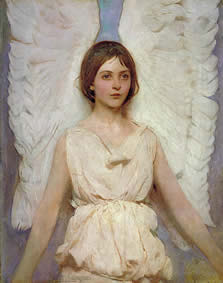
Abbott H. Thayer, Angel, 1887, oil Smithsonian American Art Museum Gift of John Gellatly

*

March 12th  Wednesday.  This morning commenced the new pattern shirt

but got but very little time to work on it.  Miss Eaton

died about eight Oclock  Mrs Witherell & Mrs S Ames laid

her out & this evening I went with Mrs Witherell to 

help her put on the robe which she made this afternoon

Mrs S Ames & myself went to the sewing circle at

Daniel Reeds  There were about twenty of us.

worked on striped shirts.  Very pleasant

A[u]gustus here to dine

This must have been an emotional day for Evelina.  Miss Eaton, a neighbor, died after a lingering illness. Sarah Ames and Sarah Witherell prepared Miss Eaton’s body, and Evelina helped put a shroud, or robe, on the corpse.  For months now, the three sisters-in-law and others had been looking after Miss Eaton. Everyone had anticipated her demise, but still, it must have been hard when she finally passed away.

After the Ames women had prepared Miss Eaton’s corpse for burial, two of them, Sarah Ames and Evelina, rode out to a meeting of the Sewing Circle.  This was the first meeting since Evelina’s own ill-attended meeting back in February.  The gathering was held at the home of Daniel and Mary Reed and about twenty women attended.  If Evelina felt awkward, she didn’t say so in her diary.  Perhaps there were women there she had been hurt by, perhaps not. Perhaps people apologized for not having shown up at Evelina’s, perhaps not. Whatever exchanges or pleasantries took place as the ladies worked on striped shirts, the mood of the afternoon must have been tinged with the sorrow of the morning and the loss of Miss Eaton. Death in the neighborhood put things in perspective.

Abbot H. Thayer, Angel, 1887, oil, Smithsonian Museum of American Art, Gift of John Gellatly

March 4, 1851

IMG_2913

March 4th  Tuesday  This forenoon finished a shirt for O Angier

Have got some old accounts books from the office

for scrap Books  Have been looking over some old

papers for receipts &c  Sarah came to pass the 

afternoon with Jane  Dr Deans & wife & Mr &

Mrs Whitwell spent the afternoon & evening in the

other part of the house  I was there at tea.

Augustus was here to dine  Pleasant but quite windy

Scrapbooks were a popular phenomenon in the 1800’s, as they had been for some time before. Sometimes called friendship albums, scrapbooks were assembled by individuals, usually ladies.  The books contained personal items as varied as pressed flowers, favorite illustrations cut out of periodicals, sketches or poetry, or special pieces of correspondence.  They were creative keepsakes, the “Pinterest” of the day.

Evelina’s approach to scrapbooking was more pedestrian than imaginative or sentimental. Her scrap books were pasted primarily with “receipts”, or recipes, cut out from newspapers, predecessors to the recipe boxes or similar notebooks that today’s cook might keep handy on a kitchen shelf.  These recipes supplemented, if not surpassed, the cookbooks available on the market by women such as Lydia Maria Child, Catherine Beecher, Sarah Josepha Hale, and Mary Peabody Mann.  With the articles clipped from periodicals, cookbooks and other household guides, a housewife or homesteader had a variety of options to refer to when it came to preserving and preparing food.  Even Old Oliver was known to pay attention to receipts; he hand-copied one for brining beef into his personal journal.

Always thrifty, Evelina used discarded account books or ledgers from the “Counting House” in which to paste her receipts.  She also used an empty ledger – the one illustrated in the photograph above, in fact – for her diary.  Its pages, meant for the posting of debits, credits or other accounting notations, were filled instead with her daily jottings.  Waste not, want not.

After a day of inevitable sewing and the more novel entertainment of working on her scrapbook, plus the company of her nephew Augustus at the dinner table, Evelina went to the other part of the house for tea.  There she joined her sister-in-law Sarah Witherell and their friends William and Eliza Whitwell and Samuel and Hannah Deans.

Dr. Deans and his family lived in Furnace Village, an area of Easton south and west of the Ames’s.  Dr. Deans, originally from Connecticut, had settled in Easton after studying medicine at the New Haven Medical School.  In addition to medicine, he also had “a warm and constant” interest in education, according to William Chaffin.  As a physician, Deans occasionally attended members of the Ames family when they took ill.

February 17, 1851

Hem

Feb 17th  Monday  Washed the dishes and worked about

house most of the forenoon  This afternoon cut out some

work for Susan & set her to hemming, counted

stiches with her.  Helen came home from

New bedford.  Spent the evening at Olivers with

Sarah W.  Worked on an apron of Susans but

had so much talking to do that […] I accomplished

but a little sewing  Pleasant but cold

Sewing was a necessity, but it was also a sociable occupation, which is perhaps one of the reasons that Evelina enjoyed it so. Her visit next door with her two sisters-in-law, Sarah Lothrop Ames and Sarah Witherell, turned into an evening of conversation with “but a little sewing,” which she didn’t seem to mind.  What did the women discuss?  Did they revisit the tender issue of the failed Sewing Circle meeting?  Or did they steer toward safer topics like Helen’s return from New Bedford? What had the fourteen-year-old been doing there?  Had she been in school? Why did she return home at the start of a week?  Susie Ames was home from school this week, too.  Was mid-February a typical time for schools to close?

At this time in our history, almost every woman knew how to sew. Sewing was a skill handed down from one generation to the next. Evelina, Sarah Ames and Sarah Witherell had each learned their stitches from their mothers or grandmothers; now it was Susie Ames’s turn to learn.  How could the women know that sewing was about to be transformed by the arrival of the domestic sewing machine, and that a forthcoming civil war would introduce mass-produced, “ready-made” clothing on an unimagined scale?  They, who in their youth had probably watched a elderly relative work a spinning wheel, would experience a dramatic trajectory in the making of apparel.  By the time Susie reached adulthood and became a housewife, some of what she was being taught would be obsolete.  But not all: hemming, mending, quilting, and neat hand-sewing would always have a place in the domestic arts, even though few women today practice the skills.

Young girls of the antebellum period like Susie and Helen and Emily Witherell  sat by their mothers’ sides and struggled to manage a needle and thread, basting or hemming or working cross stitches.  Some of them created the hand-wrought samplers that hang now in textile collections, featuring alphabets or numbers or biblical quotations with colorful, tiny stitches painstakingly wrought by stubby little fingers at age eight or twelve or fourteen. Sewing was a necessity, but it was an art form as well.

February 12, 1851

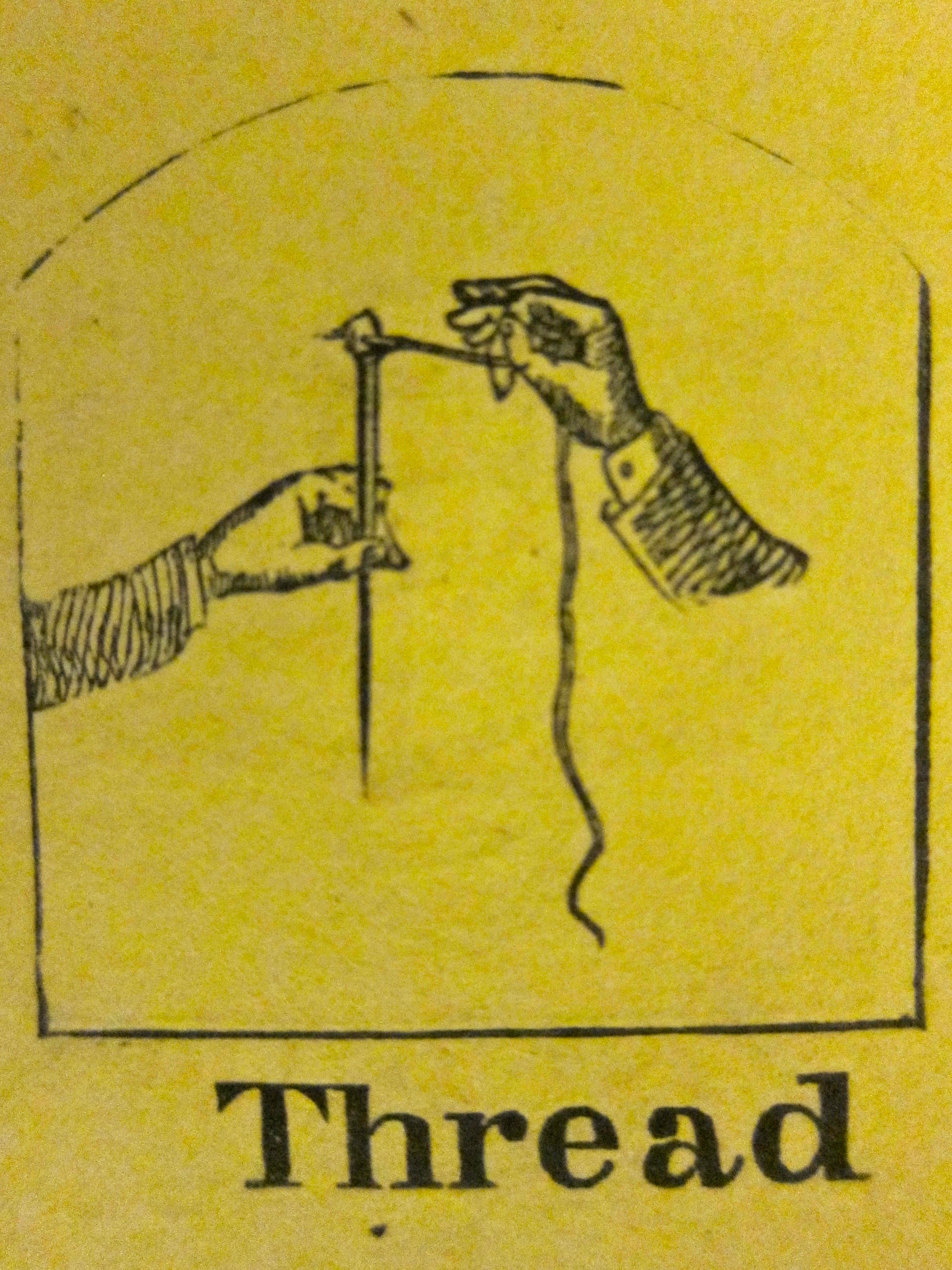
Thread

1851

Feb 12th This was the day for the sewing circle & what a crowded

house! Not one here except Mr Whitwell and our own

families  Father Ames came in to tea & Sarah W

George, Emily & Oliver & wife  Poldens boy was buried

to day  Isabell & Ann went to the funeral & took tea

with Jane after they came back.  I prepared enough

for 40 and think it is very provoking to have none

 of the members  It is a delightful day.  Letter from Miss Foss

No one came to Evelina’s party.

“Very provoking,” indeed.  Mortifying, even, that not a single member of the Sewing Circle attended today’s meeting, unless you count Reverend Whitwell.  All the preparations, the baking, the cleaning, the spools of thread from Boston, all in vain.

Evelina took the rejection with a lacing of humor: “What a crowded house!”  Although disappointed and upset, she must have been grateful for the way the Ames clan filed in to partake of the feast. From Old Oliver (who almost never came to tea) and all three Witherells to Oliver Jr and Sarah Lothrop Ames to her own children and husband, presumably, the family closed ranks around her and filled her parlor with warm bodies.  Even the Irish servant girls on their way home from a wake partook of the spread of food – in the kitchen with Jane McHanna, of course.

So what happened?  Evelina said the day was delightful but her father-in-law, a dependable chronicler of the daily weather, described “the going” that day as “rough + bad” even though the weather itself was “fair”.  After days of terrible weather that had swung from rain to ice and back again, some of the absentee members probably couldn’t drive their wagons out of their own yards.  Bad roads might account for some, if not all, of the truancy.

Nevertheless, the incident raises questions about Evelina’s popularity and social standing.  She was married to one of the most important men in town, and she and Oakes enjoyed the friendship of many.  Is it possible that some of the women in the Unitarian Circle resented her, or felt themselves superior to her?  Where were the women she had grown up with? Were they jealous of her? Did she fail socially in comparison to her sisters-in-law, each whom had a more refined upbringing? Sarah Ames and Sarah Witherell never failed to attract a lively turnout for their Sewing Circles.

All these possibilities must have swirled in her mind.  The true test would come when the Sewing Circle met again at Evelina’s, many months from this day, this awkward day that Evelina surely hoped to forget.

February 10, 1851

Storm

Feb 10th Monday  Warm this morning but not pleasant  Jane 

put her clothes out but the wind commenced blowing quite

hard with some rain, so that the clothes had to be taken

in & were dried over the registers  Cut Susan a Chemise

out of the width of  1  1/4 yd wide cloth and partly made it

Worked about house as usual on washing days in 

the forenoon  Wind blows quite hard this eve.

What a jungle of white linens the Ames house featured this Monday, with Jane McHanna having to drape dripping laundry around the heat registers.  So much for Evelina’s cleaning the floors the other day.  Miserable winter weather – snow, rain, ice, wind and rain again – was wreaking havoc with the domestic schedule.

One person in the Ames household celebrated her 12th birthday today: Sarah “Emily” Witherell.  Emily was born in New Jersey where her parents had lived while her father, Nathaniel Witherell, Jr., worked with William Leonard Ames, her mother’s brother, at various Ames enterprises.  Tragedy had struck in recent years, though, with the death of her father and the subsequent “drounding” of her two year old brother, Channing.  Emily was stricken with loss at an early age.

With her mother, Sarah; older brother, George Oliver Witherell; and grandfather Old Oliver Ames,  Emily now lived in North Easton, Massachusetts in “the other part of the house”.  She probably still attended school, but she and Susie Ames were too far apart in age at this point to be close friends, although they would soon find themselves sharing  piano lessons.  Her cousin Oliver (3) found Emily to be outspoken and opinionated; she was, evidently, unafraid of speaking her mind at a time when candor in women was not prized.

Emily never married.  After Old Oliver died in 1863, when she was about twenty-four, Emily and her mother moved into Boston, eventually taking up residence in Back Bay at the Hotel Hamilton and living off of distributions from investments managed by her male cousins.  A spinster cousin, Amelia Hall Ames, the only daughter of William Leonard Ames, eventually moved in with Emily.  These two cousins, in turn, may have undertaken to raise yet another cousin, Eleanor Ames, a granddaughter of William Leonard Ames. All that is in the future; on this day in 1851, we can hope that Emily had a special birthday despite the weather. She deserved a happy moment.