September 18, 1851

1851_Fillmore_Boston_MA_USA_GleasonsPictorial

*

Thurs Sept 18  Went to Boston with Oliver & wife

& Helen to the railroad celebration.  In company

with Mr Orrs family went to see the regatta & about

nine Returned and dined at Mr Orrs with Mrs

Witherell Emily Mrs S Ames & Helen  Mrs Stevens

&c  Afternoon went out shopping with them  All

except Mrs Witherell spent the night at Mr Orrs

Evelina traveled to Boston today to join the crowds at the Great Railroad and Steamship Jubilee.  President Fillmore, Senator Daniel Webster and dignitaries from Canada as well as the United States had arrived the day before. Speeches were made and congratulations went all around for the new “railroad communication” between the two countries. On this, the second day of the festivities, races were held, one a “grand excursion in Boston Harbor” in which cutters from both countries raced; Canada won.

The Ameses attended a regatta out at Hull, near Point Alderton (better known today as Point Allerton.) It must have been interesting for the usually land-locked Evelina to be at the shore; she rarely got to see the ocean, as her trips to Boston were typically spent in the retail center of the city.It was to that retail center that she and other ladies in her party went in the afternoon. Time to shop.

Also on this date, some 200 miles southwest of this railroad jubilee, in another thriving retail and business center, a new newspaper was born. The New York Times was founded and sold for 2cents a paper.


Reception of President Fillmore at the Boston and Roxbury lines by the municipal authorities, 1851

September 16, 1851

Cake


Tuesday Sept 16th  Mrs Witherell Emily & Cousin H Mitchell

went into Boston this morning and are going to stop the

remainder of the week  I made some cake

this morning & had to be away from Miss Eddy

more than I could wish  Mrs S Ames & Helen &

Oliver here to tea  Harriet came in but did not stop

long  Miss Eddy will stop the night here

A visit from Miss Eddy, a woman who has been staying with various friends – or relatives – in Easton, may have been the impetus for Evelina to bake a cake this morning to serve at tea.  It’s worth noting that despite having collected peaches and grapes during the last few days, Evelina didn’t make a fruit pie or tarts to serve. She was saving that fruit to put up for the winter, and wouldn’t have wanted to waste any of it on a tiny social occasion. Cake it was.

The Ames family from next door, Oliver Jr., Sarah Lothrop Ames, and their daughter Helen came for tea, ate some cake and presumably chatted with Miss Eddy.  Sister-in-law Harriett Ames Mitchell stopped by briefly, too. Not making an appearance in the front parlour, however, was Sarah Witherell and her daughter from the other part of the house. They had departed that morning for a planned week in Boston, traveling with a Mitchell cousin.

Sarah Witherell had headed to Boston in anticipation of a special event, The Great Railroad and Steamship Jubilee. The Jubilee was to be a “celebration commemorative of the opening of railroad communication” to Canada.”*  It recognized the creation of a railroad line from Boston to Burlington, Vermont that connected with a steamship to Canada via Lake Champlain. Travel in the United States had become international. The celebration would go on for three days, and many members of the Ames family would strive to attend some part of it.


*The Railroad Jubilee: an account of the celebration commemorative of the opening of railroad communication between Boston and Canada, Sept. 17th, 18th and 19th, 1851.


September 14, 1851

87219f


*

Sunday Sept 14th  Have been to meeting to day,  At noon

brought Miss Eddy home with us.  She walked

with Augustus to church. It is communion day

and Oakes Mrs Stevens & I stoped to bring

Mrs Witherell home.  We rode up to the great

pond and beyond to get some grapes & afterward

called at Mr Torreys

The Ames family attended both morning and afternoon service this Sunday, but instead of staying near church for the intermission, they rode home for a midday break.  Another change in routine may have been that communion was served at the service, which seems out of keeping with modern Unitarian practice.  Does anyone know if Unitarians took communion in the mid-19th century?

After church some of the Ameses rode up to the Great Pond, stopping at Col. John Torrey’s in the village on their way home. Evelina says she, Oakes and Mrs. Stevens brought Sarah Witherell along, a generational grouping that suggests that the “Oakes” in the carriage was her husband rather than her son Oakes Angier. Yet Evelina has, to date, always referred to her husband as “Mr. Ames,” as was the custom.  Did she write his first name unconsciously, or was her son the one in the carriage?  Readers, do you have an opinion? Whoever was in the group, each seemed to have a pleasant late afternoon foraging grapes in the cooler air.

Elsewhere in America on this date, James Fenimore Cooper, author of the popular Leatherstocking Tales, died in Cooperstown, New YorkWhile his Leatherstocking novels secured him fame throughout the western world, Cooper wrote many other novels, some with political overtones to them.  He was not popular with the Whigs. One day shy of his 62nd birthday, he died of dropsy (edema.)

* Baumann’s Rare Books


September 9, 1851

DSCF2567small

 *

Tuesday 9th  Frank & Mrs Mitchell returned this

morning & Oakes A went from Bridgewater to the

convention at Springfield.  Mother Mrs

Stevens & self & Susan passed the afternoon

at Mr Torreys.  The Col was very clever

gave us lots of peaches.  Harriet Mitchell

came home with them this morning and spent

the evening here.

Evelina and others enjoyed an afternoon call on John Torrey, who was evidently quite amusing, and came home with at least one basket of peaches. Frank Morton Ames brought his Aunt Harriett Mitchell back from a party in Bridgewater, but his oldest brother, Oakes Angier Ames, didn’t return with them. Instead, he traveled west to Springfield, probably by rail, to attend a Whig Convention. At the age of twenty-two, Oakes Angier was diving into politics, and the Whigs in Easton thought well enough of him to represent them at the meeting.

Led by Senators Henry Clay and Daniel Webster, the Whig Party had developed in the 1830’s as an anti-Andrew Jackson party, and had managed to put four presidents in the White House, including its present occupant, Millard Fillmore. The party would soon dissolve over the issue of slavery, leading many of its northern adherents to attach themselves to the new Republican Party. Many were against slavery because it conflicted with an economy based on free-trade. But in the meanwhile, the Whigs wanted modernization and strong policies to guide economic growth.  Jeffersonian in their preference for Congress over the Presidency, they would have said they opposed tyranny.

The convention in Springfield was held on one day, September 10, “to make the customary arrangements for the annual State elections”.*  The group of about 1,000 attendees nominated the Hon. Robert C. Winthrop of Boston as candidate for Governor and the Hon. George Grennell of Greenfield as candidate for Lieutenant-Governor. The keynote speaker at the convention, Ezra Lincoln, spoke of state matters, but spent a moment on national issues as well:

“…[I]t is felt throughout the country that a crisis of no ordinary difficulty exists. Whether we look to the debates and the proceedings of Congress; to the popular elections throughout the country; to the tone of public opinion, as indicated throughout the Union by the press, and the discussions everywhere taking place, we cannot be insensible to the fact that the stability of our institutions is put to a severe test.  It is probably left to this generation to ascertain, by a severe experiment, the soundness and vitality of those principles which were embodied by our fathers in these Constitutions, as well as of the several States, as of the Union…” *

Oakes Angier and others at the convention could not have known how severe the experiment ahead of them would be.

* Proceedings of the Whig State Convention, Held at Springfield, Massachusetts, September 10, 1851.


September 6, 1851

shopping

Sat Sept 6th  Alson brought Mrs Stevens before we

were up this morning left his carriage here

while he went to Boston.  We went into Olivers

& passed the afternoon with Mrs Latham & Mrs W & Mrs

Mitchell I called on Mrs Peckham while the others

went to Mr Manly’s garden  Mr Ames brought home

some cuff pins for Alsons wife & Mrs Stevens

Evelina was probably pleased today to lapse back into a sociable, summer agenda.  Family friend Mrs. Stevens arrived at dawn, it would seem, delivered by Evelina’s brother Alson Gilmore on his way into Boston. The two women later went next door to call on Sarah Lothrop Ames and were joined by sisters-in-law Sarah Ames Witherell and Harriett Ames Mitchell and the former’s houseguest, Mrs. Latham.  Chat, chat, chat.

As they had done occasionally throughout the summer, many of the women went up to look at the flowers in Edwin Manley’s garden. The blooms they saw would be among the last for this year.  Evelina eschewed that walk (or ride) and went instead to call on Susan Peckham, wife of John Peckham, clerk for the shovel company.  The Peckhams were about to move, so perhaps Evelina went to see what help she could be, or to say goodbye. Susan Peckham must have been packing things up, a chore that would have made Evelina, who was lately familiar with the bustle of departure, feel right at home.

Oakes Ames spent the day in Boston, as he did almost every Saturday.  He went on business for the shovel company, often returning with orders or payments.  Just as often, he carried out particular errands for his wife.  Yet it’s not clear whether she or he or both, perhaps, suggested the purchase of cuff pins (perhaps what we call cuff links) for Mrs. Stevens and Henrietta Williams Gilmore.  Both women had birthdays around this time.

September 3, 1851

Trunk

Wednes Sept 3d  Alson came this morning & brought

Orinthia and staid to dinner and carried Mrs Stevens

home with him  Orinthia has been packing her clothes

Mrs Stevens stiched three more collars for me & Mrs

Witherell two that are for Frank.  Abby Torrey called

this afternoon &c and on her return Orinthia & I went

to the store  Pauline passed the afternoon with Helen

Orinthia Foss was packing her clothes, getting ready to return home to Maine. What prompted the departure isn’t clear. Did she lose her job, or was she called home on family matters? She would return to North Easton eventually, but did she know that when she left?  How did she feel about leaving this town where she had lived for six months? How did Evelina feel about the loss of her young friend, even temporarily?

Orinthia wasn’t the only one with a trunk to be packed. Oliver Ames (3), too, was a day away from departure and had a trunk into which his mother – and others, perhaps – were placing his new collars and mended shirts. Last minute sewing was still going on, but by this time the trunk would have been nearly full of the clothes that Oliver would need for a term at college.

That Oliver was going away to study at Brown was just shy of miraculous.  At 20, he was old to be going, for one thing; in the nineteenth century, the average students were teenaged, like Fred Ames at Harvard. But more than that, his father Oakes had not wanted him to go. According to one 19th century acquaintance of Oliver, Oakes “had inherited some measure of that Puritanical contempt for the liberal arts.” After completing prep school, Oliver had been directed to work at the factory, “to learn the trade of shovel-making. But the desire for a higher education remained strong, and when at the end of his five years apprenticeship he had mastered the trade, his father yielded to his solicitations, and allowed him to enter Brown University.” * Oliver had earned his ticket out.

* Hon. Hosea M. Knowlton, “Address,” Oliver Ames Memorial, 1898, pp. 98-99


September 2, 1851

Cloth

Tuesday Sept 2d  Again this morning sat down quite early to 

sewing for Oliver cut him out 5 dickeys & finished 

one that was cut last autumn.  Mrs Stevens stiched

2 of them.  Mrs Stevens Pauline & self passed the

afternoon with Mrs Witherell  The weather is

very unpleasant & cold and this evening it rains

hard

The northeast wind of yesterday brought no good weather with it.  The ladies stayed indoors and sewed clothes for Oliver (3), only breaking stride enough to move in the afternoon to the other part of the house to do more of the same. Most likely, Sarah Witherell sewed with them.

Evelina noted today that she worked on dickeys, or shirt fronts, for her son.  She finished one that she had cut out almost a year earlier, which begs the question: Where had she kept it all that time?  Where did she store the fabric, thread and trim for her multiple projects? She had a workbasket, certainly; any sewing woman in that time and place would have had one.  But a workbasket was just that, a basket, or a box.  It might hold a thimble, scissors, needles, a bodkin, an emery bag, plus “tapes, and buttons, and hooks and eyes, and darning cotton, and silk winders, and pins, and all sorts of things,* but it wouldn’t hold bolts of cloth or unfinished, flounced skirts. The yards of fabric and dickeys-in-progress, the aprons to be hemmed and the chemises to be sewn together, would be stored elsewhere. Where?

Perhaps Evelina had shelves in a corner closet to hold her projects, or maybe she laid claim to a particular chest of drawers in the sitting room. When she was working on large projects, such as the cover for the lounge she made earlier in the summer, perhaps the piece simply lay out in one of the rooms until completed. Was she tidy or messy? How did she manage? She may have wished for a room that could be just hers for her projects.  With that large family, and all the houseguests they welcomed, an extra room wasn’t likely to be available.


* Susan Warner, The Wide, Wide World, p. 40


August 26, 1851


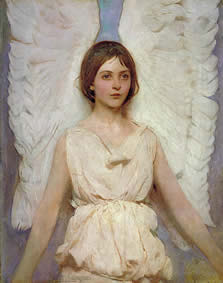
Abbott H. Thayer, Angel, 1887, oil Smithsonian American Art Museum Gift of John Gellatly

Abbott H. Thayer, Angel, 1887, oil
Smithsonian American Art Museum
Gift of John Gellatly


Tues Aug 26th  Clinton Lothrop died about ten Oclock

last night  Has been sick a long time with

the Typhus fever  Mrs Witherell & I made the

shroud for him  Mrs Mitchell went to Taunton

to get Bonnets &c for Mrs Lothrop

Rebecca White came after Pauline this morning

Alson here to Dinner and tea is drawing stones for

Edwins cellar.  Oakes A and Frank returned this evening


Dewitt Clinton Lothrop finally died.  He had been suffering from typhus, “an acute infectious disease caused by the parasite Rickettsia prowazekii, transmitted by lice and fleas [,and] marked by high fever, stupor alternating with delirium, intense headache and dark red rash.”* It’s not the same disease as typhoid fever, although the two conditions have some similarities. Clinton, as he was known, had probably been bitten by a flea.

One of nine sons of Howard and Sally Lothrop, Clinton was a brother of Sarah Lothrop Ames. While most of his surviving brothers had moved away from Easton in pursuit of their own lives, Clinton was the duty son who had stayed home with his parents. Only 26 years old and married with two small sons, he had tended the family farm.

Evelina and Sarah Witherell quickly prepared a shroud for the body, while Harriett Mitchell rode off to Taunton to find mourning clothes for the young widow, Elizabeth Howard Lothrop (or for the mother, Sally Williams Lothrop.) That no one had purchased the mourning clothes before now suggests that, despite the probability of death, everyone had hoped that Clinton would recover.

It was a busy day for Evelina.  Besides helping sew the shroud, she saw her friend Pauline Dean depart to visit elsewhere in Easton and welcomed her brother Alson to midday dinner. Alson was working nearby, helping his son, Edwin Williams Gilmore, build a house.  Jane McHanna washed clothes, and she and Evelina probably continued to set the house to rights after a weekend of guests. Oakes Angier and Frank Morton returned home from their fishing trip.

* Craig Thornber, Glossary of Medical Terms Used in the 18th and 19th Centuries, http://www.thornber.net

August 21, 1851

PINEAPPL-h

*

Thurs 21st Aug  This morning sat down to work quite early

finished my purple morning dress and 

Susans pink print that was made over

Pauline is not willing that I should work

much  She has had the offer of marriage

from a Mr Stowe of Concord Mass & the same

is an offer from John Reed, an old man of

70 years  She is very fascinating  Mrs Witherell

& Mitchell went to Boston for paper for parlour

Evelina had a houseguest who wasn’t interested in sewing, but that didn’t prevent her from finishing two dresses she’d been working on. She was caught up with the romantic dilemma of her friend, Pauline Dean, who was considering two offers of marriage. Evelina’s daily life was so far from being romantic that she found Pauline’s tales “very fascinating.”

We don’t know much about Pauline Dean, except that she corresponded with Evelina and visited periodically. We don’t know where or how Pauline lived, but we can surmise that she was originally from the Easton area. She was familiar with the town and several of its inhabitants; perhaps she was related to one of the Dean families in the area.

While Evelina and Pauline visited, sisters Sarah Witherell and Harriett Mitchell went into the city in search of wallpaper. Sarah was looking to replace the wallpaper she had only recently put up in her parlour; she didn’t like it or the way it had been hung. The wallpaper in the illustration above is circa 1845 and demonstrates the prevailing ornate taste of the time.

Adelphiapaperhanging.com 

August 19, 1851

4gbhistory


*

Tues 19th Aug  Sat down quite early to fix some work for

Ellen, about 11 Oclock Mrs Norris and a Mr Young from

Bridgewater came  Dined here and left about three

they wanted the boys to go Fishing Thursday but Clinton Lothrop

is not expected to live through the day and they

thought it best to defer going untill Monday

Mrs Witherell & Mitchell & myself went into

school this afternoon  Very warm

Melinda Orr Norris and a Mr. Young had midday dinner with the Ameses, during which they invited the Ames sons to go fishing. The boys accepted but deferred the trip to the following week.  Clinton Lothrop, their Aunt Sarah Lothrop Ames’s younger brother, was deathly ill and they wanted to wait until after his anticipated passing.

It was a hot summer day, with no such thing as air conditioning or window fans. In their full-skirted dresses, the Ames women surely were hot as they chored around the house or sat with visitors. They possibly opened their parlor windows to let in some air, but would have let in the insects, too, if they did so.  “Wove wire” had appeared here and there on the market as an alternative to horsehair weaves, but wouldn’t be commonplace until the Civil War. Around 1861, Gilbert & Bennet, a sieve-making firm in Georgetown, Connecticut, lost its southern customers and began to manufacture window screens as a way to use its surplus wire mesh cloth. Window screens took off. Before then, how did people cope?

Evelina and her sisters-in-law, Sarah Witherell and Harriett Mitchell, left the closed air of their homes and went to the local school house in the afternoon. Evelina doesn’t explain the purpose of the trip. Surely the hot sun beat down on them outdoors, but their bonnets kept their heads protected, at least.

* Gilbert & Bennet’s Red Mill on the Norwalk River where woven wire cloth was first developed as a commercial substitute for horsehair. Photo from historyofredding.com.