October 19, 1851

OLYMPUS DIGITAL CAMERA

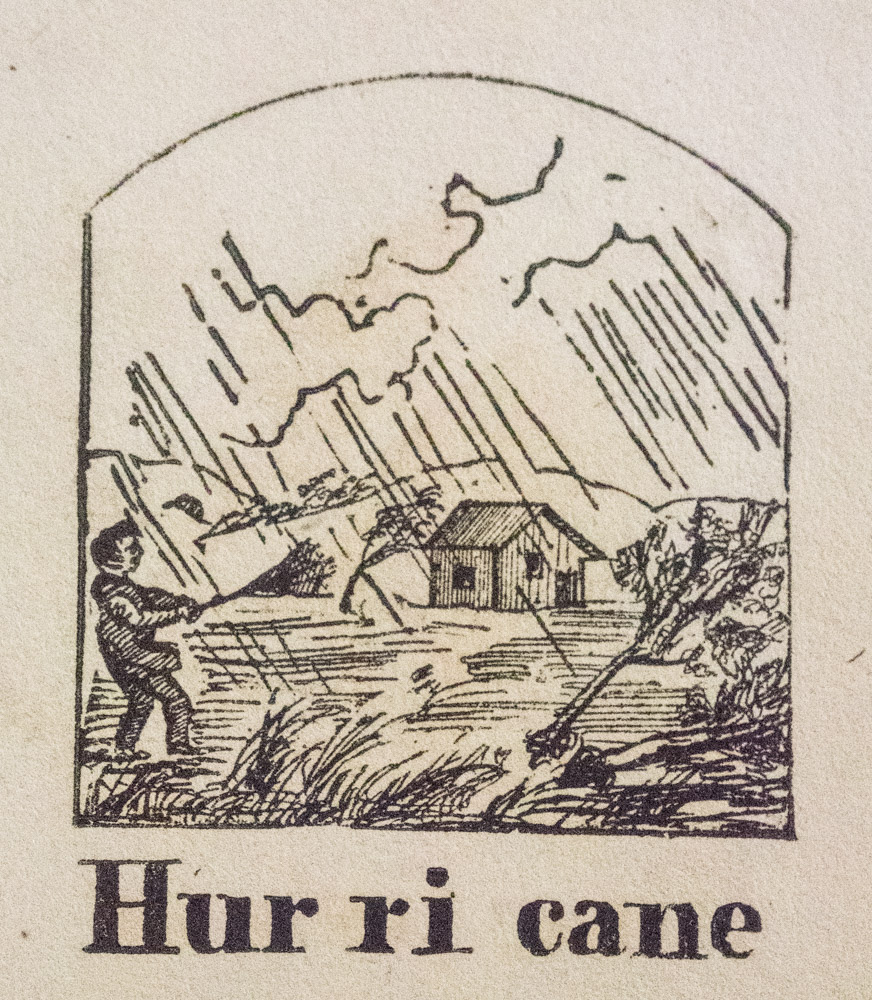
Sunday Oct 19  Last night was very stormy, rained very fast

and heavy wind.  This evening is very pleasant

but it has rained all day so that none of the 

family went to meeting  Alson came after Lavinia

about three Oclock  I have been reading most

all day “Olive”  It is rather interesting but wish 

I had spent the day more profitably

Evelina’s father-in-law, Old Oliver Ames, also recorded the day’s bad weather in his daily journal: “it began to rain last night + this morning there is a north eas[t] storm + the wind blows verry hard. it stormed nearly all day but was clear at night – there was an inch + a half of water fell”

According to the weather record for 1851 – the first year that Atlantic hurricanes were officially tracked – the storm that Evelina and Old Oliver describe was Tropical Storm #6. It made landfall in Rhode Island, thus its impact on nearby North Easton would have been severe. Despite the rain and wind, the buildings in the Ames complex appear to have come through fine. Old Oliver would have mentioned it otherwise.

For the fourth week in a row, Evelina missed church. One Sunday, there had been no service; on two other Sundays, she had been ill and today, weather prevented attendance. She was probably missing her weekly dose of religious direction from Reverend Whitwell and social interaction with her fellow Unitarians.  She occupied herself by reading “Olive,” which was most likely a domestic novel in the genre that she often read.  It would have been the kind of book that Old Oliver called “love trash.”

October 12, 1851

OLYMPUS DIGITAL CAMERA

Sunday Oct 12th  Had a Catholic meeting at 8 Oclock  Jane went

Have not been to meeting to day on account of the

humour was affraid that I could not sit still.  Susan

went & all the rest of the family  Read in Goodeys

Ladys Book .  Quite stormy & could not go to

Augustus’ as I intended  Have had a very quiet 

day

For the third Sunday in a row, Evelina missed church.  Her nettlerash, or “humour,” still bothered her to such an extent that she had trouble sitting still. She stayed home and by her own admission, “had a very quiet day” while the rest of her family went to meeting. Even the servant, Jane McHanna, left the house to go to a service in the new Catholic Church on Pond Street.

Her father-in-law, Old Oliver Ames, who kept a daily record of the weather, reported that “this was a cloudy warm day and there was 2 or 3 small showers in all about one 4th or 3/8 of an inch southerly.” Evelina evidently studied the raindrops from her perch in the house and decided to postpone her intended visit to the village to see her nephew and his family. Instead she read from Godey’s Lady’s Book, the popular monthly periodical to which she subscribed.

Published in Philadelphia by Louis Godey and edited by Sarah Josepha Hale (a high-profile writer who, among many other accomplishments, wrote Mary Had a Little Lamb), Godey’s Lady’s Book was, as its title suggests, targeted at women. It featured domestic fiction and household hints, sentimental poetry and architectural plans.  It showcased contemporary writing by authors such as Nathaniel Hawthorne and Washington Irving, yet also published three editions in which women, and only women, wrote the articles.  A testy Hawthorne actually complained to his publisher about the influx of female authors, calling them “a damned mob of scribbling women.”

By 1855, the magazine even carried a feature entitled Employment for Women. Each monthly volume of Godey’s contained various illustrations and at least one fashion plate, imperative for home-seamstresses everywhere who wanted to stay abreast of the styles in dress. It was a magazine perfectly aimed at Evelina, and she followed it loyally.

September 28, 1851

149

*

Sunday, Sept 28  Having a bad cold and headache I did not attend church

to day have not read as much as I should had I been

well  Susan has got quite smart and has been

reading the wide wide world  It has been very 

quiet here all day  I have been looking at

my accounts book have neglected it sadly

of late but hope to do better for the future


The excitement and strain of the last week or so – the return from Boston, the plunge into redecorating and her daughter’s sudden and demanding illness – may have taken their toll. Evelina came down with a cold and was too ill to go to meeting.  That she was too sick to “read much” indicates just how crummy she must have felt. She generally enjoyed reading on Sundays after church. The only activity that seemed to interest her today was looking at her “accounts book,” but that didn’t cheer her up much. Perhaps she suddenly reckoned with the money she and Oakes had recently spent.

Little Susie Ames, who had been so sick with nettle rash, was definitely on the mend.  She may not have gone to church either, but she was deep into reading The Wide, Wide World, a popular, famously sentimental novel by Susan Warner (published under the pen name of Elizabeth Wetherell.) This pious classic tells the story of little Ellen Montgomery, a girl about Susan’s age who is separated from her mother and sent to live with distant relatives. She struggles among strangers – kind and mean – to accept her fate and learn to trust God. A best-seller in its day, it clearly appealed to Susan, and Evelina, too, presumably.


* Ellen Montgomery, the young heroine of The Wide, Wide World, is often in tears, as this period illustration from the popular novel shows.

September 27, 1851

333_EOA_484_-_1850_20_H1a

 $20 Gold Piece, 1850

Sat Sept 27  Have been very busy to day but can

scarcely tell what I have done have been working

about house most of the time  Have bought

Mrs Mitchells beaureau and to night it has

come and it looks better than I expected  agreed

to pay her 18 dollars but shall give her 20 for it

Mr Ames carried back the chairs to Bigelows

and bought me one at Courrier & Trouts for […] 25 Dols

William Chaffin, Unitarian minister and town historian, once described Evelina as “very economical.”* He claimed that she mended her husband’s pants so that he wouldn’t have to spend money on new ones. Some Ames descendants and others knowledgeable about the family history also consider Evelina to be the personification of Yankee frugality. She sewed tucks into dresses, reused old pieces of carpet, made her own soap and kept careful household accounts. She mended coats, upholstered a lounge for the parlor and roped relatives and friends into helping her make shirts for all the men in her house. She did work that she could have paid others to do for her. Was she being cheap or was work a habit with her? Or both?

Evelina could and did spend money, as last week’s flurry of shopping in Boston demonstrates. She bought dress fabric, chairs for the parlor and new wallpaper. And today, only one week later, she paid her sister-in-law, Harriett, $2 more for a chest of drawers than the price they had agreed upon. The gesture was generous, and underscores the possibility that Evelina was not quite the cheapskate that family tradition has allowed.

As the acquisition of the used “beaureau” shows, Evelina was having a burst of redecorating. What had set this off? The shovel shop was doing well, obviously, so they could afford to buy new things. Beyond having the means, what encouraged her to make these alterations? Was she being encouraged by her husband? He seemed to be right there with her at the store.  Was Oakes’s participation prompted by an easy complacency about his wife’s spending or a shared enthusiasm for the new purchases? Was an influx of wealth changing the way they lived?

* William Chaffin, Oakes Ames, private publication, Courtesy of Easton Historical Society

July 28, 1851

Bookcase

Monday July 28th  Was about house as usual this 

morning and have been mending some and fixing

some of Susans clothes  Oakes & Oliver (3) are

having a book case put up in their room by

Ira Ford  They have almost got books enough to

fill it  Julia is to work for Mrs Witherell

making her a purple morning dress

A young carpenter named Ira Ford built a bookcase at the Ames house today in the bedroom of Oakes Angier and Oliver (3).  The boys had acquired schoolbooks and other “books enough” and needed a place to store them all.

Like their mother and unlike their father, the Ames sons like to read. The middle son, Oliver (3), in particular, cherished reading. According to an unnamed eulogist in a memorial volume published in 1895,  Oliver (3) built up quite a collection of books in his lifetime: “In the company of books he found an absorbing pleasure, and to the library which he had begun to collect in his early age he made in later years large additions of rare and valuable volumes.”* After Oliver (3)’s demise, those books that weren’t kept by his family were auctioned off at Sotheby’s.


*Anonymous, Oliver Ames Memorial, ca. 1895, p. 38 

April 2, 1851

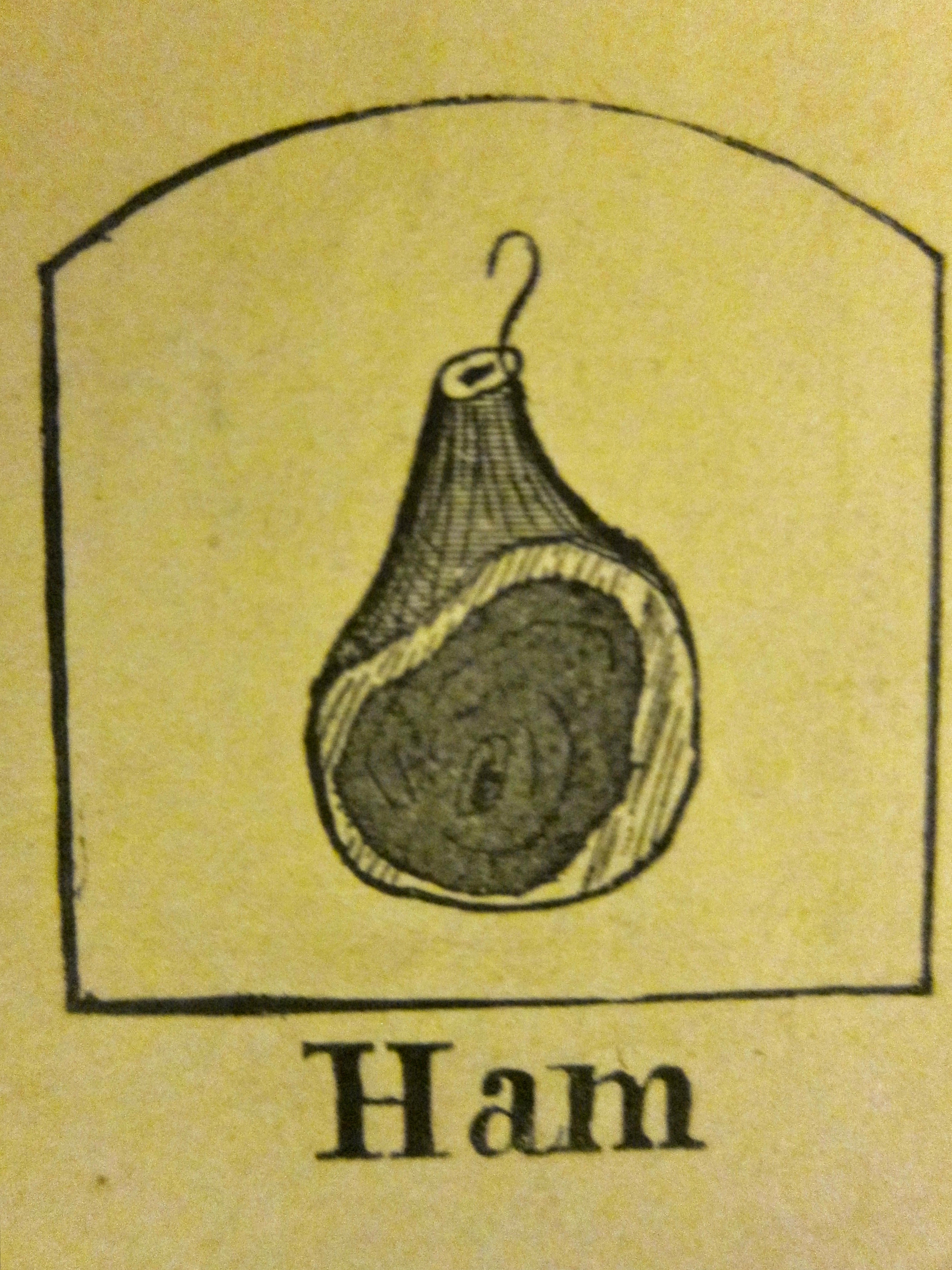
Ham

1851 Wednesday

April 2nd  Jane & myself have been taking care of a hog

that was killed yesterday.  Have the lard tried

sausages made  fat back & hams salted and the whole

hog already for cooking.  This afternoon Jane ironed

seven fine bosom shirts.  This evening have been reading

being to[o] much fatigued to work.  Augustus went to 

Boston

It was a busy day in the Ames kitchen as Evelina and her servant, Jane McHanna, set about preserving one of the pigs that Evelina’s father-in-law, Old Oliver, had slaughtered the day before.  He sold some of the pork, but held back at least one of the animals for his own household.  Evelina and Jane had a long day’s work processing the animal, which had weighed about 300 pounds when slaughtered.

As the women broke the animal down into workable pieces, they “tried the lard,” which meant that they boiled much of the pork fat in water on the top of the stove, taking care to avoid the spattering as the fat popped and the water drew down. The resulting lard was cooled and stored, probably in stoneware jars, for future household use.

Also to be cooked in the future were the big hams, ribs, hocks and more.  The large hams were salted and hung in a safe place like the cellar or a smokehouse until ready to be baked or boiled and eaten, while smaller pieces like the ham hocks would have gone into glass jars or stoneware. Everything got prepared, even sausages, which was a process unto itself, what with grinding the meat, mixing in the herbs and spices, and packing the mixture into the intestinal casing.

In addition to all this, Jane found both time and energy to iron “seven fine bosom shirts.” The cookstove, which had been heated for trying the lard, must have been hot enough to heat up the flatirons.  Perhaps not wanting to waste that good energy, Jane set up the table to iron.

Those two women must have slept well this night.


March 25, 1851

438px-HardTimesComeAgainNoMore1854

/51

March 25  Worked on Olivers shirt this forenoon

In the morning read to Mother awhile

Mrs J Porter spent the day with Mrs Witherell

I called to see her.  Her youngest boy was with

her between three & four years.  Her oldest daughter

15 & her other son 13 years.  Has lost four children

Abby & Malvina were here to tea.  Pleasant

Augustus went to Boston.  I received a letter from Louisa

J. Mower  Oliver went this morning to New Jersey.  Helen to school

A quiet weekday in Easton, punctuated by departures.  Augustus Gilmore went into Boston, perhaps on errands for the new boot factory. Helen Ames returned to school and her father left for New Jersey on shovel business. Pleasant weather facilitated everyone’s travels.

Sarah Witherell had a visitor today, a Mrs. J. Porter, who brought three children with her. Evelina, who “called to see her,” noted that Mrs. Porter had borne four other children who had died, a sorrow Evelina would have been especially sympathetic to, having lost a child of her own. So had Sarah Witherell. Surely there was a tinge of loss hovering on the edges of this modest gathering, “frail forms fainting round the door,” as Stephen Foster’s classic ballad* from 1854 would soon suggest.

In the United States in 1851, average life expectancy was less than 50 years old. No small variable in that number was the high rate of infant mortality. The expectation that an infant might not survive was so prevalent that some parents didn’t name their children until after the child had lived through its first twelve months.  It wasn’t unusual for census records to show entries for two- or six- or nine-month old babies described as “Infant Not Named.”  Children and young adults died, too, from diseases that we have since held at bay, but babies were especially vulnerable.

*Hard Times Come Again No More

March 23, 1851

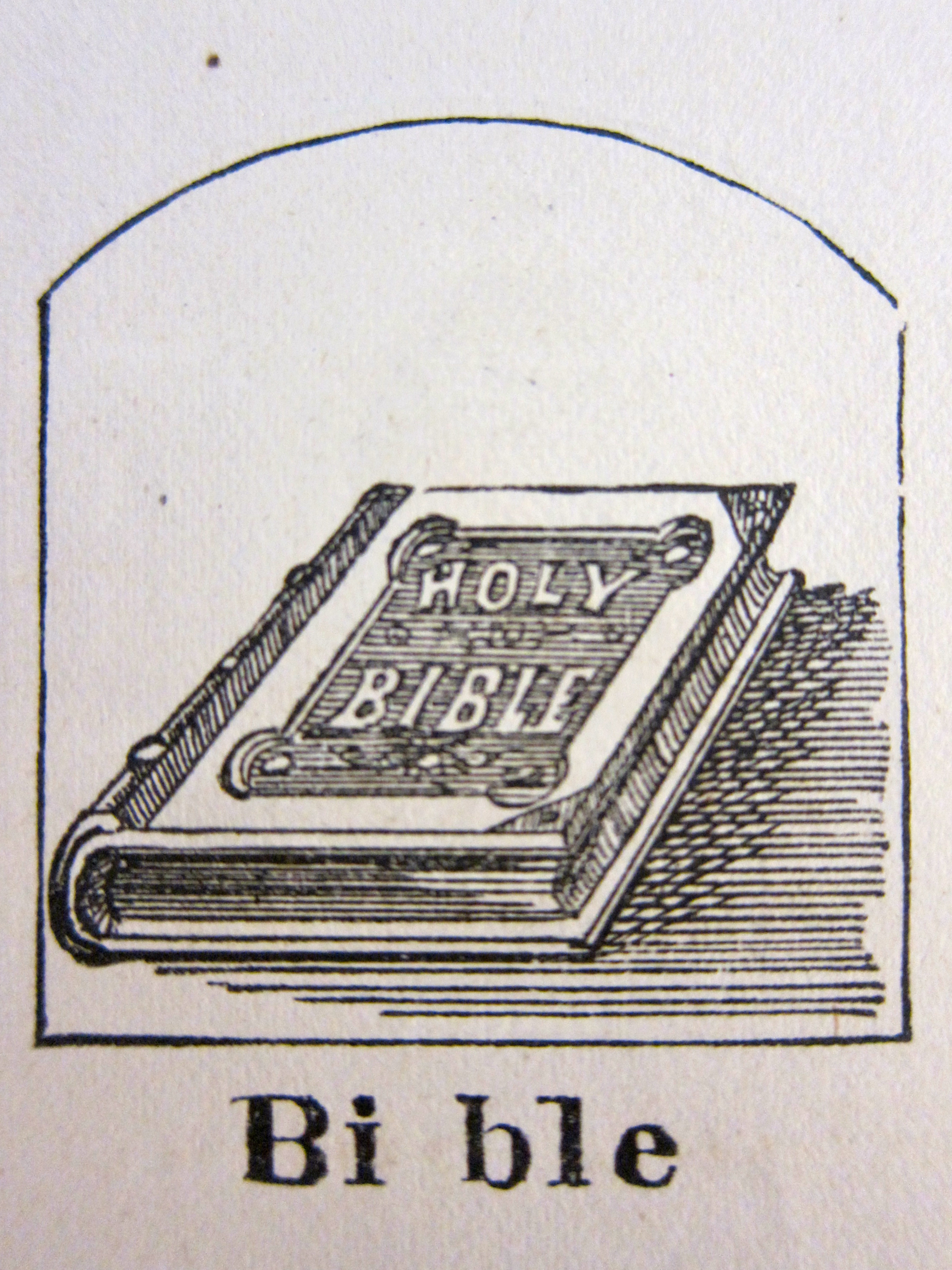
Bible

1851

March 23 Sunday.  Have been to church to day and 

stoped at noon to hear the bible class

with Alsons wife & others, got some subscriptions

for the blinds.  Mother came home with

us from church to make a visit.

Orinthia & myself read to Mother a story in 

The Boston Museum a long one but not worth

much Edwin called and Fred & Helen

A beautiful day it has been

Not only was Helen home from school for a visit, but her older brother Fred was back, too, from Philips Exeter Academy where he was preparing for college. How pleasant for Oliver Jr and Sarah Lothrop Ames to have their two children home, however briefly. Helen and Fred stopped in to say hello, as did another cousin on the Gilmore side, Edwin Williams Gilmore. Plus, Evelina’s aged mother, Hannah Gilmore, returned from church with the Oakes Ames family to “make a visit” of a few days. The old house was busy toward the end of the day, and tea this evening must have been especially sociable.

Earlier in the day, at the intermission between services, Evelina popped into a Sunday School class – perhaps for adults? She also did a little fund-raising for the church, or for a charity with which the church was affiliated.  She and others raised some “subscriptions for the blinds” (which does not mean they were ordering new window treatment!)  They were hoping to help the sightless.

Although Evelina was both devout and charitable, she was not sanctimonious. In her diary, she never mentions reading the Bible. She loved reading, and made note of various novels, stories and articles, such as today’s story that “was not worth Much.” But the Bible itself went unnamed.  If she did read chapter and verse from time to time, which seems likely, she simply never said so.  Perhaps reading from it may have been as automatic as looking something up in the dictionary might be for us.  She didn’t feel the need to remark on it.

March 16, 1851

OLYMPUS DIGITAL CAMERA

March 16th Sunday.  Went to meeting all day.  Oakes Angier

did not go. There were but a very few present

as it was very windy & cloudy commenced raining about

noon. Spent the intermission at Mr. Whitwells.

I liked both sermons, particularly in the afternoon.

Orinthia staid at home in the afternoon having

a bad cold This Evening wrote a letter to Louisa

J Mower & read the papers

Most of the Ames family attended church today. The crummy weather couldn’t keep them at at home, although it affected the travel of others in the congregation. Evelina continued to admire Reverend Whitwell and listened carefully to his sermons. She enjoyed the company of his wife Eliza, with whom she spent today’s intermission between services. Orinthia Foss, meanwhile, went back to the house at noon with a cold. Did she catch it yesterday when the ladies were out making calls?

After church on Sunday was usually a quiet time. The Ameses followed the old Puritan practice of not working on the Sabbath. Sewing was included in that stricture, meaning that Sunday was the one day Evelina gave her thimble a rest. She usually filled what we would call “down time” by writing letters or reading. On this afternoon, she wrote a letter to Louisa Mower in Maine, perhaps bringing Louisa up to date on Orinthia’s stay in Easton and her new teaching responsibilities.

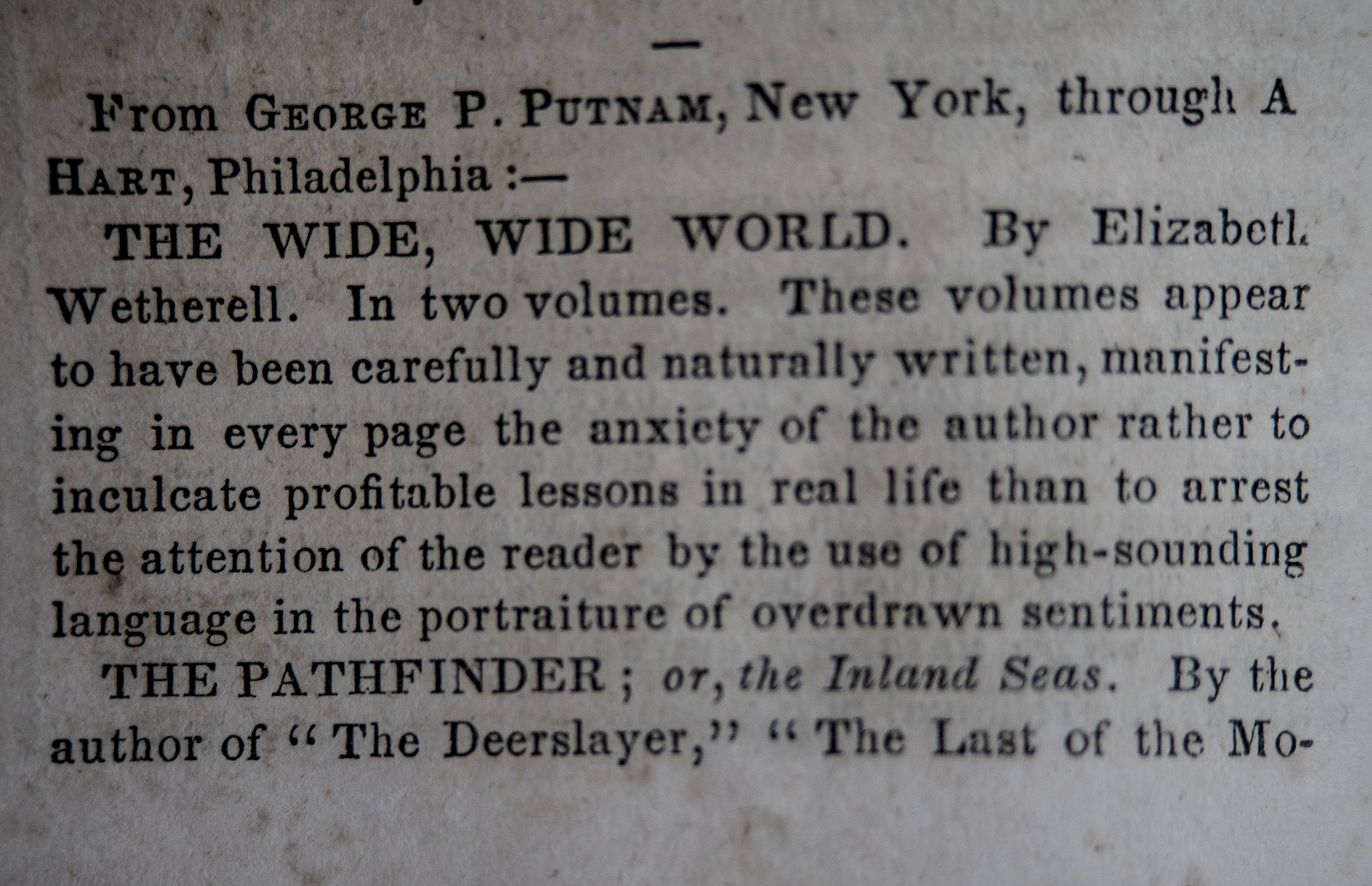
As for reading, Evelina and Oakes either subscribed to or bought directly (in Boston) various periodicals and newspapers.  One of her favorites was Godey’s Ladys Magazine, a popular women’s monthly published in Philadelphia. If Evelina looked through the March issue today, in the section entitled “Editors Book Table,” she may have read notices for two books just published by George Putnam in New York. The first was The Wide, Wide World by Elizabeth Wetherell (pen name for Susan Warner), a Christian-themed novel that would be a big bestseller and a mainstay of 19th century fiction for decades. The short review described the book as “carefully and naturally written, manifesting in every page the anxiety of the author […] to inculcate profitable lessons in real life.” Both Evelina and her daughter would read it.

James Fenimore Cooper’s The Pathfinder was next in the list of new books and promised more adventure than The Wide, Wide World. Evelina never mentioned reading any of Cooper’s books but perhaps her sons, who also loved to read, enjoyed the Leather Stocking Tales.

March 8, 1851

Grace Aguilar (1816 - 1847)

Grace Aguilar
(1816 – 1847)

/51

March 8th Sat.  This has been a very stormy day,  Windy & snowy.

Orinthia did not keep school and we have had

a nice quiet time.  I have finished putting the 

bosom & wristbands into Franks shirt and worked

some on a coarse shirt.  Orinthia finished a 

coarse shirt that she has been making & commenced 

another for one of the boys.  I have finished reading

Womans Friendship & like it pretty well.

Woman’s Friendship was a domestic novel by English author Grace Aguilar.  In her short life,  Aguilar wrote not only novels, but also poetry, histories, and  religious treatises that explored her Jewish heritage.  Among the latter, she translated “The Spirit of Judaism” from the French, and wrote her own extensive exploration of the scriptures, “The Jewish Faith: Its Spiritual Consolation, Moral Guidance and Immortal Hope.”  She was prolific and extremely bright.

Her domestic novels – the kind of writing that Old Oliver called “love trash” – were her most successful publications. Such novels were a literary genre, not unlike today’s “chick lit,” that was written for, and often by, women.  The novels usually had storylines that featured the travails of young heroines.  Woman’s Friendship, published posthumously, was the tale of one such young woman who suffers many misfortunes and reversals but manages to save her family after her father’s early death and her brother’s losing fight with consumption, all the while retaining the lifelong friendship of a countess. Putting the improbabilities of its plot aside, Evelina liked it. As she sewed today with Orinthia Foss, Evelina may even have had the story from the book in her head.  She certainly liked the book well enough to eventually commence another novel by Miss Aguilar.

It was Saturday, the day that Oakes Ames usually went into Boston.  Did he go today, or did the weather make traveling too difficult?   Were they all getting tired of winter?