March 30, 1851

headache1

*

March 30 Sunday  Have not been to meeting at all to day.  My

cold is very troublesome have a very bad head ache.

could not read much.  Mr Cyrus Lothrop 3d called this 

evening & Frederick, Oakes Angier & Orinthia rode

down to Mr E Howards this evening.  Mrs Howard

has gone to Nashua to make a visit.  Mother returned

home from meeting  A very fine day

I commenced making fire in the furnace

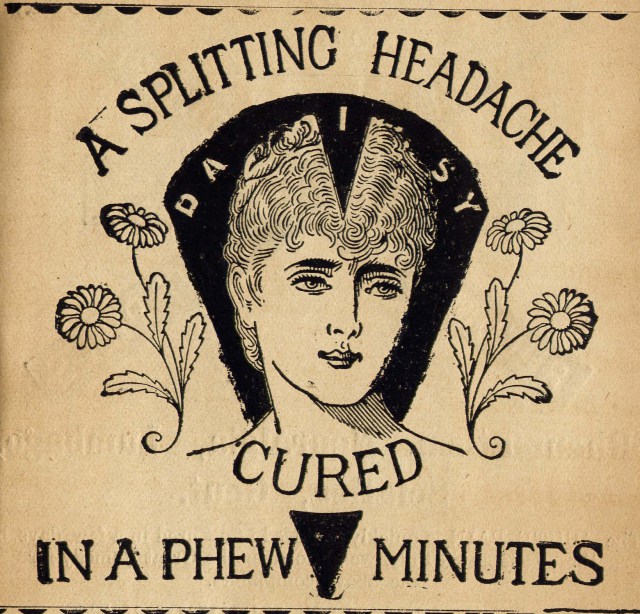
Evelina continued feeling poorly today. After yesterday’s helping of the commercial elixir, Wistar’s Balsam of Wild Cherry, one can’t help but wonder if her headache was, in fact, a symptom of hangover from the alcohol she unknowingly ingested.

The consumption of alcohol was absolutely forbidden at the Ames’s house.  Both Oakes and his brother Oliver Jr took a temperance pledge early on, and kept it. They hoped their workmen would follow their example. In this they differed from their father who, in his heyday of running the shovel works, had allowed his workers a ration of rum as part of their regular routine.  Old Oliver’s habits had been learned in the 18th century, which had a more lenient attitude about liquor.  In the 19th century, however, tolerance of alcohol disappeared. Temperance became the banner of the day, its support increasing yearly and culminating, ultimately, in the Prohibition amendment in the 20th.

In the Ames dining room, even something as mild as cider was frowned upon.  Cider was considered by some at a “gateway” beverage to liquor and hard spirits; others found it innocuous. Evelina kept some in the pantry to put in her mince pies but never served it at table.  Once, however, she offered a tumbler of cider to her future son-in-law, Henry French when he turned down a cup of coffee. Oakes admonished them both by stating flatly that, “No cider shall be drunk at my table.”

Alcohol was a controversial issue.  If Evelina had known that the medicine she was taking was laced with alcohol, she might not have indulged.  If Oakes had known, he wouldn’t have allowed her.

*Advertisement from ca. 1900.  
 

March 22, 1851

images-1

1851

March 22 Sat. Early this morning Mrs S Ames & Helen

called.  Helen likes her school & room mates

This forenoon I have been busy but cannot

tell of much that I have accomplished.

In the afternoon I put a new bosom into a

shirt for Mr Ames & Orinthia finished the 

fifth shirt that she has made since

she has been here.  A[u]gustus dined here

Sarah Lothrop Ames brought her daughter Helen over this morning for a visit, so Evelina could see and hear for herself that Helen was happy at boarding school.  Was Sarah Ames’s motive in bringing Helen by the house prompted by unalloyed familial affection, or did she also wish to show that she and her husband had been right to send Helen away? Did she want to share with Evelina some of the challenges – and gratifications – of raising a daughter?

Sarah herself had grown up as one of ten children, of whom she was the only girl.  It seems probable that Sarah had been doted on as a child. Now, as a mother of her own, she may have replicated – almost automatically – the singular attention with which she had been raised, and focused it on Helen.

More. Shirts. Orinthia Foss, by boarding at the Ames house in the middle of shirt-making March madness, had no easy escape from the chore.  And once she was pressed into service, the production of shirts sped up.  Did Orinthia mind all the sewing?  Did she wish she could get outside into the spring air to explore the town?    A dutiful young woman from the upcountry of Maine, she may have marveled at finding herself in North Easton and appreciated its novelty.  Orinthia seemed to look up to Evelina as her guide, a role Evelina fell into happily, enjoying, in her turn, the novelty of being looked up to.

March 16, 1851

OLYMPUS DIGITAL CAMERA

March 16th Sunday.  Went to meeting all day.  Oakes Angier

did not go. There were but a very few present

as it was very windy & cloudy commenced raining about

noon. Spent the intermission at Mr. Whitwells.

I liked both sermons, particularly in the afternoon.

Orinthia staid at home in the afternoon having

a bad cold This Evening wrote a letter to Louisa

J Mower & read the papers

Most of the Ames family attended church today. The crummy weather couldn’t keep them at at home, although it affected the travel of others in the congregation. Evelina continued to admire Reverend Whitwell and listened carefully to his sermons. She enjoyed the company of his wife Eliza, with whom she spent today’s intermission between services. Orinthia Foss, meanwhile, went back to the house at noon with a cold. Did she catch it yesterday when the ladies were out making calls?

After church on Sunday was usually a quiet time. The Ameses followed the old Puritan practice of not working on the Sabbath. Sewing was included in that stricture, meaning that Sunday was the one day Evelina gave her thimble a rest. She usually filled what we would call “down time” by writing letters or reading. On this afternoon, she wrote a letter to Louisa Mower in Maine, perhaps bringing Louisa up to date on Orinthia’s stay in Easton and her new teaching responsibilities.

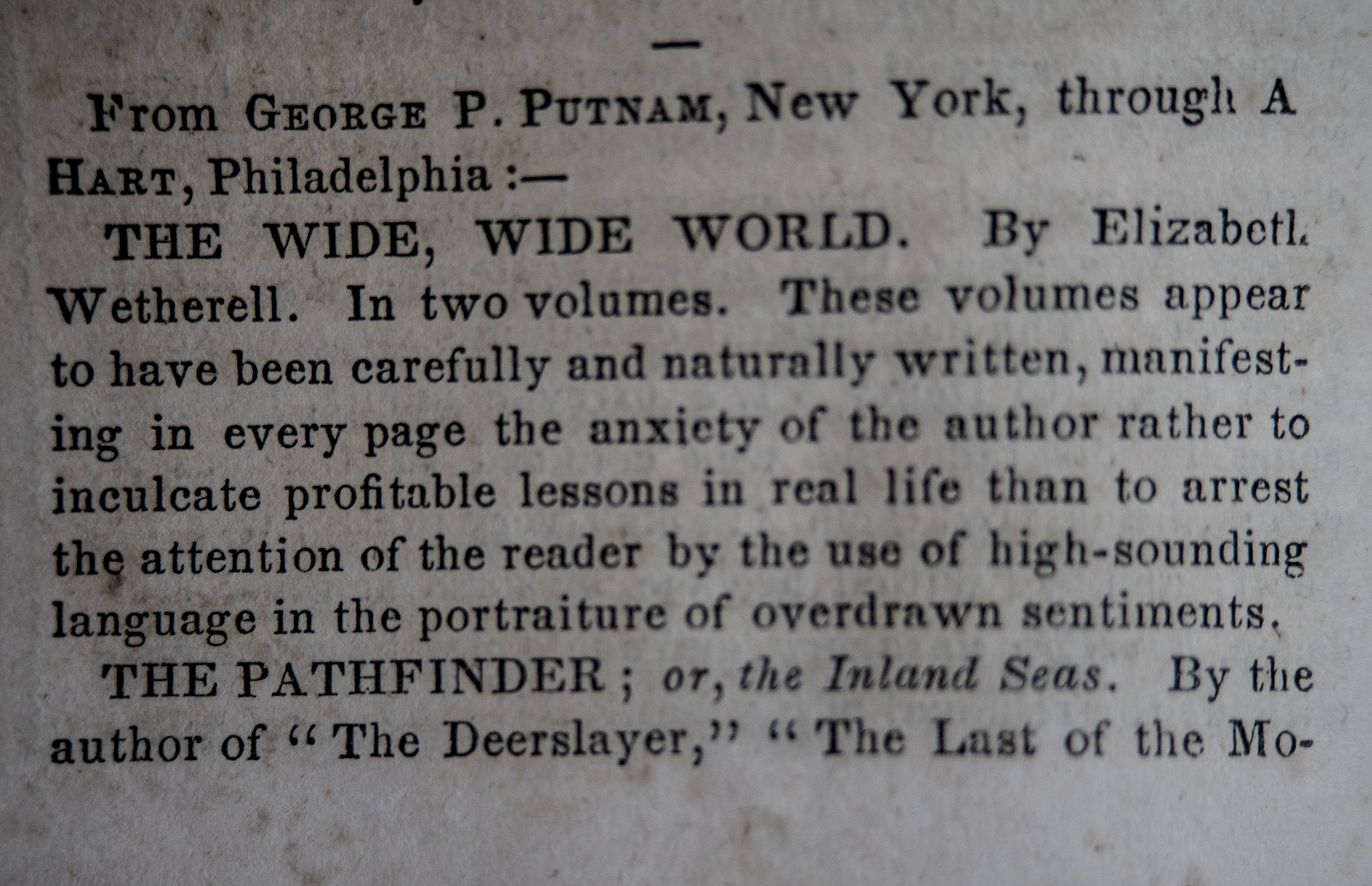
As for reading, Evelina and Oakes either subscribed to or bought directly (in Boston) various periodicals and newspapers.  One of her favorites was Godey’s Ladys Magazine, a popular women’s monthly published in Philadelphia. If Evelina looked through the March issue today, in the section entitled “Editors Book Table,” she may have read notices for two books just published by George Putnam in New York. The first was The Wide, Wide World by Elizabeth Wetherell (pen name for Susan Warner), a Christian-themed novel that would be a big bestseller and a mainstay of 19th century fiction for decades. The short review described the book as “carefully and naturally written, manifesting in every page the anxiety of the author […] to inculcate profitable lessons in real life.” Both Evelina and her daughter would read it.

James Fenimore Cooper’s The Pathfinder was next in the list of new books and promised more adventure than The Wide, Wide World. Evelina never mentioned reading any of Cooper’s books but perhaps her sons, who also loved to read, enjoyed the Leather Stocking Tales.

March 15, 1851

Rein

1851

March 15th Saturday  This morning Orinthia & myself gave the sitting

room &c a thourough cleaning & afterwards sat down to 

sewing.  Mended a number of articles  Orinthia put some

new sleeves into an old shirt of Franks that were small

This afternoon Orinthia Susan & I went down to Mothers with Charley,

called at Mr Guilds & Howards to see about her school and at Major Sebas & Mrs R

Howards.  Mr Ames brought from Boston Velvet chalk.  Pleasant

Charley was a horse, one of several that the Ames family owned.  Today Charley was put to work pulling Evelina, her daughter Susan and the new teacher, Orinthia Foss, in a carriage along the rough road from North Easton to the Gilmore farm near the Raynham town line. This, after Evelina’s mentioning only the day before the “bad traveling” on the local roads. They must have had a bumpy ride.  The weather was nice, though, so on they went.

Coming back from the Gilmore farm, they made several calls, the first two at Mr. Guild’s and at Elijah and Nancy Howard’s on school matters.  Evelina continued to act with or for Orinthia Foss “about her school.”  The ladies were on a roll with their visiting and stopped in at Seba and Eleuthera Howard’s farm.  Their last stop was a visit to Mrs. Roland Howard, a widow who was also a member of the Sewing Circle.

Evelina, Orinthia and Susan weren’t the only travelers out this day.  Oakes Ames made his usual Saturday trip into Boston on shovel business and brought back some “Velvet chalk” for dressmaking.

March 14, 1851

Hose

March 14 Friday  Quite early this morning sat down to 

mending the stockings.  Jane had mended them for two

or three weeks & they were very much out of order.  At

ten Oclock comenced working on the new pattern shirt

& finished it before eight the bosom was ready to put in.

made the button holes & helped Orinthia finish a

a coarse shirt of Oakes Angier.  Very pleasant

but bad traveling

Jane McHanna, the Irish servant who did the laundry and cooking for Evelina and Oakes Ames, was not much of a seamstress.  She had recently been assigned the task of mending everyone’s stockings, or hose as they were also known, but evidently, Jane’s mending did not pass muster. Evelina had to see to the work herself.  This explains why we’ve never heard of Jane sewing any of the shirts that Evelina had been working on for weeks.

Orinthia Foss was around to rely on, however.  When not teaching her little classroom, she seemed to help Evelina in various ways, sewing and choring.  Evelina must have been grateful not just for the assistance, but also for the company of another adult female in a home usually filled with the sounds and sights of four grown men and one little schoolgirl.

“Bad traveling” meant that the roads were in transition from winter to spring.  Roads weren’t paved, of course, so by this time of the year they were rutted, rough and still patchy with snow or wet with puddles. Sleighs no longer worked, so wagons, carriages and carts had to bump and rock along the byways.  Hard to say who had tougher going, the animals pulling or the passengers riding.

March 11, 1851

photo*

/51

March 11  Tuesday.  Orinthia & myself each finished a coarse shirt

this morning before school  I then went to mending

shirts and worked on them all the forenoon & untill

about two Oclock & went to cutting out shirts.  Cut three

coarse ones for Oakes Angier & one fine one from the pattern

I had of Sister Sally.  Cut out some stories for my scrap

book.  This evening commenced the sleeves of a shirt.

Augustus dined at Mr Peckhams  Pleasant but windy

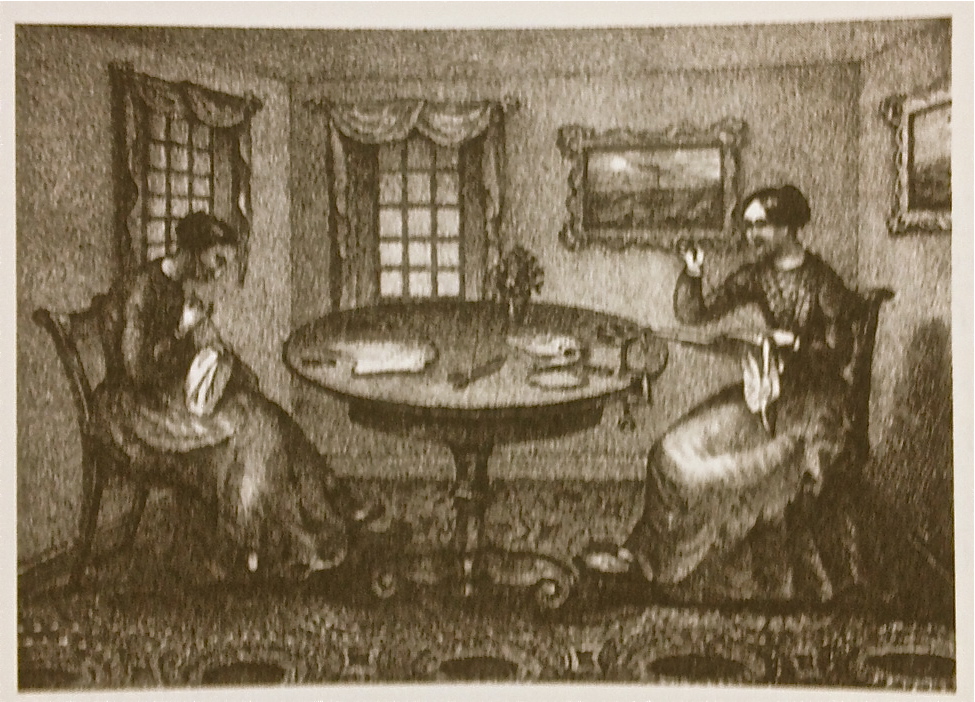
The ladies continued sewing on shirts.  Evelina sewed for so long that her eyes must have hurt by the end of the day, yet she was still working with her needle when the lamps were lit. She mended many shirts, finished sewing one and cut out four more. Orinthia Foss, the young schoolteacher who was boarding with the Ameses, helped her.

Of the four shirt patterns Evelina cut, one was a new design from “Sister Sally,” most likely the wife of Horatio Ames. Horatio was the second son of Old Oliver and brother to Oakes, Oliver Jr., William, and Sarah Witherell. The black sheep of the family, he lived in Connecticut where, like his brother William, he ran an ironworks operation.  He and his wife Sally had begun their married life in North Easton; his father had built them a home there and their first child, another girl named Susan, was born only a few months after Oakes Angier.  As the two earliest grandchildren of Old Oliver and Susanna, the two cousins had certainly played together.

Evelina did take one break from sewing.  She cut out some items for her scrapbook, which up to now had been filled mostly with “receipts” or recipes.  That, or Evelina was creating two scrapbooks, one for keepsakes and favorite readings, the other filled with recipes for the kitchen.

*Illustration “Ladies Sewing Birds,” advertising broadside of C. E. Stearns, Middletown, Connecticut, 1851. Connecticut Historical Society, Hartford

March 10, 1851

images-2

/51

March 10  Monday  This is town meeting day.  Mr Ames & O Angier went

They spent the whole day there but accomplished very little

Mr Pratt & Brown chosen School committee O Angier was

nominated for one & lacked by one vote of being chosen

They brought home the school report of the last year

which is not very favourable for the schools in town generaly

Miss Foss & Clarks school are spoken very well of.

It commenced snowing about ten Oclock & is quite stormy this evening

Town Meeting was – still is – a great New England tradition. In the 19th century (and well into the 20th) the meetings were often scheduled in March, making them an annual marker of winter’s impending departure.

People turned out for town meeting.  Rather, men turned out for town meeting.  Women, who before 1780 in Massachusetts had enjoyed suffrage, no longer could vote.  National suffrage for women, a cause that would create deep divisions among the Ames women of a later day, would not be achieved until 1920.

Oakes Ames and his eldest son, Oakes Angier Ames, attended meeting and stayed all day. Oakes Angier evidently ran for school board but just missed being elected. He was showing a taste for politics, something that his father felt as well. His mother, perhaps influenced by her son’s loss, harrumphed that “very little” was accomplished at this year’s meeting, although she seemed pleased that their boarder, Orinthia Foss, was mentioned as being a good teacher.

Today’s town meeting was moderated by one of Easton’s greybeards, Capt. Tisdale Harlow. A resident of the Poquanticut section of town, Harlow was a former selectman, town treasurer, school board member, veteran of the War of 1812, and captain of the Easton Light Infantry in 1833-34. He had crossed swords with the Ames family in the 1830’s in a town row about the introduction of Unitarianism into the Congregational church. Harlow and many others were against it; Old Oliver, his sons and others were for it.  The sectarian controversy wore on for about eight years and ultimately led to a permanent split in the congregation. Historian William Chaffin suggested that “[i]ts unhappy effects were felt for many years.”  Were there remnants of hard feelings on display at today’s town meeting?

March 7, 1851

photo

1851

March 7th  Have been giving my rooms a thorough sweeping

& dusting which took me all the forenoon

This afternoon worked on an old shirt of Franks

Am putting new wristbands & bosom into it.

This evening Oliver, Frank & Orinthia have gone to

Alsons to a party.  Orinthia would not go to the dancing

school last night on account of something Frank said & had to be urged

to go to Alsons to night  Augustus not here   Pleasant

Some entertainment today for the young people: a party at Alson and Henrietta Gilmore’s house out in the country.  What was the occasion?  Was it a casual get-together, a spur-of-the-moment gathering, perhaps extending from the assembly of the night before?  Had Lavinia Gilmore or her brother Francis asked for the party, or had it been planned by their parents?  Were they hoping to promote their daughter’s eligibility for marriage?  Was there method to the gathering, or was it just for fun?

Orinthia Foss, the young schoolteacher boarding with the Ameses, was included in the festivities, although she apparently went with some reluctance.  It seems that Frank Morton Ames had teased her in some fashion, hurting her feelings or insulting her the day before. Frank could be a handful, according to William Chaffin, who wrote that Frank “needed more discipline than Oakes [Angier] or Oliver [3].”   Frank was a seventeen year old youth, after all, with more energy than wisdom, probably competing with his older brothers for respect and attention, and letting his mouth do his thinking.

Another younger sibling came to North Easton today.  William Leonard Ames, fourth son of Old Oliver, “came this morning from New Jersey,” according to Old Oliver’s daily record.  In New Jersey, William Leonard ran an ironworks operation, a related family business that had recently failed. According to extensive research by industrial scholar Greg Galer, William Leonard and his eldest brother, Oakes Ames, were at odds over the handling of the demise of the business.  Oakes had “engineered the bankruptcies of these operations for his financial gain,”* while William had barely managed to walk away.  As a result, the two brothers were not on good terms.  Evelina doesn’t mention William’s arrival.  She sticks to her sewing, new wristbands for Frank.

* Greg Galer, Forging Ahead, p. 6.

March 6, 1851

Thread

March 6th  Thursday.  This morning Orinthia cleaned the sitting room

and I sat down to work quite Early on Mr Ames shirt

and finished it about ten Oclock  I then went to

mending some old shirts & colars &c  Sarah Witherell

brought me the fourth bosom that she has stiched for

me.  Jane went to Mrs Willis to get her dress  Miss Foss

and myself called to see Mr Guild about the school & on

Ellen Howard  A[u]gustus here to dine  Morning pleasant  storm at night

More men’s shirts.  If we’re getting tired of reading about them, imagine how tired Evelina must have been sewing them – and she had many more to go. She evidently had a method to her sewing, in that she worked on the same kind of clothing in succession until she had finished.  She didn’t make just one shirt for her boys or husband, she made several in a row.  She didn’t just make one apron for her daughter, she made three or four in a row.  Perhaps the cutting of the fabric and the arrangement of the pattern components were made easier when addressed as multiples.  The economy of cloth-cutting trumped the tedium of repetition.

Leaving the shirt bosoms and collars behind, Evelina went out with Orinthia Foss in the afternoon.  They paid a call on a Mr. Guild on a school-related matter, showing that Evelina continued to be involved with some aspect of the private school.  It was unusual for a married woman to be so active in this way.

Their second call was on Ellen Howard, daughter of Nancy (Johnson) Howard and Elijah Howard.  Mr. Howard was a sometime business partner of the Ames men and a prominent citizen of Easton.  Mrs. Howard was his third wife, he having buried his first two.  He had twelve children, of whom seven were with Nancy; Ellen was in the latter group.  In 1851, Ellen was seventeen, the same age as Frank Morton Ames, and she often socialized with the Ames sons.  In introducing Orinthia to Ellen, Evelina was perhaps hoping the two young women might become friends.  In the future, Orinthia would board with the Howards.  In Ellen’s future, in 1860, she would marry George Withington, a young minister who came to town to replace the departed William Whitwell.

The fine weather that allowed Evelina and Orinthia to travel around town disappeared by evening and ushered in a storm.  Such variability was to be expected this time of year.  It was March, after all.

March 5, 1851

Village

1851 March 5th  Wednesday  Early in the morning worked about

house.  About nine Oclock called at Mr Holmes 

to see Mrs Wright and to enquire for Miss Eaton

She is comfortable but failing  Went into school

and staid until dinner time  like the appearance 

of the school very much & think Orinthia a good

teacher, calculated to gain the good will of the Scholars

This afternoon working on a shirt for Mr Ames.   A[u]gustus here

Abby spent the evening here  Very pleasant

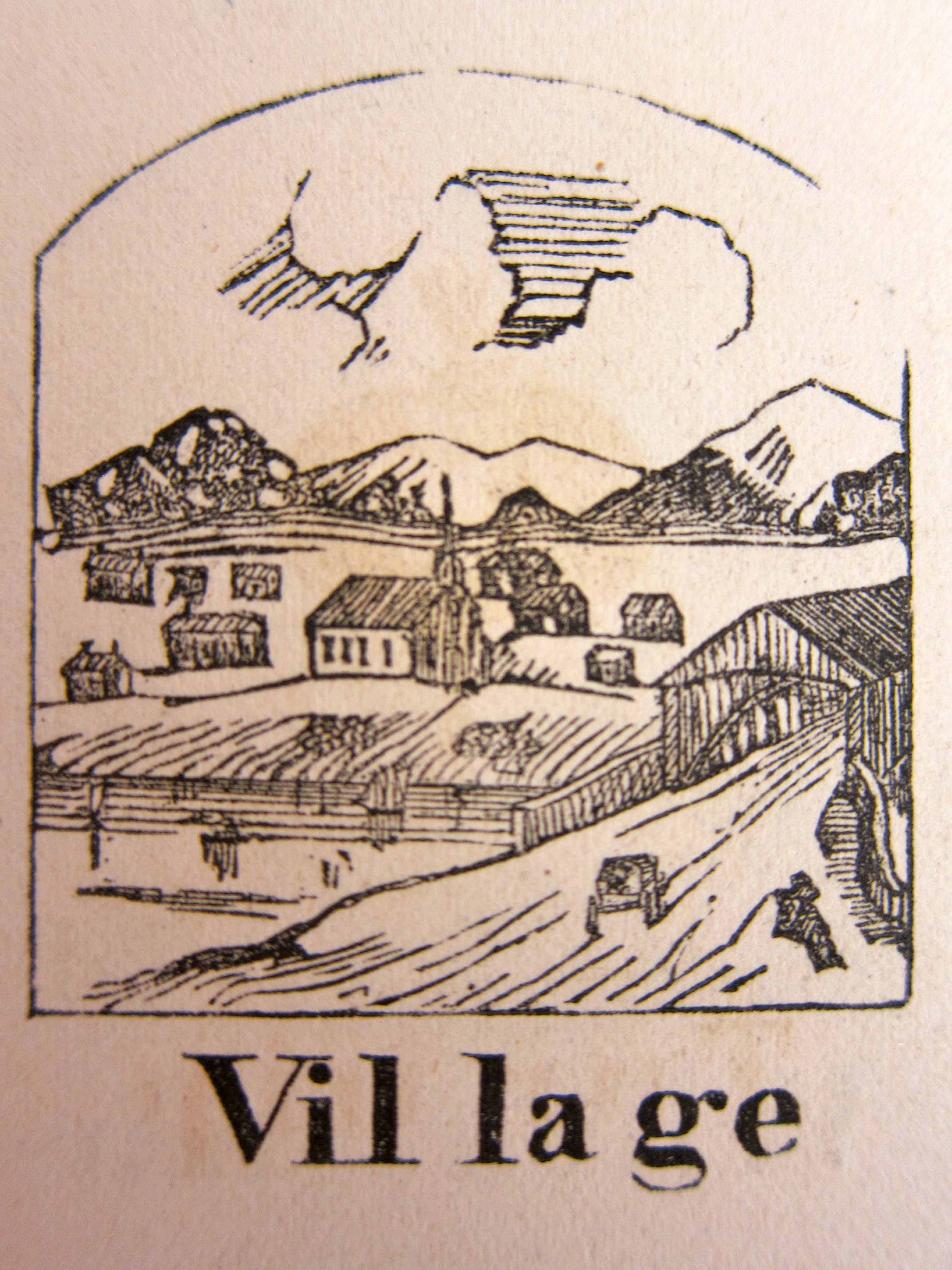
A “very pleasant” day pulled Evelina out of doors this morning at a time when she ordinarily would be choring or sewing. Fresh air and sunshine were too welcome to resist.  She walked the short distance to the village and called at the Holmes’s to ask after the two invalid women there, Mrs. Wright and Miss Eaton.

This is the last point in the diary when Mrs. Wright is mentioned, which begs the question of whether or not she survived her bout with pleurisy.  Probably not, even though Evelina didn’t mention her demise or her funeral.  Based on Evelina’s continued, if periodic, interaction with the Holmes household without ever again mentioning the presence of Mrs. Wright, it makes sense that the latter passed away about this time.  Additionally, an 1855 census confirms her absence.

Interesting to note that Evelina wrote of calling at “Mr. Holmes”, even though she clearly went by to see the women of the house.  The patriarchal culture – and laws – of the day saw men, and men alone, as heads of any household.  A house belonged to a husband, not to a wife.  Unless Mrs. Holmes were widowed, the proper reference to her abode would acknowledge her husband’s tenancy, not hers.  This was a dictate that Evelina almost always practiced; even when she went next door to see her sister-in-law, Sarah Lothrop Ames, she wrote that she had gone to Oliver’s.  It was his house, not Sarah’s.

The little schoolhouse where Orinthia Foss taught was also in the village, and it was here that Evelina spent the rest of the morning, watching the young teacher and approving of her way with the children. Meanwhile, back at the house, Jane McHanna was preparing the midday dinner, for which all family members returned at noon.  Evelina stayed home after her morning out, and took up the inevitable sewing.  Her niece Abby Torrey visited, and may have helped with some of the stitching.