April 6, 1851


800px-Martin_W._Carr_School_-_Somerville,_MA_-_DSC03412

*

1851

April 6 Sunday.  Have been to meeting all day, and 

as usual heard two excellent sermons from

Mr Whitwell.  It rained very hard while

we were going and has rained fast all day.

Edwin called after meeting & Martin Carr &

a Mr Davenport from Attleborough.  Oakes & Oliver

called at Mr Bisbees with them

The Ames family went to both church services today and, as Evelina had come to expect, heard “two excellent sermons” from Rev. Whitwell. Despite the rain, the Ameses had visitors this afternoon. Friends of Oakes Angier and Oliver (3) called: cousin Edwin Williams Gilmore, and friend Martin Carr, who brought a Mr. Davenport with him. The young men all went out together.

Martin W. Carr was the son of “Uncle Caleb” Carr, a long-time employee of the shovel shop, and brother of Lewis Carr, the young man who died back in January from consumption. The family was descended from Robert Carr, an early governor of Rhode Island.

Martin would find his own claim to fame.  A jeweler by profession, he went on to found M. W. Carr and Company, maker of knick-knacks and souvenirs, including “gold and silver jewelry, hairpins, belt and shoe buckles, button hooks and garter belts […] matchbooks, cigarette cases, ashtrays, hatpin holders, letter openers, souvenir spoons, ink stands, magnifying glasses, lamp shades, bud vases, napkin rings and trays with imprints of the homes of American authors such as Emerson, Longfellow and Hawthorne.”**  The factory was a mainstay of Davis Square in the City of Somerville, and Carr himself a prominent citizen involved in many civic activities.  The city honored him in 1898 by naming an elementary school after him. The Easton boy made good.

* Martin W. Carr School, 1898, Somerville, Massachusetts, National Register of Historic Places, now condos.

**Somerville Journal, 1894/Coldwell Banker

March 27, 1851

0380042t

1851

March 27 Thursday.  Spent the day with Mother at A[u]gustus,

got home just before six Oclock and went

in the evening to the dancing school with Mrs S. Ames

Cut out and commenced a bleached shirt for

Mr Ames but have not done so much as to finish 

the sleeves.  Mrs. S. Ames has been to Boston from 

Sharon.  A fine day and very good travelling

the roads are quite dry.  Mother stopt at Mr Torreys.

After Evelina and her mother spent the day with, respectively, nephew and grandson Augustus, Hannah Gilmore left to spend the night at her son-in-law, John Torrey’s, house in the village, leaving Evelina briefly unencumbered from looking after the elderly woman. Evelina seized the opportunity to go out with her sister-in-law, Sarah Ames, to help chaperone a dance for the young people.

No doubt the Ames sons, Oakes Angier, Oliver (3) and Frank Morton were at the dancing school, as they had been for most of the previous Thursday evening assemblies. So, probably, was Fred Ames, making a rare appearance while home from school.  While adults from their parents’ generation were always present at these occasions, one wonders how the young men felt having their mothers among the group standing guard.

These assemblies were important social occasions that provided innocent pleasure and animation. They fostered acquaintances among the young people of the town who had few other opportunities to mingle.  Dance steps were learned, exercise was taken, manners were polished, courtships were sparked, hearts were engaged or disappointed, and perpetuation of the species forwarded in this important small town gathering. Surely both Evelina and Sarah Ames watched the proceedings with interest.

March 24, 1851

canton-ma-landscaping

/51

March 24 Monday  It was so unpleasant this morning

that Jane could not put her clothes out but

about noon it cleared up and she has got

them all dry  I have cut out a shirt for Oliver 

of fine unbleached cloth and have sewed

some of it & mended Mr Ames coat & vest

He went to Canton this afternoon.  Mr Whitwell

called.  Mrs Witherell passed an [illegible] this evening

Perhaps wearing one of his new shirts, or at least wearing a mended one, Oakes Ames traveled to neighboring Canton today.  Named for Canton, China, because some imaginative citizen believed the Chinese city to be its geographical twin on the opposite side of the world, the Massachusetts city had manufacturing interests much like Easton. Since before the American Revolution, the Kinsley family had operated an ironworks there. Like the shovel works, the Kinsley business had started small and grown well. Initially, it produced farm implements and was entirely family-run. It had a forge, a large rolling mill and the capability of producing steel.

In 1851, Lyman Kinsley was its sole operator; by 1858, the company would be owned by the Ameses. Oliver Ames Jr. would become its first Ames president, with others to follow (Frederick Lothrop Ames would be next, and after him, his son Oliver.) Frank Morton Ames would be its General Manager. Perhaps Oakes’s visit to Canton today, although certainly having something to do with getting steel for shovels, was also quietly prompted by some foreknowledge that the Ameses were interested in acquiring this complementary business.

Once the Ames owned it, the Kinsley Iron and Machine Company would eventually develop to produce wheels and axles for railroad cars, another product that would fit nicely with Ames business interests.

March 20, 1851

photo

Shirt bosoms

/51

March 20 This morning at 1/2 past seven commenced 

a fine bleach shirt for one of my sons

and finished it about ten Oclock this evening

Made the whole but stiching the bosom

Mrs Witherell brought the 8th bosom that

she has stiched for me this forenoon and 

sat with me two hours  William left this 

morning.  Clothes dried and ironed.  Cloudy & snowy

A[u]gustus here to dine

Today Old Oliver wrote in his daily journal:

“it is a snowing moderately this morning  William left here this morni[n]g for New Jersey.  It did not snow long but it was cloudy all day wind north west but it thawed some.”

William went back to the family-financed foundry in New Jersey for a final time before making the momentous change of striking west.  He wanted to put distance between himself and the shovel operations in Easton.  With his older brothers Oakes and Oliver Jr. managing the family business, his only chance at success was to find his own niche somewhere beyond their reach. At age 38, he was about to begin a very different life.

As William rode off, Evelina, naturally, was wielding needle and thread.  After so many days of sewing shirts, she was adept enough to sew one entirely in a single day, beginning just after breakfast and finishing up right before bed.  Having her kind sister-in-law Sarah Witherell to sew with for part of the day was a pleasant diversion.  That Sarah contributed so many “bosoms” (detachable shirt fronts also known as dickies, false-fronts, and, in the 20th century, tux fronts) suggests that some of the shirts might have been destined for the men in her care, her father Old Oliver and her son, George Oliver Witherell.

March 17, 1851

images-1

*

March 17  Monday  A very cloudy windy morning  Jane could

not put her clothes out.  Orinthia washed the dishes

& I made the beds &c. Commenced working on a

fine unbleached shirt that was cut out

last Nov & partly finished.  It is all done but

[…] putting in the sleeves & making Collar and 

binding  Cut out some receipts for my scrap 

book from the Ploughman  A[u]gustus here to dine

The Massachusetts Ploughman was an agricultural newspaper published in Boston that provided reading material for a number of Ameses.  It was probably subscribed to by Old Oliver, who maintained an interest in farming that he couldn’t seem to pass on to any of his children. Although the Ames shovel business had helped turn once-rural North Easton into a productive, if small, industrial village, agriculture still ruled the show as the “largest single sector of the economy even in the highly commercial states of Massachusetts and Connecticut.”** Most people still farmed, raised livestock, worried about bringing in the hay, and looked for guidance from experts such as those behind the Ploughman masthead.  Evelina turned to the paper for recipes.

It may have been St. Patrick’s Day, but no celebrating would have gone on in the Ames compound.  At the factory, however, things might have been different. Thirteen years from this date, in the middle of the Civil War and less than a year after Old Oliver’s death, Oliver Jr. would note in his diary that on “St Patricks day did not run Engines in Shop.”  Was that also true in 1851, or did Old Oliver’s animosity toward the Irish preclude such an indulgence?

* A late-19th century copy of the Massachusetts Ploughman after it merged with the New England Journal of Agriculture.

** Jack Larkin, The Reshaping of Everyday Life, 1790-1840, 

March 13, 1851

mens_fashion_1856

1851  March 13  Thursday  This forenoon worked on an old pair of 

pants for Oliver  They needed a great deal of 

repairing and I worked on them untill two Oclock

This afternoon & evening spent at Alsons with Oliver 

& wife, Wm Reed & wife, Mrs Whitwell, A[u]gustus & J. Pool

& wife passed a very pleasant afternoon.  I knit on

Susans Angola yarn stocking.  It has stormed

quite hard all the afternoon, got there about five Oclock

Did the Ames men dress like the gentlemen in this 1850’s illustration?  Oakes Ames, as we know from stories his appalled friends told, did not dress so well. But his sons might have aspired to be fashionable. Certainly Oliver (3), whose old pants Evelina mended today, might have wished for such an outfit, one that befitted a man with his eye on college.

It’s doubtful that the pants Evelina sewed today came out looking like those in the fashion plate.  As accomplished a seamstress as she was, the men’s pants she was most familiar with were working pants, the ones her sons wore to the shovel shop everyday. It took her several hours to repair this pair. Then, not willing to let her hands be idle, she carried a knitting project to her brother Alson’s, perhaps traveling there with her brother-in-law, Oliver Jr. and his wife Sarah Lothrop Ames. The Gilmores were having a little gathering.

Alson and Henrietta Gilmore seemed to be socializing a great deal this month.  Last week they held a dance that the Ames sons attended, this week they had friends in for tea, and sometime before that they had sent their nineteen-year-old daughter, Lavinia, into town to stay with the Ames family for a week. What was going on? Did this increased social activity stem from cabin fever or was it mere coincidence? Were the Gilmores working to find a husband for Lavinia?

The Angola yarn that Evelina knitted into a stocking for little Susie is something of a mystery ingredient. Does any reader know about this yarn?

March 8, 1851

Grace Aguilar (1816 - 1847)

Grace Aguilar
(1816 – 1847)

/51

March 8th Sat.  This has been a very stormy day,  Windy & snowy.

Orinthia did not keep school and we have had

a nice quiet time.  I have finished putting the 

bosom & wristbands into Franks shirt and worked

some on a coarse shirt.  Orinthia finished a 

coarse shirt that she has been making & commenced 

another for one of the boys.  I have finished reading

Womans Friendship & like it pretty well.

Woman’s Friendship was a domestic novel by English author Grace Aguilar.  In her short life,  Aguilar wrote not only novels, but also poetry, histories, and  religious treatises that explored her Jewish heritage.  Among the latter, she translated “The Spirit of Judaism” from the French, and wrote her own extensive exploration of the scriptures, “The Jewish Faith: Its Spiritual Consolation, Moral Guidance and Immortal Hope.”  She was prolific and extremely bright.

Her domestic novels – the kind of writing that Old Oliver called “love trash” – were her most successful publications. Such novels were a literary genre, not unlike today’s “chick lit,” that was written for, and often by, women.  The novels usually had storylines that featured the travails of young heroines.  Woman’s Friendship, published posthumously, was the tale of one such young woman who suffers many misfortunes and reversals but manages to save her family after her father’s early death and her brother’s losing fight with consumption, all the while retaining the lifelong friendship of a countess. Putting the improbabilities of its plot aside, Evelina liked it. As she sewed today with Orinthia Foss, Evelina may even have had the story from the book in her head.  She certainly liked the book well enough to eventually commence another novel by Miss Aguilar.

It was Saturday, the day that Oakes Ames usually went into Boston.  Did he go today, or did the weather make traveling too difficult?   Were they all getting tired of winter?

February 24, 1851

School

Feb 24th Monday.  This morning Orinthia commenced a

private school at the school house had twenty

scholars.  Was choring about house all the forenoon

This afternoon made over a valance for

Franks bed and did some mending.

Martin Guild was burried at two Oclock.  None

of us attended the funeral  Helen & Sarah Ames

called a few moments this evening.  Heavy rain.

Looks like little Susie was back in school today, this time under the tutelage of Orinthia Foss, the new teacher.  Not only would Susie see Miss Foss in the school room every day, but also at home for breakfast, dinner, and tea. During her tenure in Easton, Orinthia would take turns boarding with different families in town beginning with the Oakes Ameses. The exact location of the schoolhouse where she taught is undetermined, but it may have been located right in the heart of the village, at the Rockery.*

As usual, Evelina spent this busy Monday doing housework, or “choring,” as she called it, in the morning, or “forenoon,” while Jane McHanna labored with the weekly washing. What do you suppose was served for midday dinner on Mondays, when the women of the house were preoccupied with everything except cooking?  Perhaps the family ate one of those mincemeat pies that had been prepared days in advance and kept very cold somewhere. Yankee housewives were known to keep some baked goods frozen for months, either by placing them on shelves in an ice house, or simply by storing them in unheated spaces not far from the kitchen. A risky practice, one might think, especially with the varied temperatures and rainy weather that has characterized this particular February.

Also as usual, Evelina turned in the afternoon to her mending and sewing. She refurbished a valance for Frank Morton’s bed.  Although his brothers Oakes Angier and Oliver (3) shared a bedroom, Frank had a space, if not a room, to himself.  A valance was an essential component of his bedstead, naturally offering some warmth and privacy that might otherwise be lacking.

* Information from Frank Mennino, Curator of the Easton Historical Society.  Thank you, Frank.

February 22, 1851

Rubbers

Feb 22nd  Saturday  This morning sat down to sewing

quite early to work on Susans apron.  Mr Torrey called 

to see about Augustus having his tenement.  Augustus

has engaged Mr Wrightmans house for the present.

Lavinia & myself passed this afternoon at Mr Torreys.

Called at the store, met Mrs. Peckham & Miss

Georgianna Wheaton there  Miss Foss came to night.  Mr

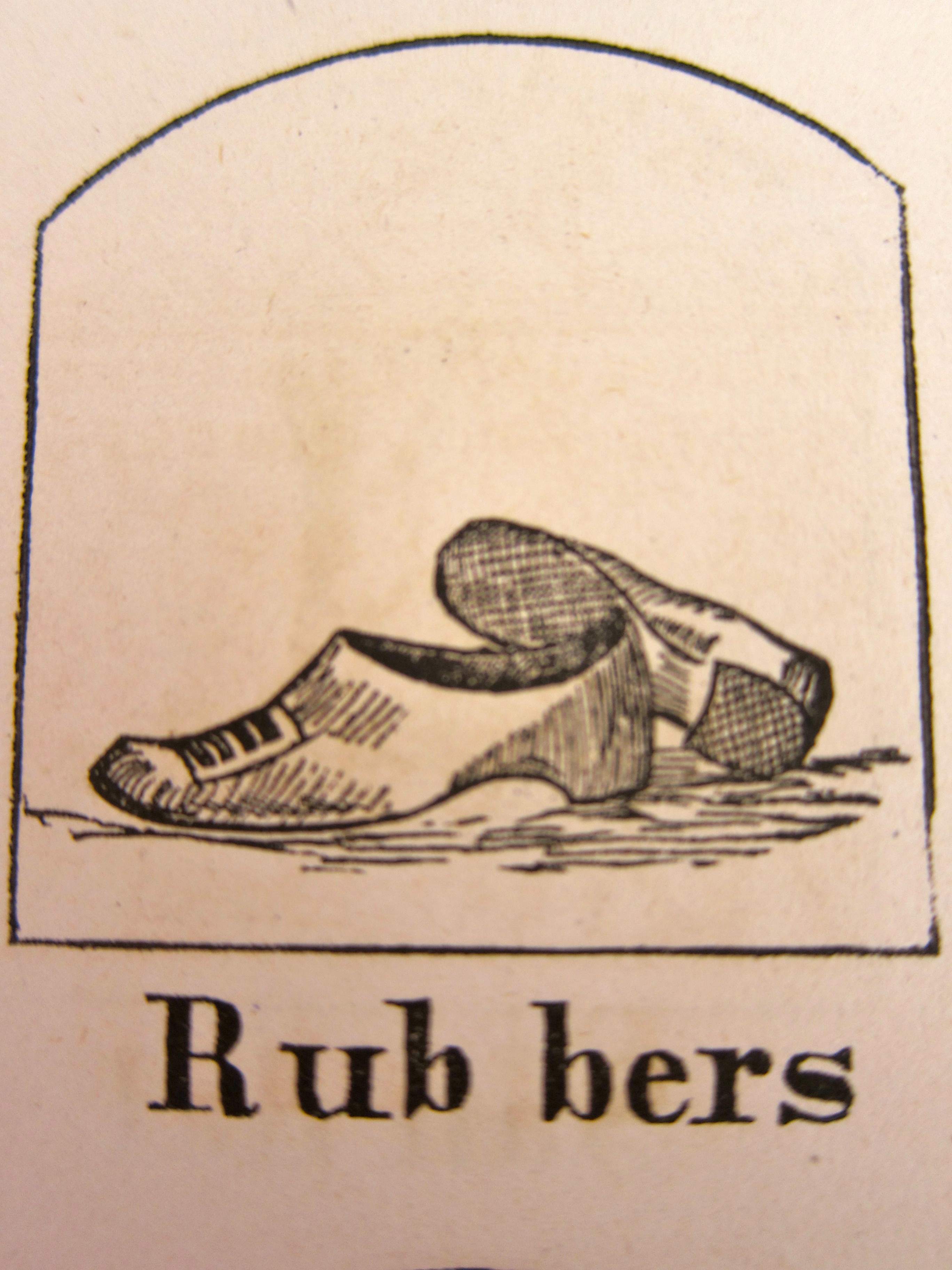
Ames has been to Boston brought Susan Rubbers.

Cleared off pleasant to night

In his journal today, Old Oliver noted that “It’s pretty muddy now,” which explains why Oakes Ames returned from Boston with overshoes, known as rubbers, for his daughter.  Probably everyone in the household donned rubbers during this late winter wetness.

Evelina negotiated the streets just fine, it seems, as she and her niece traveled the short distance to the center of town to call at the company store and at her brother-in-law’s house.  Their mutual nephew, Augustus Gilmore, had decided not to rent from Col. Torrey and would be settling his family instead at a Mr. Wrightman’s house.  And at the end of the day, a new person entered the domestic scene.  Miss Orinthia Foss, the new schoolteacher, arrived from Maine.

February 22 is a date that people acknowledged in 1851 in a manner similar to the way people do in 2014, because it’s George Washington’s birthday.  In this year of Evelina’s diary, President Washington had only been dead for a little over fifty years.  People were alive who could still remember him; Old Oliver was one of them.  Old Oliver was born in 1779, while the Revolutionary War was being fought.  He was two years old when the British surrendered at Yorktown, and eight years old when representatives of the new states assembled in Philadelphia to write a constitution.  George Washington was elected to head that convention and became the country’s first president in 1789, when Old Oliver turned ten.  When Washington died in 1799, beloved and mourned, Old Oliver was a twenty-year old bachelor just making his way in the world.  Much about that world would change over Old Oliver’s lifetime, but the reverence that citizens of the United States felt for their first leader would hold strong.

February 21, 1851

Bed

1851  Feb 21  Friday  It stormed so hard & so dark that Mr & Mrs

Whitwell spent last night with us & returned

home about 8 Oclock this morning  Lavinia &

myself have been sitting quietly sewing.

Susan is all engaged making Labels for the shop

has cut quite steady all day.  Helen brought her work in, and staid two

or three hours but I could not prevail on her to stop to tea

Bridget has hired a bed & bedstead

The family business, O Ames and Sons (as it had been known since 1844 when Old Oliver handed over two-thirds of the reins to his sons Oakes and Oliver Jr.) was just that: a family business.  The Ames men all had rolls to play in its operation, from manufacturing to sales to management.  On this day in 1851, it appears that an Ames female had a roll to play, too.  Little eight-year old Susie Ames spent the day making labels for the shop.  Presumably, this meant she was cutting out printed labels to be affixed to individual shovels.  Did she sit at a table in the kitchen or the dining room, paper and scissors in hand?  Was she paid for this effort, or was this just a rainy day game for her?  Who thought this up?

While Susie wielded scissors, the women wielded needles, of course.  Evelina and her niece, Lavinia Gilmore, kept each other company as they sewed and were joined for a few hours by Helen Ames from next door.  Although Lavinia, aged 19, lived in the country and Helen, aged 14, lived in town, the two young women, distantly related by marriage, were friends.

Lavinia was in town visiting her aunt Evelina.  Last night, Mr. and Mrs. Whitwell stayed over, unable to return home because of bad weather.  A new servant, Bridget, had just ordered a bed and bedstead for herself. In a two-family house already filled with ten people, not including servants, where did everybody sleep? People surely doubled up; Oakes Angier and Oliver (3), for instance, shared a bedroom and probably a bed. Although this practice, too, was disappearing, many houses of the period still kept beds in their parlors; apparently the Ames did this, so perhaps that was where the Whitwells spent the night.

The difference between a bed and a bedstead was simply that the former included only the mattress and linens (also known as bedding), while the latter was the frame on which to put the mattress.  This verbal distinction was beginning to disappear at the time, but it was still useful in an era when some people – servants, particularly – only had bedding on which to sleep.  A mattress could be rolled up and moved around, a wooden frame could not.  Bridget showed hope or confidence in her place in the household when she ordered a bedstead as well as a bed.