March 17, 1851

images-1

*

March 17  Monday  A very cloudy windy morning  Jane could

not put her clothes out.  Orinthia washed the dishes

& I made the beds &c. Commenced working on a

fine unbleached shirt that was cut out

last Nov & partly finished.  It is all done but

[…] putting in the sleeves & making Collar and 

binding  Cut out some receipts for my scrap 

book from the Ploughman  A[u]gustus here to dine

The Massachusetts Ploughman was an agricultural newspaper published in Boston that provided reading material for a number of Ameses.  It was probably subscribed to by Old Oliver, who maintained an interest in farming that he couldn’t seem to pass on to any of his children. Although the Ames shovel business had helped turn once-rural North Easton into a productive, if small, industrial village, agriculture still ruled the show as the “largest single sector of the economy even in the highly commercial states of Massachusetts and Connecticut.”** Most people still farmed, raised livestock, worried about bringing in the hay, and looked for guidance from experts such as those behind the Ploughman masthead.  Evelina turned to the paper for recipes.

It may have been St. Patrick’s Day, but no celebrating would have gone on in the Ames compound.  At the factory, however, things might have been different. Thirteen years from this date, in the middle of the Civil War and less than a year after Old Oliver’s death, Oliver Jr. would note in his diary that on “St Patricks day did not run Engines in Shop.”  Was that also true in 1851, or did Old Oliver’s animosity toward the Irish preclude such an indulgence?

* A late-19th century copy of the Massachusetts Ploughman after it merged with the New England Journal of Agriculture.

** Jack Larkin, The Reshaping of Everyday Life, 1790-1840, 

February 25, 1851

Helen Angier Ames

Helen Angier Ames

1851

Feb 25  Tuesday  This morning Helen left home for school

at Dorchester.  She felt so bad when she left

that I did not go in to see her.  Her Father & Mother

went with her and returned to night, they went into

Boston and stoped an hour or two.  Mr Jennings

& Crommet called this evening to see Orinthia

I have been to work on a bosom of shirt putting

a new one into an old shirt of Oakes Angiers.  Very windy.

A[u]gustus here

Under some duress, the teenaged Helen Ames was taken to boarding school today, clearly not wishing to go.  Her parents insisted and accompanied her to see her settled.  Their stop in the city on the way home might have been a lift of spirits for a mother and father who had just driven away from a disconsolate child.

The children of both Oakes and Oliver Jr. each went away to school for a portion of their education.  Oakes and Evelina’s boys had already gone and returned home; Susan still had her boarding school ahead of her.  Oliver Jr. and Sarah’s two children, Fred and Helen, were at this stage both away at school.  Oliver Jr. and Sarah were empty-nesters, to use a term they wouldn’t have recognized.  They might have recognized the emotion, however.  Strange to think of them in their separate house, just the two of them now, quiet, (although Sarah’s younger brother, Cyrus Lothrop, sometimes lived with them) while right next door in the old homestead lived a whole commotion of relatives.

Schooling seemed to be the theme of the day.  A Mr. Jennings and a Mr. Crommet called to see Orinthia Foss, presumably on matters of her employment as a schoolteacher. Does any reader out there know either of these names?

His wife and son still living elsewhere – Bridgewater, perhaps – while he set up their rented lodgings in North Easton, Augustus Gilmore was staying temporarily with his aunt Evelina and her family.  He would soon bring Hannah, who was expecting, and little Eddie to town.

February 21, 1851

Bed

1851  Feb 21  Friday  It stormed so hard & so dark that Mr & Mrs

Whitwell spent last night with us & returned

home about 8 Oclock this morning  Lavinia &

myself have been sitting quietly sewing.

Susan is all engaged making Labels for the shop

has cut quite steady all day.  Helen brought her work in, and staid two

or three hours but I could not prevail on her to stop to tea

Bridget has hired a bed & bedstead

The family business, O Ames and Sons (as it had been known since 1844 when Old Oliver handed over two-thirds of the reins to his sons Oakes and Oliver Jr.) was just that: a family business.  The Ames men all had rolls to play in its operation, from manufacturing to sales to management.  On this day in 1851, it appears that an Ames female had a roll to play, too.  Little eight-year old Susie Ames spent the day making labels for the shop.  Presumably, this meant she was cutting out printed labels to be affixed to individual shovels.  Did she sit at a table in the kitchen or the dining room, paper and scissors in hand?  Was she paid for this effort, or was this just a rainy day game for her?  Who thought this up?

While Susie wielded scissors, the women wielded needles, of course.  Evelina and her niece, Lavinia Gilmore, kept each other company as they sewed and were joined for a few hours by Helen Ames from next door.  Although Lavinia, aged 19, lived in the country and Helen, aged 14, lived in town, the two young women, distantly related by marriage, were friends.

Lavinia was in town visiting her aunt Evelina.  Last night, Mr. and Mrs. Whitwell stayed over, unable to return home because of bad weather.  A new servant, Bridget, had just ordered a bed and bedstead for herself. In a two-family house already filled with ten people, not including servants, where did everybody sleep? People surely doubled up; Oakes Angier and Oliver (3), for instance, shared a bedroom and probably a bed. Although this practice, too, was disappearing, many houses of the period still kept beds in their parlors; apparently the Ames did this, so perhaps that was where the Whitwells spent the night.

The difference between a bed and a bedstead was simply that the former included only the mattress and linens (also known as bedding), while the latter was the frame on which to put the mattress.  This verbal distinction was beginning to disappear at the time, but it was still useful in an era when some people – servants, particularly – only had bedding on which to sleep.  A mattress could be rolled up and moved around, a wooden frame could not.  Bridget showed hope or confidence in her place in the household when she ordered a bedstead as well as a bed.

February 12, 1851

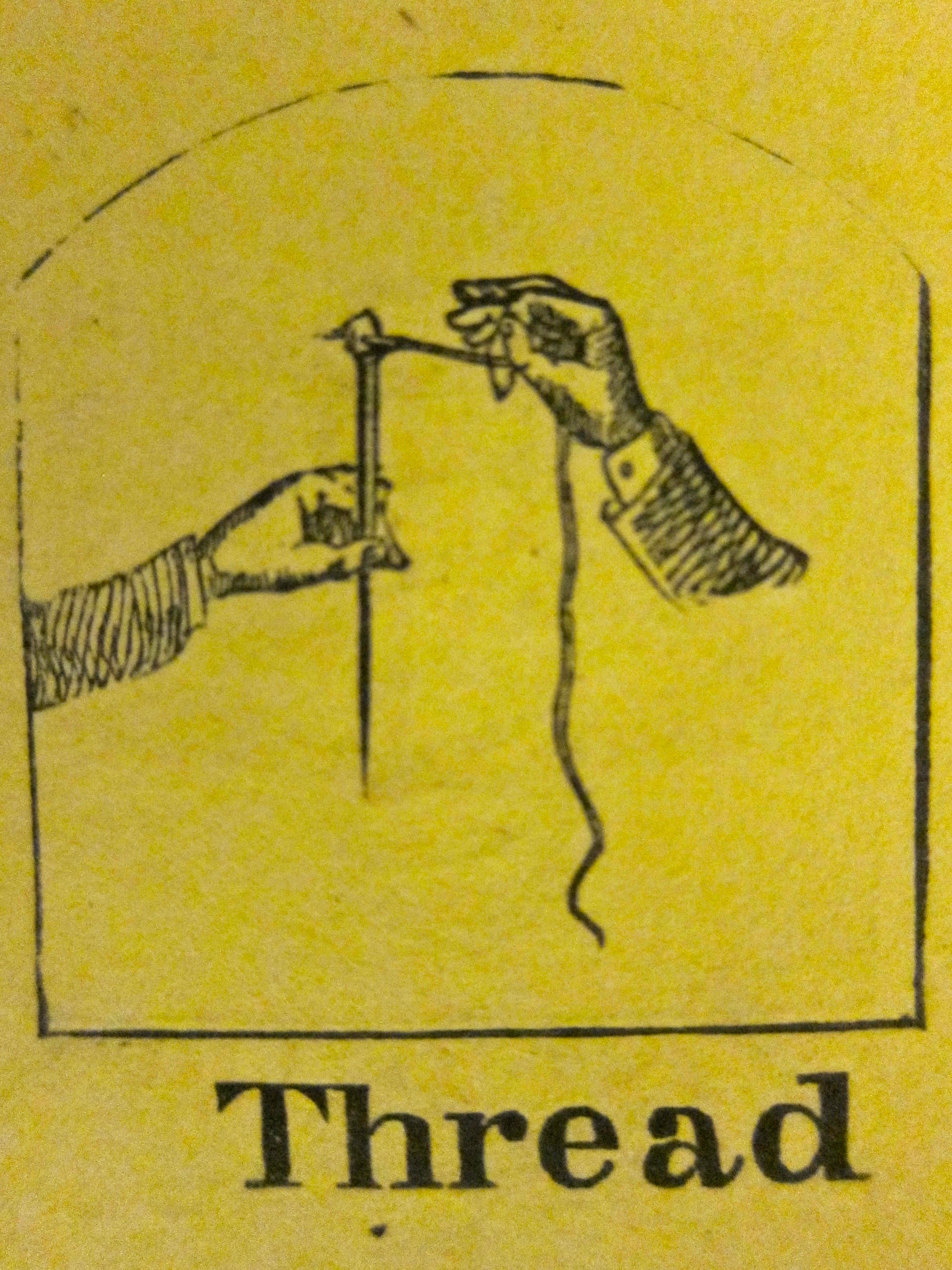
Thread

1851

Feb 12th This was the day for the sewing circle & what a crowded

house! Not one here except Mr Whitwell and our own

families  Father Ames came in to tea & Sarah W

George, Emily & Oliver & wife  Poldens boy was buried

to day  Isabell & Ann went to the funeral & took tea

with Jane after they came back.  I prepared enough

for 40 and think it is very provoking to have none

 of the members  It is a delightful day.  Letter from Miss Foss

No one came to Evelina’s party.

“Very provoking,” indeed.  Mortifying, even, that not a single member of the Sewing Circle attended today’s meeting, unless you count Reverend Whitwell.  All the preparations, the baking, the cleaning, the spools of thread from Boston, all in vain.

Evelina took the rejection with a lacing of humor: “What a crowded house!”  Although disappointed and upset, she must have been grateful for the way the Ames clan filed in to partake of the feast. From Old Oliver (who almost never came to tea) and all three Witherells to Oliver Jr and Sarah Lothrop Ames to her own children and husband, presumably, the family closed ranks around her and filled her parlor with warm bodies.  Even the Irish servant girls on their way home from a wake partook of the spread of food – in the kitchen with Jane McHanna, of course.

So what happened?  Evelina said the day was delightful but her father-in-law, a dependable chronicler of the daily weather, described “the going” that day as “rough + bad” even though the weather itself was “fair”.  After days of terrible weather that had swung from rain to ice and back again, some of the absentee members probably couldn’t drive their wagons out of their own yards.  Bad roads might account for some, if not all, of the truancy.

Nevertheless, the incident raises questions about Evelina’s popularity and social standing.  She was married to one of the most important men in town, and she and Oakes enjoyed the friendship of many.  Is it possible that some of the women in the Unitarian Circle resented her, or felt themselves superior to her?  Where were the women she had grown up with? Were they jealous of her? Did she fail socially in comparison to her sisters-in-law, each whom had a more refined upbringing? Sarah Ames and Sarah Witherell never failed to attract a lively turnout for their Sewing Circles.

All these possibilities must have swirled in her mind.  The true test would come when the Sewing Circle met again at Evelina’s, many months from this day, this awkward day that Evelina surely hoped to forget.

February 1, 1851

Ames Home and Office, North Easton, Massachusetts ca. 1852 - 1862

Ames Home and Office, North Easton, Massachusetts
ca. 1852 – 1862

Feb 1st  Saturday  Sit down to mending again this morning

Mended a pr of kid gloves and a number of other things

Went into the other part of the house with mother

to tea  worked on panteletts finished two prs.  Mrs Packard

and Mrs Rhoda Fuller called there  Mr Ames has been 

to Boston & brought home Ladys Books Grahams & Harpers

& International Magazines & 1/4 lb Angola yarn.  Have been

reading in the magazines this evening.  Cloudy & warmer

Evelina often mentions going into “the other part of the house,” which was a section of the house on the southern side in which Old Oliver, a widower, lived with his widowed daughter Sarah Witherell and her children.  This section was created when Old Oliver turned the original (ca. 1812) dwelling into a duplex in 1827 on the occasion of the marriage of Oakes and Evelina.

In 18th century New England, family custom often dictated that the eldest son inherit the family homestead and, in order to effect that, houses were sometimes renovated to allow two families to live side by side until the transfer of property came to pass.  That this practice was becoming less prevalent in the 19th century meant nothing to Old Oliver who, independent and conservative, still had his feet in the 18th century in certain ways.  His home would go to his eldest son, and he would eventually provide homes for his other children as well.

In the above photograph of the Ames House on Main Street, we can see the original home in the center, a building that is divided in two on the inside, with Old Oliver’s doorway facing toward the camera (behind the middle tree).  The entryway for Oakes and Evelina faces the street.  To the left of the house is the attached office, where Oakes and Oliver Jr and others kept track of business matters.  It was known as the Counting House.

In the background to the right is the house Old Oliver built for Oliver Jr and wife Sarah Lothrop Ames on the occasion of their marriage in 1833.  In 1863, they would tear this down and rebuild a more modern and formal abode, one that still stands today. The old homestead, which housed generations of Ameses in its time, was torn down in 1951, approximately 100 years after this photograph was taken.

January 12, 1851

Preach

/51 Jan 12 Sunday  Have been to church all day and heard two

excellent sermons from Mr Whitwell.  The afternoon text was

“Train up a child in the way he should go and when he is old

he will not depart from it”  Passed this evening at Mr Willard

Lothrop with Mr Ames & met with Minister Norris & Mr Torrey

This noon I stopped to hear Mr Whitwells class in the Sabbath

School afterwards went into Mr Daniel Reeds with Mother

Very warm + pleasant for the time of the year

The Ames family, Unitarians all, attended meeting today and stayed for both services, which encompassed a morning program, an intermission, and an afternoon program.  In their family pew, Evelina, Oakes, Oakes Angier, Oliver (3), Frank Morton and Susan sat with or near Old Oliver, Sarah Witherell and her children, George and Emily.  Also nearby, if not in the same pew, sat Oliver Jr, Sarah Lothrop Ames and their children, Fred and Helen, faces upturned to hear Reverend Whitwell deliver the day’s two sermons.  Eight-year old Susie may have squirmed in her seat; she wasn’t inclined to sit still for the second service.  And Oakes Ames was known to fall asleep, however inspiring Mr. Whitwell’s words were to Evelina.

In 1851, the Unitarians congregated at a church in Easton Centre, a few miles south of the village of North Easton (but still within the boundaries of the Town of Easton, Massachusetts.)  Like many families, the Ameses had to travel by carriage or sleigh to attend Sunday service.  The adults would have ridden, or “been carried,” as the expression went,  but the children may have had to walk the distance.  Children walking to church, regardless of distance, was common.  If this was true for the Ames family, we might imagine that cousins Oliver (3) and Fred walked together, as they were close friends.

At intermission, children went into Sunday School and the adults socialized.  Winthrop Ames, a grandson-to-be, described the scene in his family history (from 1937):

“They tethered their horses in a long, open shed and stayed through both morning and afternoon services, eating the luncheons they had brought and gossiping with the townsfolk during the intermission.”

On this winter Sunday Evelina and her mother, Hannah Lothrop Gilmore visited at the nearby home of Daniel and Mary Reed.  Socializing continued in the evening as Evelina and Oakes called on Willard Lothrop.

January 7, 1851

 Sleighing

/51 Tuesday Jan 7th Jane better and finished her washing and I did the

housework this morning.  Mr Ames went to Boston to get

some grindstones  This afternoon wrote a letter to O

Foss & cut Susan a gingham apron  Mr Whitwell called.

Robinson primed the mantelpieces ready for painting

Ann commenced making fire in the Furnace  Daniel

Wheaton & wife passed the evening at Olivers and we

played cards.  Pleasant & beautiful sleighing

After the cold weather of the previous few days, this Tuesday was mild enough for people to be out and about, enjoying the relative ease of gliding along in their sleighs.  Not so for Oakes Ames; he went into the city in search of grindstones for the shovel shop, most likely taking an ox-drawn wagon to bear the heavy load home.

The Reverend Mr. William Whitwell paid a call at the house.  He and his wife Eliza were relatively new to the community and were becoming good friends with Oakes and Evelina.  Mr. Whitwell would serve as acting  pastor for Easton’s Unitarian congregation for the next seven years.  His eventual successor, the Reverend William Chaffin, described Whitwell as “a good man and a cultivated scholar” whose term was “quiet and uneventful.”*  In fact, Whitwell’s writing on St. Paul can be found in a famous Unitarian publication of the day, The Christian Examiner.

Other little moments in this ordinary day included a new sewing project and the repainting of mantels by Mr.  Robinson, a local painter and paperer.  Meanwhile, Ann Orel, a teenage Irish maid who worked for Sarah Witherell, started up the new coal furnace.  Perhaps the arrival of coal dust necessitated the painting of the mantels?

This evening, Evelina and Oakes walked next door to play cards with Sarah and Oliver Ames Jr. and their mutual acquaintances, Daniel and Hannah Wheaton.  Unitarians had no problem with card playing.

* Chaffin, History of Easton, Massachusetts, 1886, p. 362

January 2, 1851

Evelina Gilmore Ames

Evelina Gilmore Ames

1851

Jan 2 Thursday  I sit down to my sewing pretty early this morning.  Had

some squash pies made   Quinn & wife carried Mrs McHanna

to Mansfield about 2 Oclock PM soon after Mrs Peckham

came & passed the afternoon & evening.  I had to get my own

tea.  Isabel washed dishes.  Mr P[eckham] came in about eight

Thomas Davidson & wife at Olivers [Jr] this evening  Frank went

to A A Gilmores with Quinn  Not able to work  Looked 

over a barrell of Apples & locked them up from the boys

Evelina had to do without her servant, Jane McHanna, this afternoon and thus made her own tea.   Isabel Orel, who usually worked for Sarah Witherell and “Father Ames” (known today as the original Ames patriarch, Old Oliver), helped Evelina by washing dishes.  Jane McHanna, meanwhile, was driven to nearby Mansfield where she may have had family.  Jane came from Ireland, originally, as did Isabel Orel, Patrik Quinn, and most of the domestic employees in the village.

John Peckham worked in the counting house at O. Ames and Sons shovel factory; he and his wife Susan would move away from North Easton this year.  Thomas Davidson, a merchant and the town’s  postmaster, spent the evening with his wife Betsey at the next-door home of Evelina’s brother-in-law Oliver Ames Jr and his wife Sarah Lothrop Ames.

And “the boys,” from whom Evelina had to safeguard the winter’s supply of apples?  They were the sons of Evelina and Oakes Ames: Oakes Angier Ames (often referred to as “O A”), Oliver Ames (the third of that name, who, for the purposes of clarity, will be identified with a “3” after his name), and Frank Morton Ames, the youngest and wildest brother of the three.   OA is 21 as the year opens, Oliver is a month shy of turning 20, and Frank is 17; he spent part of this day with his older cousin Augustus Gilmore.  Strapping young men, they work at the shovel shop six days a week.  Small wonder that they have prodigious appetites, thus causing their mother to lock up the apple barrel to protect the supply.