February 28, 1852

image059

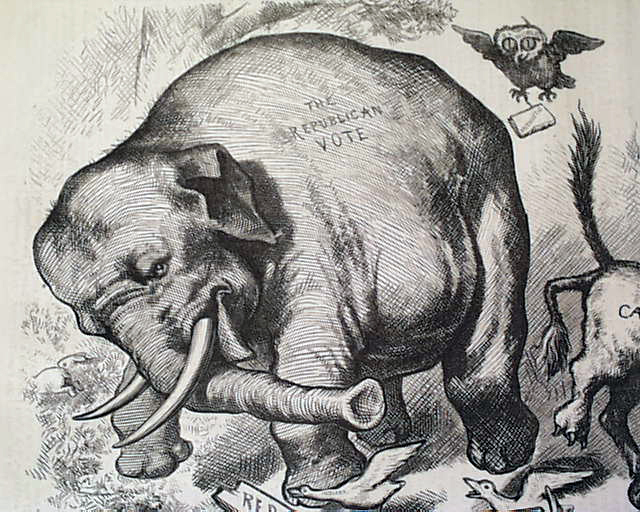
Thomas Nast’s first rendition of the Republican party’s symbol, early 1870s

1852

Feb 28th Saturday  It has been a stormy uncomfortable 

day  Mother is quite unwell & rather homesick

Mrs Witherell spent two hours here this

forenoon  I have finished the flannel

skirt that I commenced Jan 30th and put

a cape top to an old one  Mr Ames has

been to Boston as usual says the slab will be here Monday

Evelina stayed indoors today, sewing, of course, but also tending to her elderly mother, who seemed fretful and “unwell.” The whole town was subjected to what modern weather forecasters would call ” a wintry mix.”  According to Old Oliver, the day began “a snowing this morning wind south east but the snow is dry – it snowd + haild untill about 4 O clock + than began to rain + raind pritty fast untill some time in the night when it cleard of[f] with the wind north west and + cold and the wind blew verry hard”*

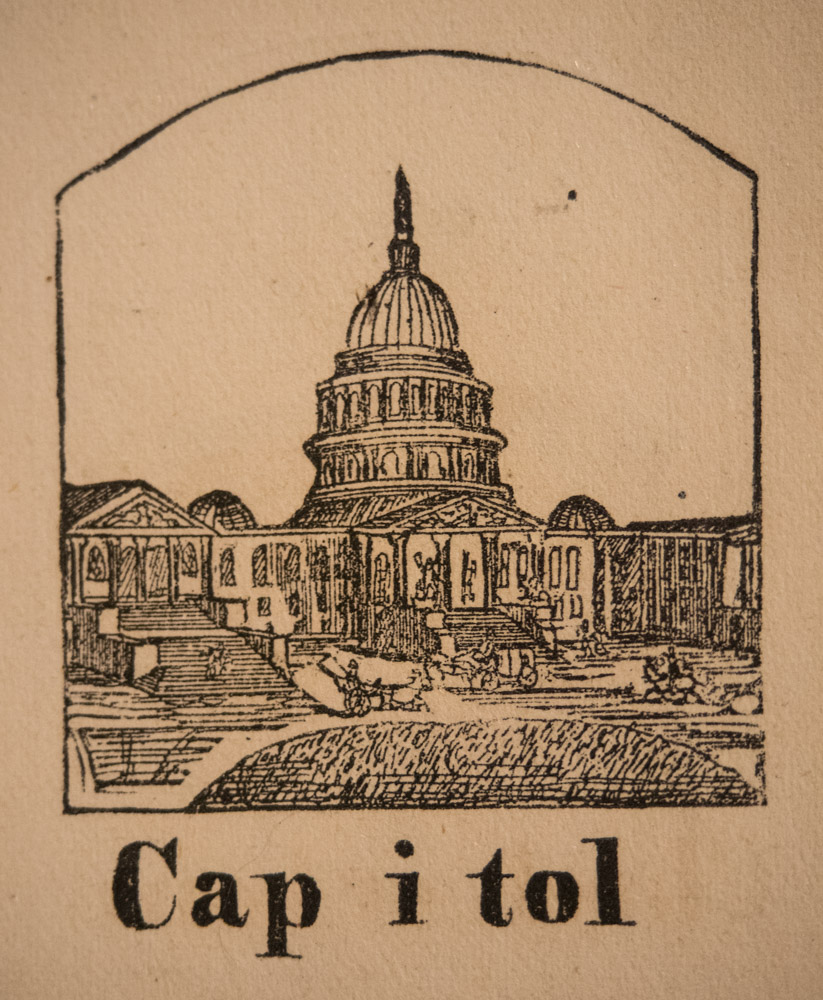
In another section of the country also known for its harsh winters, this date in history (plus two years) marks the genesis of our country’s Republican party. According to political historian Robert Remini, “[o]n February 28, 1854, a number of Free-Soilers, northern Whigs and antislavery Democrats met in Ripon, Wisconsin, and recommended the formation of a new party to be called “Republican.”**  Several months later, on July 6, after Congress passed the controversial Kansas-Nebraska act, the nascent group met again in Jackson, Michigan, where they “formally adopted the new name and demanded the repeal of the Kansas-Nebraska and Fugitive Slave Acts and the abolition of slavery in the District of Columbia.”

It wouldn’t take long for the Ames men, former Whigs, to join the new political party.

*Oliver Ames, Journal, Stonehill College Archives, Arnold Tofias Collection

Robert Remini, The House: The History of the House of Representatives, 2006, p. 150  

(NB: A source cited in Wikipedia in February, 2015, says that the date for this meeting in Ripon was March 20)

February 27, 1852

Tea kettle


Feb 27

1852  Friday  this morning I invited Mrs Lothrop here

but she went to Mrs Jason Howards to spend the day

came here this evening  Mrs S Ames & Fred dined

here  Mrs & Mr Horace Pool  Mrs W Williams  Abby

Edwin & wife Oliver & wife & Fred & Mrs Witherell

were here to tea  All came unexpectedly.  Had 

a very pleasant visit from them.

Many folks came to call today.  Sarah Ames Lothrop and her son, Frederick Lothrop Ames, joined the Ameses for midday dinner. (Although Oliver (3) had returned to Brown, Fred hadn’t yet gone back to Harvard.) A real crowd arrived “unexpectedly” for tea.  Sarah and Fred returned, bringing Oliver Ames Jr. with them. Sarah Ames Witherell came in from the other part of the house, resulting in all three sisters-in-law being together. Newlyweds Edwin and Augusta Gilmore walked over from their nearby home, and old Mrs. Gilmore – Evelina’s mother – was already on the premises. The family gathered.

From farther away came Horace and Abby Avery Pool, uncle and aunt to the bride, Augusta.  A Mrs. W. Williams arrived, as did Abby Torrey, Evelina’s niece. Abby’s head must have been full of the previous evening’s entertainment, that of Willard Lothrop’s visit and trance. It’s likely that some of this evening’s conversation turned on spiritualism.  One wonders what Oakes and Oliver Jr. thought of the topic.

Perhaps Evelina served some ginger snaps or currant cake from Tuesday’s baking. The tea itself could have been one of any number of types. Lydia Maria Child published her opinion on the subject: “Young Hyson is supposed to be a more profitable tea than Hysons; but though the quantity to a pound is greater, it has not so much strength. In point of economy, therefore, there is not much difference between them. Hyson tea and Souchong mixed together, half and half, is a pleasant beverage, and is more healthy than green tea alone.  Be sure that water boils before it is poured upon tea  A tea-spoonful to each person, and one extra thrown in, is a good rule.  Steep ten or fifteen minutes.”*

*Lydia Maria Child, The American Frugal Housewife, 1846


February 22, 1852

georgewashington

1852

Feb 22nd Sunday Quite a snow storm this morning but

most all went to church.  I came home at noon on

account of a violent tooth ache and did not return.  Mrs

S Lothrop & son spent this afternoon, Frank carried

Orinthia home after meeting. Read in Grahams

Magazine  Mr Ames & self passed the evening at Edwins

It has cleared off very pleasant this evening

“It was a snowing this morning + all the forenoon and fell 2 or 3 inches deep wind southerly + thawd some  was clear at night,” according to Ames patriarch, Old Oliver. Yet the family rode through the snow to get to church. Poor Evelina got “a violent tooth ache” and had to go home after the first service. She must have felt better as the day progressed, for in the evening she and her husband, Oakes, went across the way to visit newlyweds Edwin and Augusta Gilmore.

Today was George Washington’s birthday. Born in 1732, he died in 1799, when Old Oliver was twenty years old. After Washington’s death, the young Congress of the day, whose partisanship between Federalists and the Jeffersonian Democrat-Republicans rivaled the divide we see in our modern Congress, came together to pass a resolution honoring the first president’s birthday. February 22, 1800 was dedicated to him and by 1832, the centennial of Washington’s birth, some type of observance of the holiday was customary.  The holiday did not become federal law until the 1879, and at the time was qualified as a “bank holiday.”

Old Oliver would have remembered the hero of the American Revolution and probably revered him, as most Americans did. Old Oliver was a child when the Constitution was written and ratified, and lived to see 16 presidents take office. For his generation, no American leader would be more heroic than General Washington.


February 21, 1852

 21621-004-0B1C48DE

Angelina Grimke (1805-1879)

1852

Feb 21st Sat  Spent all the forenoon mending Mr Ames

shopcoat.  Cut Susan a pink long sleeve apron and

Orinthia sewed on it  Have finished Mr Ames another

dickey which makes seven that I have made lately

This afternoon carr[i]ed Mrs Solomon Lothrop &

Orinthia to mothers.  Orinthia stopt at a sing at

the Schoolhouse near Doct Swans  Frank went and

brought her back.  Mrs S Ames called this evening to 

settle and paid me 1,70 cts which makes us even

Normal wintertime activities went on under a sky that Old Oliver described as “fair in the fornoon + cloudy afternoon + much warmer.”*  Evelina mended, sewed and socialized with her friend and former boarder, Orinthia Foss; she also settled accounts with her sister-in-law, Sarah Lothrop Ames. Per usual, Oakes Ames went into Boston.

It was in Boston, in fact, on this date fourteen years earlier that for the first time ever in the United States, a woman addressed a legislative body. On February 21, 1838, abolitionist Angelina Grimke presented the Massachusetts Legislature with an anti-slavery petition signed by 20,000 Massachusetts women. In a speech that was lauded by abolitionists, deplored by traditionalists and parsed by all, she not only called for the abolition of slavery, but declared the right of women to act politically. “We are citizens of this republic and as such our honor, happiness, and well-being are bound up in its politics, government and laws.”**

Daughter of a southern slave-holder, Angelina (known as “Nina” in her family) and her older sister, Sarah Grimke, also an active abolitionist, faced predictable opposition as they transgressed convention. Angelina’s speeches in Boston and elsewhere drew taunts, outrage, disbelief, and disrespect. The Congregational clergy of Massachusetts condescended together one Sunday and, across pulpits, accused Grimke of jeopardizing “the female character with widespread and permanent injury.” Others – men and women – were impressed. One member of the audience at the statehouse said, “Angelina Grimke’s serene, commanding eloquence [she spoke for two hours] enchained attention, disarmed prejudice and carried her hearers with her.”**

How might the Ames clan have reacted?


*Oliver Ames, Journal, Stonehill College Archives, Arnold Tofias Collection

**www.massmoments.org


February 15, 1852

 lilliam_wald2

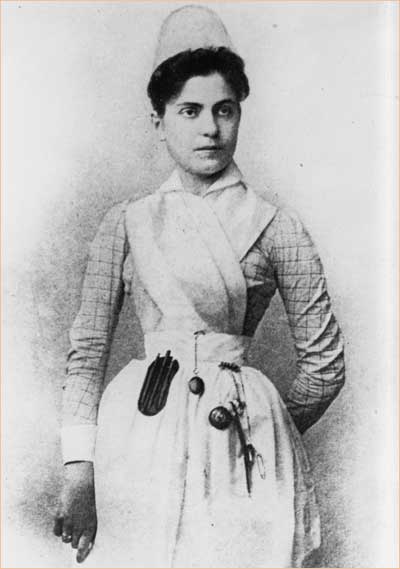
Nursing uniform from the late 19th c.*

1852

Sunday Feb 15th  Have been to church and at

noon went to Mr Baileys to see sister Amelia

who is nursing there  Mother went with me

Have been reading since meeting  Edwin & wife came

in to spend the evening but Mr Ames & self were

just going to Mr Swains and they would not let 

us stop for them so they went to Augustus  Had a 

pleasant call or rather visit at Mr Swains  came away

about nine Oclock  Very pleasant

The sun came out today, so despite it being “pritty cold,”** the Ames family went to church. During the intermission between morning and afternoon services, Evelina and her elderly mother, Hannah Lothrop Gilmore, rode out to visit Amelia Gilmore.  Amelia was the widow of Evelina’s brother, Joshua Gilmore, Jr. Joshua had died three years earlier, at age 35, leaving Amelia with two sons to raise.

In order to support herself and her boys, Amelia hired out as a nurse.  In this instance, she was looking after a Mr. Bailey, who must have lived near the Unitarian church. He may have lived alone, been ill and needed paid help; otherwise the convention of the day would have meant his female relatives looked after him. When Amelia wasn’t working, she and her youngest son, Samuel, lived with the Alger family near the Gilmore farm. The older son, Charles, had hired out somewhere but would soon come to reside with his uncle Alson Gilmore.

In 1852, nursing was not a formal profession.  Women (nursing was considered the exclusive province of women at the time) undertook nursing because they needed to work and this was one of very few avenues open to them. They based their protocol on personal experience in caring for ill members of their own families. There were no training programs or certification venues available, in no small part because there were so few hospitals. People were cared for at home. It would take the Crimean War in Europe and the Civil War in the U.S. to change attitudes and formalize medical care.

*Courtesy of http://www.nursinglink.monster.com

**Oliver Ames, Journal, Stonehill College Archives, Arnold Tofias Collection


January 24, 1852


IMG_2669


1852

Jan 24th  Saturday   Worked all the forenoon mending

Olivers overcoat & pants. Have finished my worsted

hood in Olivers this afternoon.  Julia Pool

Augusta & Edwin were there to tea. Mr Ames

has been to Boston & has brought home Oliver a

gold watch  Fred & Oliver have fine time and 

are wide awake  They sleep together.  Fred came 

in here tonight.

Evelina must have written this entry at night, perhaps in her bedroom where she could hear her son Oliver (3) and nephew Fred Ames conversing and laughing elsewhere in the house.  The first cousins, college men both, enjoyed one another’s company and were spending the night together. Up to now, they were the only family members in recent memory to go to university and must have had some stories to compare.

The fond regard that Oliver (3) and Fred held for one another would last throughout their lives, although it would be sorely tested on occasion. As grown men caught up in the high stakes of the railroad business, they found themselves holding opposing views more than once.  And after the sudden death of Oakes Ames and the attendant financial woes that followed, Oliver (3) defended his father’s legacy, while Fred supported his own father’s efforts to recoup funds that Oliver, Jr. believed were his.  In other words, Oliver (3) and Fred faced off over money. Yet they moved in similar circles, invested in similar capitalist ventures and, in 1893, when Fred himself died quite suddenly, Oliver (3) grieved, “completely broken down by [the] sad news.”*

Those difficult times lay ahead, but on this day, Oliver (3) had something to celebrate.  His father, Oakes, had given him a gold watch, perhaps in honor of his 21st birthday, which was right around the corner. Perhaps, too, Oakes was honoring his middle son for his successful studies at Brown University, studies that Oakes had initially resisted. The watch was certainly a sign that Oakes was proud.

*Oliver Ames Third, Diary, September 13, 1893, Collection of Stonehill College Archives


January 21, 1852

OLYMPUS DIGITAL CAMERA

1852

Jan 21st  Wednesday.  Had quite a job to thaw out the boiler

in the bathing room which was left Saturday evening

for Mr Ames to take a bath which he chose not

to take & was forgotten.  A tin pail of water was frozen

so hard as to burst out the bottom, so much

for forgetfulness & carelessness.  Oliver came home

this evening and brought me a picture a present from my 

sons.  Mrs. Witherell & Ames spent part of the evening

Bathing in 19th century America was an improvement over the hygiene practices on the 18th century, but still less frequent than today. Where we might shower once a day, people like the Ameses might bathe once a week, often on a Saturday night in order to be clean for Sunday service.  Others bathed less, or differently. For some, sponging off was preferable to full immersion in a tub.

Oakes Ames had his Saturday night bath lined up to go, but decided against it and left the water behind to the mercy of the cold bathing room, where it froze.  Evelina had to clean up the consequent spill, tsk-tsking all the while about “forgetfulness & carelessness.” This small vignette does suggest just how cold the room was where they bathed. Regardless of the temperature of the water, stepping in or out of the tub was chilly. No wonder they didn’t bathe every day.

The day wasn’t all bad, however. Evelina’s sons, led by middle child Oliver (3), gave her a gift, a picture.  What was the occasion? Not her birthday, not Christmas. Perhaps just a spur-of-the-moment thank you for being their mother. The gesture seems sweet, thoughtful and generous.

January 20, 1852

OLYMPUS DIGITAL CAMERA

Jan 20th Tuesday  Have made Susan two pr of fur cuffs

one pair for school and one for best.  Hannah called

for me to go with her to call upon Augusta, went

with her found Julia Pool there stoped but a few

moments. This evening Mrs Witherell Emily & Mrs

S Ames brought in their work and passed the evening

They say I never give them the credit of coming here

at all. I certainly will this time

In what Evelina considered to be a rare occurrence, her two sisters-in-law, Sarah Witherell and Sarah Ames, “passed the evening” at Evelina’s. The women brought their work boxes or baskets and sewed together, young Emily and perhaps young Susie with them. Usually, Evelina went over to one of their sitting rooms.

On this same date in 1865, when Evelina’s life had changed, and she and Oakes were in Washington, D.C. while Oakes served as U.S. Congressman from Massachusetts, Oakes was called to the White House.  Winthrop Ames, who once possessed the diary in which Evelina recorded her days in Washington, tells us that Evelina wrote “today Mr. Lincoln sent for Oakes to come to the White House.  He went immediately after dinner and talked with the President until after midnight.’ ”

Winthrop went on to add, in his own words:

“Ames reported that the President said to him then, and in later conferences, ‘Ames, you take hold of this. If the subsidies provided are not enough to build the road ask double and you shall have it. Take hold of it yourself.’ And he added,’by building the Union Pacific, you will become the remembered man of your generation,’ The President said further that if the railroad could be so far completed that he might take a trip over it when he retired from the Presidency it might be the most memorable occasion in his life. Alas! his next railroad trip was to be in the funeral car that bore him to his grave in Springfield, Illinois.”*

*Winthrop Ames, The Ames Family of Easton, Massachusetts, 1937, p.


January 16, 1852

image


1852

Jan 16th Friday  Made the bed in the front chamber and 

put the room in order swept the stairs &c &c

worked on Susans morino hood  Mrs Wm Reed &

Mrs Hall called  Augusta & Edwin here to tea and

spent most of the evening  Edwin put the casters

on my hourglass table and I nearly finished putting

on the cover  Mrs S Ames called a few moments.

In between the day’s activities of choring, sewing and finishing up a project for newlyweds Edwin and Augusta Gilmore, Evelina received several callers, including Abigail Reed, wife of the elderly William Reed, and a Mrs. Hall. Evelina had called on Mrs Reed the day before; Mrs Reed returned the courtesy today. Paying calls was an intrinsic part of social life in the nineteenth century, especially among women and especially in cities, but also in smaller country towns such as Easton. Social exchange, which in the country had been a somewhat relaxed occurrence based on an informal combination of need, opportunity and desire, was becoming ritualized.

As of 1850, social visits were beginning to follow a proscribed pattern, like the one described in The Art of Pleasing,* written about this time. On the topic of “Receiving Visitors”:

“To receive visitors with ease and elegance, and in such a manner that everything in you, and about you, shall partake of propriety and grace, – to endeavor that people may always be satisfied when they leave you, and be desirous to come again, – such are the obligations of the master, and especially of the mistress of a house.

“Everything in the house ought, as far as possible, to offer comfort and grace. Perfect, exquisite neatness and elegance, which easily dispense with being sumptuous, ought to mark the entrance of the house, the furniture, and the dress of the lady.”

In a cautionary paragraph, the author goes on to advise against sewing when company calls: “If a lady who receives a half ceremonious visit is sewing, she ought to leave off immediately, and not resume it except at the request of the visitor.”  That stricture may have been a difficult one for Evelina to follow, given how incessantly she sewed. But she and her sisters-in-law would have striven to be au courant with the etiquette of the day.

Before many more years went by, the phenomena of calling cards would be introduced, creating “an increasingly complex etiquette which determined the length and frequency of calls, whether a call should be returned or not and the sorts of people to whom a family was, or was not, ‘at home.’ Families connected by kinship, business and politics interchanged calls and invitations, but ranked and classified their acquaintances in ever more precise grades of social acceptability.”** These new rules would apply particularly to the next generation of Ameses.

H. M. Rulison, The Art of Pleasing, Cincinnati, 1853, pp. 27-28

** Jack Larkin, The Reshaping of Everyday Life, 1988, p. 265


January 10, 1852

Oakes_Ames_-_Brady-Handy

 Portrait of Oakes Ames by Matthew Brady 

1852

Jan 10th Saturday  Mr Whitwell & Ames have not met again

to day  Mr W called just as Augusta Helen Susan

& self were in the sleigh to take a ride  We have

called at mothers  Mr Horace & John Pool, Edwin

& wife here to tea  Swept the parlor this morning

and put the house in order partially frosted a loaf of cake

for Augusta having made one of hers carried the frosting

over and made her a call while heating it

The boys presented their Father a gold pen & pencil

Oakes Ames turned 48 years old today, as did the local Unitarian minister, William Whitwell.  Last year and again this year, Evelina was unsuccessful in getting the two men together to celebrate. Oakes Angier and Frank Morton gave their father a gold pen and pencil to mark the occasion, a fine gesture.

As Oakes closed in on the half-century mark, he presumably began to look beyond the confines of the work he and his brother Oliver Jr. did for the shovel company. The next generation, in fact, was being groomed to run O. Ames & Sons; Oakes Angier, as eldest son of the eldest son, was on deck to superintend the company whenever Oakes and Oliver Jr. decided to step down. He was learning every aspect of the manufacturing process. Oliver (3) and Fred Ames were at college, Oliver presumably honing the skills he would need to take over his father’s role in managing sales, while Fred was on a path to being the financial clerk or CFO we might say today. Frank Morton Ames was learning a variety of skills, too, although he was seen more as a spare man waiting to step in should his cousin or either older brother fail somehow.

What could Oakes do with his tremendous talent and energy? Clearly, the roiling politics of the day interested him. By 1860, his gregarious nature, quick comprehension and thirsty ambition led him to accept the nomination and election to Massachusetts Governor Andrew’s Council as representative from Bristol County. Two years later, by “a large popular vote,”* Oakes Ames was then elected to the Thirty-Eighth U. S. Congress, where he would serve for four terms.

In 1872, according to circumspect historian, Reverend William L. Chaffin, Oakes “declined a renomination.”* He died in May, 1873, shortly after the conclusion of Credit Mobilier, a national political scandal for which many held Oakes culpable. At the time, his natural candor and fearlessness worked against him and he was unable to dodge the political manuevering that placed most of the blame on him. That same brave honesty, coupled today with calmer, historical perspective, has since served to cast Oakes Ames in a better light.

William L. Chaffin, History of Easton, Massachusetts, 1886, p. 654