October 11, 1852

factory-steam-engine

Early factory steam engine

Monday Oct 11th  Catharine Middleton & Murphy washed

and I sat down quite early to my sewing

with Mother & Louisa  Mended stockings

This afternoon we spent at Augustus

Mother & Louisa are going to spend the 

night  Mr Torrey & Abby were there

Mr Ames & Oakes A went to West B

I have been sewing on the skirt of Susans

fall Delaine

This was a typical Monday as far as domestic matters were concerned. In the morning, the women washed clothes and mended stockings. In the afternoon, they went calling on relatives in the village. But it was a red-letter day at the shovel shop, as men arrived to install the a steam engine – the first – at the factory.

Old Oliver seemed excited: “this was a fair good day for the season the man came here to sett up the enjoin four of them.” The company’s first steam engine was placed in the new Long Shop by the Corliss Nightingale Company of Providence. It was a technological change that Oliver had resisted in the past, but had since come to accept. His son, Horatio, in particular, had urged the change for several years in order “to counter water supply limitations”* In January, 1847 he had written his father and his brother, Oliver Jr., on the topic.

To Old Oliver:

I shall think a steam engine […] of sufficient power to carry 3 hammers and carry all your polishing works shearing and punching and Bisbees works […] would be cheaper and better […] It is too bad that you do not keep nearer supplying the market with shovels when a comparatively small expense would do it in addition to your other works.”*

To Oliver Jr.:

I enclose you with […the] price and terms for a steam engine. It will do you no hurt to compare cost of this and water power. it will take about one ton of coal a day to drive it and the repairs will be no more than a water power if as much[…] You never need fail for water either too much or too little […] I am altogether in favor of this plan over water power in your situation.”*

Horatio was right, as it turned out. The new engine was the beginning of modernization for O. Ames and Sons.

Gregory Galer, Forging Ahead, MIT, 2002, p. 251.  Text of Horatio Ames correspondence from Stonehill College Archives, Arnold Tofias Collection

October 10, 1852

Daniel_Pierce_Thompson

Daniel Pierce Thompson

(1795 – 1868)

Sunday Oct 10th  It is quite unpleasant to day and

as mother & Mrs Mower was not going to meeting

I staid with them  Mrs Ames Oakes A & Frank

went this forenoon, and Mr Ames returned alone

this afternoon  I have been reading some in

the Rangers Torys Daughter and writing

Helen came in and played on the piano

this evening  Mrs Witherell & Ames came in a while

Evelina skipped church to stay home with her mother and houseguest, not minding too much because of poor weather, which Old Oliver described as  “cloud[y] damp + verry warm wind.”

The women did not sew, but they probably chatted a bit and read a lot. Evelina was reading The Rangers: Or, The Tory’s Daughter: A Tale Illustrative of the Revolutionary History of Vermont and the Northern Campaign of 1777, by Daniel Pierce Thompson. Mr. Thompson was a famous writer in the period before the Civil War, especially in New England. His novels were as well-known as Nathaniel Hawthorne’s, but his turgid prose, popular in its day, has caused him to fall far out of fashion. He was also a political figure in Vermont and an active abolitionist, but his novels are not much remembered.

The first two sentences of the book that Evelina was reading illustrate his dated style:

Towards night, on the twelfth of March, 1775, a richly equipped double sleigh, filled with a goodly company of well dressed persons of the different sexes, was seen descending from the eastern side of the Green Mountains, along what may now be considered the principal thoroughfare leading from the upper navigable portions of the Hudson to those of the Connecticut River. The progress of the travellers was not only slow, but extremely toilsome, as was plainly evinced by the appearance of the reeking and jaded horses, as they laboured and floundered along the sloppy and slumping snow paths of the winter road, which was obviously now fast resolving itself into the element of which it was composed.

In the evening Evelina put down the book – which must have been slow going – and whatever letters she was writing, and the whole family listened as Helen Angier Ames played the new piano.


October 3, 1852

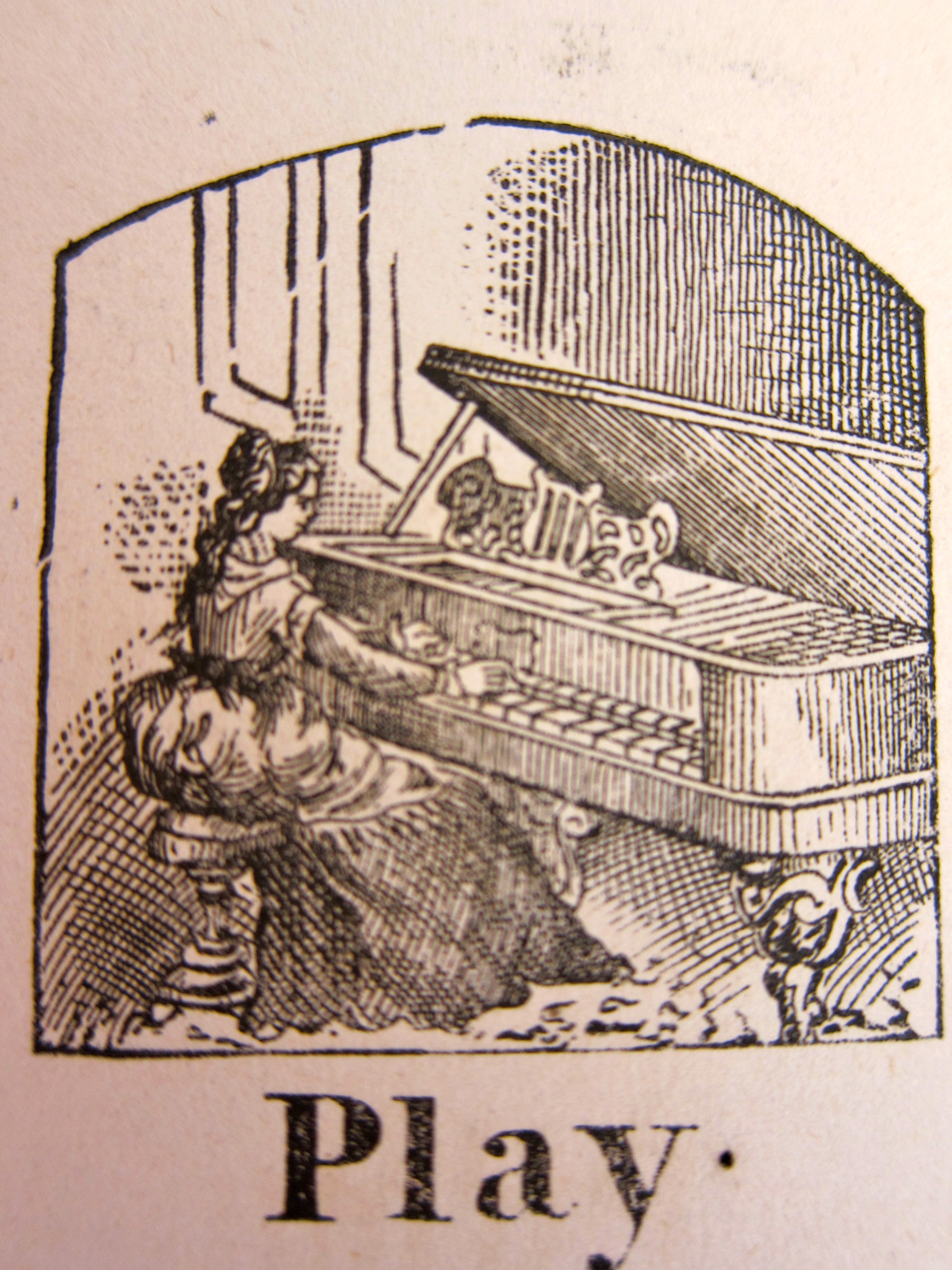
Play

Oct 3d Sunday  We have all been to meeting to day

Mrs Norris Mr Ames & self came home at noon but did not

have a dinner cooked  After meeting Frank carried Miss Linscott

& Orinthia to Bridgewater & Melinda & self went to Mothers and

called on Miss M J Alger while Frank went to carry them home

Mrs A[l]ger had her piano & played Horatio Jr is here came last night

More comings and goings today. Everyone went to church, of course, but afterwards dispersed in different directions. Frank Morton Ames obliged the young, single ladies in the group by driving them home to Bridgewater. While he headed east, Evelina and her friend Melinda Norris rode south to the family farm to visit the elderly Mrs. Gilmore. They also stopped to visit Miss M J Alger, the woman who would be giving piano lessons to Susie Ames and Emily Witherell. She, or her mother, played a piano for them.

Old Oliver reported that “this was a fair pleasant day for season Oakes came home from N. York las[t] night.” Oakes Angier stayed behind, on business or pleasure we don’t know. Evelina reported, as her father-in-law did not, that Horatio Ames Jr. was back for a visit. He was the son of Horatio Ames, a brother of Oakes and Oliver Jr. It’s unclear if Horatio Jr. was living in Boston at this point or was still in Connecticut at the family home there.


October 2, 1852

doc-2-dakotapaul

Oct 2d Saturday  Have had quite a party this after 

noon  Mrs Norris, Mrs Mower, Miss Foss, Linscott

& Lavinia here to dine & Hannah Augusta Abby

& Malvina here to tea  Carried Augusta out to

ride the first that she has been out for a long time

We have been to the shops and making calls

and I have done no sewing to day  Mrs Mower

went home with Lavinia  Made my peach preserves

Mr Ames came home from New York


Friends of Evelina descended on the house today, some for dinner and some for tea. Carriages full of females trotted along Main Street, coming or going to the Ames residence. Evelina’s friend, Orinthia Foss and her fellow school teacher, Frances Linscott, came from Bridgewater and spent the night. Niece Lavinia Gilmore arrived to help with house guests Melinda Norris and Louisa Mower, the latter from Maine. At tea time, Evelina’s sister-in-law Hannah Lincoln Gilmore and two nieces, Abby and Melvina Torrey, joined the group. For the second time this week, many women filled the parlor. We might imagine that Evelina was really enjoying herself.

What did the men of the family do to cope with all the socializing? Join the crowd or disappear into the office next door? What must Oakes Ames have thought when he walked in, home from his business trip?

Augusta Pool Gilmore, who had been ailing for many weeks now, was on the mend. She, too, came for tea and later was taken out for a drive. Like yesterday, the weather was mild and sunny and Augusta must have felt reborn to finally get out of her sick room and back with the living.

Even with a big midday meal and many for tea, the servants – and perhaps Evelina herself – still managed to put up some peach preserves. What a busy kitchen!


September 24, 1852

Giffard1852

Henri Giffard’s Dirigible  

Friday Sept 24th  Mr Ames & Oakes Angier went

to Boston and are going to New York for New

Jersey to night  I have been to work again about

house all day ironing and this that & tother

Catharine got my quilt out and has been

mending some stockings  Mr Rathbourne

returned to P[rovidence] this afternoon  Oliver carried him

to Mansfield  They went to Canton this afternoon


Today Evelina saw her husband and eldest son depart for New York and New Jersey, by way of Boston; that helps explain the extra laundry day yesterday. The men were off on shovel business and the fact that Oakes Angier went along suggests that he was enjoying good health. He was also learning the family trade.

Back at the house in North Easton, domesticity reigned, as usual. Even Evelina couldn’t quite keep track of all the little tasks she was addressing. It was simply “this that & tother.” Mending, ironing, quilting went on. Her son Oliver was riding here and there with his houseguest, Mr. Rathbourne.  It looks like the only son who was present at the shovel works was the youngest, Frank Morton.

Miles away from anyplace that any Ameses were traveling today, a steam-powered dirigible, lifted by hydrogen, rose in the air for the very first time. Hot air balloons had already ascended the skies in various places and for various lengths of time. The airship was new and different by virtue of its shape, design, and engine. Created by a Frenchman, Henri Giffard, the airship made its maiden voyage from Paris to Elancourt. It traveled 17 miles. The winds were too strong for it to return to Paris, as planned, but Giffard was nonetheless able to steer and turn the airship in its course. It was the shape of things to come.


September 23, 1852

IMG_2471

Sarah Lothrop Ames

(1812 – 1890)


Thursday Sept 23th [sic] Have not sewed at all to day Starch

the clothes and ironed some fine shirts

Lavinia washed the clothes that Oliver brought

from Providence & Mr Rathbourne from 

Providence came this afternoon to visit […]

Oliver  He went to Stoughton after him

Mrs Holmes & sister came after some plants


It’s unusual to read of Evelina and her servants doing a wash on a Thursday, but so it was. Son Oliver (3) had returned from a trip to Providence with dirty laundry in tow and, more than that, a houseguest headed their way. Evelina had to finish up the laundry and prepare for company. She evidently had help from her twenty-year-old niece, Lavinia Gilmore, who, by washing the clothes of her twenty-one-year-old cousin, demonstrates not only the strict division of labor of the day, but the then-unexamined destiny of spinster daughters and nieces to serve the men of their family.

Next door, Sarah Lothrop Ames celebrated her 40th birthday which, in those times, was the front door to old age. It was her destiny to grow up in Easton, the only daughter of the Honorable Howard Lothrop and his wife, Sally Williams Lothrop. She had nine brothers, which makes us wonder if she, as a singleton girl, was doted on, or depended on, or both. On June 11, 1833, Sarah married Oliver Ames, Jr., third son of Old Oliver and Susannah Angier Ames. In social terms, it was a marriage between two of the town’s important families. The couple moved into their own house, built for them by Old Oliver, next door to the family homestead. They would eventually tear that house down and build a grander one, known to us as Unity Close.

Sarah and Oliver Jr had only two children, Frederick Lothrop and Helen Angier, at a time when a larger family was more typical. We can’t know if their decision to stop at two was happenstance, voluntary, or imposed by medical circumstances. Fred, they raised to go into the family shovel business, much as Oakes and Evelina did with their three sons. Fred was given a full college education, however, as his cousins were not. Helen and her younger cousin, Susan, meanwhile, were raised to be proper young ladies with fine dresses, piano lessons, and good schooling. It is doubtful that Helen ever had to wash her brother’s clothes. There were servants for that.

Like her sisters-in-law Evelina and Sarah Ames Witherell, Sarah Lothrop Ames was a regular church-goer and a conscientious neighbor. She did her duty with the elderly and infirm in the village, and she was a loving daughter to the end with her parents. Her mother, once widowed, developed dementia and incontinence, yet Sarah cared for her until her death. She was close to her children and grandchildren, of whom she had five.

A widow herself by 1877, Sarah would live until 1890, outlasting her husband, brothers-in-law, sisters-in-law and all but one brother, Cyrus, to whom she left the use of Unity Close for his lifetime. After his death, it passed to her eldest grandson, Oliver Ames (1865-1929).


September 12, 1852

Peach

Sunday Sept 12th  A very stormy day and none of the 

family have been to church.  Frank  C Hobart

& Helen went to the meeting house but there

was no meeting  Mr Ames & self laid down

and read “Poor rich man and Rich poor man”

Mother is better  Hannah has been to

[illegible] in the rain but is not able to work.

Cate Hobart, William & Olivers family came in this evening to eat peaches

Bad weather kept most folks indoors on this Sabbath day. Old Oliver reported a more than adequate rainfall: “it raind last night and nearly all day to day wind sotherly and warm   in that has fell yesterday + to day there is one inch + nine tenths of an inch.”* Despite the rain, Frank Morton Ames carried his cousin Helen and her classmate Catherine Hobart to church, but the service was cancelled. They must have had a wet ride down and back, but perhaps enjoyed the journey anyway.

Inside the Ames homestead, things were pretty quiet. Old Hannah Gilmore was feeling better, but servant Hannah Murphy was not. Evelina and Oakes spent some time upstairs and together read a story, probably from one of Evelina’s periodicals. Son Oliver (3) was likely to be reading, too. Perhaps Oakes Angier was reading or resting, in the interest of maintaining the good health he appeared to have regained. Certainly all three sons appeared late in the day, when family from around the compound gathered for tea.  William Leonard Ames and his young son, Angier Ames, who were staying with Old Oliver, popped in from the other part of the house. Oliver Ames Jr., his wife Sarah Lothrop Ames, daughter Helen and friend Catherine, on the other hand, had to cross the wet yard to attend. The big draw appears to have been peaches, a fresh, local and strictly seasonal treat.

*Oliver Ames, Journal, Stonehill College Archives, Arnold Tofias Collection
September 5, 1852

books

Illustration from Godey’s Lady’s Book*

Sunday Sept 5th  1852 Went to meeting and came home

at noon with Mr Ames & Mrs Stevens.

Was very sleepy this forenoon and did

not hear much of the sermon but thought

it good what I did hear. Had an excellent

sermon this afternoon  Mr Whitwell preached

After meeting Mr Ames & Mrs Stevens & self

walked to the new shops called at Edwins.

Finished a letter to Harriet Ames

Reverend William Whitwell delivered two good sermons today, even if Evelina slept through parts of the first one. Were she and Oakes both nodding off in the Ames pew? Hopefully their sons, Oliver (3) and Frank Morton, and their guest, Mrs. Stevens, stayed upright as Mr. Whitwell spoke.

A walk “to the new shops” was the exercise they took after church. Construction work on the factory building must have been well along, if not finished on the exterior. Stopping in to see Edwin and Augusta Gilmore afterwards would have been easy, as the young couple lived right across the street from the new Long Shop and its grounds .

Letter writing, and probably a little reading, filled the remaining quiet hours of Evelina’s Sunday, As a subscriber, she would have had this month’s Godey’s Lady’s Book to look at. The September issue included fiction in the form of stories and poems, as well as prose articles on the Crusades, the printing of calico, a history of boots and shoes, archery, the employment of women in cities (in this issue focusing on the Philadelphia School of Design), and “Lingerie: Caps for the Chamber and Sick-Room.” * Evelina had been in various sick rooms enough lately to make this article of particular interest to her – although we cannot know whether she read it or not, or whether any of the women she helped nurse had adorned themselves with such headgear. We can know, however, that this particular article took credit for introducing the word “lingerie” to America, whose readers who were “doubtless […] unfamiliar” with it.

*Godey’s Lady’s Book, September, 1852, p. 287

September 1, 1852

Men's Work Shirt, mid-19th c.

Men’s Work Shirt, mid-19th c.

Wednesday

Sept 1st 1852  Have been cutting out shirts & fixing

them for Catharine to sew  She does very

well at sewing but I have to get it ready for

her  Mrs James Mitchell & Catharine Hobart

came before noon at Olivers   And I have

been in there  Did not get ready to go

very early  Mr Ames has gone to the 

Whig convention at Worcester


Evelina had settled back into her sewing routine, the latest project being shirts for the men in her family. The last time she had sewn a large batch of shirts was back in March, 1851. It looks like the men had worn through the allotment and needed new ones. Evelina and her servant, Catharine, probably used the Bartlett sheeting mentioned two days earlier for material.

Next door, Sarah Lothrop Ames welcomed some visitors from Bridgewater: Harriet Lavinia Angier Mitchell (not to be confused with Harriet Ames Mitchell) and Catharine Hobart, the latter a classmate of her daughter, Helen.  In another three years, Catharine Hobart would later become a member of the family when she married Oakes Angier Ames. We might imagine that Catharine asked after him, perhaps expressing concern for his health. How much information did the family share about Oakes Angier’s lung condition?

While the women worked and socialized at home, the Ames men were out and about. Oakes Ames attended the Whig Convention in Worcester to help put together the Whigs’s slate for the fall election, and Old Oliver “went to quincey + Braintree to get stone for the foundation for the steam enjoin”.  The building of the new factory to replace the one that had burned down in the spring was not yet complete.


August 29, 1852

300px-1852_Atlantic_hurricane_season_summary_map

Map of 1852 Hurricane Season, 21st century imagery*

Sunday Aug 29

1852  Has rained powerfully all day  Not one

of the family been to meeting  Mr Ames &

self laid down about twelve and when

we went downstairs found Edwin & wife

among the missing  Made them come back

to tea and spend the night  I have

felt tired & lazy and have read but

very little

The unofficial hurricane season of 1852 opened about ten days before today’s diary entry with a storm now classified as the Great Mobile Hurricane of 1852. According to modern meteorologist Christopher Landsea (great name for a weatherman!)*, the unnamed storm hit the Florida Keys, made landfall near Pascagoula, Mississippi and broke back out into the Atlantic in South Carolina, destroying lighthouses, homes, trees, bridges and crops in its way. It surged northward toward Cape Cod, where it still had enough energy to be felt in New England. Thus could Old Oliver report today that “the wind changed to northeast last night and there was an inch + a half of rain fell and it is a raining this morning and it raind all day + the wind blew hard”**

While this weather event of hemispheric proportions pounded its way across the eastern United States, a quite different vignette unfolded inside the Ames’s home. Eveline writes that the family skipped going to church, naturally, given the weather. She and her husband, from whom she had been absent for ten days or so, went upstairs to their bedroom and lay down – and closed the door, presumably. We can’t know the details, nor should we. But we can be grateful for this rare and tiny glimpse of intimacy between Evelina and Oakes, and smile at the Victorian discretion exercised by Evelina as she recorded the event.

*Information courtesy of Wikipedia, “1852 Atlantic hurricane season,” accessed 8.26.2015

** Oliver Ames, Journal, Stonehill College, Arnold Tofias Collection