March 24, 1851

canton-ma-landscaping

/51

March 24 Monday  It was so unpleasant this morning

that Jane could not put her clothes out but

about noon it cleared up and she has got

them all dry  I have cut out a shirt for Oliver 

of fine unbleached cloth and have sewed

some of it & mended Mr Ames coat & vest

He went to Canton this afternoon.  Mr Whitwell

called.  Mrs Witherell passed an [illegible] this evening

Perhaps wearing one of his new shirts, or at least wearing a mended one, Oakes Ames traveled to neighboring Canton today.  Named for Canton, China, because some imaginative citizen believed the Chinese city to be its geographical twin on the opposite side of the world, the Massachusetts city had manufacturing interests much like Easton. Since before the American Revolution, the Kinsley family had operated an ironworks there. Like the shovel works, the Kinsley business had started small and grown well. Initially, it produced farm implements and was entirely family-run. It had a forge, a large rolling mill and the capability of producing steel.

In 1851, Lyman Kinsley was its sole operator; by 1858, the company would be owned by the Ameses. Oliver Ames Jr. would become its first Ames president, with others to follow (Frederick Lothrop Ames would be next, and after him, his son Oliver.) Frank Morton Ames would be its General Manager. Perhaps Oakes’s visit to Canton today, although certainly having something to do with getting steel for shovels, was also quietly prompted by some foreknowledge that the Ameses were interested in acquiring this complementary business.

Once the Ames owned it, the Kinsley Iron and Machine Company would eventually develop to produce wheels and axles for railroad cars, another product that would fit nicely with Ames business interests.

March 19, 1851

Slaves

1851

March 19 Wednesday  This morning commenced another

shirt that was cut out last fall & the

sleeves finished & the body nearly ready for the

bosom. Made the bosom & collar and finished

it all off this evening. Mr Ames went to

Boston this morning The snow is not deep but

much banked Augustus here to breakfast & dinner

Orinthia finished the shirt that she worked on yesterday

The last days of winter in Easton appeared calm, with the final snowfall (they hoped) on the ground, nephew Augustus still pulling up a chair to the Ames dinner table, and Evelina and Orinthia sitting near the windows, sewing more men’s shirts. But all wasn’t well in the nation. Since the passage of the Fugitive Slave Act the previous fall, discord over the issue of slavery had increased.  In Boston, where Oakes Ames went today, passions ran high among abolitionists.

What did Oakes and Evelina think of the debate? The Ames men admired Daniel Webster, but the famous Whig senator had helped engineer the political compromise that led to the slave act and been roundly denounced for what many in Massachusetts saw as a sell-out. In the interest of preserving national unity, Webster urged his constituents to obey the federal law. If the story that historian William Chaffin tells is true, Oakes Ames disobeyed it. Writes Chaffin:

“Rev L. B. Bates was once here as Methodist minister.  He says that one night not long after the passage of the infamous Fugitive Slave Law a poor slave called him up at midnight for food and help. Rev. Bates fed him and then took him to Oakes Ames who gave him money and sent him on his way rejoicing.”

Lewis Bates was certainly a respected minister in North Easton, but he wasn’t appointed until 1859, so the timing in his recollection of Oakes Ames assisting a runaway slave close on the heels of the passage of the Fugitive Slave Act doesn’t jibe. Either Bates got it wrong in the telling or, because he was writing the story many decades later, Chaffin got it wrong in the remembering. The whole tale may be apocryphal, but two ministers believed it to be true. Helping a slave would have been in keeping with Oakes’s generous spirit.

March 18, 1851

imgres

1851

March 18th Tuesday  A very bad north East snow

and Orinthia did not keep school and we both

sit down to sewing quite early.  She to work

on a coarse shirt for Oakes Angier and I have

made a collar and finished the shirt that

I commenced yesterday  Wm Called for the 

first time since he came here.  A[u]gustus dined 

& spent the night

More snow, enough to call off school and prevent nephew Augustus Gilmore from departing to his lodgings at Mr. Wrightman’s.  Did it fall on any little crocuses in Evelina’s flower beds? Wasn’t it getting to be springtime?

Augustus, a man with a robust figure and evident appetite, continued to spend time with the Ames family, often joining them at dinner. Did he pay for his board, or did Evelina and Oakes give him free meals?  Evelina began to track his meals by underlining those occasions in her diary.  Why? Did she begrudge her nephew’s presence in the dining room, or did her tracking of his meals have some other purpose?

William Leonard Ames, youngest living son of Old Oliver, had been visiting in North Easton for ten days, yet today was the first time he called on Evelina and Oakes.  His avoidance of their parlor spoke loudly of the animosity between William and Oakes.  His pronounced delay in paying a call on his oldest brother might well have been his only way to retaliate for the financial distress that Oakes had caused him in the closing of the family ironworks in New Jersey, an operation that had been in William’s care.  For a deeply researched account of the particulars of the rift between the two brothers, in which the blame seems to lie more with Oakes, see Greg Galer’s thesis, Forging Ahead.  

March 10, 1851

images-2

/51

March 10  Monday  This is town meeting day.  Mr Ames & O Angier went

They spent the whole day there but accomplished very little

Mr Pratt & Brown chosen School committee O Angier was

nominated for one & lacked by one vote of being chosen

They brought home the school report of the last year

which is not very favourable for the schools in town generaly

Miss Foss & Clarks school are spoken very well of.

It commenced snowing about ten Oclock & is quite stormy this evening

Town Meeting was – still is – a great New England tradition. In the 19th century (and well into the 20th) the meetings were often scheduled in March, making them an annual marker of winter’s impending departure.

People turned out for town meeting.  Rather, men turned out for town meeting.  Women, who before 1780 in Massachusetts had enjoyed suffrage, no longer could vote.  National suffrage for women, a cause that would create deep divisions among the Ames women of a later day, would not be achieved until 1920.

Oakes Ames and his eldest son, Oakes Angier Ames, attended meeting and stayed all day. Oakes Angier evidently ran for school board but just missed being elected. He was showing a taste for politics, something that his father felt as well. His mother, perhaps influenced by her son’s loss, harrumphed that “very little” was accomplished at this year’s meeting, although she seemed pleased that their boarder, Orinthia Foss, was mentioned as being a good teacher.

Today’s town meeting was moderated by one of Easton’s greybeards, Capt. Tisdale Harlow. A resident of the Poquanticut section of town, Harlow was a former selectman, town treasurer, school board member, veteran of the War of 1812, and captain of the Easton Light Infantry in 1833-34. He had crossed swords with the Ames family in the 1830’s in a town row about the introduction of Unitarianism into the Congregational church. Harlow and many others were against it; Old Oliver, his sons and others were for it.  The sectarian controversy wore on for about eight years and ultimately led to a permanent split in the congregation. Historian William Chaffin suggested that “[i]ts unhappy effects were felt for many years.”  Were there remnants of hard feelings on display at today’s town meeting?

March 9, 1851

Down_in_the_Cave_Church_Pews_Company_Town_Exhibition_Coal_Mine_Beckly_WV_8576_(7536218802)_(2)

/51

March 9  Sunday  Have attended meeting all day.  Mr

Whitwell gave us two excellent sermons particularly the

afternoon  William is here & went to meeting.  came

Friday morning  I spent the intermition with Mrs Elijah

Howard at the meeting house very pleasantly indeed.

After meeting looked over some of the old Saturday

Couriers  Edwin made a call is about sick with a cold

It is quite pleasant, but snow on the ground & bad

traveling

Evelina and Oakes saw Oakes’s younger brother William at church, probably for the first time since William had returned to town. The relationship between the two brothers was not cordial, but the families sat together in the same pew (or set of pews, given the size of the extended family) and could hardly have avoided one another.

As usual, Evelina enjoyed listening to Mr. Whitwell’s sermons.  She enjoyed the “intermition” between the morning and afternoon service at the church, too.  She spent it sitting with Nancy Howard, mother of Ellen Howard on whom Evelina had called earlier in the week.  The formality of the times shows in Evelina’s referring to Nancy not by her first, or Christian, name, but by her husband’s name. Even in her own journal, writing of friends, Evelina maintained the nomenclature of “Mr.” and “Mrs.”  Formality of address was second nature to her, as it was to most well-bred people of the day.  Even husbands and wives typically referred to one another as “Mr.” and “Mrs.” when speaking in the third person.

Oakes Ames must not have gone into Boston the day before or, if he did, he failed to return with the latest magazines.  For her reading that night, Evelina opted to look over old issues of  The Saturday Courier .  Where was this paper published?  Not in Easton, not in Boston.  Bridgewater? Canton? Stoughton? Taunton? Does any reader know about this newspaper?

It also may be that Oakes was away from Easton this week.  He often traveled to other nearby states for the shovel company, taking orders and collecting accounts, a task that his middle son, Oliver (3), would eventually take on.

*Photo from Down in the Caves Church Pew Company.

March 7, 1851

photo

1851

March 7th  Have been giving my rooms a thorough sweeping

& dusting which took me all the forenoon

This afternoon worked on an old shirt of Franks

Am putting new wristbands & bosom into it.

This evening Oliver, Frank & Orinthia have gone to

Alsons to a party.  Orinthia would not go to the dancing

school last night on account of something Frank said & had to be urged

to go to Alsons to night  Augustus not here   Pleasant

Some entertainment today for the young people: a party at Alson and Henrietta Gilmore’s house out in the country.  What was the occasion?  Was it a casual get-together, a spur-of-the-moment gathering, perhaps extending from the assembly of the night before?  Had Lavinia Gilmore or her brother Francis asked for the party, or had it been planned by their parents?  Were they hoping to promote their daughter’s eligibility for marriage?  Was there method to the gathering, or was it just for fun?

Orinthia Foss, the young schoolteacher boarding with the Ameses, was included in the festivities, although she apparently went with some reluctance.  It seems that Frank Morton Ames had teased her in some fashion, hurting her feelings or insulting her the day before. Frank could be a handful, according to William Chaffin, who wrote that Frank “needed more discipline than Oakes [Angier] or Oliver [3].”   Frank was a seventeen year old youth, after all, with more energy than wisdom, probably competing with his older brothers for respect and attention, and letting his mouth do his thinking.

Another younger sibling came to North Easton today.  William Leonard Ames, fourth son of Old Oliver, “came this morning from New Jersey,” according to Old Oliver’s daily record.  In New Jersey, William Leonard ran an ironworks operation, a related family business that had recently failed. According to extensive research by industrial scholar Greg Galer, William Leonard and his eldest brother, Oakes Ames, were at odds over the handling of the demise of the business.  Oakes had “engineered the bankruptcies of these operations for his financial gain,”* while William had barely managed to walk away.  As a result, the two brothers were not on good terms.  Evelina doesn’t mention William’s arrival.  She sticks to her sewing, new wristbands for Frank.

* Greg Galer, Forging Ahead, p. 6.

March 2, 1851

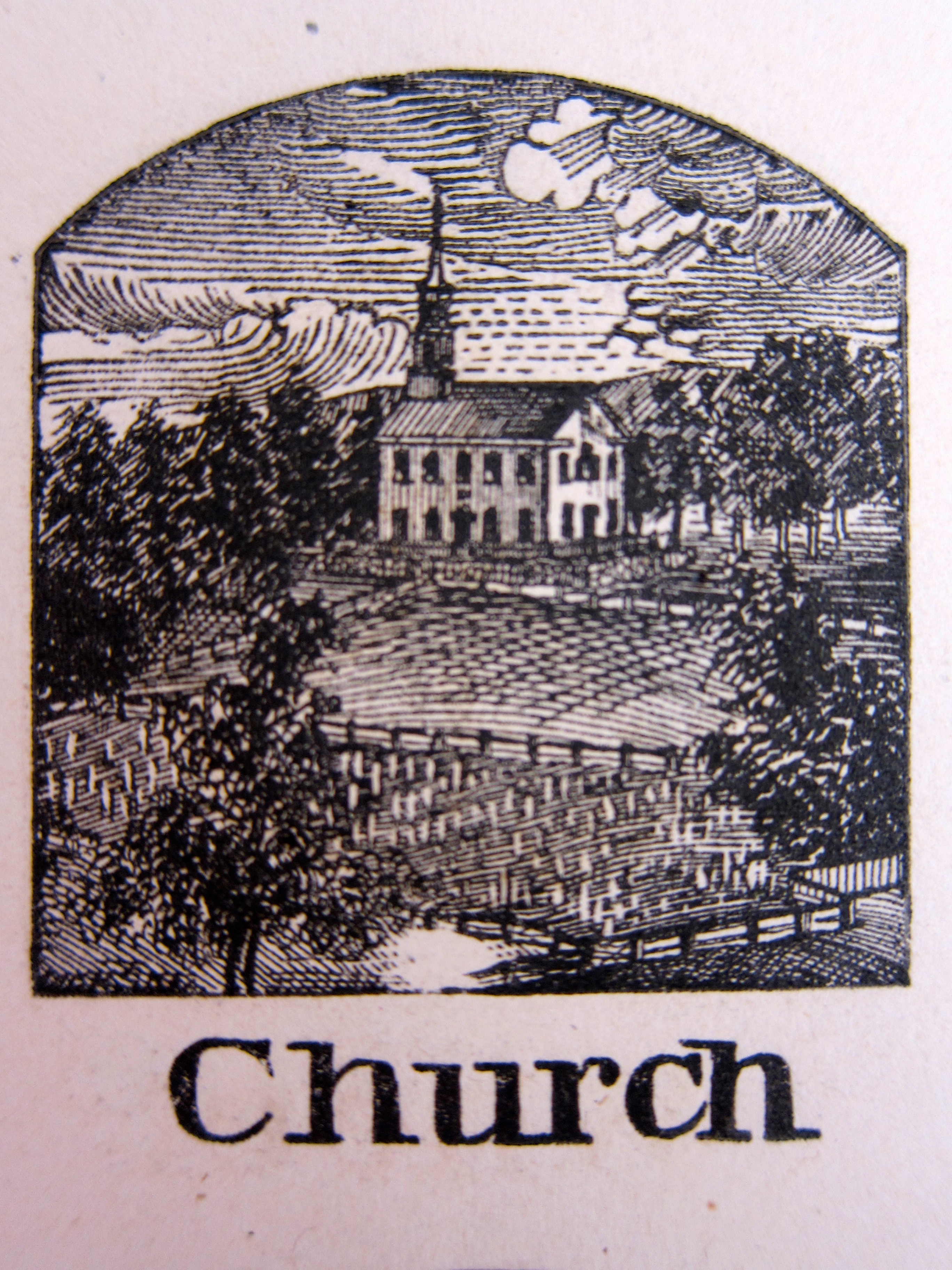
Church

March 2nd  Sunday.  Have been to meeting all day.  Mr Whitwell read

notes for Mr Guilds family  His text in the morning was

I would not live alway  It was an excellent sermon.

In the afternoon his sermon was for the male part

of the congregation.  The good man of the house.

An excellent sermon for my dirty boys if they

would only profit by it.  This evening commenced

reading Woman’s Friendship.  Rather pleasant but cold

Evelina went back to church today for the first time in three weeks.  She had been absent since February 10, the week that she hosted a Unitarian Sewing Circle meeting to which no one came.  To her diary she cited a bad cough as reason for her absence.   On this Sunday, she had finally recovered from that cold.  She had also, evidently, regained her dignity.  Back to church she went and sat right down in the family pew.

Her attention was focused on Reverend Whitwell and his thoughtful words.  She wouldn’t live “alway,” and in the meanwhile she had to work on her sons to become better people.  What did she think of her sons to describe them as “dirty boys?” What did Mr. Whitwell mean, “the good man of the house?”  Did her own good man of the house, Oakes, pay attention to this sermon?

Oakes Ames was actually known for sleeping in church, according to town historian, Reverend William Chaffin.  Chaffin charitably suggested that “Mr. Ames was so hardened with business affairs that he invariably went to sleep in church during the sermon.”  Chaffin also remembered that Oakes Ames stayed awake during his own maiden sermon in North Easton.  Used to seeing Oakes with his eyes closed, someone in the congregation that day chided him about it, to which Oakes replied with typical bonhomie, “Well, I knew Mr. Chaffin was here as a candidate for settlement, and I had to keep awake the first Sunday to see if his preaching was safe enough to sleep under.”


February 22, 1851

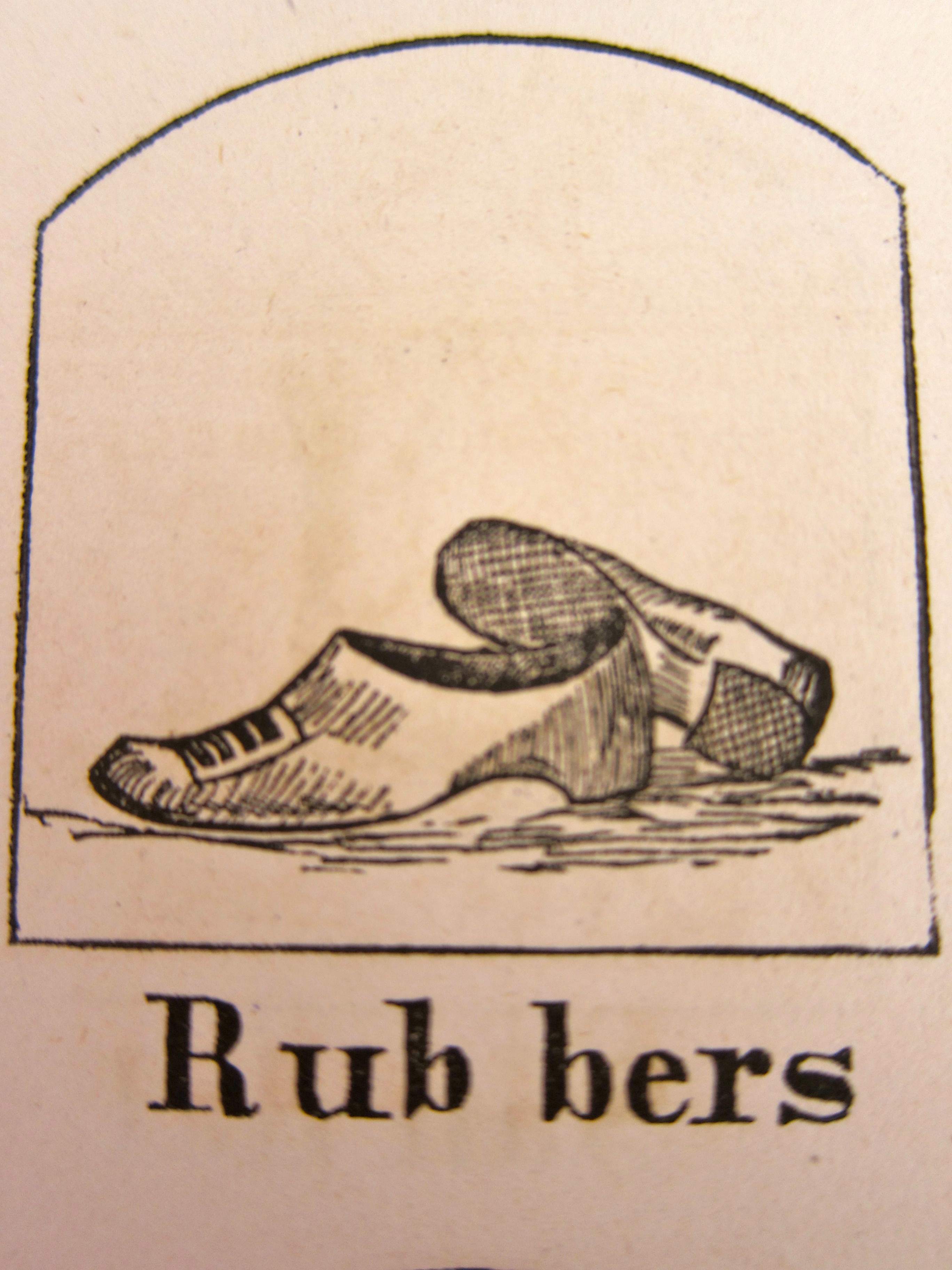
Rubbers

Feb 22nd  Saturday  This morning sat down to sewing

quite early to work on Susans apron.  Mr Torrey called 

to see about Augustus having his tenement.  Augustus

has engaged Mr Wrightmans house for the present.

Lavinia & myself passed this afternoon at Mr Torreys.

Called at the store, met Mrs. Peckham & Miss

Georgianna Wheaton there  Miss Foss came to night.  Mr

Ames has been to Boston brought Susan Rubbers.

Cleared off pleasant to night

In his journal today, Old Oliver noted that “It’s pretty muddy now,” which explains why Oakes Ames returned from Boston with overshoes, known as rubbers, for his daughter.  Probably everyone in the household donned rubbers during this late winter wetness.

Evelina negotiated the streets just fine, it seems, as she and her niece traveled the short distance to the center of town to call at the company store and at her brother-in-law’s house.  Their mutual nephew, Augustus Gilmore, had decided not to rent from Col. Torrey and would be settling his family instead at a Mr. Wrightman’s house.  And at the end of the day, a new person entered the domestic scene.  Miss Orinthia Foss, the new schoolteacher, arrived from Maine.

February 22 is a date that people acknowledged in 1851 in a manner similar to the way people do in 2014, because it’s George Washington’s birthday.  In this year of Evelina’s diary, President Washington had only been dead for a little over fifty years.  People were alive who could still remember him; Old Oliver was one of them.  Old Oliver was born in 1779, while the Revolutionary War was being fought.  He was two years old when the British surrendered at Yorktown, and eight years old when representatives of the new states assembled in Philadelphia to write a constitution.  George Washington was elected to head that convention and became the country’s first president in 1789, when Old Oliver turned ten.  When Washington died in 1799, beloved and mourned, Old Oliver was a twenty-year old bachelor just making his way in the world.  Much about that world would change over Old Oliver’s lifetime, but the reverence that citizens of the United States felt for their first leader would hold strong.

February 21, 1851

Bed

1851  Feb 21  Friday  It stormed so hard & so dark that Mr & Mrs

Whitwell spent last night with us & returned

home about 8 Oclock this morning  Lavinia &

myself have been sitting quietly sewing.

Susan is all engaged making Labels for the shop

has cut quite steady all day.  Helen brought her work in, and staid two

or three hours but I could not prevail on her to stop to tea

Bridget has hired a bed & bedstead

The family business, O Ames and Sons (as it had been known since 1844 when Old Oliver handed over two-thirds of the reins to his sons Oakes and Oliver Jr.) was just that: a family business.  The Ames men all had rolls to play in its operation, from manufacturing to sales to management.  On this day in 1851, it appears that an Ames female had a roll to play, too.  Little eight-year old Susie Ames spent the day making labels for the shop.  Presumably, this meant she was cutting out printed labels to be affixed to individual shovels.  Did she sit at a table in the kitchen or the dining room, paper and scissors in hand?  Was she paid for this effort, or was this just a rainy day game for her?  Who thought this up?

While Susie wielded scissors, the women wielded needles, of course.  Evelina and her niece, Lavinia Gilmore, kept each other company as they sewed and were joined for a few hours by Helen Ames from next door.  Although Lavinia, aged 19, lived in the country and Helen, aged 14, lived in town, the two young women, distantly related by marriage, were friends.

Lavinia was in town visiting her aunt Evelina.  Last night, Mr. and Mrs. Whitwell stayed over, unable to return home because of bad weather.  A new servant, Bridget, had just ordered a bed and bedstead for herself. In a two-family house already filled with ten people, not including servants, where did everybody sleep? People surely doubled up; Oakes Angier and Oliver (3), for instance, shared a bedroom and probably a bed. Although this practice, too, was disappearing, many houses of the period still kept beds in their parlors; apparently the Ames did this, so perhaps that was where the Whitwells spent the night.

The difference between a bed and a bedstead was simply that the former included only the mattress and linens (also known as bedding), while the latter was the frame on which to put the mattress.  This verbal distinction was beginning to disappear at the time, but it was still useful in an era when some people – servants, particularly – only had bedding on which to sleep.  A mattress could be rolled up and moved around, a wooden frame could not.  Bridget showed hope or confidence in her place in the household when she ordered a bedstead as well as a bed.

February 18, 1851

yoke-of-oxen

Feb 18  Tuesday  After doing my usual mornings work sit

down to sewing on Susans work   She sewed with me

and counted stiches again  She will do pretty well

and keep quite steady when we count stiches

This afternoon went into Olivers to assist on Helens

quilt but found it most done.  Was called home

to see Mr Whitwell   Abby & Malvina Torrey & their 

cousin Mrs Fullerton  called  Pleasant

Sewing lessons for eight-year old Susie Ames continued today.  She seemed to be getting the hang of the needle as long as she counted her stitches.  This meant calculating and maintaining an equal number of stitches per inch of sewing. After the lesson was through, Evelina tripped next door to help with the making of a quilt. She discovered that the work was pretty well complete, however, which was just as well as she was called back home to sit with Reverend Whitwell, who came to visit.  More follow-up to the Sewing Circle meeting?

Outside, away from this cozy domesticity, Old Oliver was clomping around looking at oxen to buy.  He found a pair that he particularly admired and seemed pleased with his purchase:

“this was fair day  wind about west and not cold   I bought a yoke of oxen to day of a Mr Whitcom of East Randolph for $125-00 they are a handsom red + look a good deal alike.  he said they would be 6 years old this spring comeing   the off one girts 7 feet + 2 inches + the nigh one 7 feet   they weighed after drinking with yoke on 3220 lb.  the man  said he had them for twins”

And while Old Oliver dealt with the farming side of the Ames enterprises, Oakes and his three sons were no doubt busy at the shovel works, the young men continuing to learn the ins and outs of manufacturing, much as little Susie was learning to be domestic.   The futures of all four offspring were being lined up.