July 25, 1851

Wine glass

Friday 25th July  Was expecting to go to Boston with

Mr Ames & Susan in the wagon but it was

misty & cloudy and we gave up going.  It cleared

up very pleasant about nine  I pick[ed] some 

currants for some wine.  Jane strained them

About ten Oclock Augustus carried me up to

see his new heir, found mother & babe comfortable

Evelina was disappointed not to travel into Boston today; the possibility of bad weather put her off the jaunt. However, she got to see William Gilmore, her new great-nephew.  Her niece-in-law, Hannah Lincoln Gilmore, and the baby seemed to be doing well, which must have been a relief. In an era when childbirth could be dangerous for mother and infant, Hannah and Willie were doing fine.

But what was going on in the kitchen at the Ames house? Evelina and servant Jane McHanna were making wine from the currants off the bushes in the back yard. Why did they do this? Alcohol was never served at the Ames house. As Sarah Josepha Hale, author of The Good Housekeeper, a popular cook book, stated emphatically, “t]here is one rule for drinks which no woman should violate – never make any preparation of which alcohol forms a part for family use!”

Yet here was alcohol being prepared in Evelina’s own kitchen.  Rather than being made to be served as a beverage, however, it was being prepared for culinary and medicinal purposes and, for such cases, it was evidently permissible. In cooking, wine or cider could be used as a preservative in mincemeat pies, for instance.  An even more viable use was as medicine for the sick.  In Little Women, Mr. March stores away some wine bottles for his invalid daughter, Beth. In Evelina’s kitchen, the homemade wine would probably be served to someone who became ill and needed a tonic. A drink called wine whey, made from strained wine and milk, was a common treatment for fever and other ailments. Wine had its uses; distilled liquors did not.

* Sarah Josepha Hale, The Good Housekeeper, 1841


July 9, 1851

IMG_2490

1851 July 9th  Julia is here again to day and my dress

not finished yet  it will take me two hours

or more to get it done  I think it will suit 

me pretty well when it is finished  Mrs Horatio

Ames & Gustavus came to Father Ames this 

afternoon  Frank and Gustavus went to Mr Algers

to get some butter

William Leonard Ames, fifth child and youngest surviving son of Old Oliver and Susannah Angier Ames, was born on this day in 1812, less than a month after the United States declared war against Great Britain. He came along at an unsettled moment in Old Oliver’s life; the latter was attempting to establish a textile factory in Easton, an enterprise that would fail when “peace came along and spoilt the business.”*

William grew up having to compete with his older brothers, Oakes, Horatio and Oliver Jr.  In 1851, he was still vying for his place in the sun, so far without much success. Several years earlier, William had undertaken the management of two separate iron furnace operations in New Jersey, both of which were underwritten by Ames money from Easton. He was not successful, and blamed his lack of success on his brother Oakes. William believed that Oakes, referred to by one historian as “the emperor of New Jersey operations,”** was selfishly working against him.  “Oakes sole object […] is to make everything as unpleasant for me as it can be.”**

The enterprise may have been unlikely to succeed all along. William was focused quite specifically on operational issues while Oakes was looking at the profits to be made from various land deals on the properties in question.  The two brothers had different goals.

William began to close down his affairs in the east and, with his young family, prepared to move west to Minnesota. There, in the St. Paul area, he found success in cattle ranching and lumber. Credited with introducing the first Shorthorn cattle into the territory, “[h]is large and successful farm […] was a practical advertisement for Minnesota as an agricultural region”*** Despite the distance between him and the family in Easton, William made periodic trips back east to see his father, bringing some of his children along.  His only daughter, Amelia, eventually returned to the east to live.

Of all the offspring of Old Oliver and Susannah, William was the most married and had the most children.  His wives, the first two of whom died before he did, were Emily Louise Brown, Amelia Hall, and Anna Pratt Hines.  He and Amelia had six boys and one girl. He and Anna, too, had one son not long before William died, in 1873.

* Oliver Ames, journal

** Gregory J. Galer, Forging Ahead, Brown University

*** ames.spps.org


July 6, 1851

photo

*

1851 July 6th  Oakes A and Mr Norris went to East Bridgewater

this morning and returned this evening  I went to

meeting this morning but had something of a head

ache and did not go but half a day.  Mr Ames

rode with me to Mr Kinsleys  Since meeting had a

very pleasant call  Met a Mr & Miss Kinsley

there from Springfield

In his Fourth of July speech two days earlier at the laying of a new cornerstone for an addition at the Capitol building, Daniel Webster praised the church-going character of the American people:

“I think it is safe to say that a greater portion of the people of the United States attend public worship, decently clad, well behaved, and well seated, than of any other country of the civilized world.”  He could have been describing Evelina as his ideal church goer.  She was undoubtedly well-behaved, nicely dressed and, whatever it means, well-seated.  On the other hand, her husband, Oakes Ames, who chose to wear shabby clothes  and was known for falling asleep in church, was not the image of American godliness that Webster intended to praise.

Evelina did attend meeting today, but only stayed for the morning service.  She had a headache, perhaps the result of hot weather or too much socializing and not enough gardening.  She recovered enough to go to Canton later with Oakes to visit the Kinsley family, a “very pleasant call.”

* W. E. Tucker, The Church Porch, an illustration designed and engraved especially for Godey’s Ladys Books, July 1851


July 5, 1851

Stage

July 5 Saturday  My finger is better and I have been

trying to do some mending  A robe for Miss Burr

was brought to me to make  but I cannot sew

on any thing nice and Mrs Witherell & Ames

made it.  Mr Norris came unexpectedly in the 

stage tonight with Mr Ames & Oliver.

The robe that Evelina was asked to sew was a shroud for Miss Burr for her coffin. Evelina and her sisters-in-law were often asked to sew such robes for the deceased, especially if the deceased had no family with the means or ability to make the robe themselves.  We don’t know who Miss Burr was, but we can infer that she might have been poor and possibly alone.

Sarah Witherell and Sarah Ames sewed the robe, as Evelina’s finger was still too sensitive to push a needle around.  Her finger was getting better, though, or she would have been unable to do any mending.

Oakes Ames and, probably, his middle son Oliver (as opposed to Oliver Jr.) returned from Boston tonight by way of stage coach. The train did not yet go to Easton and wouldn’t until 1855. Accompanying Oakes and Oliver (3) was Caleb Norris, an in-law of the Orr family in Boston.  Caleb had recently married Melinda, one of the Orr daughters. Caleb worked in retail in the city.  His purpose in traveling to Easton was unplanned and remains unclear. Possibly he was just making a visit; he was probably close in age to Oakes Angier and Oliver (3) and may have been friends with them.


June 29, 1851

portrait of yoiung man yawning

 *

1851

June 29th Sunday  Went this forenoon to meeting

came home again did not feel like going

back again as it [was] very warm and I was very

sleepy and thought I might as well sleep at 

home as at church  After meeting at night

Mr Ames & I walked to Mr Peckhams to see

Mrs Swain.  She is a very pleasant woman I

should judge.

Small wonder that Evelina nearly fell asleep in church this morning. Reverend Whitwell’s sermons usually held her attention, but she was tired. She’d been busy all week, augmenting her usual chores and interests with a visit from her brother, John. On top of the emotional excitement of that rare reunion, she went to Boston yesterday, an excursion that typically delighted and exhausted her at the same time. She needed a nap.

Late in the day, evidently refreshed, Evelina and Oakes walked to the home of John and Susan Peckham. Mr. Peckham served as clerk for the Ames Shovel works, but was preparing to move away with his young family.  Replacing him, apparently, was the new clerk, John H. Swain. Evelina had already met Mr. Swain when he dined with them back in May. Tonight she met his wife, Ann, who made a favorable impression. The two families would become close over the years.

 * Photographer Unknown; portrait of a young man, yawning; ambrotype; ca. 1854; George Eastman House, Donald Weber Collection


June 25, 1851

14 Fanny Palmer (American artist, 1812-1876) Published by N Currier American Farm Scenes 3 1853

*

1851

June 25th Wednesday  Worked awhile in the garden and 

then sit down to sewing with mother

After dinner Francis came after mother […]

John & wife and Miss Wait (Otis Howards lady)

arrived there about nine  I went home with

mother and Mr Ames came after me Had

a very pleasant visit  By what they say I 

should judge the west point students had rather

a hard time


Beyond today’s normal work load of gardening and sewing lay a very special event. Evelina traveled south to the family farm where she had grown up, something she often did.  The farm was now owned and worked by her older brother, Alson; it was there that her mother usually resided.  But today, another brother, John, came to visit and joined her there.  The three siblings, John, Alson, and Evelina, were the only survivors of a brood of eight. It was a rare family reunion for them and their mother.

Most historical accounts place John and his wife, Huldah Alger Gilmore, in South Leeds, Maine.  This was probably accurate, as no evidence exists otherwise. Gilmore is not an uncommon name, however, and the postmaster John Gilmore in Leeds, Maine may not be Evelina’s brother.  Evelina’s reference to a discussion about West Point suggests a possibility that John and his wife could have lived there.

Regardless, Evelina seemed very happy to see her two brothers.  Her husband, Oakes, came along eventually to see his in-laws and fetch his wife back home to North Easton.

* Currier & Ives, Farm Yard, ca. 1853


June 22, 1851


strawberry

1851

Sunday 22nd June  Have been to meeting to day Heard two

very good sermons from Mr Whitwell  Mother came

home with us to spend a few days.  Since meeting

mother Mr Ames & myself rode to the ponds and to 

Mr Manlys garden  Mother was delighted with her ride

seemed to enjoy it as much as a child  When we

returned we found Emily sick  She is very much

out of her head  Dr Deans called but did not come in

Went to Mr Horace Pools at noon for strawberries


“Doubtless, God could have made a better berry, but doubtless God never did,” was a well-known remark about strawberries made in the 17th century by William Butler. Unlike today, when modern agriculture has developed a system that brings us strawberries any time of year, in 1851, the fruit was still strictly seasonal and short-lived. Strawberry season was much looked forward to.

Horace and Abby Pool evidently had a good strawberry patch at their home in south Easton, to which they invited a few fellow parishioners during the intermission at church.  Had the strawberries already been picked, or did folks wander through a strawberry patch in their Sunday finest, a la Emma Woodhouse at Donwell Abbey? Was the fruit served with cream and sugar, or taken home to be eaten later?

The fine day continued after church when Oakes and Evelina took old Mrs. Gilmore for a ride north to see the ponds and visit Edwin Manley’s garden. On a less delightful note, Sarah Witherell’s daughter, Emily Witherell, suddenly took sick. “Out of her head,” Evelina described her, suggesting perhaps that Emily had a high fever. The doctor was called.

June 17, 1851

DSCF1590small

1851 June 17th  Worked untill about nine Oclock in

the flower garden  Then cut the tick to the mattress

a[nd] basted it ready to make  Jane was ironing and 

I assisted about dinner  After dinner made three button

holes in Mrs S Ames dress.  Went to Mr

Wm Reeds to tea with Mr Ames, Oliver & wife

Mrs W, Mitchell & Mr & Mrs Whitwell & Alson & wife


Gardening, sewing, ironing and cooking made up today’s housework at the Ames’s home on Main Street.  Buttonholes, too, which could be challenging, were a particular specialty of Evelina; many people brought her their buttonholes.  The fact that Sarah Lothrop Ames took her buttonholes to Evelina rather than to a hired dressmaker underscores Evelina’s talent in this department.

William and Abigail Reed must have enjoyed Evelina’s company on Sunday between services, for they invited her back to a small tea party.  The whole Ames family was invited, in fact, and then some. Minus Old Oliver, and the young people, naturally, siblings Oakes, Oliver Jr., Sarah Witherell, and Harriett Mitchell, with wives Evelina and Sarah Ames, gathered at the old professor’s home for a “cuppa.” Reverend William Whitwell and his wife, Eliza, went too, as did Alson and Henrietta Gilmore. That was a good crowd for a 19th century parlor.

Tea was generally the most sociable meal of the day.


June 15, 1851

Burning_Bush_Dictamnus_Fraxinella_Seeds

June 15 Sunday  Have been to meeting all day.

At noon went with Alsons wife & Rachel to

Mr William Reeds had a very pleasant call

Since meeting walked with Mr Ames & Susan 

up to the fly away pond and home by

Edwin Manlys to see his flowers  he has 

fine plants in blossom, among others the

Fraxinella  It sprinkled some and we called

at Mr Peckhams & saw Mrs Washburn

The weather over the past week was so mild that, despite the occasional sprinkle, folks were outdoors as much as possible. Evelina made all kinds of social calls today.

At the intermission between services, she went calling with a sister-in-law from the Gilmore side of the family: Henrietta Hall Gilmore, wife of Alson.  Henrietta was Alson’s second wife, his first having died young, and mother of six of his seven children, including Lavinia, of whom we have seen much this past spring. With Henrietta was someone named Rachel, who was possibly Henrietta’s daughter or another niece with the same name. The ladies called at the home of William and Abigail Reed.  Mr. Reed, older than Evelina by a generation, was a former teacher at Milton Academy and a graduate of Harvard’s Divinity School, although he never settled in a particular parish.  An acting Justice of the Peace, Mr. Reed was well known and well liked.

This afternoon after church, Evelina, Oakes and their daughter walked the road to Fly Away Pond and on to Edwin Manley’s garden.  There the Fraxinella, also known as Burning Bush, caught Evelina’s eye.  More for her garden?


* Fraxinella, seedempire.com

June 13, 1851

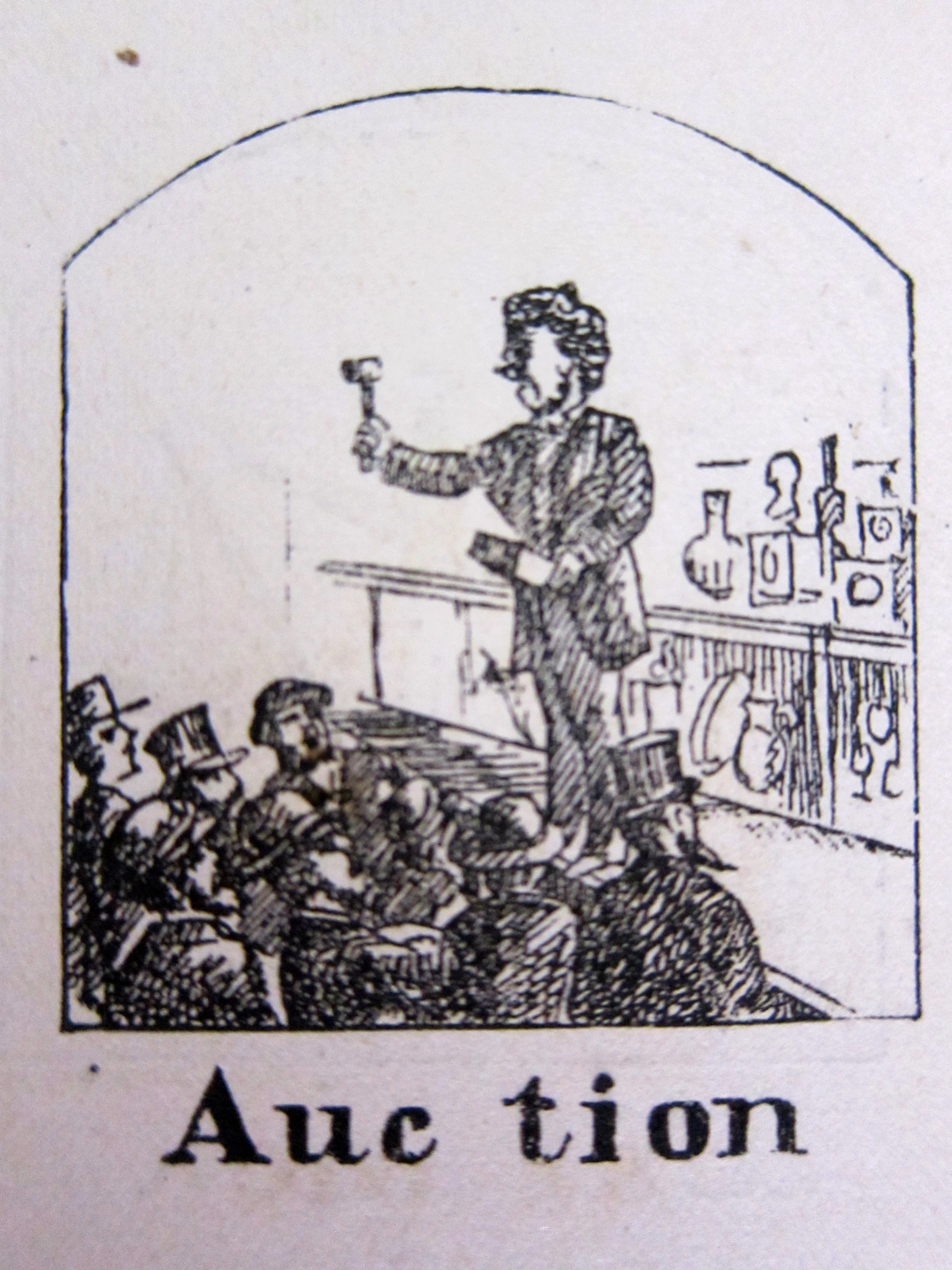
Auction


June 13 Friday.  Miss Eaton left this morning.  Mr

Ames attended Mr Thayers auction bought the place

While he was gone I mended his coat

I have finished Susans green borage Delaine

Harriet & Lucia Mitchell & Mrs Reed came

to the other part of the house about ten &

stoped till about two Oclock – I have spent 

most of the afternoon there.  Bridget here to work

Went in the evening to hear Willard preach


Oakes Ames bought a “place” today at auction, an event that must have been somewhat informal given that Oakes didn’t wear his coat.  The property he bought may have belonged to a shoemaker named Charles Thayer who died around this time.  There were many Thayers in Easton, however, and had been for generations.  Where was this property?  And what did Oakes do with it?

Although the date was Friday the 13th, Evelina would have had no concern about bad luck as our modern superstition that the date is unfavorable was not yet established. In the 19th century and before, some cultures did consider 13 to be an unlucky number, coming as it does after the number 12, which tends to be auspicious.  Others thought that Friday was an unpromising day of the week, not a good day to start a trip, for instance.  But it wasn’t until the late 1860s that the two bad omens merged and became an ominous symbol unto itself.

Interesting that Willard Lothrop, Easton resident, shovel worker and Spiritualist, spoke this evening to a group – and that Evelina went to listen. Spiritualism (which, Chaffin* reminds us, is “not, strictly speaking, a religious denomination,”) had a foothold in Easton and would for years to come. In a curious juxtaposition, a later officer of the “First Spiritual Society of Easton,” would be Fred Thayer, son of the very Charles Thayer whose property we think was sold today.

William Chaffin, History of Easton, 1886