November 8, 1851

Vegetables

Sat Nov 8th  Jane is still in Mansfield and Bridget

sick consequently I have to do the housework and

I have scarcely sat down for one moment  Alson

came up with a load of vegitables and Hannah

called and I left my work while they stopped

Mrs Witherell came home this evening and I have been

in there  Mr Ames went to Boston stopt at Canton to a

whig meeting.  Oakes & Frank brought him home.

Not only was the dependable Jane McHanna away, but the Ames’s second servant, Bridget O’Neil, was sick.  Dr. Ephraim Wales had checked in on Bridget the previous evening but she was still laying low.  Evelina, capable if disinclined, was faced with doing her own housework. She spent most of the day choring, as she called it.

Her brother, Alson Gilmore, drove a wagon up from the Gilmore family farm to deliver a “load of vegitables” to the Ameses. His daughter-in-law, Hannah Lincoln Gilmore, who lived right in the village, came to call and for those visits, Evelina paused to chat.  Once they left, however, she must have plunged into sorting and storing the vegetables that Alson had brought. By this time of year, they would most likely have been root vegetables such as turnips, parsnips, carrots and potatoes. She would have stored them somewhere cool, dry and varmint-free: the cellar, if it wasn’t too wet, or the buttery or even the shed. Sharp-eyed housewife that she was, Evelina would have made sure everything was put away safely.

Oakes Ames, meanwhile, went to Boston as usual on this Saturday, but also “stopt at Canton to a whig meeting.”  The following Monday was Election Day and the party faithfuls were gathering in anticipation. This is the first mention in Evelina’s diary of Oakes’s participation in local politics. Their son, Oakes Angier, had shown interest earlier in the year, running unsuccessfully for the Easton school superintending committee, and attending the Whig convention in Springfield.  But her husband’s interest, although it had probably existed prior to this moment, had not drawn comment. Evelina mentions the meeting most likely because of the impending vote, but the statement coming so close on the heels of an undisclosed agreement she and Oakes had made only one week earlier gives creedence to the possibility that their agreement had something to do with Oakes’s waxing interest in politics.

November 2, 1851

IMG_0540

1851

Sunday Nov 2d  This has been a stormy day, but this evening

has cleared off pleasant  I have been to meeting all

day & went to Mrs John Howards at noon with

Lavinia & Mother  Mr Ames came home at noon and it rained

so hard that he did not go back.  Mr Whitwell

gave us two fine sermons.  Mr Ames & self passed

the evening at Augustus.  Have made an agreement

which I hope we shall both be careful to keep.

At the end of this rainy, chilly Sunday at the start of November, “the most disagreeable month in the whole year,” according to the fictional Margaret March, eldest of Louisa May Alcott’s four sisters in “Little Women,” our non-fictional Evelina and her husband, Oakes, reached an important decision.  Unfortunately, we don’t know what that decision was.

Surely this entry is one of the most tantalizing in Evelina’s diary. She and Oakes “made an agreement” that she hoped they’d “both be careful to keep.”  What did they decide? What promises did they exchange? Oakes had been away from home a great deal lately; did their discussion stem from that? Was this the moment when Oakes determined to become involved in regional politics? Would he have needed Evelina’s approval?  If this was the case, what might he have asked of her, or offered her in exchange?

Or was the decision less historic and more pedestrian? Did their discussion have anything to do with domestic arrangements or the recent spending on the house? Were they going to exercise more prudent care of their “accounts,” as Evelina calls them? Did their agreement have something to do with their children? Did it stem from something Reverend Whitwell said in one of his “fine sermons”? What was this agreement?

And were they able to keep it?


October 28, 1851

fig7

*

Tuesday Oct 28.  Have been assisting Mr Scott about papering

again to day and have painted over some things

and places about the house. Finished papering the

sitting room and little entry just after dinner

Hannah called with Eddy a few moments

Mr Ames is still in Boston passed last

night there.  I spent the evening in the other

part of the house.


Yesterday’s unseasonable snow storm departed and left behind “a fair day**”  Evelina seemed not to notice the difference, focused as she was on the repapering and repainting of the downstairs of her part of the house. She was helping with the actual papering. Her husband, Oakes, was away in Boston, so her only responsibility was making sure that meals were on the table for sons Oakes Angier and Frank Morton and daughter Susan Eveline, a task she typically delegated to her servants.

Hannah Lincoln Gilmore, who was married to Evelina’s nephew, Alson “Augustus” Gilmore, paid a call with her older son Eddy. Edward Alger Gilmore was a toddler who had fidgeted more than once in his great-aunt’s parlor. He was only two years old, and probably couldn’t yet pronounce his name.

Eddy’s middle name came from his maternal grandmother, Rachel Howard Alger (1802-1823), the first wife of Alson Gilmore and mother of Hannah’s husband, Augustus.  Rachel died less than a year after Augustus was born; Augustus couldn’t have remembered her, but he clearly wished to honor her by naming his own first-born after her. The Alger family was settled in Bridgewater, Taunton, and Easton, all descendants of a Thomas Alger in the 17th century. Both Evelina and Sarah Lothrop Ames were among the hundreds of descendants in the Thomas Alger line.


* Illustration in “Scientific American”, ca. 1880, of machine production of wallpaper, New York, Courtesy of National Park Service, http://www.cr.nps.gov/history/online_books/tpsd/wallpaper.

** Oliver Ames Journal, courtesy of Stonehill College Archives


October 27, 1851

winter_snowfall-t2

Monday Oct 27th  Mr Scott came this morning about nine

It being very stormy he could not get here before

Mr Smiley came just before and worked about

three hours.  After dinner went to Mansfield.

I have been helping Mr Scott paper the sitting

room  Have been busy all day about the 

papering.  Mr Ames went to Boston this afternoon

was also gone Thurs & Friday of last week


Snow! At least that’s what Old Oliver reported in his journal: “this morning the ground was coverd with snow and it snowd about all the forenoon, and was cold. wind north west + blowd hard, at night the fields are coverd with snow 2 or 3 inches deep – there has bin 1 ¼ inches of rain this time”  Evelina only reported that the weather was “stormy.”

Not only did the weather interfere with the travel of the workmen; it also surely challenged servant Jane McHanna as she attempted to wash and dry the weekly laundry. Yet it didn’t seem to prevent Oakes Ames from heading to Boston in the afternoon.  He had been there often of late.  Indoors, Mr. Scott continued to put up new wallpaper in the downstairs.  The redecorating and attendant removal of much of the furniture had been going for a week.

It was the 300th day of the year.

October 25, 1851

WHEATLAN-h

*

1851

Sat Oct 25th  Mr Scott & Holbrook have been to work

all day papering the parlour and they have got

it papered only from the little entry door

around to that corner of the mantlepiece.

Mr Smiley worked here about two hours to day

put on the border in the parlour as far as it [was]

papered and some paint on top of the closet

shelves.  I have trimmed the paper and &c.


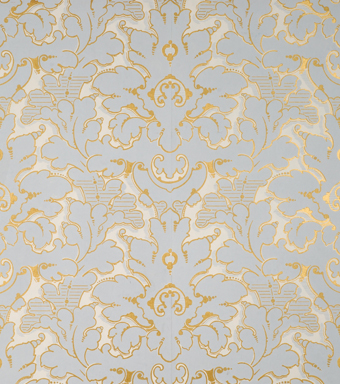
The wallpaper in the illustration above is an example of a mid-19th century pattern that might have been available in Boston, where Evelina purchased her new paper for the parlor. Two men, Mr. Scott and Mr. Holbrook, did some papering today, but not fast enough to suit Evelina. She was so eager to have the paper up that she helped by trimming some of it herself.  What did the workmen think about that? Mr. Smiley, who only seemed to work a few hours at a time, applied a border to what paper had been put up and painted a few shelves.

Oakes Ames was probably absent today, as Saturday was his usual day to be in Boston taking orders for shovels. Sons Oakes Angier and Frank Morton would have been at the factory across the street, honing their skills in the manufacture of shovels. Little Susie was probably at school.


*Example of mid-19th century wallpaper, courtesy of adelphiapaperhanging.com

October 24, 1851

pantry-shelves-vintage-650-225x300

*

Friday Oct 24th  Jane & Bridget have cleaned the buttery

and I have had some paint put on the 

shelves  Mr Smiley worked here about three

hours, he went to Mansfield and came here 

about two Oclock.  Scott & Holbrook have finished

the first coat to the sitting room & parlour

I have been about house most of the day.  Sit awhile

with Susan Orr.  Capt Isaac Lothrops wife buried this P. M.

Much cleaning was going on at the Ames’s house in tandem with major redecorating. Evelina the housewife was impelled to tidy everything up before and after various workmen came through to scrape, dismantle, build, paint and/or paper the downstairs rooms. Her servants, Jane McHanna and Bridget O’Neil, scurried around with her, clearing shelves so that the men could follow and do their work.

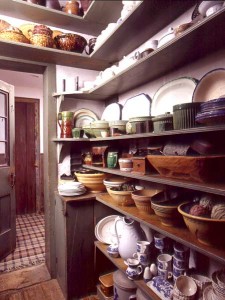
The buttery that Evelina mentions was, in fact, a shelved area off her kitchen that served pretty much as a pantry.  She had food storage “down cellar”, of course, but the buttery, being close by and on the same floor as the kitchen, would have been more accessible for daily use.  She would have stored everyday items like coffee or tea there, for instance. If the Ameses had kept dairy cows, milk would have been poured into pans there, to be skimmed for cream.  Yet the term buttery derives not from its use for dairy products, but from an archaic British term for the room where large caskets of wine, known as butts, were stored. (One butt was the equivalent of two hogsheads or four barrels of wine.) There was no storing caskets of wine at the Ames’s.

Oakes Ames was away during yesterday and today’s disruption, though sons Oakes Angier and Frank Morton and daughter Susan Eveline were home and had to sidestep the disarray. Oakes was away on shovel business, most likely.  No one from Evelina’s household appeared to attend the funeral of Isaac Lothrop’s wife.


* 19th century pantry, courtesy of http://www.oldhouseonline.com, photo by Gross & Delaney


October 18, 1851


Herman_Melville_1860Herman Melville

Sat Oct 18  Have been to Boston with Mr Ames to day &

have bought Paper for the sitting room &c &c

went into all the stores where there were ribbons

to match my dress could not find a good one

Did not get near all the things I wanted

Lavinia came here to night.  Mrs S Witherell

& Miss S Orr called a few moments

It was a full Saturday for Evelina. She accompanied her husband into Boston and while he probably visited customers and took orders for shovels, or collected payments from various vendors, Evelina went shopping. She purchased new wallpaper for the sitting room and more. She was on a tear to refurbish the old homestead – or at least her half of it – yet wasn’t able to “get near all the things” she wanted.  She searched for ribbon, too, maybe to go with the new cashmere dress that she and Julia Mahoney only recently finished.

Evelina and Oakes returned to Easton in time to welcome niece Lavinia Gilmore for the night. As they traveled back from the city, they may have noticed the sky beginning to cloud up, pushed along by winds from the south. After their return, Sarah Witherell and her houseguest, spinster Susan Orr, popped in from the other part of the house, perhaps to ask what wallpaper Evelina had selected.

Far away, in London, 500 copies of a new novel called “The Whale” were published today in three small volumes. In a month, the same book, written by young American author Herman Melville, who dedicated it to his friend Nathaniel Hawthorne, would be published in New York with an added title: “Moby-Dick.”  Evelina never mentioned it, but might she have read it?

October 17, 1851

OLYMPUS DIGITAL CAMERA

Friday Oct 17 Was working about house most of the

forenoon and have been sewing on Susans

and my dress.  Carried my work to Augustus

for a couple of hours this afternoon.  Lavinia

and Abby were there  Mr Ames has been quite 

unwell for a day or two and to night has taken

a warm bath  I have written a letter to Oliver

this evening  Mr Ames sent him a check for 25 Dls.


Oakes Ames had taken ill. Had he caught the nettlerash from his wife and daughter? Or was his illness something closer to a simple bad cold? He was “quite unwell.” Whatever he had, Oakes chose to palliate his ailment with a hot bath. Did he take a sitz bath, one that would alleviate itching from a rash?

That Evelina makes note of her husband taking a bath insinuates that his bathing was something out of the ordinary, which wouldn’t be unusual for the era. Regular bathing, which for many meant a weekly bath, was only just becoming the norm, and indoor plumbing was only just taking hold in urban areas.  Unlike the image in the illustration (which was published circa 1877), most bathtubs at mid-century were still free-standing.  The bath water was poured from buckets of hot water, which had been drawn from a well or cistern or kitchen pump and heated on the stove.  (Thus the expression, “to draw a bath.”)

The Ameses were fortunate in having their own indoor plumbing, a fact we know from Winthrop Ames’s mention in his family history of a “bathing room” in the house. Was this room shared by both families, as the brick oven was?

Oakes wasn’t too ill to write a check for his son, Oliver (3), who was away at college. Evelina wrote to Oliver and perhaps enclosed the check with her letter.  Had Oliver written home asking for money?  Such a scenario is certainly time-honored.


October 14, 1851


Corpse


Tues Oct 14th  Expected Julia here to work this 

morning but she sent word that she would not come

untill afternoon and it has put me back about my work.

Went to the store and got muslin for Mrs Willis robe,

and linings for dresses.  Helped Mrs Witherell & Mrs S

Ames make the robe  Julia came this afternoon & cut

the waist to my dress  Mr Ames has been to Boston &

Braintree

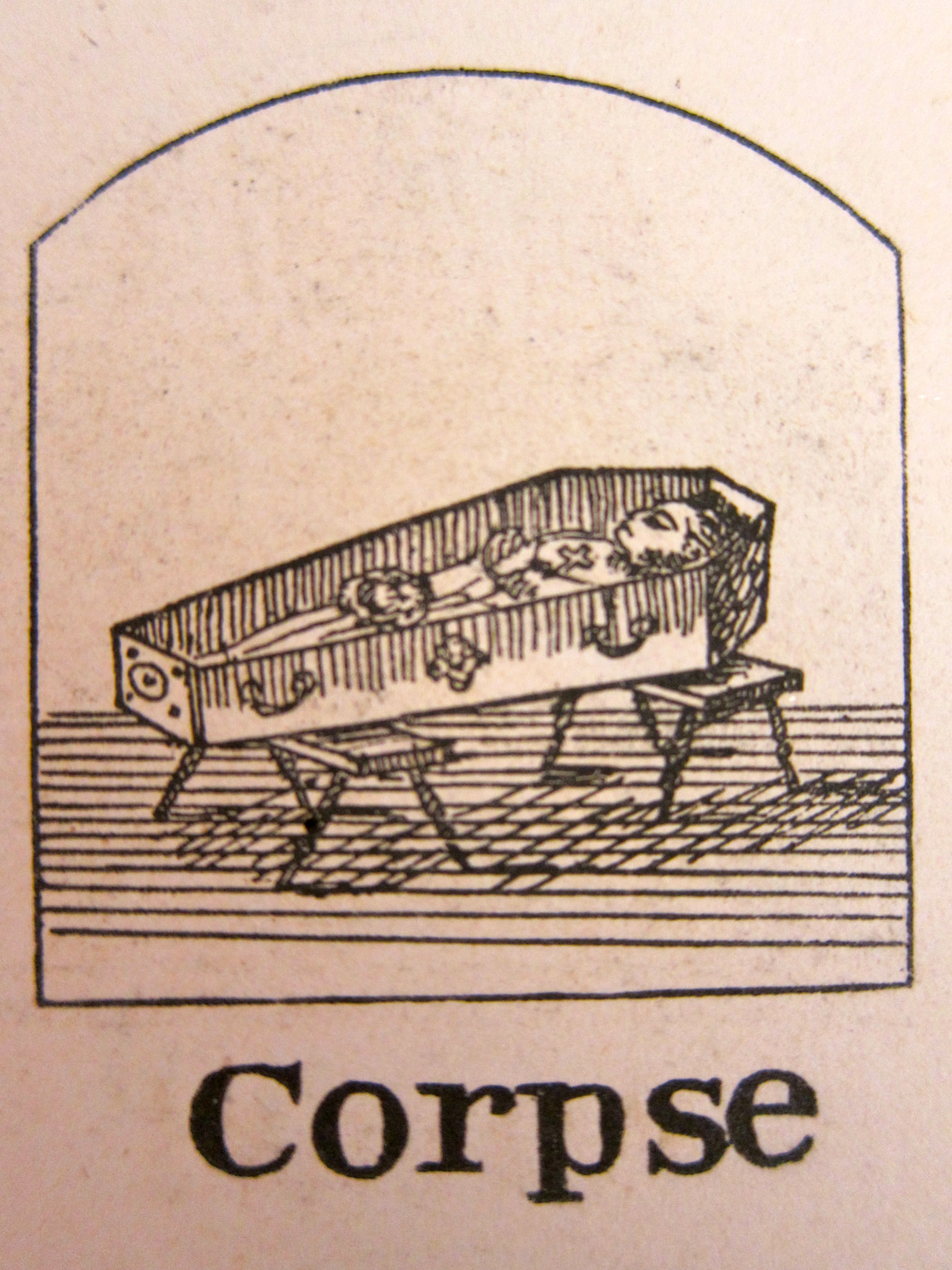
The sad business of sewing a robe, which is what the Ameses called a shroud, fell to Evelina and her sisters-in-law. The Ames women often were called on to make robes for the deceased, as they did today for a neighbor, Mrs. Willis. Mrs. Willis, who had died the day before, presumably had no family members who could otherwise sew the robe. Evelina herself picked up the muslin, the traditional material for a burial sheet, from the Ames store. The process of preparing the dead for burial tended to follow the existing customs:

“Before the Civil War, the care of the dead was largely the domain of the deceased’s family and neighbors. The corpse was customarily laid out on a board that was draped with a sheet and supported by chairs at either end. The body was washed, almost always by a female member of the household, and wrapped in a sheet for burial. A local carpenter or furniture maker […] supplied a coffin, a simple pine box with a lid. The undertaker, often the same carpenter or furniture maker […] took the coffin to the house and placed the body inside. With the family and friends gathered around, the minister performed the appropriate religious rituals, and then the undertaker conveyed the coffin to the graveyard.”*

Other sewing went on today as well. Evelina had spent the past several days piecing together a dress made of cashmere, and was waiting for the dressmaker of choice, Julia Mahoney, to work on the waist.  Julia was late, however, which threw a wrench into Evelina’s plans for the day. Evelina didn’t like tardiness, and was unhappy to have to rearrange her day. Eventually, however, Julia arrived and “cut the waist.”

Oakes Ames, meanwhile, went into Boston and Braintree, presumably on shovel business.  Saturday was his usual day to go into Boston; it being Tuesday, perhaps something beyond Oakes’s usual job of taking orders for shovels was called for.

*http://www.memorialhall.mass.edu/classroom/curriculum , “Death and Dying in the 18th and 19th Centuries”


October 9, 1851

IMG_1057

Thursday Oct 9th  Jane has been sick to day went to bed directly

after washing the breakfast dishes and I had to get

dinner  After dinner she was much better and was

able to […do] the dishes  This afternoon I have passed

in Olivers with Miss S. Orr.  Mrs Witherell & Mitchell

Mr Ames & William there to tea Have trimmed

Susans bonnet with dark ribbon


Jane McHanna was sick.  The domestic team at the Oakes Ames house was barely operational, what with Evelina herself still feeling the effects of a mean case of nettlerash. But between them, the two women, servant and mistress, managed to make meals appear on the dinner table in a timely fashion. Did the men of the house appreciate the extra effort going on behind the kitchen door?

Tea was a special event today, served next door at Oliver, Jr. and Sarah Lothrop Ames’s. Present were five of Old Oliver’s six surviving children: Sarah Witherell, Harriett Mitchell, Oakes Ames, William Leonard Ames, and the host, Oliver Ames, Jr. William was visiting, if not from New Jersey, then from his current way station on his journey to Minnesota. Harriett, too, held visitor status;  she and her children were about to return to her husband in Pennsylvania. Only Sarah Witherell, Oakes, and Oliver Jr. lived in North Easton and saw one another regularly.

Missing from the group was Horatio Ames, who lived down in Connecticut. No one’s favorite sibling, some – Oakes, particularly – may even have appreciated his absence. Interesting that Old Oliver himself isn’t mentioned as being present.

Another guest who was also there at this rare gathering of the clan was Miss Susan Orr, a long-time family friend (or relative?) who had known the group when they were children. She could remember Oakes Ames as a baby. Susan had been staying with Sarah Witherell and Old Oliver for about ten days. Meanwhile, a different Susan, only nine-years-old, got her bonnet trimmed with a new ribbon.