December 20, 1851

unnamed Dec 20 Saturday  Have been very busy all day working

on different articles  Mended some clothes

for Frank, the stockings and mended the

places that were cut & bound the end of

some pieces of carpeting Jane finished the 

second robin that she has made for Frank

Mr Ames brought home some marble rubber

and lining & ribbon for Susans bonnet   ”


[T]his was a fair day and not verry cold” was the weather report from Old Oliver Ames. It was a normal Saturday at the Ames’s house in all respects. Evelina mended clothes, darned socks and repaired some carpeting.  Jane McHanna sewed, too, having recovered from an acute indisposition caused by coal the day before. She finished a “robin” (which one reader suggests was a kind of tough work pants) for Frank Morton Ames, Evelina’s youngest son.

Oakes Ames went into Boston, as usual, for a weekly check-in with shovel customers, after which he went shopping for his wife. From a list Evelina must have given him, he made his way along Washington Street and around Faneiul Hall, probably knowing just which shop to go to for such-and-such ribbon or a well-priced bolt of flannel. He returned to North Easton laden with parcels wrapped in paper and tied with string.

December 18, 1851

62834-004-ED8B9BE0


A Delaine Sheep

Dec 18 Thursday  Finished the back of Susans hood

and finished the blue and orange deLaine

for self that Julia cut a new waist for last spring

Mary left this morning said she was going

to Bridgewater for her clothes   It is bitter cold and 

I fear she will suffer  Jane has finished two

prs of cotton flannel drawers for me that she

has been sewing on since she was sick

Another “fair cold day;”* not an ideal time for the servant, Mary, to travel from North Easton to her home in Bridgewater.  Whether she rode or walked, she must have been quite exposed and have become sick, for she didn’t return to the Ames household for the rest of the winter. She only reappears in Evelina’s diary the next July, working by that time for Alson and Henrietta Gilmore at their farm.  What prompted her departure?  Was she homesick for family in Bridgewater, or tired of working at the Ames’s house?

Sewing was today’s occupation of choice for Evelina and her remaining servant, Jane McHanna. Evelina picked up an unfinished project from the previous spring, one that she had nearly finished with help from local dressmaker, Julia Mahoney.  It was a “blue and orange deLaine,” meaning that it was a print or plaid, fine-weave, challis-like wool dress, one that would be of service in this cold weather. The wool itself came from a type of Merino sheep known as a Delaine (as in, “of wool” in French.) Jane, meanwhile, sewed some flannel underclothes for Evelina, who would be warmly dressed once these articles were finished.

Next door, in the other part of the house, a man named Holman Johnson, probably visiting on shovel business, stayed the night.

*Oliver Ames Journal, Stonehill College Archives, Arnold Tofias Collection


December 17, 1851

Sleigh

Dec 17th  Wednesday.  Mary went to ironing this

morning and Jane did the housework and I have been

knitting on Susans hood have got the front done and 

commenced the back  Abby spent the afternoon

& Malvina came in past eight  Jane ironed 7

shirts this afternoon  Very cold weather

Old Oliver Ames didn’t always agree with his senior daughter-in-law, but on this day he and she shared the same opinion about the temperature outside. “[T]he coldest day we have had this winter,” he wrote in his journal. Not surprising that Evelina and her servants stayed inside and focused on their indoor domestic responsibilities. All three women seemed to have recovered from their recent colds and illness and they probably wanted to keep it that way.

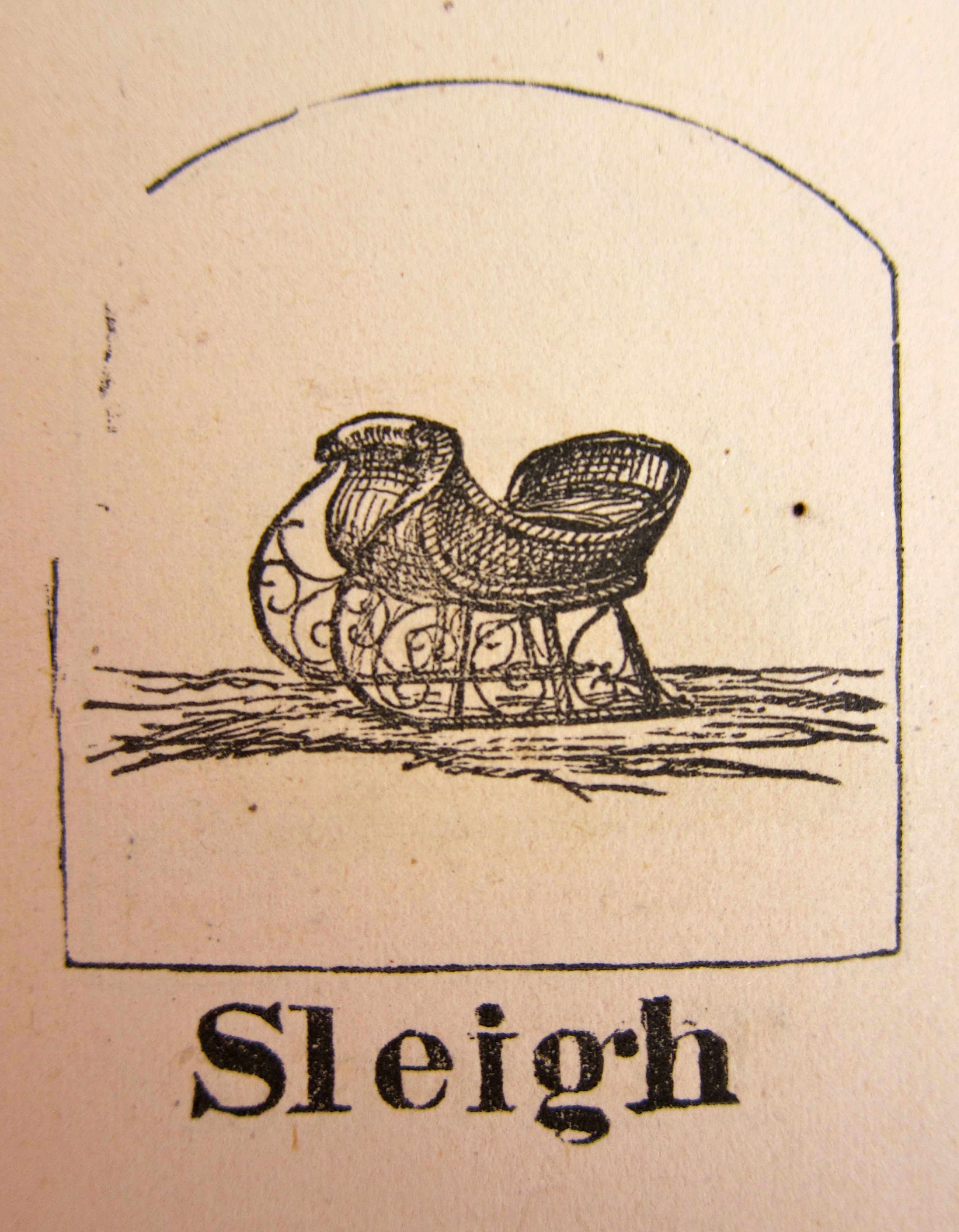
Some people went outside, though.  Evelina’s nieces, Abby and Malvina Torrey, spent part of their day with her.  They must have walked over from the village – a short walk, fortunately, in the windy, freezing sunshine.  Other Eastonians who were out and about would have moved around best in their sleighs, as a buildup of snow had hardened into a smooth, slick surface on the roadways.  Old Oliver himself may have gotten around that way.  He noted that “light slays run pritty well now.”


December 4, 1851

Clerk

Dec 4th  Thursday.  Returned from Boston to night

Have got the greater part of the things

I wanted.  could not suit myself in all.

Mother spent yesterday with Augustus & to day

at Mr Torreys returned here this evening

Left Mr Orrs this morning did not dine there

it takes so much time  Julia is at home

It is three weeks [entry ends here]


After seeing her husband off on his business trip to New York, Evelina spent yesterday and today shopping in Boston. She seemed satisfied with her purchases, though she confessed that she “could not suit myself in all.” Was she buying cloth or ribbon or other fashion accessories, or decorative items for the refurbished parlor, or foodstuffs for the pantry? It was early December, a time in our own culture when we modern folks are apt to be out (or online) shopping for Christmas presents. Evelina may have been buying Christmas gifts for her family, although that is unlikely, as the Ameses barely recognized Christmas, let alone celebrated it.

Although public opinion in New England was changing, a poor opinion of Christmas prevailed among the Yankees of Evelina’s generation, and certainly of Old Oliver’s. It was based on a Puritan tradition that considered Christmas as “an emblem of popery.”  Yankees “were strongly influenced by the traditions of Calvinism and the routine of the established Congregational church, honoring a certain stoicism, hard work, and stern independence.”  Instead of Christmas, “Thanksgiving was the most important day of the year.”* That would change.

But Evelina must have caught the train back to Stoughton, or the stage home to Easton, empty-handed of the kind of Christmas plunder that her favorite author, Charles Dickens, so famously described.


*Jane Nylander, “Our Own Snug Fireside,” 1993, New Haven, p. 8


December 3, 1851


railnet1850

Dec 3d  Wednesday.  Mr Ames started for New York by

way of Boston.  I went to Boston with him dined

at Mr Orrs  Melinda went for Selina and

she passed the night there with me.  I was very

busy shopping all day  In the evening Mr & Mrs

Norris  Selina & self played cards  Past eleven

when we retired.  Mr & Mrs Byram were there


As Old Oliver wrote at one point in his journal, “Oakes went to New York the 3rd of this month to settle up our accounts.”  With his natural bonhomie and sharp talent, Oakes was the best salesman on the Ames team.  On this trip, he would be away for eight days, delivering invoices, collecting payments, checking on inventory and bringing new orders back home.

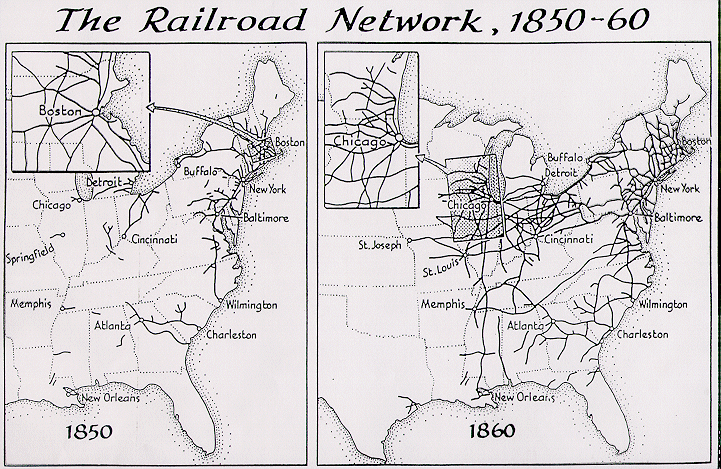
Evelina accompanied her husband into Boston, where they stopped for midday dinner at the Orrs’ before Oakes boarded his train. He would have traveled to New York by way of Springfield, or else taken the Old Colony line down to Fall River where steamboats picked up passengers to complete the trip to New York City.  Evelina, meanwhile, stayed in Boston to shop and enjoy a bit of socializing with the extended Orr family. She played cards past her bedtime.

Back in Easton, shovel making and farm work went on as usual.  Old Oliver, as always, noted the weather: “this was a fair day wind north west + cold. ”  He added that  “we kild 4 hogs to day everage wate 356 lb sold to the workmen at 7 cents a pound those we sent to boston sold for 7 ¼ cents”.  He sold some of the fresh pork to his workmen, probably through the Ames store, and sent the surplus to Boston to be sold.


November 28, 1851

Clock

Nov 28th Friday  Had rather of a late breakfast

Oliver did not rise untill past ten Oclock

Have been very busy to day making some

collars for Mr Ames & have been looking

over Olivers clothes some  Mr & Mrs Thom

Ames have spent the afternoon with Mrs Witherell

I have been to see them this evening

Like many middle-class families in 1851, the Ames family probably kept at least one clock against a wall or on a mantel. By its hands Evelina could tell that her middle son, Oliver (3), had slept exceedingly late on this morning after Thanksgiving. She might have looked up from her sewing to notice the minutes move by. Just home from his first term at Brown University, Oliver was keeping collegiate hours that were rather more elastic than the factory time by which the days usually ran. Tired from his studies and his journey home, Oliver slept in. Workers at the shovel shop were not accorded that luxury.

Absent a working clock in the house, how did people in the village and its close environs know what time it was?  Pocket watches were popular, certainly, but many in the village wouldn’t have owned one. The young, single immigrant men who lived in the Ames tenement, for instance, and the working families who lived in the factory houses around town needed temporal oversight. A bell at the factory guided them.

According to historian Gregory Galer:

“Life in North Easton in the 1840s was dominated by the Ames Company.  With the move to a more regular work schedule the company instituted the use of a bell, heard throughout the village, to be sure employees would keep a schedule which would allow them to fullfil their duties at the shovel shop.”*

Evelina’s grandson, Winthrop Ames, noted:

“Every week-day morning at ten minutes before five the shop bell warned the town to yawn itself awake; and at nine in the evening it rang a curfew (as it still does) to advise bedtime.  The factories started at seven, by lamplight in winter, and stopped at six, with an hour out at noon for dinner – a ten-hour day.”**

Winthrop was writing in 1937; in 1952, the Ames factory would close in Easton and move to West Virginia.  No curfew bell rings in North Easton today.


*Greg Galer, Forging Ahead, MIT, 2001, p. 240

*Winthrop Ames, The Ames Family of Easton, Massachusetts, privately printed, 1937, p. 128

November 21, 1851

Bed

Friday Nov 21st  Jane has not been able to do any thing

to day has had Dr Wales.  I have heat the

brick oven twice made Apple & mince pies

& brown bread  Mr Clarke has taken the 

box & sink from the little porch.

Mrs Witherell has been baking and she

made my bed & Susans for which I feel

quite mortified  And assisted about the dishes.

Jane McHanna, the Ames’s servant, really was ill. Dr. Ephraim Wales called at the house to examine her. A young doctor, he was the son and grandson of doctors, also named Ephraim. Beyond that, we don’t know much about him. He and his wife, Maria, were listed in both the 1850 and the 1855 census, yet he drew no mention in the detailed chapter on physicians in William Chaffin’s History of Easton, Massachusetts. Perhaps they moved away before 1886, when Chaffin published his tome.

In 1851, Ephraim and Maria may have lived in the village; by 1855, they appear to have moved out to the country and settled near the Gilmore farm.  Regardless of his home address, on this particular day Dr. Wales braved some wet weather to visit Jane. Old Oliver described the day as ” a verry rainy day wind North east – East + south East the wind blew quite hard there was about 3 inches of rain fell. it raisd the two resevors 13 inches each.”

Evelina and her sister-in-law, Sarah Ames Witherell, stayed indoors and baked. With Jane sidelined, Evelina was once again doing the cooking and the housework, too busy to sew. Sarah must have felt sorry for Evelina, for she slipped away from the baking and made the beds for Evelina while the latter was coping in the kitchen, then came downstairs and helped with the dishes. Sarah, a widow who kept house for her father, was always looking after others.

November 16, 1851

IMG_0017

Modern photograph of house in North Easton built by Edwin Williams Gilmore, 1851


Sunday 16th  We have all been to meeting all day

Went to Mr Whitwells at noon with mother

rode with our new horse do not believe he

is any great affair  Edwin took tea with 

us and I went into his house with him  Wrote

a letter to Oliver.  Oakes A went to North

Bridgewater to see Mr French about selling

some hogs for father.  I asked once to let me go but

he went without me


The Ameses went to meeting today, naturally, and Evelina visited with her mother at the parsonage during intermission.  The Ames family often rode in tandem if not together to church; Evelina perhaps rode in a carriage with Old Oliver and Mrs Witherell.  She certainly seemed underwhelmed by the new horse that Old Oliver had recently acquired.

Edwin Williams Gilmore, Evelina’s nephew, stopped by for tea at the end of the day.  He was building a house in North Easton, barely a stone’s throw away from the Ames compound. Although he may have worked at the shovel factory at this time, he would soon embark on a business of his own: a hinge factory that would be a successful enterprise for decades to come. He wasn’t interested in working and living on the family farm; that job would fall to his younger brother, Francis.

For now, Edwin was an ambitious twenty-three year old who wanted to live in the village.  The house, which his father, Alson, had been helping him build, was almost ready. His next step would be to marry, and he evidently had a wife in mind: twenty-two year old Augusta Pool, his neighbor near the farm. Evelina may have been privy to Edwin’s plans; if not, she surely enjoyed looking in on the new property so close to her own. Her visit with Edwin perhaps made up for not going with her son Oakes Angier to North Bridgewater.


November 11, 1851

Helen Angier Ames

Helen Angier Ames


Tues Nov 11th  Jane and Bridget washed this morning and I have

cleaned the front chamber closet and put things in

order in the chamber and worked about house untill about

four and went to tea in Olivers  Mr & Mrs Swain and 

Mrs Meader (Mrs Swains brothers wife) were there

Father & Sarah and her children dined there  They

had ducks for dinner

Post-election political discussions were no doubt rebounding in print news across the nation but in North Easton, Massachusetts, at the Ames compound, domestic concerns held sway. There was washing, cleaning and tidying up to be done. Laundry day had been postponed from its usual Monday slot; perhaps Evelina had waited for Jane McHanna to return from Mansfield. Evelina didn’t like doing laundry at all.

Today was Helen Angier Ames’s fifteenth birthday.  The only daughter of Sarah Lothrop Ames and Oliver Ames, Jr., she was at school in Boston, so not able to celebrate at home. Neither was her brother Fred at table, for he was at Harvard.  Perhaps the roast duck that Sarah and Oliver served to their dinner guests was in Helen’s honor, in absentia.

Helen Ames never married, choosing instead – or learning to accept – spinsterhood in North Easton and Boston.  She had a small social life with friends and family and when the railroads became more established, she traveled with her parents and cousins to places like Niagara Falls, Detroit, and points west. She played piano very well, occasionally playing the reed organ at the Unitarian church, where she was “acknowledged to be the best performer.”** Her uncle, Cyrus Lothrop, named one of his sailing vessels after her: the Schooner Helen A. Ames.

As a teenager, Helen enjoyed the company of Evelina’s niece, Lavinia Gilmore, another young woman from Easton who would never marry. Helen also was in school with a friend from Bridgewater named Catherine Hobart, the youngest daughter of a family well known to the Ameses.  Catherine, or Cate, would one day become her cousin Oakes Angier’s wife.

Helen’s father died in 1877, her mother not until 1894.  In 1882, at the age of 46, she herself “died suddenly in the prime of a life of thoughtful and generous service, deeply honored, loved, and lamented.”* Her brother, Fred, commissioned John LaFarge to create a stained-glass window, the Angel of Help, for Unity Church in memory of a sister he had loved.


*William L. Chaffin, History of Easton, Massachusetts, 1886, pp. 411-412

**Winthrop Ames, The Ames Family of Easton, Massachusetts, privately printed, 1937, p. 130


November 8, 1851

Vegetables

Sat Nov 8th  Jane is still in Mansfield and Bridget

sick consequently I have to do the housework and

I have scarcely sat down for one moment  Alson

came up with a load of vegitables and Hannah

called and I left my work while they stopped

Mrs Witherell came home this evening and I have been

in there  Mr Ames went to Boston stopt at Canton to a

whig meeting.  Oakes & Frank brought him home.

Not only was the dependable Jane McHanna away, but the Ames’s second servant, Bridget O’Neil, was sick.  Dr. Ephraim Wales had checked in on Bridget the previous evening but she was still laying low.  Evelina, capable if disinclined, was faced with doing her own housework. She spent most of the day choring, as she called it.

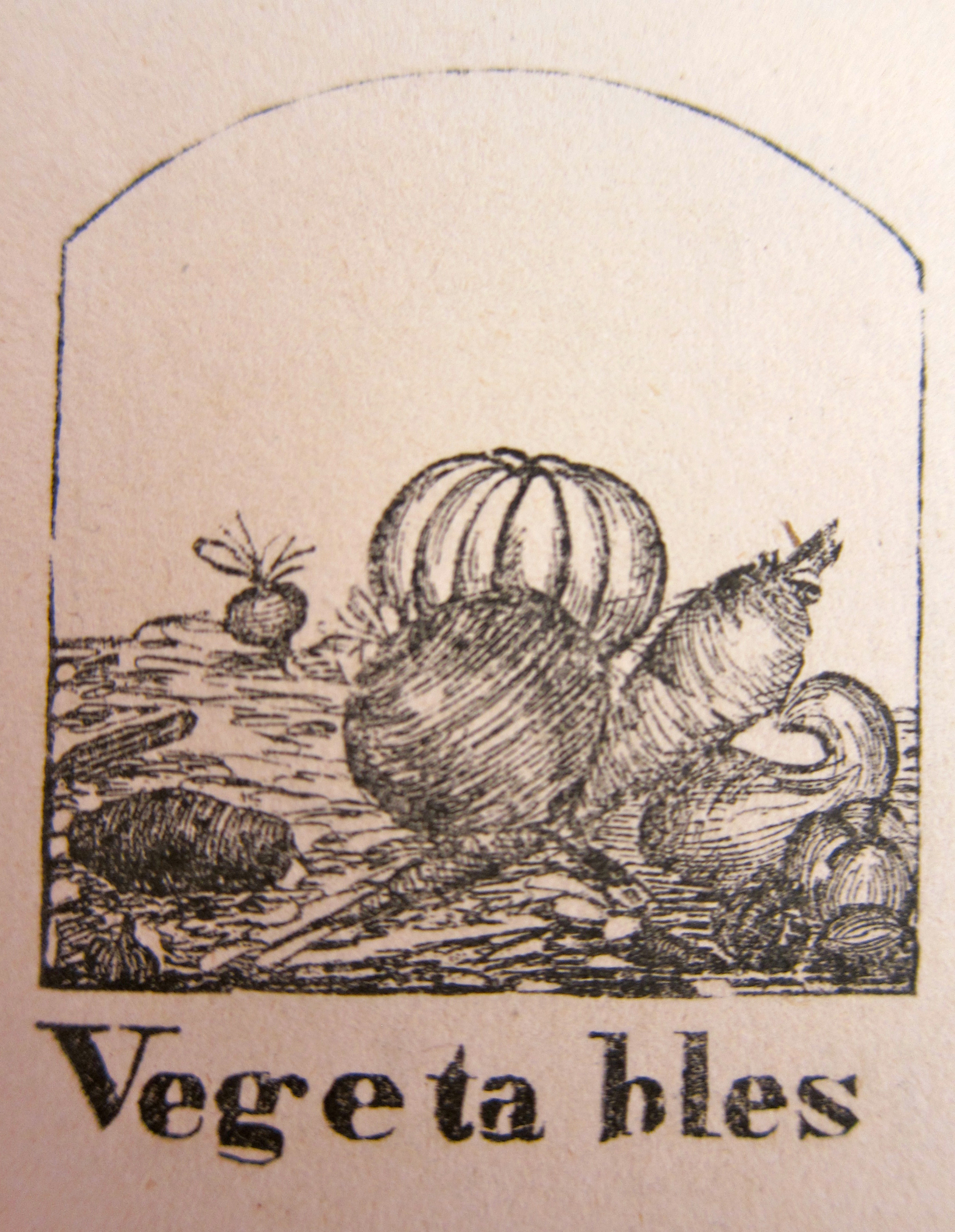
Her brother, Alson Gilmore, drove a wagon up from the Gilmore family farm to deliver a “load of vegitables” to the Ameses. His daughter-in-law, Hannah Lincoln Gilmore, who lived right in the village, came to call and for those visits, Evelina paused to chat.  Once they left, however, she must have plunged into sorting and storing the vegetables that Alson had brought. By this time of year, they would most likely have been root vegetables such as turnips, parsnips, carrots and potatoes. She would have stored them somewhere cool, dry and varmint-free: the cellar, if it wasn’t too wet, or the buttery or even the shed. Sharp-eyed housewife that she was, Evelina would have made sure everything was put away safely.

Oakes Ames, meanwhile, went to Boston as usual on this Saturday, but also “stopt at Canton to a whig meeting.”  The following Monday was Election Day and the party faithfuls were gathering in anticipation. This is the first mention in Evelina’s diary of Oakes’s participation in local politics. Their son, Oakes Angier, had shown interest earlier in the year, running unsuccessfully for the Easton school superintending committee, and attending the Whig convention in Springfield.  But her husband’s interest, although it had probably existed prior to this moment, had not drawn comment. Evelina mentions the meeting most likely because of the impending vote, but the statement coming so close on the heels of an undisclosed agreement she and Oakes had made only one week earlier gives creedence to the possibility that their agreement had something to do with Oakes’s waxing interest in politics.