June 11, 1852

Coffeepot


June 11th Friday  This morning had quite a fuss with

Jane about her coffee & beef &c and cannot put

up with such work and to night have engaged

a new girl  Helen & self carried Mr & Mrs

Orr to the Stoughton cars this afternoon […]

We went to the shops this morning & called

on Augustus Abby & Mrs Witherell


A red letter day for Evelina: She fired Jane McHanna. In Evelina’s mind, Jane’s work had fallen off – particularly when compared to the accomplishments of Mrs. Patterson – and today, after a “fuss” about breakfast, Jane had to go. Their relationship had ever had its ups and downs; today it ended.

The kerfuffle between Evelina and Jane must have been observed, or overheard, by houseguests Robert and Melinda Orr. Perhaps their presence influenced Evelina’s decision to dismiss Jane, Evelina wanting to exhibit higher standards of domestic efficiency than Jane was used to producing. However it came about, the result was that Jane would go. Evelina found a replacement by nightfall, but would Jane be equally lucky?  A lone woman without means, could she find a new position quickly?

The morning’s upset may have lingered in Evelina’s mind throughout the day, but she continued to entertain her Boston guests according to the means at her disposal. Besides calling on various family members, they walked around the shovel works, a tour which would have interested Robert Orr.  He lived in Boston, but his family in Bridgewater and elsewhere had worked with iron for many years.

In the afternoon, Evelina and her niece Helen Angier Ames “carried” the Orrs to the railroad stop in Stoughton and bid them goodbye. It was one month ago today that George Witherell died.

June 7, 1852

Washing

June 7th

1852 Monday  Mrs Patterson went to Bridgewater

to see about her things that she left

there and returned this afternoon  Jane has

done the washing and I have been very busy

about house all day.  Mr Scott  Holbrook

and another painter have been here painting

the back entry chamber & Franks chamber

Scott has grained the stairway & painted the stairs


Dry weather continued, which was bad for the crops but good for the laundry. The white sheets and shirts must have dried quickly in the “midling warm”* sunshine and light southern breeze.  Today would prove to be Jane McHanna’s last turn at washing the Ames family’s clothes.

Old Oliver, meanwhile, spent part of his day, at least, observing someone’s construction project, as “Capt Monk began to move the hous[e] where Tilden lived to day.”* We don’t know who Capt. Monk was, but we do know that a team of oxen had to be assembled for that task. Were any of Oliver’s oxen used?  Did he lend a hand? It’s doubtful that he would have observed in silence, his instinctive leadership and irrefutable expertise too compelling not to use, or be asked for.

The Tilden whose house was being moved was probably Francis Tilden, a teamster who worked for the Ameses. He looked after the oxen. When an Old Colony Railroad line was extended to North Easton a few years later, in 1855, Mr. Tilden would become the expressman.  He would trade in his oxen for a rail car and spend the rest of his life conducting the train back and forth between Boston and North Easton. Oliver Ames Jr. often rode it, calling it “Tilden’s train.”

*Oliver Ames, Journal, Stonehill College Archives, Arnold Tofias Collection

May 26, 1852

Bird

1852

Wedns  May 26th  Jane has done part of the ironing  I have

put down the carpet in the front chamber & sitting

room and the bedroom carpet partly down and 

got the rooms in pretty good order  Mr Scott

& Holbrook commenced painting in the other

part of the house yesterday   Mrs Patterson

staid at home to do her washing & ironing

Mr Ames went to Bridgewater West


Spring cleaning continued; Evelina laid carpet today, often one of the last chores on the list. She could almost check the sitting room off the list, and seemed pleased that the house was “in pretty good order.”

Another spring ritual, this one involving bird hunting, may or may not have taken place on this date; by 1852, it may have been outlawed.  But the hunt, which always took place on the last Wednesday in May, was recent enough to have included various Ameses, if we assume they chose to participate.  Town historian William Chaffin describes the ritual in his 1886 History of Easton:

“At different times in the history of the town rewards were offered for killing crows and blackbirds, which were supposed to be very destructive to corn […]

“Scarcely two generations ago [which would place the event somewhere as late as the 1840s] the custom prevailed of young men choosing sides, and each side on a given day starting out and killing all the birds they could. The day chosen was the old ‘Election day’ so called, the last Wednesday in May, once the time for the convening of the State Legislature, and which came to be known as ‘Nigger ‘lection.’  It was one of the greatest holidays of the year for the boys. […] [T]hose taking part in the shooting started out at daybreak and killed as many birds as possible.  They usually met at some appointed place before dinner, to count the birds and see which side had won the victory.  In North Easton, the rendezvous was at Howards’ store […]

“The understanding was that only harmful birds should be killed; but it was easy to include nearly all birds in this category, because, it was argued, bobolinks and swallows destroyed bees, and robins stole cherries, etc. In some places the party beaten paid for the dinner and drinks of all.”*

In the 21st century, it’s difficult to fathom both the wanton waste of this offensively-nicknamed holiday, and the glee that evidently accompanied it. That hunting has an appeal, we don’t question, but that songbirds were the quarry is hard for modern folks to accept. **


William Chaffin, History of Easton, Massachusetts, 1886, pp. 776-777

** This editor freely confesses to being a birder and particularly fond of bobolinks.

May 13, 1852

DSCF1683small

Thursday May 13th  Worked in the garden about an hour

this morning  Assisted about putting George into the 

coffin, put in some geraniums leaves feverfew

blossoms and wild flowers  Has rained very hard

all day.  funeral at three Oclock  Mrs Lovell &

son brought Mrs Witherell and Mr & Mrs Brown came

beside a few neighbors.  Mr. Whitwell spoke well

On this cold, stormy spring day, George Oliver Witherell was laid to rest. Although he is now buried in the Village Cemetery in North Easton, he was initially buried elsewhere near his father, Nathaniel Witherell; his little brother, Channing; and his grandmother, Susannah Angier Ames and a few other Ames relatives. Only after the Unitarian Church was built in 1875 were the remains of all moved to the cemetery behind the new church.

Evelina helped place her nephew George in his coffin and added what could almost be described as a potpourri of geranium leaves, feverfew and wild flowers that would have provided a sweet, masking scent. Feverfew, an aromatic member of the daisy family, was also commonly used as an herbal medicine. Gardener and housewife that she was, Evelina would have had these dried leaves and petals on hand.

The service for George would have begun at the house and moved to the graveside, rain or no rain. A memorial sermon would follow the next Sunday, but this day Reverend Whitwell spoke over the coffin in a heartfelt service for family and close friends. Besides the Ames clan, who would have been there in full force, George’s paternal grandmother, Mrs. Witherell, was brought down from Boston to attend. To no one’s surprise, “Mr. Whitwell spoke well.”

May 4, 1852


IMG_0159

Trellis on the door of the home of Oakes and Evelina Ames and extended family, ca. 1860


Tuesday May 4th  Mr Healy & Morse commenced the trellis

for our front door  We had quite a consultation how it should

be made  I[t] was very cold & windy this morning & I fear I

have taken cold in being out so long  Have mended Olivers

sack and cut the pattern and have done some other mending

Augusta made a long call. It is really very pleasant to have

her so near.  Mrs S Ames went to Boston

The trellis that Evelina refers to today could very well be the modest trellis that graces one of the doors in the above photograph. The doorway facing the street in the approximate middle of the photograph was the door that Evelina, Oakes, and their family used for their own. The doorway on the far left, facing the yard, was likely the entry that Old Oliver and his daughter, Sarah Witherell, used. The house on the far right was a separate dwelling that belonged to Oliver Ames Jr. and his wife, Sarah Lothrop Ames.

None of these buildings is still standing. The one on the far right was torn down in 1863 and replaced by a larger, more formal house that is still extant today, with lovely gardens and a well-kept air.  The house in the center, halved on the interior to accommodate the two households of Evelina and Sarah Witherell, was torn down in the 1950s, at the behest of Oakes Angier Ames’s eldest son, Hobart Ames. The site has since been reclaimed by trees and undergrowth.

The trellis was meant to add a fashionable air to Oakes’s and Evelina’s side of the house. Evelina was trying to bring the simple, old Federal dwelling into the Victorian age, inside and out. She had a particular vision for her home, and she worked hard to realize it. Small wonder that the construction required “quite a consultation.”


April 17, 1852

Village

1852

April 17  Saturday  Julia was at work here a year ago to day

has improved very much in dress making since then

I have my black silk nearly finished.  The Delaine

all done except the sleeves & buttons, am waiting

to go to Boston to get the trimmings.  This afternoon 

have been altering some old dresses for Susan

Hannah called to get me to go up by the school

house and select a place for a house for them

Mrs Witherell went with me  A beautiful pleasant day

Sewing continued today, with Julia Mahoney again on hand to assist with Evelina’s new dresses, one of black silk, the other of a light wool they called delaine. The finished projects would have to wait for trimmings to be fetched from Boston. Evelina meanwhile refashioned some old dresses for her daughter, for “[e]very season there was a great remaking of old garments to bring them up to date.”*

The bad weather of the past two days disappeared and was replaced by fair skies. Despite continued cold temperatures, Evelina was finally drawn outside on a fun errand. Invited by her niece, Hannah Lincoln Gilmore, and accompanied by her sister-in-law, Sarah Ames Witherell, she went to the local school house to look at some property that her nephew, Alson Augustus Gilmore, and Hannah, his wife, were considering.  They had been renting rooms from Col. John Torrey, but now were planning to build a house.

Everyone in North Easton lately seemed to be wielding a hammer. It was spring.


*Winthrop Ames, The Ames Family of Easton, Massachusetts, p. 127


April 4, 1852

Crucifix


1852

April 4th Sunday.  Orinthia and self went to the

Catholic meeting this forenoon after waiting more than

an hour the priest came and driveled over a mess

of nonsense in latin, they distributed palm as they called

it being nothing more than cedar & pine twigs.

Sat there three tedious hours, came home and

went to our church in the afternoon. since have

written a letter to Sister H. &c  Susan went over to Anna.

Evelina’s ill-tempered condescension continued today when she and her sidekick, Orinthia Foss, attended a morning service at the little Catholic church on Pond Street. It was Palm Sunday. Father Thomas was late – not unusual for an itinerant priest – and the service was in Latin, a language that Evelina didn’t understand, all for a holy day that Unitarians didn’t acknowledge. Most vexing of all, perhaps, was that the palms weren’t even real.

By her own account, Evelina was better satisfied by a service in the afternoon at her own church. The question is, why did Evelina attend the Catholic service to begin with? Out of curiosity? Out of respect for her own Catholic servant, Jane McHanna? Was this Orinthia’s idea?

Whatever her motive, Evelina came away from her “three tedious hours” as anti-Catholic as ever. Such feelings would not have been encouraged by her husband, Oakes, who was more welcoming of the Irish newcomers. But Evelina would have found reinforcement at home from her father-in-law, Old Oliver, who was no fan of the Irish Catholics in Easton, for all the work they did at the shovel shops.

In Easton, in Boston and all over New England, differences between the old Puritan customs and the transplanted Irish culture were pronounced and, for many, unyielding. In strictly religious terms, Unitarians couldn’t imagine a religion that kowtowed to a foreign leader, as they deemed the pope, while Catholics were incredulous that Protestants could just shake off the time-honored and revered practices of the original church. The melding of the two cultures would be a long time coming, and in some circles is still a work in progress.

March 31, 1852

Thread

1852

March 31st Wednesday  Have been to the sewing circle

at Mr Harrison Pools.  Mrs S Ames & Augusta

went and we took Orinthia with us from Mrs Howard

Mother Henrietta Lavinia Rachel Mrs Nahum & Horace Pool

& Ann Pool were there   It rained very fast as we were

coming home  I left two shirts to be made that I

put in the circle last fall

The Sewing Circle was back.  Female parishioners from the Unitarian Church had begun once again to meet on a monthly basis to sew. Like other sewing circles around the country, they met for fellowship, guidance from the local clergy, and the sewing of clothes and linens for one another or others. They hadn’t met – officially, anyway – since December.

On this weekday the group met at the home of Mary and Harrison Pool in southeastern Easton. From North Easton came Evelina, Sarah Lothrop Ames, and Augusta Pool Gilmore, the young bride who was returning to the area of town where she had grown up. The women stopped en route at Nancy and Elijah Howard’s to pick up Orinthia Foss. Hostess Mary Pool, who had three young children underfoot, welcomed them. Others who attended included Evelina’s mother, Hannah Lothrop Gilmore; Henrietta Williams Gilmore, Lavinia Gilmore, Rachel Gilmore Pool, Lidia Pool, Abby Pool and Ann Pool. It was a veritable family reunion.  Except for Orinthia Foss, every women present was related by blood or marriage to at least one other woman there.

Such a gathering must have been good amusement, with less formality than the social calls that some of the women had paid the day before. But spirits may have been dampened by the “very fast” rain that pummeled the carriages when the meeting ended and the women returned home.

March 23, 1852

SurvChain

 Gunter’s Chain**

March 23

1852 Tuesday. Alson and wife dined here and spent

the afternoon at Edwins  He has been running

out lines for Edwin & Melvin Randall  Orinthia

went home with them.  Was at tea in Edwins

& this evening with Augusta at Augustus’

Augustus has gone to New York.  Susan is staying

there to night went just after dinner.  Oliver & wife

went to Boston this morning   Rained untill early night.

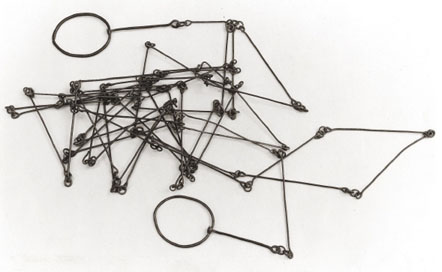
The Gilmore clan was moving around today. Evelina’s nephew, Alson “Augustus” Gilmore, was headed for New York City on business for his boot company or the Ames shovels, or both. Evelina’s brother (and Augustus’s father), Alson Gilmore, and his wife, Henrietta Williams Gilmore, had midday dinner at the Ames house. Alson was in the village helping another son, Edwin Williams Gilmore, and an Easton man, Melvin Randall, run out lines.

The phrase “running out lines” is open to interpretation (ice fishing is a possibility!), but the most likely meaning is that ground was being measured, perhaps for the new factory buildings soon to be built. A running measure is the cumulative distance in a straight line from a fixed point. The standard instrument used to get a running measure, at least in the 18th and 19th centuries, was a Gunter’s chain. It was used in conjunction with a compass and a transit (for establishing straight lines) to measure ground.

Invented by an English clergyman and mathematician, Edmund Gunter, around 1620, the Gunter’s chain “played a primary role in mapping out America.”** The Army Corps of Engineers would have owned such chains in bulk. The chain’s 100 lines measure 4 poles, or 66 feet, or 22 yards, depending on how you care to count it. Eighty chains equal one mile.

The Gunter’s chain, however, helpful as it was, was apt to be hand-made and thus subject to variation. It was eventually replaced by the more accurate surveyor’s tape.

By the way, for those readers who follow the game (or watch Downton Abbey), the length of a cricket pitch is exactly one chain.

*Thank you, Frank Mennino, for your assistance on today’s blog.

**Image from Colonial Williamsburg, courtesy of http://www.history.org

March 19, 1852

moms_white_cake_2

March 19th Friday  Have heat the brick oven baked

mince & dried apple pies & Jenny Lind cake  Amelia

went to Mr Torreys this morning and Orinthia

afternoon & self this evening, when we returned

found Edwin & wife here.  Mr Whitwell called

had called at Edwins for the first time

Jenny Lind, international opera star, was so famous at mid-century that many things were named in her honor: A street in North Easton, for one, and more. The “Swedish Nightingale,” young, pretty and gifted, was promoted to the hilt by master showman P. T. Barnum. Happy fans and clever merchandisers attached her name to a bed, a bonnet, a steamer trunk, a pudding, a saloon in Brooklyn and a gold-rush town on the Calaveras River in California. She also had a cake named after her.

Evelina baked a Jenny Lind cake today.  Perhaps she took the “receipt” from a popular cookbook by Mrs. A. L. Webster titled The Improved Housewife. The result was a real departure from the usual fruitcake:

Stir together 2 cups white sugar and 1 butter.  Add 10 egg-whites, well beaten. Just before setting in , add half a teaspoonful soda dissolved in cup of cold milk and 1 and half cream tartar mixed with 4 cups flour.  Flavor with vanilla, or to taste. Line pans with buttered paper, and bake in moderate oven fifteen or twenty minutes.  Frost it. – Or: the 10 yolks with the other ingredients as above, and the grated rind of 2 lemons for the flavoring, make a nice cake.”