September 1, 1851

000100849[1]

*

Sept 1st Monday  Jane & Ellen washed and have done most

of the housework and I have been to work on Olivers

clothes have sewed pretty steady to day.  Pauline has

been sewing on a pr of Muslin undersleeves that

I gave her but has not finished them.  Mrs Stevens

covered some button and sewed them with Olivers vest

& mended the buttonholes


Sewing was “pretty steady” today as the date of her son Oliver (3)’s departure for college loomed nearer. Evelina was mending everything and making new items like collars and dickeys. She tried to mark Oliver’s clothes so that they wouldn’t get lost – a time-honored effort by many a mother when a child leaves for college. How did she mark the clothes, though, in those days before indelible ink markers?  There were certainly no “iron-ons” and probably no manufactured name-tags that would have been sewn in by hand, either.  Her most likely solution would have been to embroider Oliver’s initials or name on the inside or underside of each piece of apparel. That sounds like a lot of work.

Houseguest Pauline Dean accompanied Evelina and sewed some on a pair of new undersleeves while another guest, Mrs. Stevens, helped cover the buttons of a vest belonging to Oliver. Clothes must have been everywhere, as laundry was being washed while all this sewing went on. It was Monday, and Jane McHanna and another servant named Ellen had the stove going and the tubs full. The “fair day” and north east wind that Old Oliver noted in his journal would have helped dry the clothes.

Old Oliver also noted that he “went to Canton to day with Mr Clark + others to put in the stone bridges below the shop.” Can any of our local historians identify these bridges?  Are they still in place? The shop, which was originally built in 1847 to supplement the factory in North Easton, is no longer standing. The image above was taken circa 1965.

* Ames Shovel Shop on Bolivar Street, Canton, Canton Historical Society, from Arthur Krim’s Historical Buildings of Canton, Vol. II.

August 26, 1851


Abbott H. Thayer, Angel, 1887, oil Smithsonian American Art Museum Gift of John Gellatly

Abbott H. Thayer, Angel, 1887, oil
Smithsonian American Art Museum
Gift of John Gellatly


Tues Aug 26th  Clinton Lothrop died about ten Oclock

last night  Has been sick a long time with

the Typhus fever  Mrs Witherell & I made the

shroud for him  Mrs Mitchell went to Taunton

to get Bonnets &c for Mrs Lothrop

Rebecca White came after Pauline this morning

Alson here to Dinner and tea is drawing stones for

Edwins cellar.  Oakes A and Frank returned this evening


Dewitt Clinton Lothrop finally died.  He had been suffering from typhus, “an acute infectious disease caused by the parasite Rickettsia prowazekii, transmitted by lice and fleas [,and] marked by high fever, stupor alternating with delirium, intense headache and dark red rash.”* It’s not the same disease as typhoid fever, although the two conditions have some similarities. Clinton, as he was known, had probably been bitten by a flea.

One of nine sons of Howard and Sally Lothrop, Clinton was a brother of Sarah Lothrop Ames. While most of his surviving brothers had moved away from Easton in pursuit of their own lives, Clinton was the duty son who had stayed home with his parents. Only 26 years old and married with two small sons, he had tended the family farm.

Evelina and Sarah Witherell quickly prepared a shroud for the body, while Harriett Mitchell rode off to Taunton to find mourning clothes for the young widow, Elizabeth Howard Lothrop (or for the mother, Sally Williams Lothrop.) That no one had purchased the mourning clothes before now suggests that, despite the probability of death, everyone had hoped that Clinton would recover.

It was a busy day for Evelina.  Besides helping sew the shroud, she saw her friend Pauline Dean depart to visit elsewhere in Easton and welcomed her brother Alson to midday dinner. Alson was working nearby, helping his son, Edwin Williams Gilmore, build a house.  Jane McHanna washed clothes, and she and Evelina probably continued to set the house to rights after a weekend of guests. Oakes Angier and Frank Morton returned home from their fishing trip.

* Craig Thornber, Glossary of Medical Terms Used in the 18th and 19th Centuries, http://www.thornber.net

August 18, 1851

Churn

Monday Aug 18th  Jane washed this morning and had Ellen

to assist so I sat down quite early to sewing

cut out a chimise for Ellen to make

This afternoon went to Mr Whitwells to tea

Mr Ames was going to Bridgewater and I

rode there with him.  Called at Mr Harveys

to try to get some butter but she had none

to spare.  Hurried home expecting Pauline she did

not come  Mr & Mrs George Lothrop came to Olivers 

The new servant, Ellen, helped Jane McHanna with the laundry today. Evelina stayed out of the way and concentrated on her sewing, setting work aside for Ellen to do later. She needed another chemise.

In the afternoon Evelina went to the Whitwells’ for tea.  She had just been there the day before during the intermission between church services. Today Oakes accompanied her and the two went on from there to Bridgewater.  Evelina was hoping to buy some butter from a Mr or Mrs Harvey, but had no luck. Evidently no longer producing butter herself, she’s had to travel this summer to find it. Oakes, meanwhile, was on his way to Bridgewater on shovel business – or Whig politics.

Not yet alluded to in Evelina’s diary is the illness of one of Sarah Lothrop Ames’s brothers, Dewitt Clinton Lothrop. Clinton, as he was known, was deathly ill with typhus fever. Another Lothrop brother, George Van Ness Lothrop and his wife, Almira Strong Lothrop, had come back to town from Detroit on Clinton’s account.


August 11, 1851

220px-Brooklyn_Museum_-_The_Invalid_-_Louis_Lang_-_overall

*

Aug 11th Monday  Had a new girl come to day to assist some about

the house and help me sew.  Went to assist Mrs Holmes

found her sick abed and alone her aunt Clifford

left her as sick as she is. She must be an unfeeling

woman  Mr Holmes went to Canton with the team and

will try to get his mother for a few days. Julia Waters

did up the work this morning  This afternoon she has

been all alone with Willie  I made her bed for her at night

Harriet Holmes, Evelina’s neighbor, continued to be quite ill.  Evelina and others looked after her, including an aunt who departed her post before a new helper arrived, earning Evelina’s stern disapproval.  As Harriet had a toddler, Willie, to look after, the aunt leaving her alone was not only “unfeeling,” but negligent.

Help was on the way. Harriet’s husband, Bradford, drove a team – of oxen, most likely – to Canton to fetch his mother. Before they returned, Evelina made fresh the sickbed, as she had done on other nights. Harriet would be tended to.

And this morning, even as Jane McHanna wrestled with the weekly wash, a “new girl” entered the Ames household to help with the chores and the sewing. That must have brightened Evelina’s Monday.


* Louis Lang, The Invalid, 1870, oil on board, Brooklyn Museum of Art, Gift of Mrs. Walter deForest Johnson.


July 15, 1851

Wring

1851

July 15 Tuesday  Jane washed this forenoon and about

nine or ten Mother Henrietta Rachel and her

babe came  They went home about 11 Oclock

mother will stop a few days  Gustavus left

yesterday morning  The afternoon Mrs H Ames

passed here  Mrs S Ames had a dress maker & did

not come in

Laundry was done today, a day later than normal because of the extra work involved in tidying up after a weekend of houseguests.  It’s not hard to imagine that such a disruption in the routine made Evelina or Jane McHanna or other members of the household think today was Monday instead of Tuesday.

Just as things were getting back to normal, however, more visitors arrived. Evelina’s sister-in-law, Henrietta Gilmore (Mrs. Alson Gilmore), arrived with Evelina’s mother, Hannah Lothrop Gilmore. As often happened, the senior Mrs. Gilmore came to spend “a few days” with Evelina, her only living daughter.  With them was Henrietta’s daughter, Rachel Howard (Gilmore) Pool (Mrs. John M. Pool or Poole) and her little girl, Ella. Ella, barely one year old, was Hannah Gilmore’s great-granddaughter. Four generations of Gilmore women visited together in the Ames parlor.

In the afternoon, Evelina had yet another sister-in-law pay a call, this one from the Ames side of the family.  Sally Hewes Ames came to visit one last time before leaving; she planned to return to Connecticut the next day. The women likely sat and sewed together; Evelina almost always had sewing or mending in her hands when socializing at home.  As was her wont, she probably gave something to Sally to work on while they talked. Perhaps even old Mrs. Gilmore sewed with them.

July 7, 1851


large-003500

*

1851 July 7th  This morning being washing day had to do the

house work and see about the dinner  My finger

is still very tender and I find it difficult to sew

but I have cut of the skirt of my borage Delaine

for Harriet to make and this afternoon have been

working the sleeves to it  Expect Julia here tomorrow

It was Monday, so Jane McHanna washed and hung out the laundry while Evelina swept, dusted and cooked the midday dinner.  Her finger may still have been sore – what had she done to it? – but she did her chores.

She did some sewing, too, or at least she prepared to sew with Julia Mahoney, the dressmaker who was expected the next day.  She cut the cloth for the skirt of a new dress, no small task. The barege she used, as noted in a previous post, was an open weave wool, lightweight and popular at mid-century.

In 1851, dresses were styled with very full skirts, some with flounces, that required upwards of 25 yards of fabric. Knowing Evelina’s instinct for thrift, we may believe that she probably settled for fewer flounces and less material. Still, even the simpler dresses with all their parts – skirt, lining, bodice, sleeves, undersleeves, pocket, collar, and any decorative element such as piping, ribbon or fringe – consumed significant yardage.  Cutting out all the pieces took expertise and room to maneuver. Imagine the project spread out across the dining room table.

How did she convince her sister-in-law Harriett to help sew the skirt?

* Fashion plate from Godey’s Ladys Magazine, July 1851


June 30, 1851

photo

1851

June 30 Monday  Jane has been washing to day but I

have done but very little of any thing. having a

very sore finger & thumb it is quite painful

have to let out the matter quite often  It has been

quite painful since Friday.  It is a very warm

uncomfortable day  I have worked some in the 

flower garden

Today was another Monday, another washday ably managed by the Ames’s servant, Jane McHanna. Evelina, who usually undertook other household chores on a Monday, wasn’t up for choring. She had a bad infection on her thumb and finger that prevented her washing the breakfast dishes, sweeping, or helping to prepare dinner. She was in pain and somewhat handicapped.

Perhaps she had cut her hand, or had worked up a few blisters, or had a bad scrape.  She could have done something in the kitchen or garden, or while sewing the tough horsehair cover for the new lounge. However she hurt herself, a skin infection was nothing to make light of in 1851.  In that age before antibiotics, Evelina had few remedies at hand beyond keeping her hand clean and perhaps applying a homemade linament or poultice. Her wound was the kind of injury that could turn septic; that she was squeezing “the matter” – or pus – out of it shows that she was conscious of a certain level of risk.

And yet, she found a way to work in the garden, so she couldn’t have been too frightened.


May 12, 1851

ServiceBerry1

Monday May 12th  Was about house all the forenoon but

cannot tell what doing  Jane has done the washing.

Orinthia washed the dishes for her. This afternoon

Orinthia and I have been out to plant the flower seeds

and I got some Shad berry & Burgundy Rose bushes

from Olivers & flowering Almonds from Alsons We 

were at work in the garden three or four hours

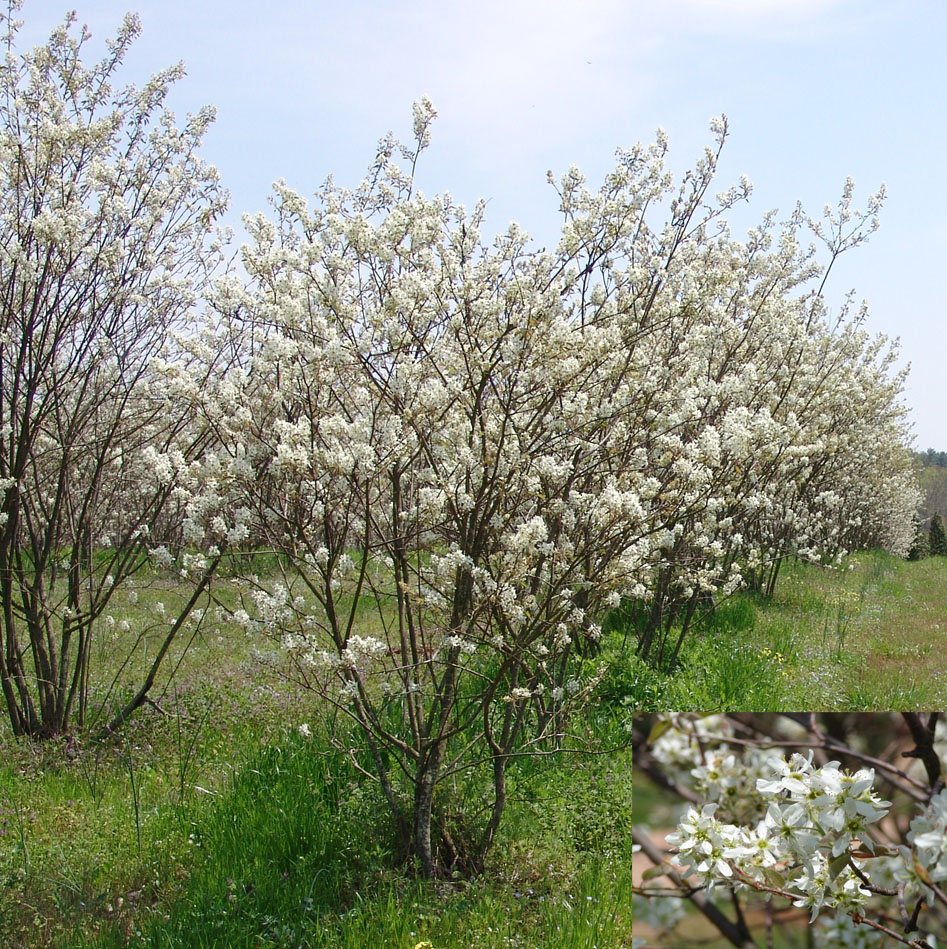
A sure sign of spring in New England is the blooming of the shadbush.  Because its little white flowers are among the earliest to be seen, its blossoms were often used at springtime funerals in the seventeenth, eighteenth and nineteenth centuries. Thus shadbush is also called the “serviceberry” bush for its appearance at funeral services; in some other locations it’s known as the “Juneberry” bush.  Wherever and whenever it grew, its presentation of blossoms was as welcome as the first robin.  The red berries it produced could be used in pies or, if not harvested, would be consumed by those same robins and other birds like cedar waxwings.

The shadberry bushes at Evelina’s were most likely planted out back behind the house near the Queset Brook, where they would tolerate the partial shade and indifferent soil.  However, the Burgundy Rose bushes that Evelina also obtained from her obliging brother-in-law, Oliver Jr., would have required a more selective location in the sun.  Were those roses planted right in Evelina’s flower beds?  Were they as red as their name sounds?

Her brother, Alson Gilmore, provided Evelina with flowering Almond bushes (Latin name is Prunus triloba.)  In contrast to the white serviceberry and the red roses, the flowering almonds produced pink blossoms.  Evelina was evidently aiming for a rosy spectrum in her yard. The flowering almonds like sun, so where might she have planted them?

The work of planting the various bushes took Evelina and Orinthia several hours to complete, and must have given them a real sense of accomplishment – not to mention sore backs.

May 5, 1851

Laundry


Monday May 5th  Made some sponge cake this morning

& swept & dusted rather more than usual Jane washed

the clothes and put them out without rinsing & let

the hard rain come on them. Has been a driving

storm all the […] day Mrs Stetson & Mrs

George [Ames] were here to tea Harriet was taken sick

and went to bed. Charles Mitchell came to see

her in the stage[…]

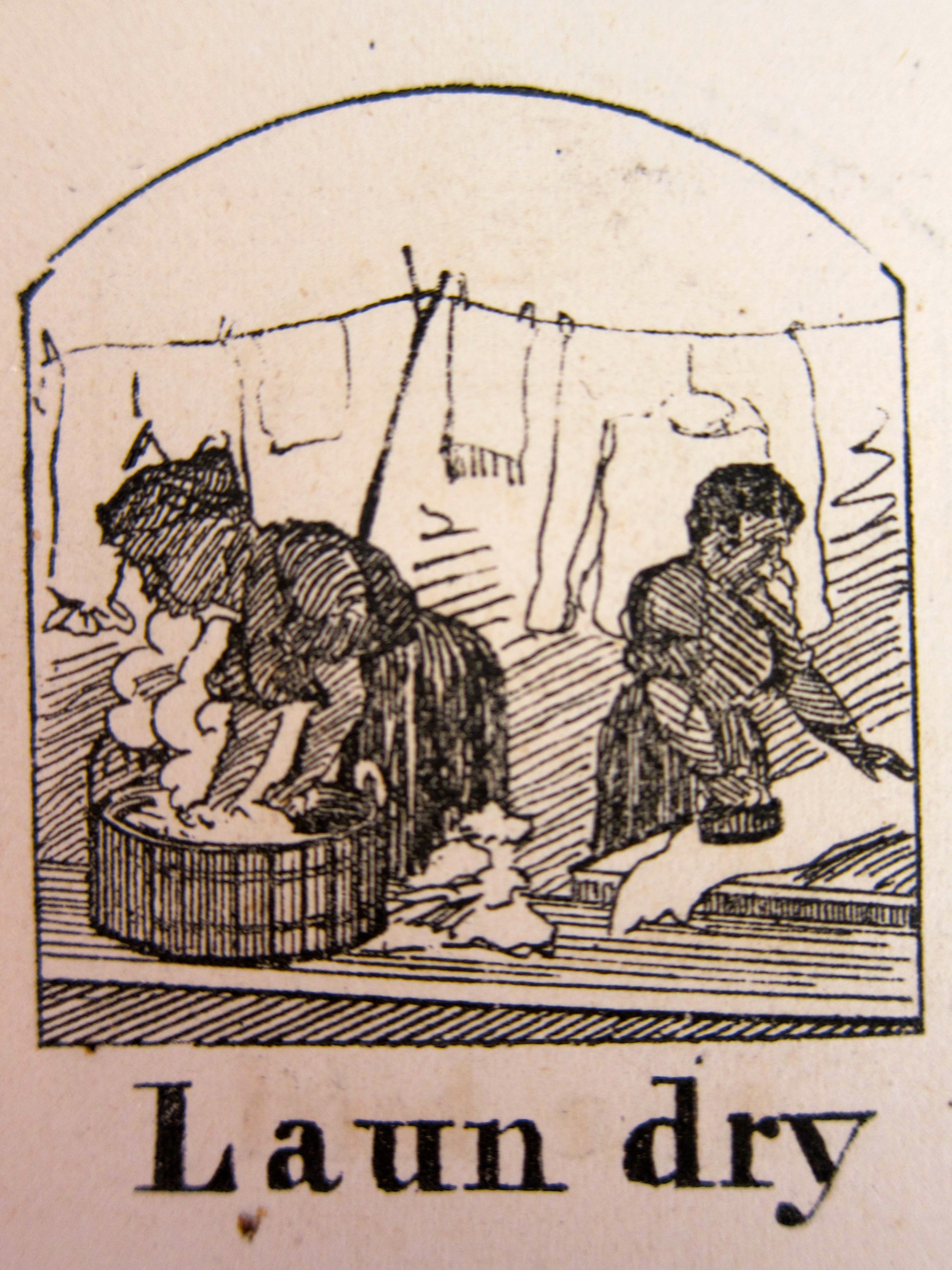
Jane McHanna had an idea this morning.  If nature was going to keep throwing stormy weather at her on Laundry Day, she’d make it work for her rather than against her. Instead of rinsing them herself, she hung those towels, shirts and all else outside and let the rain rinse the suds off. The “hard rain” saved her some tub time, although hanging those heavy clothes with the suds still on them couldn’t have been easy work.

Meanwhile, Evelina stayed indoors sweeping, dusting and doing some light baking.  Instead of firing up the brick oven, she probably baked her sponge cake right in a tin stove that she most likely had in her kitchen.

Sponge cake was a dessert whose recipe the Puritans brought over from England.  In western cooking, it was one of the earliest iterations of a yeastless batter. Mary Peabody Mann wrote in her 1858 cookbook, Christianity in the Kitchen, that sponge cake “if made right, is the least injurious of any form of cake, because it contains no butter.”  She cautioned, however, that “it is very difficult to make it good.  Eggs must be perfectly fresh, in the first place. They should be kept in cold water the night previous, and the whites should be beaten in a cool place, separately, and to a thick froth, with a cork stuck cross-wise upon a fork, and without stopping once.” Sarah Josepha Hale, meanwhile, in her 1841 The Good Housekeeper, offered her own admonishment that cakes, “those tempting but pernicious delicacies [,are]…to be partaken of as a luxury.”

The man who called on the ailing Harriett Ames Mitchell was her brother-in-law, Charles, who had once lived with Harriett and Asa in Cambridge, before they moved to western Pennsylvania. Charles, younger by several years, was a good friend of the family. Mrs. Stetson was also a friend of the family and Almira Ames was a cousin. Everyone sipped tea while rain fell on the roof, the road, the garden and the white, wet laundry.


April 28, 1851

CarumCarvi


1851

April 28th Monday  Have had Mrs Connors here to help

about washing, Janes finger being sore  She came

at half past 6 and left about half past two charged

42 cts.  I helped about the washing  Willard Randall

came this afternoon to work over the earth in the

flower garden.  Frank came from the shop about

five and worked some on the beds.  I have set out

some carraway roots that Alson gave me.  Helen came

home with Cyrus


According to some calculations, the 42 cents that Mrs. Connors was paid to do the Ames’s laundry translates to a labor value of $13.20 today. Mrs. Connors was paid little better than a nickel an hour. Evelina worked on the washing today, too, much as she disliked it.

Once the laundry was set out to dry, Evelina got back to the garden.  Her son Frank Morton helped her when he got home from work; he seemed to enjoy being in the garden as much as she did. That, or helping his mother till the soil was his assigned chore. Willard Randall, another shovel shop employee and member of the extensive Randall clan, came up again to continue working “over the earth.”  Was Willard pleased to walk up to the Ames’s yard to turn over the soil in the boss’s wife’s flower garden? Did he have a garden of his own at home that needing tending?

The caraway roots that Evelina picked up on Saturday at the Gilmore farm went into the ground today, probably in an area close to the kitchen, a time-honored location for every housewife’s herb garden.  The rhubarb and horseradish would go in there too.

Helen Angier Ames, the niece who lived next door, returned home today from boarding school in New Bedford.  Her uncle, Cyrus Lothrop, “carried her” home, as the phrase went.