June 14, 1852

FullSizeRender

June 14th

1852 Monday  Am 43 this day quite an old woman

Julia Mahoney came to work on my dresses

Hannah Murphy commenced working for me

this day & Mrs Patterson is here and it

has been about as much as I can attend to

to wait upon the rest  If I had two or 

three more it would be all I could attend to


Hannah Murphy, replacing the departed Jane McHanna, donned an apron this morning and “commenced working.”  Mrs. Patterson was still on the premises and the three women proceeded with the Monday chores, laundry included. Evelina was very busy tending to it all.

Yet today was Evelina’s birthday and she felt old.  We in the U.S. might scoff at the notion that 43 feels old; our current life expectancy for females is 81.  In Massachusetts in 1850, however, it was no more than 45. Who knew how long Evelina would live?  While she had the hopeful example of her hardy, octogenarian mother to emulate, she also would have remembered her two older sisters, both dead in their thirties. She may have considered the possibility that, like her mother, she could live to an advanced age. In fact, she would live to be 73; on this birthday, she had thirty more years in front of her.

At the shovel factory, Oliver Ames took his mind off his concern for the crops and focused instead on the arrival of Clark S. Manchester, who “came here to day from Fall River to build our stone shop.”* Mr. Manchester, 37 years old, was a native of Little Compton, Rhode Island, who had only recently moved to Fall River with his wife and two children. His expertise with stone work had led him to the Ameses, or they to him.

So the new building began, on the west side of Shovel Shop Pond. This location was different from the original and recently rebuilt factory, which sat at a lower edge of the pond in order to maximize the drop in water level. Water still powered the factory machines, and the new location to the west would still rely on water power from “just above where the Queset entered Shovel Shop Pond.”** But different from the old factory, this new Long Shop would accommodate a modern steam engine, a huge advance in technology. A new era in production was waiting to begin, and the stone buildings would reflect the change.

Oliver Ames, Journal, Stonehill College Archives, Arnold Tofias Collection

** Gregory Galer, Forging Ahead, 2002, p. 250


June 7, 1852

Washing

June 7th

1852 Monday  Mrs Patterson went to Bridgewater

to see about her things that she left

there and returned this afternoon  Jane has

done the washing and I have been very busy

about house all day.  Mr Scott  Holbrook

and another painter have been here painting

the back entry chamber & Franks chamber

Scott has grained the stairway & painted the stairs


Dry weather continued, which was bad for the crops but good for the laundry. The white sheets and shirts must have dried quickly in the “midling warm”* sunshine and light southern breeze.  Today would prove to be Jane McHanna’s last turn at washing the Ames family’s clothes.

Old Oliver, meanwhile, spent part of his day, at least, observing someone’s construction project, as “Capt Monk began to move the hous[e] where Tilden lived to day.”* We don’t know who Capt. Monk was, but we do know that a team of oxen had to be assembled for that task. Were any of Oliver’s oxen used?  Did he lend a hand? It’s doubtful that he would have observed in silence, his instinctive leadership and irrefutable expertise too compelling not to use, or be asked for.

The Tilden whose house was being moved was probably Francis Tilden, a teamster who worked for the Ameses. He looked after the oxen. When an Old Colony Railroad line was extended to North Easton a few years later, in 1855, Mr. Tilden would become the expressman.  He would trade in his oxen for a rail car and spend the rest of his life conducting the train back and forth between Boston and North Easton. Oliver Ames Jr. often rode it, calling it “Tilden’s train.”

*Oliver Ames, Journal, Stonehill College Archives, Arnold Tofias Collection

May 24, 1852

Chimney

May 24th 1852

Monday  We have carried on a large stroke of business

to day  Mr Healy helped put the oilcloth in the 

dining room plained the floor & fitted the blinds

for the side lights  Mrs Patterson & Jane washed

and we have taken up the sitting room & bedroom

carpets & cleaned the clothes closet  Mr Scott

had partly painted the dining room & Mr Burnham

had built the chimney higher in the cook room

After a day off for the Sabbath, the women in the Ames house went back to spring cleaning. Today there were men on hand to help.  Henry Healey, frequent carpenter for the Ameses, planed the floor in the dining room and laid down the new oilcloth that Evelina had just bought in Bridgewater. He also fitted the blinds for the sidelights of the front door; perhaps they had been damaged in the fierce nor’easter back in April, when water beat into the house. That, or he just put up something new over those side panels.

In the dining room, Mr. Scott was painting and in the kitchen, Mr. Burnham was raising the chimney, perhaps repointing some of the older bricks in the process.  How Jane McHanna and Mrs. Patterson managed to do the weekly laundry around that activity is a mystery. Perhaps they worked outside in the yard. It was indeed a “large stroke of business.”

May 3, 1852

frontispiece_of_edward_shaw's_'the_modern_architect'_(1854)-141D753C60C6EA2D682

The Modern Architect”*

1852

May 3d Monday Our cook room being painted  Jane

had to wash in the bathing room.  Susan washed

the dishes and I did the rest that was done

about the work which was not much.  Rode

to Mr J Howards to get Rural Architect for Mr

Healy called at Mr Clarks and got some Gladiolus

bulbs and at Jason Howards to see their garden

afternoon planted some sweet peas & lilly seed

Oliver came home to night from Providence


More planting, this time of sweet peas and lilies, went on this afternoon. Gardening was preferable to choring on any given day, but it was probably especially true on this Monday. The kitchen, or “cook room” as Evelina called it, was being painted, making the usual chores more difficult. Servant Jane McHanna had to wash the weekly laundry in the bath tub. Evelina must have been pleased to be outdoors in the sunshine, viewing other gardens and planting flowers in her own. She also would have been pleased to greet her son, Oliver (3), home from college on a break.

At some point during the day, Evelina rode south to John and Caroline Howard’s to borrow a book written by Richard Upjohn, a prominent architect. “Upjohn’s Rural Architecture: Designs, working drawings and specifications for a wooden church, and other rural structures” was a popular new publication featuring home designs in the latest styles. Upjohn, who became the first president of the American Institute of Architects, favored Italianate and Gothic style cottages. His book appealed to the up-and-coming middle class as well as to the wealthy. Evelina borrowed it to show her carpenter, Henry Healey. She had something in mind for Healey to build.


*Frontispiece from “The Modern Architect,” by Edward Shaw, 1854


April 14, 1852

Washing

1852

April 14th Wednesday  Jane washed yesterday and put

her clothes out to day […] and it is very pleasant and

most like spring of any day we have had.  Made two

toilet cushions and covers for them of plaid muslin

Mrs Sarah Ames brought in her work this afternoon

awhile and I put a bosom into a shirt for

Mr Ames.  Read this evening in Night & Morning

The rain and snow of the preceding two days had disrupted domestic routine, meaning that servant Jane McHanna washed the weekly laundry on Tuesday instead of Monday and hung clothes out today. Evelina didn’t seem to mind, given how “most like spring” the day turned out to be. She seemed to have recovered from having gone without much sleep the day before.

Sarah Lothrop Ames came over from next door and the two sisters-in-law sat and sewed. Evelina sewed a shirt front for her husband and made two toilet cushions. The word “toilet” in the nineteenth century referred to personal grooming, as in getting dressed or cleaning one’s teeth or sitting at a dressing table.  A toilet cushion, then, was most likely a seat for a stool or small chair for a bedroom or dressing area. Evelina made both the pillow itself and its cover of “plain muslin.”

Night and Morning was, presumably, a work of fiction. Evelina must have found it in one of the periodicals she liked to read, such as Gleason’s Pictorial, or in a book she or Oakes had purchased in Boston.  Any readers out there familiar with this work?


March 22, 1852

Sweep


1852

March 22  Monday  Have been sweeping dusting &

cleaning all day  Have put in order parlour

entries, parlour & sitting room chambers and back

& shed chamber, nearly dusk before I got through

Orinthia & Susan washed the dishes in the 

morning  Orinthia has written another two or three 

letters has not done much  beside  Ain’t she lazy?

It was Monday. Evelina spent her day “sweeping dusting & cleaning,” and Jane McHanna washed tubs of clothes and hung them out to dry, but “lazy” Orinthia only helped wash the breakfast dishes and wrote a couple of letters. In comparison to quiet, helpful Amelia Gilmore, whose visit Evelina had enjoyed, Orinthia Foss and her spirited but indolent company was a come-down.  We should remember that Orinthia was single and only in her early twenties (although in that era, some would have said she was already a spinster) while Amelia, a widow, was in her early thirties and Evelina, a matron, in her early forties. The age gap between Evelina and Orinthia was beginning to wear thin on Evelina’s part, and perhaps on Orinthia’s as well.

Spring had officially arrived two days earlier on March 20. No buds or blossoms were yet in evidence, however, and more snow had yet to fall. The industry that Evelina demonstrated today with her broom and dust rag suggests that she was rehearsing for spring cleaning, perhaps wanting to get it out of the way so that the moment anything came up in her flower beds, she’d be free to go outside and garden. Perhaps she looked at the still-frozen ground and imagined her flowers in full bloom. It was getting to be that time.


March 8, 1852

Carpenter

March 8th

1852 Monday  To day is town meeting.  George brought

sister Amelia here this afternoon  Have got

the carpet down in the front entry and 

the chamber carpet partly down

S Ames sent for the entry lamp for fear

I suppose that I should keep it but

she […] might not been alarmed

Carpenters have come to rebuild the shops

A new week signaled a fresh start. It had only been six days since the fire at the shovel factory, but the clean-up had gone quickly. The ruins were “dismal,” as Evelina noted yesterday, but the debris was mostly gone, hacked down, shoveled up and carted away. Carpenters had arrived to begin rebuilding, as Old Oliver, too, noted in his diary:  “some of the carpenters came on to day to build up our shops + Mr Phillips + his son came.”*

Life in the village was returning to normal.  Housewives, some with servants, tended to washing day. Children went to school and men went to town meeting.  As at church, the fire must have been part of the conversation as the men gathered to decide on town affairs and expenditures for the coming year. People must have wondered how soon the shovel shop would be up and running.

At the meeting, a new moderator, Alson Augustus Gilmore, presided. Not yet thirty years old, it was his first time holding the gavel; he would repeat the performance twenty-four times over the coming decades.  According to William Chaffin, Gilmore and his predecessor, Elijah Howard, Jr., “served with signal ability.”**

Evelina and her sister-in-law, Sarah Lothrop Ames, had a minor set-to over “the entry lamp,” which appears to have been a luminary that was shared by both houses. Sarah was evidently skittish about not having it, and Evelina was annoyed to have it commanded away.  No cause for alarm, she might have said. She wouldn’t have been annoyed for long, however, as a favorite family member, Amelia Gilmore, arrived for a visit. Amelia was the young widow of Evelina’s younger brother, Joshua Gilmore, Jr. She had lately been working as a private nurse.

*Oliver Ames, Journal, Stonehill College Archives, Arnold Tofias Collection.

**William Chaffin, History of Easton, 1886, p. 637

February 23, 1852

Looking glass

Monday 23d Feb 1852  Worked about the house this forenoon

dusted the chambers and washed around the

windows &  doors.  Susan washed the dishes. Am

trying to have her learn to knit, improves some

but rather slowly  This afternoon have been mending

some and have put one new sleeve into my

blue & orange Delaine  The looking glass came

out from Boston to night

We might call it a mirror, but Evelina and most of her contemporaries called her new purchase a looking glass. (Think of “Through the Looking Glass and What Alice Found There,” Lewis Carroll’s 1871 sequel to his 1865 “Alice’s Adventures in Wonderland.”) Like the framed prints Evelina had recently bought for her walls, the looking glass was a fashionable piece of decor. She must have been tickled to have one hanging in her parlor.

New “methods of mass-producing large, flat panes of glass had been perfected and, by combining them with heatless, chemical-coating technologies,”* mirrors had become easy to manufacture – and affordable.  At mid-century they became stylish and ubiquitous, symbolic of the new taste and purchasing power of the middle class. In a home like Evelina’s which, 50 years earlier, might have boasted no more than a small, courting-type mirror, a big, new looking glass, hung on braided silk roping from molding above it, had become de rigeur.

Other than this exciting upgrade in the parlor, today was a Monday like any other. Jane McHanna did the laundry, Susie Ames washed the breakfast dishes, and Evelina took to her needlework.  She was teaching her daughter to knit.


*Wikipedia, Mirrors, accessed February 19, 2015.

January 19, 1852

d44daf6476649bfb638e3038c8f2221c

Fashion illustration from Godey’s Lady’s Book, 1850


1852

Jan 19th Monday  Susan washed the dishes and after doing

my usual mornings work commenced sewing some pieces

of fur that was taken off my cloak for Susan a muff

to carry to school.  Finished it before dark and in

the evening made over her best muff and it looks

as well if not better than when new. feel very well

satisfied with my days work  Very cold.


The snow continued today. According to Old Oliver Ames, “it snowd all last night + more than half the day to day and it was a verry cold storm – it did not snow fast any part of the time and all that has come now will not measure more than 6 inches on a level. it drifted considerable and is dry + light.”*

Susan Ames probably would appreciate the muff that her mother was making for her to keep her hands warm.  She already had one for “best” to wear to church, but this one would be for everyday. Made from recycled pieces of fur off her mother’s cloak, Susie would be making quite a fashion statement for a nine-year-old school child, most of whose classmates would likely have worn mittens.  Even Meg and Jo March had to walk to their jobs without muffs, holding instead warm popovers fresh from the oven to keep their fingers from numbing up.

At day’s end, Evelina was “very well satisfied” with the muffs she had reworked.  The household today appears to have been running well which would have amplified Evelina’s happy mood. Jane McHanna must have worked some magic to get the laundry done despite the snow storm.

*Oliver Ames, Journal, Stonehill College Archives, Arnold Tofias Collection

January 12, 1852


 Plate

Jan 12 Monday  Susan washed the dishes this morning

and I went to work on my plants making some frames

for them and was to work on them and about the

house all the forenoon.  This afternoon have been

mending pants for Oakes Angier.  Have put a new

pocket into one pair  Jane washed and has been to see

Mrs Savage  Carried Augusta’s cake over to her and

Called a few minutes on Mrs Sarah Ames  Very cold


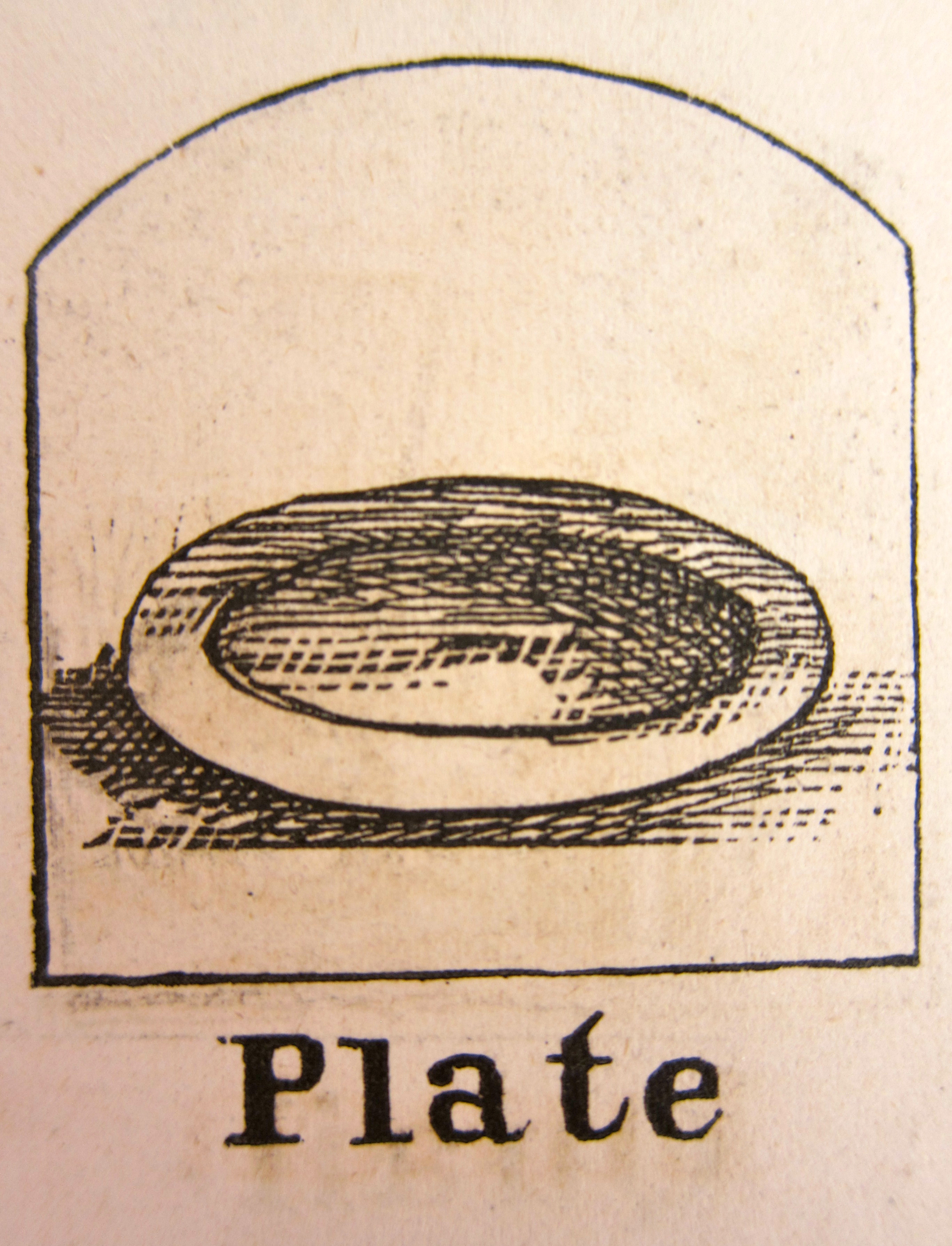
After breakfast each morning, a stack of dishes awaited washing in the Ames kitchen, numbering approximately seven plates, seven cups, seven saucers, 14-21 pieces of cutlery, various serving platters and bowls and serving spoons, plus the pots and pans used in preparation.

Hot water would be boiled and poured into a bucket or perhaps a basin set inside a dry sink. Using a cake of homemade soap, either chipped into the water or swirled by hand, Susie Ames or Jane McHanna or Evelina herself from time to time, washed each item with a washrag, rinsed the piece in a separate pan of clean water and placed it on a rack to dry or be wiped dry with a dish towel. The chore could take 30 to 45 minutes, and had to be repeated at dinner and tea.  It wasn’t as convenient as hand-washing dishes today – no liquid soap, no faucet spray – and it certainly wasn’t like loading the dishwasher.

Inventors, in fact, were trying to develop a machine that would wash dishes; the first such patent was filed in 1850. It wasn’t until 1886, however, that a wealthy woman named Josephine Garis Cochrane would make the first successful dishwashing machine. She didn’t wash dishes herself, but her servants did and often chipped the ceramic plates in the process.  Impatient with the damage, as well as the length of time it took to wash all the dishes after the many dinner parties she gave, she decided to make a machine to do the work.

Mrs. Cochrane  contrived a wire rack shaped for various specific dishes to fit inside a wheel inside a copper boiler. “A motor turned the wheel while hot soapy water squirted up from the bottom of the boiler and rained down on the dishes.”* The dishwasher was born. It went on to be displayed at the 1893 Columbian Exposition in Chicago, where it won a prize.  The Garis-Cochrane Company was formed and manufactured dishwashers until bought by KitchenAid, which in turn is owned by Whirlpool.

All this was a far cry from nine-year old Susie Ames washing up the breakfast dishes, plate by plate.


* Wikipedia, “Josephine Cochrane”, January 10, 2015