July 28, 1851

Bookcase

Monday July 28th  Was about house as usual this 

morning and have been mending some and fixing

some of Susans clothes  Oakes & Oliver (3) are

having a book case put up in their room by

Ira Ford  They have almost got books enough to

fill it  Julia is to work for Mrs Witherell

making her a purple morning dress

A young carpenter named Ira Ford built a bookcase at the Ames house today in the bedroom of Oakes Angier and Oliver (3).  The boys had acquired schoolbooks and other “books enough” and needed a place to store them all.

Like their mother and unlike their father, the Ames sons like to read. The middle son, Oliver (3), in particular, cherished reading. According to an unnamed eulogist in a memorial volume published in 1895,  Oliver (3) built up quite a collection of books in his lifetime: “In the company of books he found an absorbing pleasure, and to the library which he had begun to collect in his early age he made in later years large additions of rare and valuable volumes.”* After Oliver (3)’s demise, those books that weren’t kept by his family were auctioned off at Sotheby’s.


*Anonymous, Oliver Ames Memorial, ca. 1895, p. 38 

July 16, 1851


Shovel Storage_1 Nov 2010

*

1851

July 16th  Wednesday  Mrs H Ames left this morning.  Will stop

a day or two at Mr Hinckleys and then venture

home  Gustavus was to meet her in Boston

Have been to work on my silk muslin dress

Julia has been here cutting the waist and it

is so near done that it will not take long 

to finish it.  Edwin & Oliver went to S. Bridgewater

to get patterns for shovel press & Back strap Machine

Evelina seldom referred to the shovel business in her diary.  The factory, the employees, the machines, the products, the day-long sounds that emanated from the shovel shops right across the street from her home went essentially unmentioned. Despite the fact that six days a week, life in North Easton revolved around O. Ames and Sons, the factory that her husband, father-in-law, and brother-in-law owned, and at which her three sons worked, Evelina was mum about the business.

Instead, she kept her attention on the domestic and social events of her own life, recording the tame goings-on of the household, which was, naturally, her sphere of interest and influence. Her focus begs the question, however, of how much of her record was consciously restricted to the quotidian. Did she hear about events at the shovel shop and choose not to include them, or were business details never discussed at the dinner table?  Were shovels excluded from pillow talk at day’s end? Or was she so familiar with the many facets of the shovel business that she took them for granted, dismissed them and looked solely at her own concerns? Was she disinterested or discrete?

That aside, shovel-making slipped into Evelina’s record today.  Her middle son, Oliver (3), and his cousin, Edwin Williams Gilmore, headed to South Bridgewater to fetch patterns and a back-strap machine for the shovel factory. The patterns were probably “dies used in a drop hammer/press that give the curved shape to the previously flat, partially formed blade.”**  The back strap was an object that facilitated the process of attaching the handle to the blade. Oliver and Edwin must have used a wagon to tote the goods back to North Easton.

* Ames shovels, Stonehill College Archives, with thanks to Nicole Casper, CRM, Director of Archives and Historical Collections

** Per Gregory Galer, PhD.

July 8, 1851

Buttonhole


1851

July 8th Tuesday  Julia has been here to day and we

have been to work on my borage Delaine  Have worked

very slowly  Julia has been to work on the waist

all day and it is not near done yet.  The waist

is made plain & I have made the button holes myself

This dressmaking is discouraging business with such

slow dressmakers.

Evelina was none too pleased with Julia Mahoney, the dressmaker whose fingers never flew as fast as her own when it came to stitching.  She wanted the new dress finished, and Julia was working too slowly for Evelina’s taste – and wallet, perhaps.

It’s worth noting that Evelina didn’t garden today or, if she did, she didn’t mention it. Her focus was not on her pinks and petunias, it was indoors on her barege delaine. Perhaps the weather was too warm to spend much time outside in her yard.

What was going on outdoors, beyond the flower beds?  On the larger canvas of the town, the vegetable crops, the corn and the hayfields should have been growing well, the latter two important food for the oxen and other domestic animals over the next winter. Haying was due to begin soon.  No doubt Old Oliver and other farmers were paying close attention to the weather and the readiness of all their crops.

July 7, 1851


large-003500

*

1851 July 7th  This morning being washing day had to do the

house work and see about the dinner  My finger

is still very tender and I find it difficult to sew

but I have cut of the skirt of my borage Delaine

for Harriet to make and this afternoon have been

working the sleeves to it  Expect Julia here tomorrow

It was Monday, so Jane McHanna washed and hung out the laundry while Evelina swept, dusted and cooked the midday dinner.  Her finger may still have been sore – what had she done to it? – but she did her chores.

She did some sewing, too, or at least she prepared to sew with Julia Mahoney, the dressmaker who was expected the next day.  She cut the cloth for the skirt of a new dress, no small task. The barege she used, as noted in a previous post, was an open weave wool, lightweight and popular at mid-century.

In 1851, dresses were styled with very full skirts, some with flounces, that required upwards of 25 yards of fabric. Knowing Evelina’s instinct for thrift, we may believe that she probably settled for fewer flounces and less material. Still, even the simpler dresses with all their parts – skirt, lining, bodice, sleeves, undersleeves, pocket, collar, and any decorative element such as piping, ribbon or fringe – consumed significant yardage.  Cutting out all the pieces took expertise and room to maneuver. Imagine the project spread out across the dining room table.

How did she convince her sister-in-law Harriett to help sew the skirt?

* Fashion plate from Godey’s Ladys Magazine, July 1851


May 14, 1851


Evelina, Oakes and Susan Ames, ca. 1860 Archives at Stonehill College, Easton, Massachusetts

Evelina, Oakes and Susan Ames, ca. 1860
Archives at Stonehill College, Easton, Massachusetts

Wednesday May 14  Susans birth day and she has had a little

party.  Julia has been here to work on Orinthias

dresses.  Ellen Howard called this evening

came from Jasons. Mrs Holmes called a 

few moments this morning.  I have swept

and dusted the front chamber and taken the 

carpet from the stairs and painted them It

has been a confused day. Pleasant this afternoon

Augustus gone to Boston


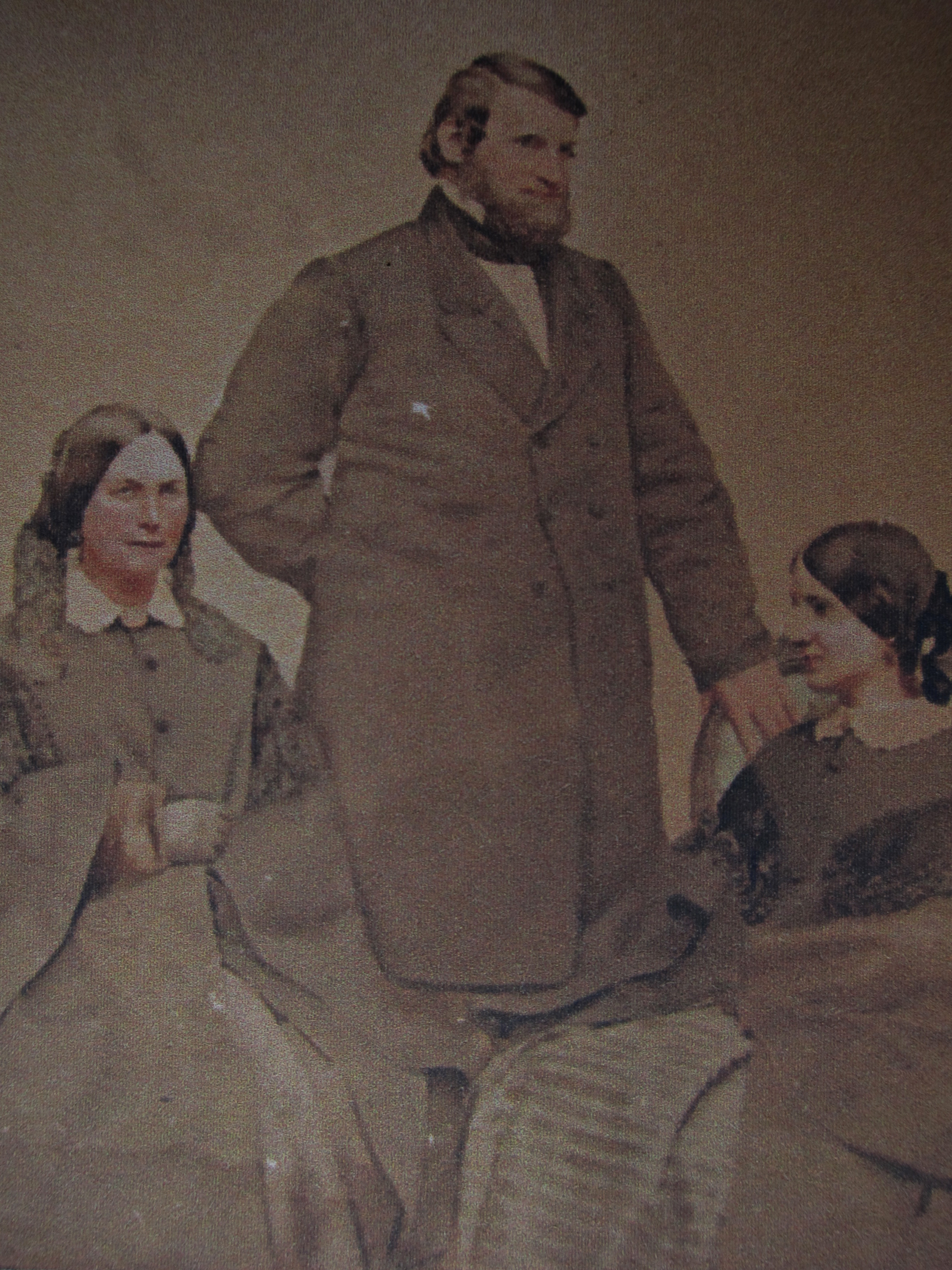
Another interruptious day, filled by “confused” and overlapping events: Susie Ames’s birthday party, Julia Mahoney’s work on dresses for Orinthia Foss, calls from Ellen Howard and Harriet Holmes, the usual choring in the downstairs rooms, not to mention Evelina’s removing the carpet from the stairs and painting the treads. What commotion.

Susan Eveline Ames, the only daughter and youngest child of Evelina and Oakes Ames, turned nine years old today and was treated to a little party. Did she have friends over or was the party strictly en famille? Did she have cake? Ginger snaps? Presents? What was a nine-year-old’s birthday party like in 1851?

Born in 1842, Susie Ames came along several years after all her big brothers were born. From the beginning, she was raised differently from them. While they were slated to work, earn and provide, her education and training were oriented toward a future of domestic responsibilities. Like most girls of the time, she was brought up assuming that she would marry and raise a family. If she failed to marry, she would have to make her way as a spinster aunt living with one or more of her brothers, or become a schoolteacher like Orinthia Foss. Which route was hers?  Marriage.

On January 1, 1861, Susan married Henry W. French, a wool merchant. She was 18 years old; he was 27. For many years, the couple lived in the Ames house with her parents, and possibly looked after the house during the periods when congressman Oakes and Evelina were in Washington. For a time, Susan and Henry lived in their own home on Main Street, on the site where the Oakes Ames Memorial Hall came to be built circa 1880.

As Evelina moved into widowhood and grappled with illness and age, Susan looked after her. She and Henry never had any children, so the particulars of her story weren’t passed on to interested offspring. She only comes to life in her mother and brother Oliver’s journals.


April 29, 1851

CultivationToolsBP

April 29 Tuesday  Frank has finished the beds in the flower

garden and I have set out some plants that Henrietta

gave me and some that I bought of Edwin Manly paid

him one dollar Julia here finishing the dresses for

Susan & my blue Delaine dress.  Mrs George Ames

& I went to Sharon and spent the afternoon

Had a pleasant ride with Dominic


Three spheres of activity informed Evelina’s day. First was gardening, made possible by Frank Morton Ames finally finishing tilling the soil in the flower beds.  He and others had been loosening the soil off and on for several days, which raises the question of how many flower beds Evelina had, and how large they were, and where they were situated relative to the house. Evelina “set out” some plants that she got on Saturday. One group came from her sister-in-law, Henrietta Lincoln Gilmore, at the Gilmore farm; she probably got those for free.  The other group from Edwin Manley, however, she had to pay one dollar for.

The second sphere of action was sewing, of course, which always seemed to be going on in center ring at the Ames house. Today Julia Mahoney, the dressmaker of choice, worked on a dress for Susan and a blue delaine, or light wool, dress for Evelina. The warm weather would soon arrive and the lighter dresses would be needed.

The last sphere was a nice change of pace – literally – for Evelina and her cousin-in-law, Almira Ames. With Dominic, a horse, pulling them along, the two women drove the carriage (or were driven) to nearby Sharon. Whom did they visit? Did they shop in the town?  The ride was pleasant, whatever the errand.


April 24, 1851

Slave_kidnap_post_1851_boston

1851 Thursday  April 24th  Julia here to finish Susans dresses

She is very slow We have got the waist done

to her Delaine & finished the print dress & cut

the lining to my dress This afternoon called 

at Augustus’ & Mr Whitwell with Mrs Peckham

A[u]gustus returned from New York this morning

and is here again to dine Hannah went to

Alsons while he was gone Pleasant weather


Evelina and Julia Mahoney sewed today, perhaps trying to make up for time lost yesterday. Evelina’s nephew, Augustus, returned to the Ames’s dinner table after a business trip to New York. Meanwhile, his expectant wife, Hannah Lincoln Gilmore, and son Eddie were staying out at the Gilmore farm with his parents, Alson and Henrietta.

Had Augustus run into any abolitionist fervor while in New York?  Probably not as great as in Boston, where controversy continued in the aftermath of the Fugitive Slave Act and the capture and rescue of Shadrach Minkins. While some of the most prominent abolitionists of the day, like William Lloyd Garrison, lived in Boston, the city was nonetheless home to many citizens who were less adamant about the issue.  They might not have liked slavery, but they feared the radicalism of the anti-slavery rhetoric more.  They were law-abiding, and the law said that slaves were property and had to be returned to their owners. Daniel Webster had decreed it, and they supported the law accordingly. The controversy pulled at everyone.

When another escaped slave, Thomas Simms, was caught in Boston, the Mayor of Boston, John P. Bigelow, ordered him sent back south. The aldermen and the police supported the move, and the black population of the city became even more nervous than before, as the poster above illustrates. Have TOP EYE Open!

April 23, 1851

Thumb

1851

Wednesday April 23d  Julila Mahoney here again to day making

Susans dark plaid print & borage delaine dresses.  I have

been sewing with her but have had many interruptions

Mr Whitwell called, Jane has cut her thumb very

bad, the nail is most off  have done it up in

borax  Carried my work awhile & sat with Mrs S Ames

Susans print dress most done It is quite pleasant

after so much bad weather

Abraham Lincoln coined an adjective that didn’t outlast his use of it, but it seems apt for the kind of day that Evelina had: “interruptious.”  While wanting only to sew, Evelina had to cope with unanticipated diversions throughout the morning. Julia Mahoney, the dressmaker, sat in a chair and sewed, surrounded by various cuts of cloth from two different dresses. Jane McHanna, probably while in the kitchen preparing food, almost cut the nail off her thumb, causing bleeding that would not have been easy to stop, and putting her out of commission for the day, at least. Reverend Whitwell called – probably instantly wishing he had chosen a different day to pay a visit.  The scene would be farcical were it not for the pain Jane obviously suffered with her thumb.

Evelina treated Jane’s thumb with borax, a mineral that we might think more properly used in detergent. To Evelina, borax was evidently a familiar way to stop bleeding and bind a cut.  Other home remedies for cuts, according to Lydia Maria Child, respected author and consummate advisor on household concerns, suggested treatment with an application of salt or molasses. In her book, The American Frugal Housewife, Child also recommended “Balm-of-Gilead buds bottled up in N.E. rum” as “the best cure in the world for fresh cuts and wounds. Every family should have a bottle of it.”

After the domestic drama of the morning, Evelina had a quieter afternoon. She spent some time with her sister-in-law, Sarah Lothrop Ames, who was still quite sick.  She probably took a deep breath of sweet spring air as she walked next door to see the invalid, welcoming the sunny change from all the recent rain.

April 17, 1851

imgres-1


1851

April 17th Thursday.  Julia has been here to finish

my Foulard Silk it does very well now & looks

very well indeed after washing It has taken

her two days to cut & make the waist baste

the sleeves & sew on the skirt She is very

slow. Orinthia did not keep school yesterday

or to day on account of the storm It has been

a driving storm to day but not as bad as yesterday

The storm that took down Minot’s Light still raged today.  Safely indoors, Evelina and Orinthia tended to sewing, joined by dressmaker Julia Mahoney, who finally finished the alterations on a silk dress for Evelina. Foulard silk was a popular, lightweight fabric – good for the coming warm weather – that typically featured a small print pattern. Used today for scarves, it could and can be hard to sew because it’s so thin.

Julia took longer to complete the outfit than Evelina thought she should, yet as Julia was probably paid by the piece and not by the hour, Evelina’s annoyance wasn’t based on monetary concerns. Perhaps her exasperation at the dressmaker’s deliberate pace stemmed from her own seasoned agility with needle and thread; perhaps she thought she could do the work faster. But Julia may still have been more skilled in the finer needlework required for high-end ladies’ dresses.  Certainly the end result proved pleasing.

According to Godey’s Lady’s Magazine, “One might as well be out of the world as out of the fashion”.  While North Easton, Massachusetts would never be in the running as a fashion center, some of its citizens cared about style and appearance.  Evelina and her sisters-in-law did. They followed the fashions, via various periodicals and on trips into Boston, and dressed themselves as modishly as they could. As Evelina’s grandson Winthrop Ames later pointed out, “Every season there was a great remaking of old garments to bring them up to date.”

The remaking of garments didn’t preclude the production of entirely new dresses, either.  But older clothes were made and remade to last as long as possible.


April 14, 1851

Coffin

1851

April 14 Monday  Julia Mahoney has been here to day

to work on my foulard silk It is bad to 

work on and she has not succeeded very well

but is coming again to finish it. Jane has

done the washing and her clothes dry

Orinthia has finished the shirt for Oliver that

was cut out March 31st Weather Pleasant

Mrs Witherell Mrs G Ames & Mrs S Ames called evening

In his journal today, Old Oliver noted that his son, Horatio Ames, was visiting. Although Horatio would have been, literally, under the same roof as Evelina and Oakes, Evelina didn’t mention his visit. She might not have seen him, of course, although she must have known he was in town and probably staying in the other part of the house.  Horatio, like their brother William, was on poor terms with Oakes and it appears that neither wanted to encounter the other.

Another heartfelt topic that found no tongue today was the anniversary of the birth of Henry Gilmore Ames, the son of Evelina and Oakes who did not survive childhood.  Henry would have been twelve years old today, but died at age two-and-a-half of an unrecorded cause.

In the future – 1876 in fact – family graves would be disinterred from their original locations and moved to a dedicated family cemetery behind the new Unitarian church on Main Street. Oakes Angier would oversee the relocation; among the graves moved would be the small one for Henry.  At the time, Oliver (3) made a few observations about the relocation, including one of the little brother they had lost: “Bro Henry was moved to day and his hair was as perfect as when he was buried. His hair was smooth and parted.”  Oliver (3) also noted that his father’s coffin was so heavy that it took seven men to lift it from its original resting place.

If Evelina remembered today’s date, she indicated nothing.  She was busy with overseeing laundry day (not that Jane McHanna needed any direction on what needed to be done,) as well as Orinthia Foss’s completion of one last men’s shirt, and Julia Mahoney’s sewing on her silk dress.  Many needles at work.