November 8, 1851

Vegetables

Sat Nov 8th  Jane is still in Mansfield and Bridget

sick consequently I have to do the housework and

I have scarcely sat down for one moment  Alson

came up with a load of vegitables and Hannah

called and I left my work while they stopped

Mrs Witherell came home this evening and I have been

in there  Mr Ames went to Boston stopt at Canton to a

whig meeting.  Oakes & Frank brought him home.

Not only was the dependable Jane McHanna away, but the Ames’s second servant, Bridget O’Neil, was sick.  Dr. Ephraim Wales had checked in on Bridget the previous evening but she was still laying low.  Evelina, capable if disinclined, was faced with doing her own housework. She spent most of the day choring, as she called it.

Her brother, Alson Gilmore, drove a wagon up from the Gilmore family farm to deliver a “load of vegitables” to the Ameses. His daughter-in-law, Hannah Lincoln Gilmore, who lived right in the village, came to call and for those visits, Evelina paused to chat.  Once they left, however, she must have plunged into sorting and storing the vegetables that Alson had brought. By this time of year, they would most likely have been root vegetables such as turnips, parsnips, carrots and potatoes. She would have stored them somewhere cool, dry and varmint-free: the cellar, if it wasn’t too wet, or the buttery or even the shed. Sharp-eyed housewife that she was, Evelina would have made sure everything was put away safely.

Oakes Ames, meanwhile, went to Boston as usual on this Saturday, but also “stopt at Canton to a whig meeting.”  The following Monday was Election Day and the party faithfuls were gathering in anticipation. This is the first mention in Evelina’s diary of Oakes’s participation in local politics. Their son, Oakes Angier, had shown interest earlier in the year, running unsuccessfully for the Easton school superintending committee, and attending the Whig convention in Springfield.  But her husband’s interest, although it had probably existed prior to this moment, had not drawn comment. Evelina mentions the meeting most likely because of the impending vote, but the statement coming so close on the heels of an undisclosed agreement she and Oakes had made only one week earlier gives creedence to the possibility that their agreement had something to do with Oakes’s waxing interest in politics.

November 7, 1851

330px-Quince


Friday Nov 7th  Mr Bartlett left in the stage this morning

and George & Mrs Witherell went to Boston I have made

13 lbs Quince preserve 4 lbs jelly and a lot of marmalade

and painted my leaf for the table and it has

kept me busy all day.  Jane went to Mansfield

yesterday with Mrs H & Ames. Bridget is here yet

was taken with a bad pain in her stomach this

evening & sent for her husband & Dr Wales

Mr. Bartlett of Maine departed the house this morning, and Sarah Ames Witherell rode into Boston with her fourteen-year old son, George Oliver Witherell. Her guests, too, had departed, and she was free to go into town.

Without assistance from servants Jane McHanna, who was away, or Bridget O’Neil, who was sick, Evelina stood over her stove today turning at least a peck of quinces into preserves, jelly and marmalade. The store of fruit would be an important addition to the Ames’s dinner table over the winter.  A period recipe for making quince preserves, from The Young Housekeeper’s Friend; Or, A Guide to Domestic Economy and Comfort reminds us of the challenges 19th century cooks faced when preserving food:

“Weigh a pound of best sugar for a pound of fruit, pared and cored.  Boil the fruit in water until it becomes so soft that care is necessary in taking it out. Drain the pieces a little as you take them from the water, and lay them into a jar […] Stone jars will do very well, but if glass is used, it is easy to see whether fermentation commences, without opening them.  Quinces done in this way are very elegant, about the color of oranges, and probably will not need scalding to keep them as long as you wish.  If any tendency to fermentation appears, as may be the case by the following May or June, set the jar (if it is in stone) into the oven after bread has been baked, and the quince will become a beautiful light red, and will keep almost any length of time.” *

Quince is a fruit that we Americans don’t see much of in the 21st century, but it was commonly used in the 19th.  A poor eating fruit, too sour to consume raw, it was high in pectin and kept well, once cooked.  In fact, quince was one of the earliest fruits to be made into marmalade; the word marmalade derives from marmelo, the Portuguese word for quince.**


Mrs. Cornelius, The Young Housekeeper’s Friend; Or, A Guide to Domestic Economy and Comfort, New York, 1845.

** “Quince,” Wikipedia, November 5, 2014


November 6, 1851

OLYMPUS DIGITAL CAMERA

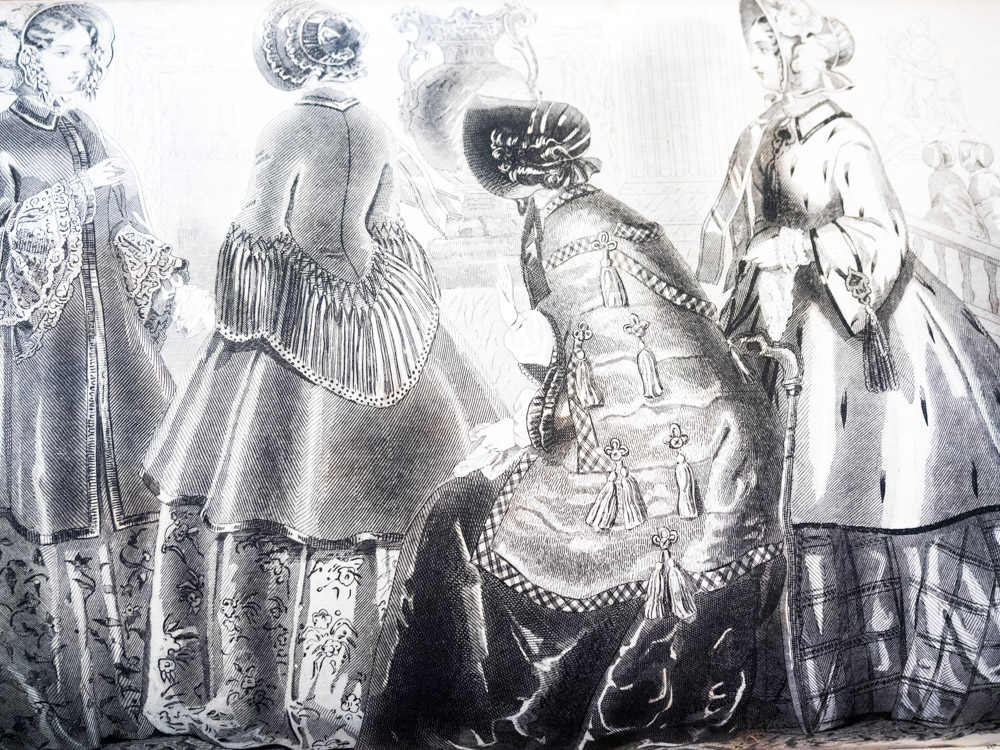
Winter wear from Godey’s Lady’s Book, November, 1851


Thurs Nov 6th  Worked about the house awhile this

morning and about eleven went into the

other part of the house to sit with the ladies

sewed the shirt onto my delaine dress.

Mrs Hubbell & Mrs Ames returned to New York

this afternoon  After they left Mrs S Ames &

self called on Mrs Swain & we went

to Augustus  Mr Bartlett is here will spend the night


After a morning of choring, sewing, and visiting, the Ames women were out and about this afternoon under fair skies. Houseguests Mrs. Hubbell and Almira (Mrs. George) Ames were carried to Mansfield to catch the train for New York.  No doubt they had on their best traveling dresses for the journey. They had been visiting Sarah Witherell and Old Oliver for better than a week.  Servant Jane McHanna traveled with them as far as Mansfield.

After midday dinner, Evelina joined another sister-in-law, Sarah Lothrop Ames, to pay a call on their young friend, Ann Swain.  Mrs. Swain, the wife of the new Ames clerk, John Swain, was a new mother already doting on her first-born son. There would be many visits to ooh and aah over the infant.  Similar oohing and aahing might have been dispensed at their second afternoon call, this one to Augustus Gilmore, his wife Hannah, and her three month old son, Willie.  Even if obligatory, surely these visits were preferable to the calls that the Ames women also made on the sick and the dying.


October 27, 1851

winter_snowfall-t2

Monday Oct 27th  Mr Scott came this morning about nine

It being very stormy he could not get here before

Mr Smiley came just before and worked about

three hours.  After dinner went to Mansfield.

I have been helping Mr Scott paper the sitting

room  Have been busy all day about the 

papering.  Mr Ames went to Boston this afternoon

was also gone Thurs & Friday of last week


Snow! At least that’s what Old Oliver reported in his journal: “this morning the ground was coverd with snow and it snowd about all the forenoon, and was cold. wind north west + blowd hard, at night the fields are coverd with snow 2 or 3 inches deep – there has bin 1 ¼ inches of rain this time”  Evelina only reported that the weather was “stormy.”

Not only did the weather interfere with the travel of the workmen; it also surely challenged servant Jane McHanna as she attempted to wash and dry the weekly laundry. Yet it didn’t seem to prevent Oakes Ames from heading to Boston in the afternoon.  He had been there often of late.  Indoors, Mr. Scott continued to put up new wallpaper in the downstairs.  The redecorating and attendant removal of much of the furniture had been going for a week.

It was the 300th day of the year.

October 24, 1851

pantry-shelves-vintage-650-225x300

*

Friday Oct 24th  Jane & Bridget have cleaned the buttery

and I have had some paint put on the 

shelves  Mr Smiley worked here about three

hours, he went to Mansfield and came here 

about two Oclock.  Scott & Holbrook have finished

the first coat to the sitting room & parlour

I have been about house most of the day.  Sit awhile

with Susan Orr.  Capt Isaac Lothrops wife buried this P. M.

Much cleaning was going on at the Ames’s house in tandem with major redecorating. Evelina the housewife was impelled to tidy everything up before and after various workmen came through to scrape, dismantle, build, paint and/or paper the downstairs rooms. Her servants, Jane McHanna and Bridget O’Neil, scurried around with her, clearing shelves so that the men could follow and do their work.

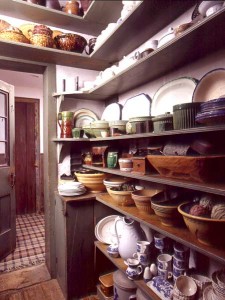
The buttery that Evelina mentions was, in fact, a shelved area off her kitchen that served pretty much as a pantry.  She had food storage “down cellar”, of course, but the buttery, being close by and on the same floor as the kitchen, would have been more accessible for daily use.  She would have stored everyday items like coffee or tea there, for instance. If the Ameses had kept dairy cows, milk would have been poured into pans there, to be skimmed for cream.  Yet the term buttery derives not from its use for dairy products, but from an archaic British term for the room where large caskets of wine, known as butts, were stored. (One butt was the equivalent of two hogsheads or four barrels of wine.) There was no storing caskets of wine at the Ames’s.

Oakes Ames was away during yesterday and today’s disruption, though sons Oakes Angier and Frank Morton and daughter Susan Eveline were home and had to sidestep the disarray. Oakes was away on shovel business, most likely.  No one from Evelina’s household appeared to attend the funeral of Isaac Lothrop’s wife.


* 19th century pantry, courtesy of http://www.oldhouseonline.com, photo by Gross & Delaney


October 20, 1851

Cheese

Monday 20th  Susan washed the dishes again this

morning and I took up the parlour carpet and cleared

the room  Mr Healy has taken out the door

where the closet used to be and getting it ready for

the masons  I have been to work getting of[f] the 

paper and to night feel quite lame.  Mr Smiley

has varnished the chairs that he painted last week

Received 6 cheeses and a tub of butter from Mrs Mower

The calendar may have said it was October, but the domestic commotion at the Ames’s suggested spring cleaning.  In order to redecorate, Evelina pulled up the carpet (which had been laid down in pieces), emptied the parlor of furniture, and spent the better part of the day scraping off the old wallpaper. A local carpenter, Henry R. Healy, was also in the house, removing a closet door and preparing a wall for masonry. Were they putting in a new fireplace?  A coal stove would be more likely. Further, another worker, Mr. Smiley, finished varnishing some chairs.  All this went on over and around the usual Monday washing of clothes by servant Jane McHanna.

Scraping wallpaper off of horsehair plaster is hard work and by night time, Evelina was smarting from the day’s exertion. She couldn’t have been unhappy, though. Much had been accomplished and, moreover, her housewifely self must have been pleased to add “6 cheeses and a tub of butter” to the larder.  Louisa J. Mower, a friend from Maine, sent the dairy items to her.  As gifts? As a purchase?

It was a day of accomplishment for Evelina.


October 13, 1851

OLYMPUS DIGITAL CAMERA

Oct 13th  Susan washed the […] dishes this morning and 

went to sewing quite early made the sleeves

to my cashmere dress and pocket made and

have got all ready for Julia to cut the waist in 

the morning.  Spent most of the afternoon in the

other part of the house  Mrs Willis died about

one or two Oclock this afternoon


“[V]erry warm and sultry like dog days” was Old Oliver’s assessment of today’s unseasonal weather. Evelina didn’t complain about it, nor did she mention any discomfort from the nettlerash that had plagued her for the last ten days.  Perhaps the burning and itching was finally subsiding.

Mrs J. Willis died today. There were a few women in North Easton who might have been this person; a possible candidate was a 44-year-old woman named Hannah Willis who lived in the Pauper’s House with her probable father-in-law, James Willis, and a child named James W. Willis. She had done some sewing for Jane McHanna back in March.

Evelina herself spent the morning with a needle and thread, making the sleeves and pocket for a cashmere dress.  She planned to use the services of Julia Mahoney to sew the waist. In the afternoon she went to the other part of the house, presumably to visit with her sister-in-law Sarah Witherell and a guest, Susan Orr. Given the heat and her slow recovery, Evelina moved around surprisingly well.

October 12, 1851

OLYMPUS DIGITAL CAMERA

Sunday Oct 12th  Had a Catholic meeting at 8 Oclock  Jane went

Have not been to meeting to day on account of the

humour was affraid that I could not sit still.  Susan

went & all the rest of the family  Read in Goodeys

Ladys Book .  Quite stormy & could not go to

Augustus’ as I intended  Have had a very quiet 

day

For the third Sunday in a row, Evelina missed church.  Her nettlerash, or “humour,” still bothered her to such an extent that she had trouble sitting still. She stayed home and by her own admission, “had a very quiet day” while the rest of her family went to meeting. Even the servant, Jane McHanna, left the house to go to a service in the new Catholic Church on Pond Street.

Her father-in-law, Old Oliver Ames, who kept a daily record of the weather, reported that “this was a cloudy warm day and there was 2 or 3 small showers in all about one 4th or 3/8 of an inch southerly.” Evelina evidently studied the raindrops from her perch in the house and decided to postpone her intended visit to the village to see her nephew and his family. Instead she read from Godey’s Lady’s Book, the popular monthly periodical to which she subscribed.

Published in Philadelphia by Louis Godey and edited by Sarah Josepha Hale (a high-profile writer who, among many other accomplishments, wrote Mary Had a Little Lamb), Godey’s Lady’s Book was, as its title suggests, targeted at women. It featured domestic fiction and household hints, sentimental poetry and architectural plans.  It showcased contemporary writing by authors such as Nathaniel Hawthorne and Washington Irving, yet also published three editions in which women, and only women, wrote the articles.  A testy Hawthorne actually complained to his publisher about the influx of female authors, calling them “a damned mob of scribbling women.”

By 1855, the magazine even carried a feature entitled Employment for Women. Each monthly volume of Godey’s contained various illustrations and at least one fashion plate, imperative for home-seamstresses everywhere who wanted to stay abreast of the styles in dress. It was a magazine perfectly aimed at Evelina, and she followed it loyally.

October 9, 1851

IMG_1057

Thursday Oct 9th  Jane has been sick to day went to bed directly

after washing the breakfast dishes and I had to get

dinner  After dinner she was much better and was

able to […do] the dishes  This afternoon I have passed

in Olivers with Miss S. Orr.  Mrs Witherell & Mitchell

Mr Ames & William there to tea Have trimmed

Susans bonnet with dark ribbon


Jane McHanna was sick.  The domestic team at the Oakes Ames house was barely operational, what with Evelina herself still feeling the effects of a mean case of nettlerash. But between them, the two women, servant and mistress, managed to make meals appear on the dinner table in a timely fashion. Did the men of the house appreciate the extra effort going on behind the kitchen door?

Tea was a special event today, served next door at Oliver, Jr. and Sarah Lothrop Ames’s. Present were five of Old Oliver’s six surviving children: Sarah Witherell, Harriett Mitchell, Oakes Ames, William Leonard Ames, and the host, Oliver Ames, Jr. William was visiting, if not from New Jersey, then from his current way station on his journey to Minnesota. Harriett, too, held visitor status;  she and her children were about to return to her husband in Pennsylvania. Only Sarah Witherell, Oakes, and Oliver Jr. lived in North Easton and saw one another regularly.

Missing from the group was Horatio Ames, who lived down in Connecticut. No one’s favorite sibling, some – Oakes, particularly – may even have appreciated his absence. Interesting that Old Oliver himself isn’t mentioned as being present.

Another guest who was also there at this rare gathering of the clan was Miss Susan Orr, a long-time family friend (or relative?) who had known the group when they were children. She could remember Oakes Ames as a baby. Susan had been staying with Sarah Witherell and Old Oliver for about ten days. Meanwhile, a different Susan, only nine-years-old, got her bonnet trimmed with a new ribbon.


October 6, 1851

OLYMPUS DIGITAL CAMERA

*

Monday Oct 6th  Went down to Dr Swans before 7 or 8 Oclock

so that I might find him at home and he has given

me some powders  When I came back found the

dishes washed and put away  Jane has been remarkable

smart  I have finished my striped french print

and have worn it this afternoon  Mr Brown

commenced school again to day  Passed the evening

at Mr Holmes with Susan


Evelina sought help today from Dr. Caleb Swan, who gave her “some powders” for her nettlerash. She would have mixed a dosage with water and swallowed it.  What was the actual medicine that she ingested? Did it contain the laudanum that was often dispensed to women in that era? Whatever it was, it seemed to make Evelina feel a bit better.

Jane McHanna, the Ames’s servant, washed the breakfast dishes for Evelina while she was at the doctor’s. Jane usually did the cooking and Evelina typically did the washing up, but in this case Jane must have recognized how sick Evelina was.  Evelina was grateful for the assistance and praised Jane for being “remarkable smart.”

The day progressed well afterwards. Little Susie returned to school where Eratus Brown was her teacher. Did she miss her old teacher, Orinthia Foss? Evelina sewed and finished making a “striped french print” dress. Stripes were in fashion that fall, as the illustration above from Godey’s Lady’s Book shows. The illustration also shows that distortion of the female figure for advertising purposes was every bit as popular in 1851 as it is in 2014. The length of the woman’s legs in the drawing is improbable, unless she is standing on stilts under that full skirt. Look at her tiny foot sticking out from the hem!

Evelina even felt well enough to go out in the evening with her daughter.  They went over to the Holmes’s where they probably visited with Harriet Holmes, the neighbor who had been so ill earlier in the summer. The Holmeses had a daughter, Mary, who was about Susie’s age.


Fashion plate from Godey’s Lady’s Magazine, September 1851