August 19, 1852

PC+Bellows+Falls01VT

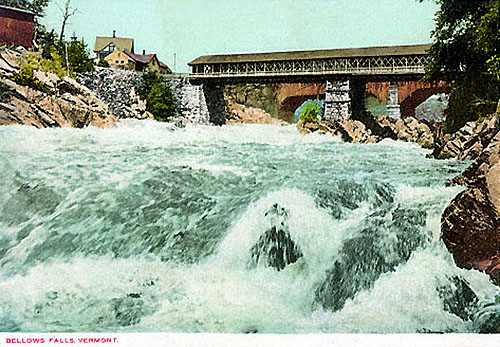
Bellows Falls, Vermont, late 19th century

Aug 19th Thursday.  Started with Mrs A L Ames

S Ames Fred Helen & Oakes A for Burlington

Left Boston at 12  Stopt for the night

at Bellows Falls much fatigued & covered

with dust.  It is a very romantic place and […]

very good accommodations at the Island house

Walked out after tea to view the place & falls

Off they went! Half the family, it would seem, exited North Easton to accompany Oakes Angier on his trip to Burlington, Vermont. Obviously, the group traveled first from North Easton to Boston, where they boarded a train, most likely, and departed at noon. Six or so hours and about 100 miles later, “much fatigued and covered with dust,” they disembarked at Bellows Falls, Vermont, a small village on the state line between New Hampshire and Vermont.

The village may have been small, but its location on the Connecticut River and its powerful falls made it a fine industrial site. Two railroads already met there, and a mill industry thrived. The bridge across the water – a later version of which is featured in the postcard illustration above – added to the picturesque quality of the town.  Evelina found it “very romantic.” Today the village is part of the larger town of Rockingham, whose population boasts a little over 5,300.
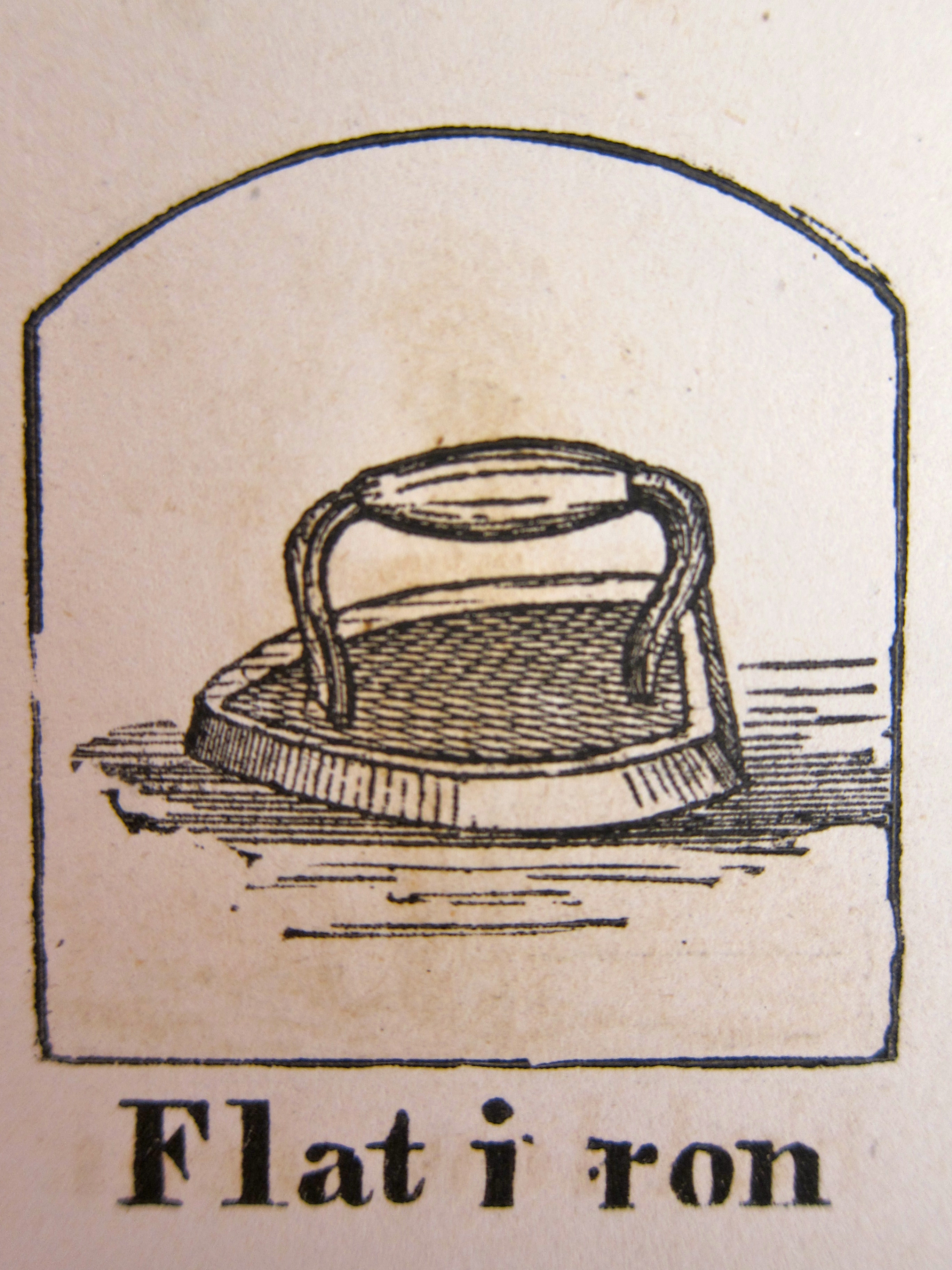


August 17, 1852

Flatiron

Aug 17th Tuesday  Starched my clothes and about

eleven Oclock was setting the table to iron

when Mother & Alsons wife came and

I put them by.  Have ironed them this after

noon in the dining room with Mrs Stevens

Henrietta Augusta & Abby sitting around

Mrs Ames & Witherell called

The Ameses had made a decision to send Oakes Angier to Vermont for a rest, and Evelina was to accompany him on the trip. Also accompanying them would be Sarah Lothrop Ames and her two teenaged children, Fred and Helen, as well as the visiting Almira Ames.

Gathered around Evelina in the afternoon were many of her usual companions: her sister-in-law Henrietta Williams Gilmore, her nephew’s wife, Augusta Pool Gilmore, her niece Abigail Williams Torrey, her guest Mrs. Stevens, and her nearest sisters-in-law, Sarah Witherell and Sarah Ames. The looming expedition must have been the topic of conversation among the women as they sat and watched Evelina iron her clothes on the dining room table. (No ironing boards yet!) The conversation might have roamed from concern for Oakes Angier to curiosity about the travel arrangements.

That the travel ahead of Evelina was serious is indisputable; it involved the well-being of her eldest son. Yet there had to be an element of adventure in the plans.  They’d be traveling across Vermont, visiting places that Evelina may never have seen. They’d be seeing relatives and friends, too, which may be the element that enticed Sarah Lothrop Ames and her two children to join the expedition.

August 15, 1852

Bed

August 15th Sunday  Did not sleep much last night

My handbag with bonnet visite & c were missing

found them this morning at Olivers  Helen

carried them home.  Have been to meeting

came home at noon  Mrs Stevens Orinthia &

Lavinia with us.  Called to see Willie

Gilmore found him more comfortable

Evelina often felt poorly right after returning from her shopping forays into Boston; on this occasion, she was unable to sleep. Surely, the seriousness of her son’s pulmonary illness was the larger culprit in her wakefulness than the usual exhaustion from her trip to the city. She was still rattled in the morning, unable to find her handbag, bonnet and
visite which, it turned out, had been mistakenly taken next door by Helen Angier Ames. It would seem that all the women were a little rattled.

The men may have been rattled, too, by Oakes Angier’s illness, but Old Oliver, at least, wasn’t showing it. He kept up his usual weather-related journal entries. Accordingly, today “was a fair warm day with the exception of two slight showers, perhaps 1/8 of an inch in both of them.”*

Somewhere in the course of the day, perhaps after church, Evelina and her husband, Oakes, and Oakes Angier himself, in all likelihood, determined on a course of action for the latter. Oakes Angier would go off to rest in fresher air and, for the journey itself, be accompanied by various family members.  The decision must have offered relief and hope to all. Evelina got outside of her own head enough to call on her nephew, Alson Augustus Gilmore, whose infant son had been so sick with dysentery. Little Willie seemed better. While there, no doubt, Evelina shared the plans to send Oakes Angier away.

*Oliver Ames, Journal, Stonehill College Archives, Arnold Tofias Collection


August 9, 1852

06_01_002623.LARGE

Map of Bristol County, Massachusetts, 1852*

1852

Aug 9th Monday  Part of the forenoon was working

about the house & cut out some work.

This afternoon started to go to Taunton

and got as far as brother Alsons when it rained

poringly and we were obliged to ride into

the barn untill it slacked a little so that we

could get into the house  Spent the afternoon 

there.  It was quite pleasant when we came 

home.  Mrs Witherell A L Ames & S Ames were with me


On the 1852 map of Bristol County, illustrated above, the town of Easton sits at the very top. Its eastern border abuts Plymouth County, which was the home of Bridgewater (today’s Brockton), West Bridgewater, and more. On Easton’s northern line sits Stoughton in Norfolk County. To its immediate south lies Raynham, home of many Gilmore cousins. We often read of Evelina traveling to these three vicinities – Bridgewater, Stoughton and Raynham –  to see family, friends, and vendors.

To the west of Easton lies Mansfield – where Oakes and Oliver (3) caught the stagecoach for Providence – and Norton. Further south, on a NNW/SSE axis, is the somewhat bow-tie-shaped town of Taunton. Taunton in the 19th century was known locally as “Silver City,” for its silver manufacturing, being the home of Reed & Barton, F. B. Rogers and others. We seldom hear of Evelina heading there, but for some reason, she and her sisters-in-law were traveling there this afternoon.

The ladies never got to Taunton, however, as an abrupt rain shower came down “poringly” while they were en route. “Good showers,”**too, according to Old Oliver, the kind of showers he’d been looking for most of the summer. When the rain commenced, the women drove their vehicle into Alson Gilmore’s barn and waited, then hurried into the house when “it slacked a little.” And there they sat, visiting with the Gilmores.

With the notable exception of Boston, to which Evelina traveled several times a year, this map pretty well represents the geographic scope of Evelina’s life to date. The northern portion of Bristol County and its abutting towns constituted her largest neighborhood, her network of friends and family, her travel pattern, her home. That was her world. It would soon get larger.


*Courtesy of the Norman B. Leventhal Map Center, Boston Public LIbrary

** Oliver Ames, Journal, Stonehill College Archives, Arnold Tofias Collection

July 22, 1852

Fly

July 22 Thursday.  this has been a hot uncomfortable

day and the flies are quite too plenty

dead ones laying on the floor in any

quantity.  Hannah is not neat at all

and does not keep the house in any order

Julia has got my skirt to the borage so

much one side that it will have to be taken

of[f]. She says she will come Saturday and do it


Oh, dear. Today was “allso a verry warm day verry much like yesterday.” * Evelina appears to have been affected by the “uncomfortable” heat. She had nothing agreeable to report. Her maid was sloppy, her dressmaker was inept, and there were dead flies all around the house. Probably not even her flower garden offered solace.

As for the flies, we modern readers must remember that window screens were in their infancy, so that when Evelina and other housewives pulled up the window sashes in their homes to try to cool the air inside, they let in flies and other bugs “in any quantity.”

Flypaper hadn’t been invented yet, either, but it would come along in another decade when a baker in the small town of Waiblingen, Germany, fed up with the flies that landed on his cakes and tortes, had the idea to coat a strip of paper with molasses and hang it in his window. The flies went for it, so to speak, and a universal aggravation was successfully addressed. Customers began to want the strips of flypaper even more than the baked goods, so much so that the baker eventually gave up baking and took up the manufacturing of his product. (He would soon replace the molasses with arsenic, but that’s another story.)

The German baker’s invention, unfortunately, came too late to help the disgruntled Evelina or the hapless Hannah on this warm, warm day in Easton.


*Oliver Ames, Journal, Stonehill College Archives, Arnold Tofias Collection

July 14, 1852

1852

P1070606-X2

High water (flood level) mark in canal in Lowell, Massachusetts


Wedns July 14th  Julia came again this morning

but we have not got along very fast

on my dress  Have no trimming for the

sleeves have written for Mrs Stevens to

get me some   There is a great deal to

do to finish my dress  Hannah & Mary 

have both been ironing all day and 

have it all done

Evelina was indoors, sewing a new dress with the help of dressmaker Julia Mahoney. Old Oliver was out haying, “jawing” orders at local men gathering up this year’s meager crop. Oakes Angier, Frank Morton and probably Oliver (3), now that he was home from college, were each posted in some area of the factory, making shovels alongside the workers. Oakes and Oliver Jr. were supervising, perhaps striding around the shovel complex watching the new building go up or sitting in the office looking at accounts.

If we modern readers want to find a day that typifies life in North Easton in the middle of the 19th century, we couldn’t do better than this ordinary summer day in 1852. In other years and in other places, July 14th has hosted more momentous events: the storming of the Bastille, the first ascent of the Matterhorn, the shooting of Billy the Kid, the day Jane Goodall arrived in Tanzania to study chimpanzees. Nonesuch in North Easton; according to Old Oliver’s record, July 14, 1852 was simply a “warm good hay”* day. Routine ruled.

This is not to say that history wasn’t happening. It was. Yet as Evelina noted, “we have not got along very fast,” a phrase that is applicable to so much of history. Change often quietly accumulates, transforming what we know in a stealthy fashion. Evelina’s hand-sewing, Old Oliver’s oxen-driven hay-wagons, Oakes’ and Oliver Jr.’s water-powered shovel machinery: all have since disappeared, replaced by modern equipment invented over time. The life that the Ameses lived was already altering, irrevocably, bit by bit.

Oliver Ames, Journal, Stonehill College Archives, Arnold Tofias Collection


July 11, 1852

imgres-1

Luther Sheldon 

(1785 – 1866)


July 11th Sunday  Went to meeting with Mrs A L Ames

this morning to Mr Sheldons church  The

church is just painted and looks nicely.

Their organ is good & fine ringing but they

had a most miserable preacher a stranger.

Communion at our church this afternoon  Mrs

Ames partook with them

Instead of going to her usual Unitarian service in Easton Center this morning, Evelina accompanied Almira Ames to the Easton Evangelical Congregational Society, also known as “Mr. Sheldon’s church.” Luther Sheldon was an orthodox Congregationalist, a man of “good sense and fine character”* who had once been embroiled in a difficult schism in the local church in the 1830s. This was a period when Unitarianism first developed and uprooted many Congregationalists. Sheldon and his congregation not only survived the division but, according to local historian Edmund Hands, were instrumental in keeping local rancor and partisanship to a minimum. The two separate churches settled into peaceful coexistence, and Sheldon and his wife continued to earn general approbation.

Partisanship still existed in a few pockets, however. Evelina often expressed dislike for any man of the cloth other than her own William Whitwell, and today was no exception. She might not have criticized Mr. Sheldon himself, but she had no problem slamming today’s visiting minister at the Congregational church as “a most miserable preacher.” What could he have said to earn such disdain?

For the afternoon service, Evelina and Almira returned to “our church.”

*Edmund C. Hands, Easton’s Neighborhoods, 1995, p. 131

July 6, 1852

500px-Illinoisoldcapitol

Old State Capitol Building, Springfield, Illinois, built 1839

1852

July 6th Tuesday  Was very busy sewing this forenoon

Mary made the sleeves to my purple cambric

calico and sewed the drugget for the sitting

room  This afternoon have been into Olivers

to tea with Mrs Witherell & Mrs Ames &c &c

Mr Jones from Foxboro called.

Received a note from Cassander Gilmore that 

Henry died this morning requesting us to attend the funeral 


In the statehouse in Springfield, Illinois, a practicing lawyer and former U. S. Representative named Abraham Lincoln gave a eulogy today for Henry Clay, the Senator from Kentucky who had just passed away. Clay had been Lincoln’s idol, his “beau ideal of a statesman.”* In 1832, Lincoln cast his first presidential vote for Clay; in 1844, he campaigned for Clay and served as an elector from Illinois. Clay’s influence on Lincoln would be life-long.

On the occasion of Clay’s death, Lincoln spoke for some time, quoting at length a laudatory editorial which lamented “that never again that majestic form shall rise again in the council-chambers in his country to beat back the storms of anarchy which may threaten, or pour the oil of peace upon the troubled billows as they rage and menace around…” Lincoln then moved on to his own simpler words. He praised Clay for his wisdom, eloquence, and perseverance, noting that “Mr. Clay’s predominant sentiment, from first to last, was a deep devotion to the cause of liberty – a strong sympathy with the oppressed everywhere, and an ardent wish for their elevation.”*

In the town of Easton, Massachusetts, on this same day, Evelina received a letter asking for her presence at a different funeral. Her cousin Henry Gilmore of Raynham had died this very morning, as his brother Cassander Gilmore wrote to say, and she and her family were pressed to attend the funeral the next day.


* henryclay.org

July 1, 1852


OLYMPUS DIGITAL CAMERA


Thursday July 1st  Transplanted some in the garden

this morning but there came up a shower

and put a stop to it  I then went to

mending on some of Susans clothes  Susan

was quite sick last night and not well

enough to go to school to day.  This afternoon 

Mrs Witherell S Ames A Ames rode to make calls

found all the ladies that we were to call on at Mr E Howards


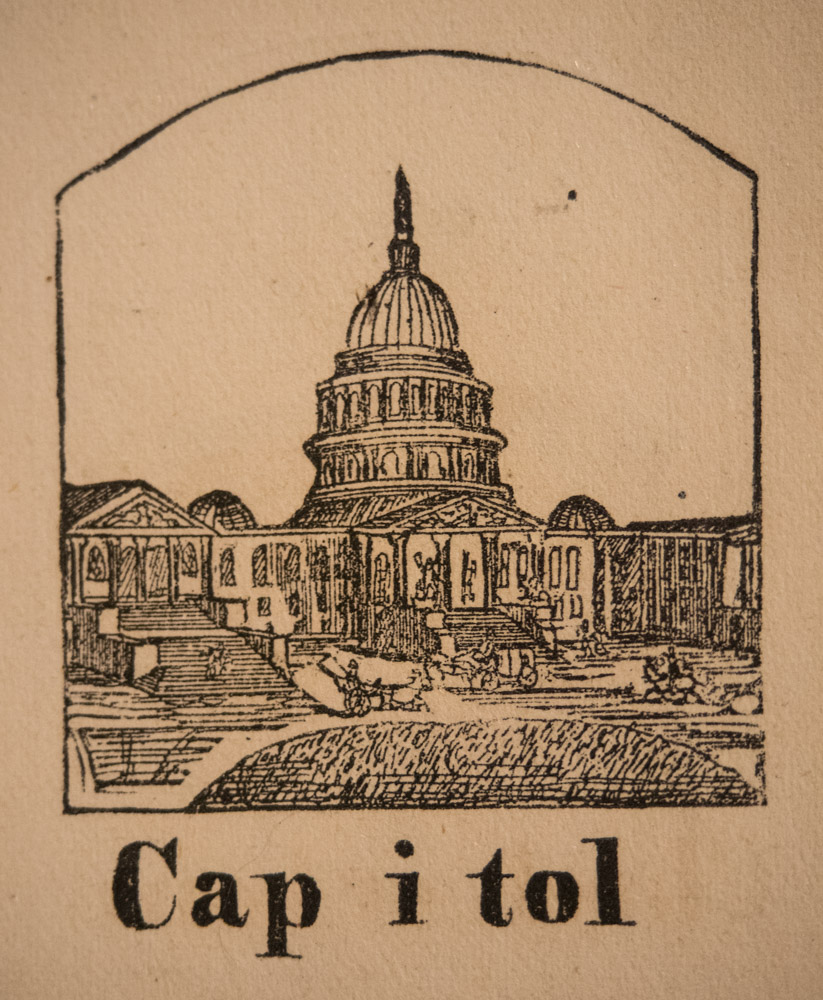
In Washington, D. C., Senator Henry Clay of Kentucky became the first person ever to lie in state in the Capitol rotunda.  A giant in his day, he had served in the House of Representatives, the Senate, and as Secretary of State. He was the man who had created the Whig Party and aspired to the presidency, who always spoke passionately for the Union and was willing to compromise to preserve it. As he himself noted in a speech in 1844, “It has been my invariable role to do all for the Union. If any man wants the key of my heart, let him take the key of the Union, and that is the key to my heart…”* He had dedicated his life to public service and the country thanked him.

The next such person to lie in state in the rotunda would be Abraham Lincoln.

Less august (but no less meaningful to Evelina) events transpired in North Easton today. Evelina, Almira Ames, Sarah Ames and Sarah Witherell “rode to make calls.” This activity marks the first time that Sarah Witherell had ventured out socially since the death of her son, George, six weeks earlier.

Old Oliver made note of the rain that had interrupted Evelina’s early morning work in the garden: “It raind a little last night + there was a little rain this forenoon it was a warm day + cloudy most of the time.”**

*Henry Clay, from 1844 speech, as quoted in “Henry Clay,” by Robert V. Rimini, New York, 1991

** Oliver Ames, Journal, Stonehill College Archives, Arnold Tofias Collection

June 22, 1852

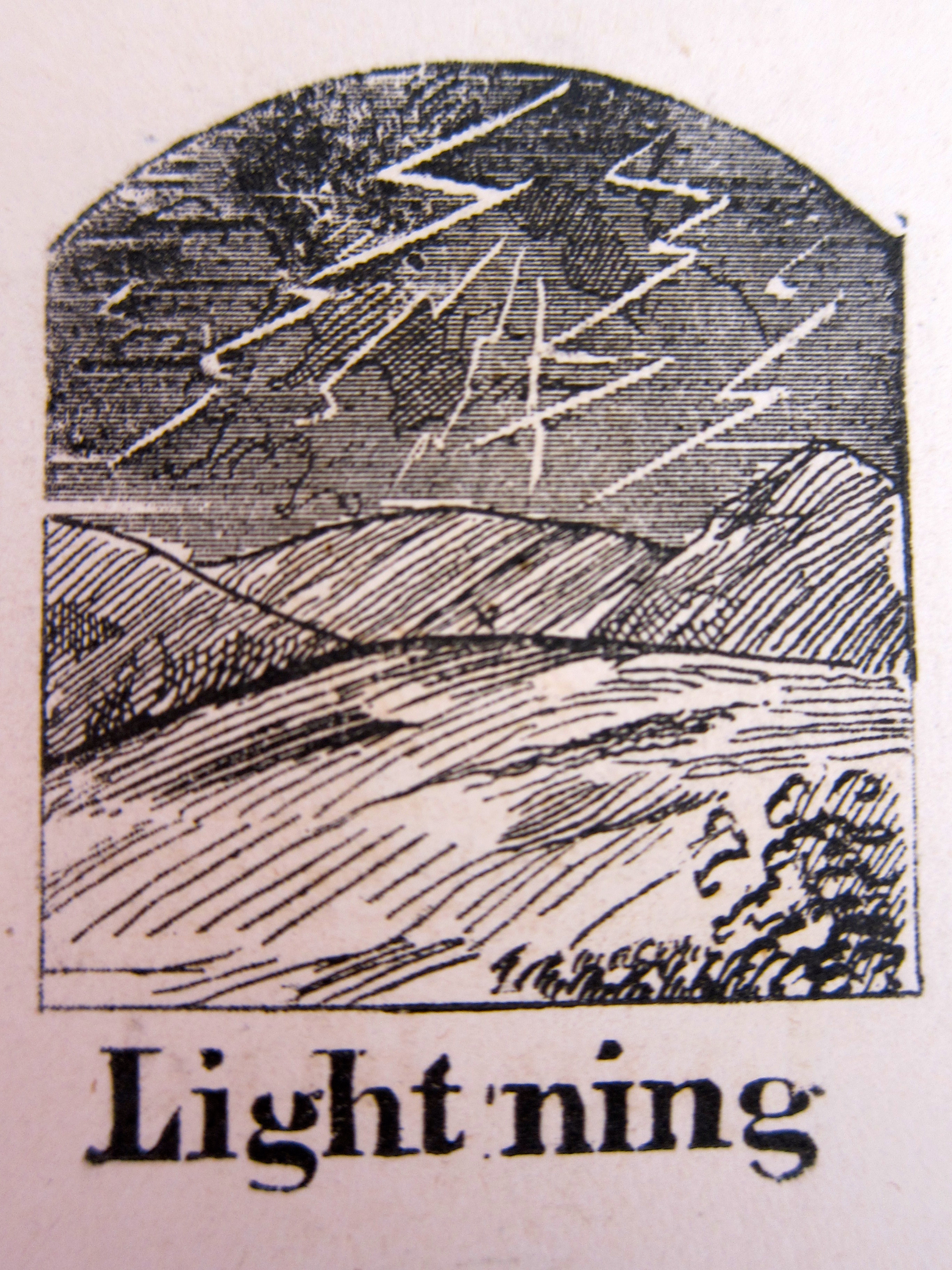
Lightning

1852

Tuesday June 22d  Worked in the garden again this

morning untill about ten.  My garden

takes up quite too much of my time.  This afternoon

carried my work into Olivers.  Sewed the skirt

on to my brown muslin and worked some on the waist

of my purple cambric dress  Catharine here again

to day but it is of no use for me to have her.  Have had

a very heavy shower with thunder & lightning


Evelina complained that gardening “takes up quite too much” of her time, but she did seem to love it. It and sewing were her especial interests. From the two occupations, we can derive the fact that she loved many colors. She didn’t just choose one or two colors, she chose all of them. In her garden we see blossoms of pink, purple, red and yellow in many shades and sizes. In her wardrobe, too, the spectrum is broad. On this day she worked on both a brown muslin and a purple cambric dress.  Just recently, she had finished a green gingham dress, and before that there was a black silk. She had sewn pink aprons, blue silks and plaid skirts, and many of her outfits had bonnets or ribbons to match. Her taste was all-encompassing, it would seem. Did her color selection reflect the styles of the day, or her personal preferences, or both?

While the colorful garden was apparently thriving under Evelina’s careful attention, her sewing projects were not. The new servant, Catharine Middleton, who had been hired primarily to assist with sewing, was not working out. She was “of no use.”

Old Oliver, the family weatherman, was unusually chatty about today’s weather.  He was excited about the rain, but feared it had come too late for certain patches of hay. He wrote: “it was fair this forenoon + cloudy in the afternoon the wind was very high all day from the South west + towards night + in the evening there was a shower of nearly half an inch, but the grass on gravely land is to far gone to be helpt.”