September 15, 1851

Peach

Monday Sept 15th  Mrs Stevens & I made our plan

to go to North Bridgewater this afternoon but

could not get a horse in season  Augustus

rode up to his house with us and we brought

Miss Eddy home with us.  Called at Mr Reeds

and got some peaches.  Mr & Mrs Whitwell

called before we went away Ruth & Louisa

Swan called at the other part of the house

Plans to go to North Bridgewater had to be cancelled today when Evelina couldn’t get a horse in time, or “in season,” as she says. The morning hours had been spent on housework and laundry, certainly, and the planned trip to Bridgewater must have been a sweet incentive to get the choring done.  No doubt Evelina and Mrs Stevens were disappointed not to go.

Evelina and Mrs. Stevens did get to call on Evelina’s nephew, Alson Augustus Gilmore and his wife, Hannah Lincoln Gilmore.  Hannah had recently given birth to her second son, Willie, and might well have welcomed the company. The women also secured some peaches at one of the Reeds’ homes, no doubt with plans to make some preserves. Reverend William Whitwell and his wife Eliza called on them and two of Dr. Caleb Swan’s offspring, Ruth and Louisa, called to see Sarah Witherell.  Ruth was about to be married. The social comings and goings of summer continued despite the light frost overnight, a sure sign of approaching autumn.

August 31, 1851

28041868_121522694550

*

Sunday Aug 31st  Went to meeting and at noon Henrietta & Mrs

Stevens came home with us.  Mrs Stevens came with 

us from church at night and Alson carried Orinthia

home  Mrs Stevens & self called at Mr Torreys

The boys went to Dr Swans & Augustus’ to call on 

Miss Eddy who is stopping there  Oliver & wife & George

and family to Mr Lothrops & Pauline went into to stay

with Helen & talk about Warren


Socializing continued today after church, with Evelina welcoming her sister-in-law Henrietta Williams Gilmore and a mutual friend, Mrs Stevens, back to the house. She and the latter went to call on Col John Torrey while the Ames sons rode south to Dr. Caleb Swan’s to call on a Miss Eddy, who must have been special to warrant all three boys coming to visit.

Not forgetting that the Lothrop family had just been through the loss of Sarah Ames’s brother Clinton Lothrop, houseguest Pauline Dean called on young Helen Angier Ames, niece of the deceased.  Evelina was certain that Pauline only went to talk about a new love interest, however. Oliver Jr and Sarah Ames, meanwhile, went with another brother, George Van Ness Lothrop, and his wife Almira to call on their parents and their brother’s widow.

George Van Ness Lothrop, a North Easton son who had moved west a decade earlier, was, in 1851, serving his adopted state of Michigan as State Attorney General. Active in Democratic politics and a general counsel of the Michigan Central Railroad for nearly three decades, he ran unsuccessfully for U.S. Representative and U.S. Senate. He was a great supporter of Stephen Douglas, which would certainly have put him at odds with his brother-in-law, Oliver Jr., who was a Lincoln man. In 1885, he was appointed by Grover Cleveland to be U.S. Minister to Russia.

He died in 1897, and was honored with a road in his name in Grosse Pointe, Michigan, just outside of Detroit.

* George Van Ness Lothrop (1817-1897)

August 10, 1851

il_570xN.520777977_foe3

*

1851

Aug 10th Sunday  As usual have been to church to day

Mr Whitwell preached.  Went to the

methodist meeting house to a sing at 5 Oclock

got sick of it and went home at recess.

Oakes A Oliver & Helen Ames went with Orinthia to the

sing and carried her home.  Frank went from 

the sing and carried Ellen H & Louisa Swan to 

ride

Her sons clearly enjoyed music, but Evelina’s appreciation was perhaps not up to theirs, if her reaction to today’s musical gathering is any indication. That, or the singing wasn’t very good.  She “got sick of” the sing at the meeting house and left when she could. Perhaps she was just ready to be at home at the end of a long, hot Sunday and already anticipated the choring and sewing ahead of her tomorrow. She may have had a good book waiting for her.

Oakes Angier, Oliver (3) and Frank Morton were regular attendees at the sings; they enjoyed the music.  They also enjoyed the company of a circle of friends who attended the sessions, including Ellen Howard and Louisa Swan. Frank Morton was the son who drove Ellen and Louisa home, while Oakes Angier and Oliver (3), along with their cousin Helen Angier Ames, drove Orinthia back to the Howard house.

Ellen Howard was the tenth of Elijah Howard’s twelve children (by three wives.) Small wonder that the Howards were willing to board Orinthia Foss for a time; Nancy Howard was quite used to setting many places at what must have been a capacious dining room table. Ellen Howard ended up marrying George Withington, a Unitarian minister who came to town about this time. He ultimately left the ministry and served for many years as Easton’s town clerk.

Louisa Swan was the daughter of Dr. Caleb Swan, who had eleven children by his three wives. Louisa never married; she eventually left Easton for Vermont, where she lived with her sister Ruth who was married to U. S. Senator Justin S. Morrill.

* Currier & Ives,The Morning Ride,”  1859

July 13, 1851

HailCorn1

July 13 Sunday  We all went to church this forenoon

but my company did not wish to go this

afternoon and I staid with them

About 4 Oclock had a very heavy shower of

rain & hail which prevented us from going to Mr

Manlys garden as we intended.  Oakes A carried

Orinthia home & stoped awhile at Dr Swans

Mrs S Ames & Mrs Mitchell & Witherell called


After noting yesterday’s accommodating weather, Old Oliver made a very different report today:

“it was fair to day but rather cool wind north west untill about 5, O,clock when there was a smart shower and a considerable quantity of hail but it was not large enough to do much damage. there was some thunder the hail cut the corn leves in strings – and at Daniel Wheatons and in Taunton it broke a good deal of glass”

Damage to the corn crop was no small matter, although Old Oliver seemed to make light of it.

Evelina, meanwhile, along with Oakes and their sons had to entertain the young houseguests, Melinda and Caleb Norris and Julianne and Benjamin Harris, once they all came home from church. The expedition to Edwin Manley’s garden, a regular and favorite destination for guests, was cancelled because of the bad weather. Instead, the company must have sat inside and listened to the pelting hail.

Eventually, the weather passed and some family members ventured forth.  Oakes Angier carried Orinthia Foss back to the Elijah Howard house, where she was boarding, and stopped to visit Dr. Swan and his two daughters, presumably, on his way home.  Evelina’s sisters-in-law came to call, and tea was likely served to a crowd.

July 4, 1851

800px-US_flag_31_stars.svg

*

July 4th  Have been transplanting some pinks &c to day We have had several heavy showers  Oakes A & Frank rode to Dr Swans to make a call and carry his chaise home  Oliver & wife Harriet & Helen went to Mr Lothrops this afternoon  Mr Ames & self to mothers.  Orinthia has gone to Cohasset with Mr Brett.  Helen came home last night   On the Fourth of July in 1851, the new 31-star flag was raised over America for the first time.  It recognized the addition of California to the union.  Previously known as the California Military District, and before that as the short-lived California Republic, the new state had been officially added back on September 9, 1850, less than three years after gold was discovered there. California’s statehood had been a political struggle in that age of slavery. Only after significant wrangling by Congress and Presidents Zachary Taylor and Millard Fillmore, did compromise legislation, spear-headed by Senator Henry Clay, finally carry the day. There was to be no slavery in California. The 31-star flag would remain the standard until 1858, when Minnesota joined the union. The nation’s 75th birthday was recognized in Washington, D.C. with a ceremony for the laying of a cornerstone of the new addition to the Capitol. Massachusetts’ own Daniel Webster gave a speech. A long speech it was, in the style of the day, in which, among other things, Webster exhorted his audience to acknowledge that the formation of the United States had wrought “astonishing changes […] in the condition and prospects of the American people” and to advise “ye men of the South” that the progress of the country was worth staying in the union for. Ten years before the Civil War, Webster opined that “the secession of Virginia, whether alone or in company, is the most improbable, the greatest of all improbabilities.”  Webster didn’t live long enough to see how wrong he had been. Back in Easton, the shovel shop was closed. Many employees may have tried to picnic despite the rain. In the Ames family, most everyone had someplace to go. Evelina and Oakes rode to the Gilmore farm to visit Evelina’s mother. Oakes Angier and Frank Morton, no doubt tired from their long day yesterday, took the borrowed chaise back to Caleb Swan. Oliver Ames Jr., his wife Sarah and daughter Helen rode over to Sarah’s parents’s house, taking Harriett Ames Mitchell with them. Where was her husband, Asa? Where were her young children? With the Mitchell in-laws in Bridgewater, perhaps. Why weren’t they all together? Even Orinthia Foss was out and about, gone to Cohasset with a Mr. Brett.   * If you want to see other designs for the 31-star flag, check out the Zaricor Flag collection at flagcollection.com

June 11, 1851

images

June [11]  Wednesday  Mended

Oakes Angiers coat put on new

buttons  Then made the button holes in 

the waist of Mrs Sarah Ames dress. Cooked

a calfs head for dinner  This afternoon

about three Mrs Witherell, Mitchell & Miss

Eaton & self went to call on Mrs Whitwell.

Called at Mr Wm Reeds  Mrs Reed was from

home.  Called at Dr Swans.  Bridget here.

A[u]ugustus gone to Boston.


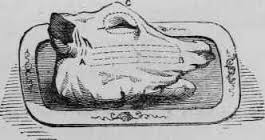
Evelina’s activities today were quintessentially nineteenth-century.  She mended her son’s coat, made button holes for her sister-in-law, rode out in the carriage with her other sisters-in-law to call on the parson’s wife, and served a calf’s head for dinner.

Perhaps there is a reader out there who has been served calf’s head, or cooked it.  Most 19th century cook books carried a “receipt” for it, right next to recipes for calf’s feet, sheep’s head, and roasted sweetbreads.  Calf’s head could be roasted or boiled; the recipe below from Mary Peabody Mann’s 1858 Christianity in the Kitchen opts for the latter.  What follows is not for the squeamish:

To Dress a Calf’s Head

Soak the head for ten minutes in lukewarm water, powder it well with rosin, dip it into a large quantity of scalding water, and holding it by the ear, scrape off the hair with the back of a knife.  When clean, take out the eyes, cut out the tongue, remove the jawbone with teeth, saw lengthwise through the skull without injuring the brains, which must be carefully taken out, and put for a few hours into lukewarm water, to disgorge, [that is, to rinse out the blood.]

Make a stock by putting into the brazing pan two or three carrots and onions, six cloves, a pint of cream, a bouquet of parsley, thyme, and bay-leaves, and after stirring this together for twenty minutes over the fire, add a pint of water.  When this is warm, mix a quarter of a pound of flour with a gallon of water, slice a lemon, add a quarter of a pound of salt, and lay the calf’s head into the stock.  Let it be entirely covered, else the uncovered part will have a dark look, and simmer it gently till it is tender.


April 21, 1851


Doctor

1851

Monday April 21st  I have ripped my blue & orange

Delaine dress & washed & ironed it ready to make over

It was quite pleasant this morning & Jane got her

clothes all dried but this afternoon & evening it storms

again. Frank has been unwell for a few days

with his throat & headache.  Dr Swan called & I paid

him 50 cts.  Mrs S Ames sick and had the Doctor

Frank helped me set out some rhubarb roots

A sunny morning sent Evelina out of doors and into her garden, which must have been muddy after all the recent rain. With the help of son Frank Morton, she put in some rhubarb.  Nearby, Jane McHanna hung the Monday wash and managed to get it dry before more wet weather arrived in the afternoon.

Frank had been unwell, as had Sarah Lothrop Ames next door and each had a call from a doctor. In those days, doctors would typically call on patients in their homes. Physicians kept offices, of course (usually in their own homes,) but generally treated people by traveling to them rather than the other way around. This practice was commonplace well into the 20th century.

Dr. Caleb Swan was Evelina’s physician of choice.  Besides being generally considered quite competent, Swan was “suave, genial and agreeable.”*  His bedside manner must have been calm and attentive. He had studied at Harvard and then apprenticed under a practicing physician, apprenticeships being standard training regimen at that time. A popular man in town, he was involved occasionally with local and state politics.  “Intensely opposed to the Know Nothing” party, he was a “pronounced anti-slavery man.”* He had a large family, and four of his sons became physicians like him.

Elsewhere in the world of shovels, Old Oliver oversaw work on a shop they kept in Bridgewater, where men were “sleighting the roof.”  Slate was the preferred roof material for owners who were concerned with the possibility of fire.

*William Chaffin, History of Easton, 1886