October 12, 1851

OLYMPUS DIGITAL CAMERA

Sunday Oct 12th  Had a Catholic meeting at 8 Oclock  Jane went

Have not been to meeting to day on account of the

humour was affraid that I could not sit still.  Susan

went & all the rest of the family  Read in Goodeys

Ladys Book .  Quite stormy & could not go to

Augustus’ as I intended  Have had a very quiet 

day

For the third Sunday in a row, Evelina missed church.  Her nettlerash, or “humour,” still bothered her to such an extent that she had trouble sitting still. She stayed home and by her own admission, “had a very quiet day” while the rest of her family went to meeting. Even the servant, Jane McHanna, left the house to go to a service in the new Catholic Church on Pond Street.

Her father-in-law, Old Oliver Ames, who kept a daily record of the weather, reported that “this was a cloudy warm day and there was 2 or 3 small showers in all about one 4th or 3/8 of an inch southerly.” Evelina evidently studied the raindrops from her perch in the house and decided to postpone her intended visit to the village to see her nephew and his family. Instead she read from Godey’s Lady’s Book, the popular monthly periodical to which she subscribed.

Published in Philadelphia by Louis Godey and edited by Sarah Josepha Hale (a high-profile writer who, among many other accomplishments, wrote Mary Had a Little Lamb), Godey’s Lady’s Book was, as its title suggests, targeted at women. It featured domestic fiction and household hints, sentimental poetry and architectural plans.  It showcased contemporary writing by authors such as Nathaniel Hawthorne and Washington Irving, yet also published three editions in which women, and only women, wrote the articles.  A testy Hawthorne actually complained to his publisher about the influx of female authors, calling them “a damned mob of scribbling women.”

By 1855, the magazine even carried a feature entitled Employment for Women. Each monthly volume of Godey’s contained various illustrations and at least one fashion plate, imperative for home-seamstresses everywhere who wanted to stay abreast of the styles in dress. It was a magazine perfectly aimed at Evelina, and she followed it loyally.

October 5, 1851

Letter

Oct 5th Sunday  Mr Whitwell has gone to Philadelphia and

we have no meeting and Mr Ames self & Susan

staid at home  Oakes A & Charles Mitchell went

to N Bridgewater to meeting  Wm & Mr B Scott

came to the other part of the house this morning.

Mrs Latham & Aaron Hobart this afternoon.  I have

been writing most all day  Am not at all well

It has been a beautiful day.

Feeling as poorly as she did, Evelina was probably grateful not to attend church. Her rash was so irritating that she had trouble sitting still, yet lacked the vigor to move around much. Too, she had worked hard the day before putting up fruit preserves and may have felt tired from the effort. She wasn’t “at all well.”

Letter writing occupied her, and probably helped take her mind off her discomfort, just as playing with dolls had distracted little Susie when she was ill. Evelina often corresponded with several female friends and relatives, like Louisa Mower and Orinthia Foss in Maine, cousin Harriet Ames in Vermont and Pauline Dean, whose home address we don’t know. Which friends did she write to today?

Other family members were more active, despite the cancellation of the usual church service. Son Oakes Angier Ames rode over to North Bridgewater with Charles Mitchell (a younger brother-in-law of Harriett Ames Mitchell) to attend meeting there. Old Oliver and Sarah Ames Witherell, in the other part of the house, received several visitors, including Aaron Hobart.  Susan Orr was still visiting there, and may have been the draw for some of the new visitors.

September 28, 1851

149

*

Sunday, Sept 28  Having a bad cold and headache I did not attend church

to day have not read as much as I should had I been

well  Susan has got quite smart and has been

reading the wide wide world  It has been very 

quiet here all day  I have been looking at

my accounts book have neglected it sadly

of late but hope to do better for the future


The excitement and strain of the last week or so – the return from Boston, the plunge into redecorating and her daughter’s sudden and demanding illness – may have taken their toll. Evelina came down with a cold and was too ill to go to meeting.  That she was too sick to “read much” indicates just how crummy she must have felt. She generally enjoyed reading on Sundays after church. The only activity that seemed to interest her today was looking at her “accounts book,” but that didn’t cheer her up much. Perhaps she suddenly reckoned with the money she and Oakes had recently spent.

Little Susie Ames, who had been so sick with nettle rash, was definitely on the mend.  She may not have gone to church either, but she was deep into reading The Wide, Wide World, a popular, famously sentimental novel by Susan Warner (published under the pen name of Elizabeth Wetherell.) This pious classic tells the story of little Ellen Montgomery, a girl about Susan’s age who is separated from her mother and sent to live with distant relatives. She struggles among strangers – kind and mean – to accept her fate and learn to trust God. A best-seller in its day, it clearly appealed to Susan, and Evelina, too, presumably.


* Ellen Montgomery, the young heroine of The Wide, Wide World, is often in tears, as this period illustration from the popular novel shows.

September 21, 1851

1525-105430-a-flumere

*

Sunday Sept 21st  Have been to meeting  Mr Ames & self came

home at noon and Horace Pool came with us

and they rode up to the great pond where they are

building a new floom.  Brought Abby Torrey from

meeting & carried her back  She & Malvina are spending 

a week at Alsons  Miss Latham & her brother Edward

came to our meeting this morning and to the other 

part of the house after  I called into see them

The new flume going in at Great Pond was attracting local attention. After church, Oakes Ames and Horace Pool rode up to see it. Oakes had been in Boston when his father, Old Oliver, had begun the work, and no doubt he was curious to see the progress.  No one would have been working on it today, as it was Sunday.

The flume was intended to harness water power for the shovel factory. It was basically an inclined ditch lined with stones and boulders to shunt the water along. Some flumes – such as those used in lumbering – are lined with wood, but that wasn’t likely to be the case here, given the scarcity of wood, the availability of stones, and the expectation of longevity. Old Oliver’s oxen must have been used to haul the many stones, and man-power used to put each one in place.  The channel itself would have been dug with Ames shovels, naturally.

Evelina, perhaps moving about slowly on sore feet, went to church and caught up with various friends and family members, including nieces Abby and Malvina Torrey. She popped into the other part of the house – the section lived in by Old Oliver and his daughter Sarah Witherell – to greet some visitors there.  She was settling back into her routine after the Boston holiday.

Photograph of an old flume, blogoteca.com/afonsoxavier, courtesy of Hadrian


September 14, 1851

87219f


*

Sunday Sept 14th  Have been to meeting to day,  At noon

brought Miss Eddy home with us.  She walked

with Augustus to church. It is communion day

and Oakes Mrs Stevens & I stoped to bring

Mrs Witherell home.  We rode up to the great

pond and beyond to get some grapes & afterward

called at Mr Torreys

The Ames family attended both morning and afternoon service this Sunday, but instead of staying near church for the intermission, they rode home for a midday break.  Another change in routine may have been that communion was served at the service, which seems out of keeping with modern Unitarian practice.  Does anyone know if Unitarians took communion in the mid-19th century?

After church some of the Ameses rode up to the Great Pond, stopping at Col. John Torrey’s in the village on their way home. Evelina says she, Oakes and Mrs. Stevens brought Sarah Witherell along, a generational grouping that suggests that the “Oakes” in the carriage was her husband rather than her son Oakes Angier. Yet Evelina has, to date, always referred to her husband as “Mr. Ames,” as was the custom.  Did she write his first name unconsciously, or was her son the one in the carriage?  Readers, do you have an opinion? Whoever was in the group, each seemed to have a pleasant late afternoon foraging grapes in the cooler air.

Elsewhere in America on this date, James Fenimore Cooper, author of the popular Leatherstocking Tales, died in Cooperstown, New YorkWhile his Leatherstocking novels secured him fame throughout the western world, Cooper wrote many other novels, some with political overtones to them.  He was not popular with the Whigs. One day shy of his 62nd birthday, he died of dropsy (edema.)

* Baumann’s Rare Books


September 7, 1851


Ames Home and Office, North Easton, Massachusetts ca. 1852 - 1862

Ames Home and Office, North Easton, Massachusetts
ca. 1852 – 1862

*

Sunday 7th  Have been to meeting all day  Mother

Mrs Stevens & I went to Mr Whitwells at

intermission Mrs Whitwell made a cup of tea

for us, brought mother home with us from meeting

at night  Mr Ames & I called at Mr Swains

Mr & Mrs Peckham are to leave tomorrow for

Taunton & the children & Mrs Metcalf  Thursday

The weather is very warm  Gave Mrs Stevens

some cuff pins it being her birth day.

Despite today’s heat, Evelina and her guest Mrs Stevens, and others of the Ames family, presumably, attended both morning and afternoon sessions of church. When the last service was over, they carried Evelina’s 79-year-old mother, Hannah Lothrop Gilmore, to North Easton to stay for a few days.

An important transition was taking place this week at the shovel works.  John Peckham, former clerk, and his family were leaving for Taunton.  His place in the Counting Office was being taken by John Swain, whom Oakes and Evelina went to visit late in the day.  Swain and his wife, Ann Meader Swain, probably hailed from Nantucket.  They had connections in North Easton, but the move to a new abode was still a big change for the young couple. Oakes, with his wide-armed jocularity and Evelina with her easy, approachable manners, must have made the Swains feel welcome.  Over the years, their friendship would solidify.

Many decades later, when Ann Swain was the only one of the foursome still alive, she told historian and minister William Chaffin about the special relationship between John Swain and Oakes Ames:

“…[H]er husband had his regular salary supplemented by an addition from Mr. Ames. Mr. Swain did more or less work for him, besides the regular office work when he was head clerk. Mr. Ames was not very methodical and his transactions for the day in Boston, jotted down in a notebook rather hastily, would sometimes be in a tangle when he came to the office in the evening (office work in those days always going on in the evening), and he would say to Mr. Swain, ‘Come, John, you help me straighten out these things.’ In common with all the persons who served him Mr. Swain had a strong affection for Mr. Ames.”**


*Ames Homestead with Counting Office on far left.  Residence demolished in 1951.

**William Chaffin, Oakes Ames, private publication                                   


August 24, 1851

Road

Sunday 24th Aug  We turned out to church pretty well for us

to day 9 from here 7 from the other part of the 

house 5 from Olivers.  Mr Whitwell preached

Cousin Jerry, Warren, Orinthia Lavinia & Rachel

came at noon  Alson & wife Edwin & Lavinia came

after meeting.  Lavinia will spend the night.

This evening Cousin J & W went with me to call at Willards

Twenty-one people attended church today from the Ames family compound.  Immediate and extended family members and their guests rode down Centre Street to the Unitarian meeting house to listen to Reverend William Whitwell preach. How many carriages rolled down the road?  Did any of them walk, or did they all ride? Did they all fit into the family pews?  Some returned home after the first service.

Adding to the crowd after church, Evelina’s brother Alson, sister-in-law Henrietta, and two of their offspring, Edwin Williams Gilmore and his sister Lavinia, came to the house as well. The gathering spoke to the warmth and closeness of the extended family.  It also spoke to the relative ease of travel at this time of year. Traveling between the homes of friends and family had been marked this month, with everyone taking advantage of the good weather – and good roads – before winter.

The visiting continued in the evening when Evelina took Jerry and Warren Lothrop to visit Willard Lothrop, a local spiritualist, shovel shop worker, and likely relative.


August 17, 1851


Marriage

Sunday 17 Aug  Went to meeting all day  At noon I went

with Henrietta to Mr Whitwells passed a very

pleasant intermission  Mother was at meeting

went home with Mrs Curtis  Orinthia came

home having a severe toothache  Frank carried

her back to Mr Howards and staid untill

nearly ten  It is very dark & stormy to night

has stormed all day.  Margaret Norton married.

As on so many other Sundays, the Ames family went to church.  Evelina stayed for both services and spent the intermission with her sister-in-law, Henrietta Williams Gilmore at the parish house. Eliza Whitwell, the minister wife, no doubt offered them a cup of tea and other refreshments. Evelina’s mother probably sat with them, too, before leaving for the Gilmore farm.

Old Mrs. Gilmore and her daughter-in-law, Henrietta, may have been privy to a marriage ceremony later in the day, when a servant of the Gilmores named Margaret Norton was married. Before the Civil War, it was customary for marriages to take place at home. As historian Jack Larkin has noted, “Most American couples were wed by a clergyman at the home of the bride, in […an] informal ceremon[y] of republican simplicity.”* But Margaret, besides having no home of her own, was from Ireland and thus probably Catholic. She may have been obliged by Catholic practice to marry in the church, possibly the new church that had just been built.

Orinthia Foss did not have such a pleasant day. She came down with a “severe toothache” and had to go home.  Frank Morton Ames offered his services as driver and stayed out late, his mother noted. Lively young man that he was, he wasn’t inclined to turn in early. Was it the stormy weather or the company of Ellen Howard and Orinthia that held him at the Howards’s house? Did Evelina wait up for him?  Or did his father wait up for him?  How did that go?

*Jack Larkin, The Reshaping of Everyday Life: 1790 – 1840, New York, 1988, p. 63.


August 10, 1851

il_570xN.520777977_foe3

*

1851

Aug 10th Sunday  As usual have been to church to day

Mr Whitwell preached.  Went to the

methodist meeting house to a sing at 5 Oclock

got sick of it and went home at recess.

Oakes A Oliver & Helen Ames went with Orinthia to the

sing and carried her home.  Frank went from 

the sing and carried Ellen H & Louisa Swan to 

ride

Her sons clearly enjoyed music, but Evelina’s appreciation was perhaps not up to theirs, if her reaction to today’s musical gathering is any indication. That, or the singing wasn’t very good.  She “got sick of” the sing at the meeting house and left when she could. Perhaps she was just ready to be at home at the end of a long, hot Sunday and already anticipated the choring and sewing ahead of her tomorrow. She may have had a good book waiting for her.

Oakes Angier, Oliver (3) and Frank Morton were regular attendees at the sings; they enjoyed the music.  They also enjoyed the company of a circle of friends who attended the sessions, including Ellen Howard and Louisa Swan. Frank Morton was the son who drove Ellen and Louisa home, while Oakes Angier and Oliver (3), along with their cousin Helen Angier Ames, drove Orinthia back to the Howard house.

Ellen Howard was the tenth of Elijah Howard’s twelve children (by three wives.) Small wonder that the Howards were willing to board Orinthia Foss for a time; Nancy Howard was quite used to setting many places at what must have been a capacious dining room table. Ellen Howard ended up marrying George Withington, a Unitarian minister who came to town about this time. He ultimately left the ministry and served for many years as Easton’s town clerk.

Louisa Swan was the daughter of Dr. Caleb Swan, who had eleven children by his three wives. Louisa never married; she eventually left Easton for Vermont, where she lived with her sister Ruth who was married to U. S. Senator Justin S. Morrill.

* Currier & Ives,The Morning Ride,”  1859

August 3, 1851

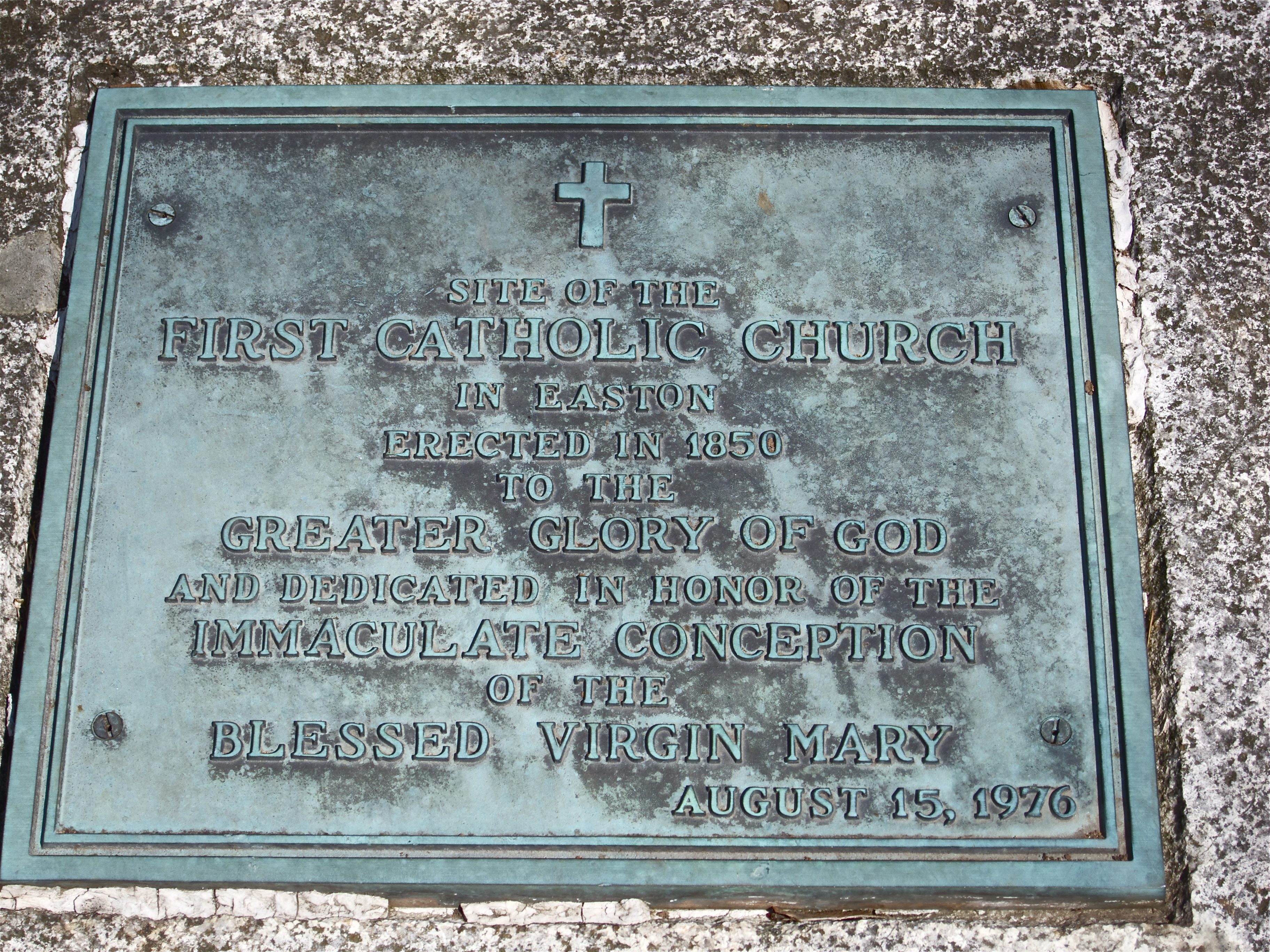
Plaque for Catholic Church

*

1851

Sunday Aug 3d  Went to the consecration of the Catholic

Church dedicated to The virgin Mary. The bishop &

priest took a pail of water and a cedar twig and went

around the house and sprinkled the foundation with the

water and then the aisles & walls and some of the

congregation got a sprinkling. This afternoon went to

our own church.  Frank carried Orinthia home

Oakes A carried Louisa Swan to the hall under our

church to a sing & carried S E Williams & L Kimball

home from it

By 1850, Easton’s Catholic population, which had been almost non-existent before about 1840, now numbered approximately 150, primarily due to the influx of Irish Catholic immigrants, many of whom went to work at the shovel factory.  The Irish had no church of their own, and had been gathering for worship in a hall belonging to the Ames family on those Sundays when an itinerant priest came to town.  The congregation had outgrown that facility, however, and needed their own house of worship.

The Ames family donated a plot of land on Pond Street to the Catholics so that they could build their own church.  The stone plaque in the photograph above commemorates that first church, built in 1850 and consecrated on this very Sunday in 1851.  Evelina and, presumably, other members of the Ames family attended the consecration, a ceremony to which Evelina paid close attention.  They went back to their own Unitarian church in the afternoon.


* SITE OF THE

FIRST CATHOLIC CHURCH

IN EASTON

ERECTED IN 1850

TO THE

GREATER GLORY OF GOD

AND DEDICATED IN HONOR OF THE

IMMACULATE CONCEPTION

OF THE

BLESSED VIRGIN MARY

AUGUST 1976 [date of plaque]