October 7, 1851

Broom

Tuesday Oct 7th  Have been at work on the dark french

print  This forenoon swept the chambers and put Franks

chamber in order that he left.  Carried my work

into the other part of the house while  My humour

troubles me so that I can scarcely sit still.  Was quite 

sick awhile this evening  We have had very cold

weather for the season for a number of days


Whatever powdered medicine Dr. Swan gave Evelina on Sunday wasn’t working. Her “humour” troubled her all day and she was especially ill in the evening. Her nettlerash made her uncomfortable and sick. With some asperity, she noted the recent “very cold weather,” which wouldn’t have helped her frame of mind.  It’s interesting to note that her father-in-law, Old Oliver described this very same day as “a fair warm day wind northerly part of the day + southerly part of the day.” It’s likely that Evelina’s perception was colored by her overwhelming personal discomfort.

Does any reader think Evelina that might be suffering from shingles?

Nonetheless, she kept busy.  She swept the house and tidied up after her youngest son, Frank. She sat down to sew, though must have found it difficult to concentrate when her skin itched and burned.  She went into the other part of the house, where Miss Susan Orr, an elderly friend (or relative?) from Bridgewater was visiting. No doubt she sought conversation to take her mind off of her own troubles. Perhaps she wished her nephew, George Oliver Witherell, a happy birthday. He turned 14 on this date.

 

September 15, 1851

Peach

Monday Sept 15th  Mrs Stevens & I made our plan

to go to North Bridgewater this afternoon but

could not get a horse in season  Augustus

rode up to his house with us and we brought

Miss Eddy home with us.  Called at Mr Reeds

and got some peaches.  Mr & Mrs Whitwell

called before we went away Ruth & Louisa

Swan called at the other part of the house

Plans to go to North Bridgewater had to be cancelled today when Evelina couldn’t get a horse in time, or “in season,” as she says. The morning hours had been spent on housework and laundry, certainly, and the planned trip to Bridgewater must have been a sweet incentive to get the choring done.  No doubt Evelina and Mrs Stevens were disappointed not to go.

Evelina and Mrs. Stevens did get to call on Evelina’s nephew, Alson Augustus Gilmore and his wife, Hannah Lincoln Gilmore.  Hannah had recently given birth to her second son, Willie, and might well have welcomed the company. The women also secured some peaches at one of the Reeds’ homes, no doubt with plans to make some preserves. Reverend William Whitwell and his wife Eliza called on them and two of Dr. Caleb Swan’s offspring, Ruth and Louisa, called to see Sarah Witherell.  Ruth was about to be married. The social comings and goings of summer continued despite the light frost overnight, a sure sign of approaching autumn.

September 4, 1851

800px-Manning_Hall,_Brown_University,_Providence,_Rhode_Island_-_20091108

*

Thurs Sept 4th  This morning Orinthia left for Maine

& Pauline for Roxbury in the stage.  Mr Ames &

Oliver via Mansfield to Providence.  Oliver is

delighted with the idea of going to school & I am

sure he will improve his time  It seems

very lonely to day I have taken the bedstead down from

the boys chamber to clean it swept the parlour & washed

most all the windows in the lower part of the house both sides

Guests and family departed the Ames compound in North Easton today. Schoolteacher Orinthia Foss left to return to Maine, probably to Leeds where her parents and two younger siblings lived.  Houseguest Pauline Dean, left, too, taking the stage with Orinthia as far as Roxbury. Her final destination was unknown.  The most noteworthy departure, however, was that of 20-year-old Oliver Ames, middle son of Oakes and Evelina.  He was going to college.

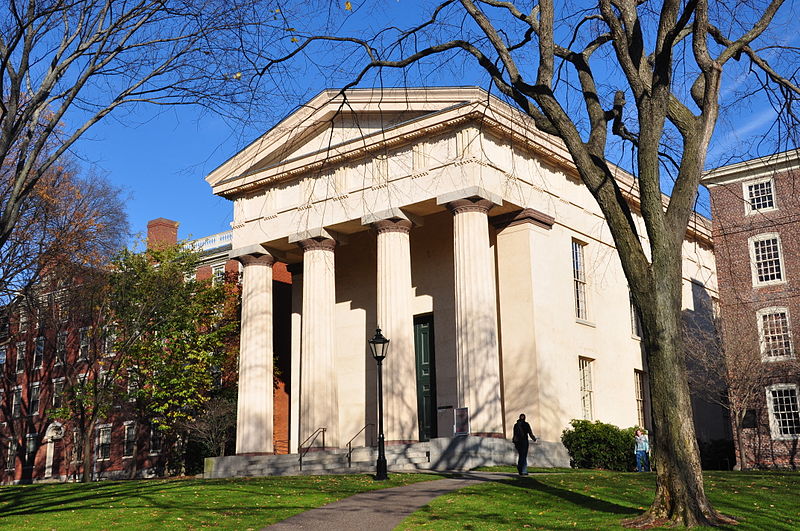
Oakes Ames, after having resisted giving his son a college education, had evidently made a decision to let Oliver go. Father and son traveled together to Providence.  Perhaps Oakes helped his son find his living quarters, perhaps he explored the campus at Brown in an attempt to know it for himself, if he didn’t know it already. Sarah Lothrop Ames’s brother from Detroit, George Van Ness Lothrop, had once attended the school; Oakes and Oliver must have known that.

Established in 1764, Brown was the third oldest college in New England. Manning Hall, the neoclassical building shown in the photograph above, was the newest building on campus. No doubt it was a building that Oliver went into often, for it held both the library and the chapel. The president of the college at the time was Francis Wayland, a Baptist minister, who was stern but beloved and progressive.

As Evelina noted, Oliver was immensely pleased to be going to Brown, and she, in turn, seemed pleased for him. She was confident that he would study hard and do well.  Her pride didn’t protect her from feeling
“very lonely” today, though.  Choring was the only antidote she could imagine to liven up the quieter house.


Manning Hall, Brown University, Providence, Rhode Island

June 30, 1851

photo

1851

June 30 Monday  Jane has been washing to day but I

have done but very little of any thing. having a

very sore finger & thumb it is quite painful

have to let out the matter quite often  It has been

quite painful since Friday.  It is a very warm

uncomfortable day  I have worked some in the 

flower garden

Today was another Monday, another washday ably managed by the Ames’s servant, Jane McHanna. Evelina, who usually undertook other household chores on a Monday, wasn’t up for choring. She had a bad infection on her thumb and finger that prevented her washing the breakfast dishes, sweeping, or helping to prepare dinner. She was in pain and somewhat handicapped.

Perhaps she had cut her hand, or had worked up a few blisters, or had a bad scrape.  She could have done something in the kitchen or garden, or while sewing the tough horsehair cover for the new lounge. However she hurt herself, a skin infection was nothing to make light of in 1851.  In that age before antibiotics, Evelina had few remedies at hand beyond keeping her hand clean and perhaps applying a homemade linament or poultice. Her wound was the kind of injury that could turn septic; that she was squeezing “the matter” – or pus – out of it shows that she was conscious of a certain level of risk.

And yet, she found a way to work in the garden, so she couldn’t have been too frightened.


May 16, 1851

330px-Carpet_beater

1851

May Friday 16th  We have been working in the chambers again

to day  I have put a straw carpet down in the 

dark bedroom chamber and moved the bed from

the sitting room chamber into it.  Have taken

the carpet from the sitting room chamber and

cleaned the room.  Orinthia & I have been working

in the garden awhile this afternoon Susan past

the afternoon at Mr Torreys

The tail end of spring cleaning was going on as carpets were laid back down and furniture rearranged. Imagine the energy it took for Evelina, Jane McHanna and, maybe, Orinthia Foss to move furniture, take up carpet, beat carpet, clean floors, put carpet back down and move furniture back into place.  The men didn’t help them with this, as the men all had their own work.  The women did this housework themselves.

Many will recognize the household “appliance” pictured in the illustration.  It’s a rug beater, used to thwack the dust out of carpet as it hung out-of-doors being aired.  Until Bissell’s carpet sweeper appeared in the 1880’s, and the electric vacuum cleaner came around the turn of the century, this is how rugs were cleaned.

The garden probably looked pretty good to Evelina and Orinthia after the dust and dirt of the morning. A different kind of soil. The women must have planted some things that Evelina picked up yesterday on her trip to Mr. Manley and Mr. Clapp in Stoughton.  Her garden was taking shape.

May 14, 1851


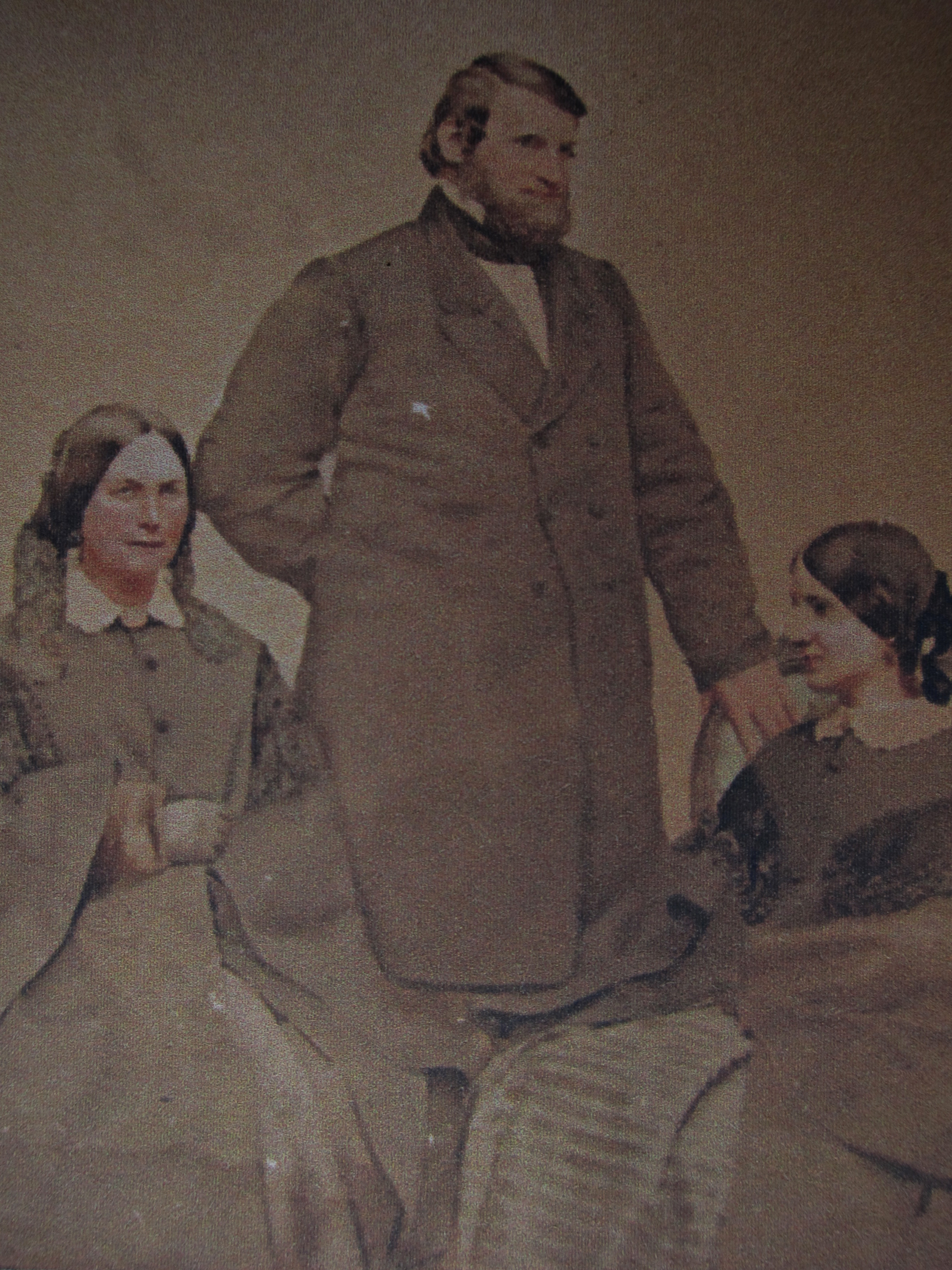
Evelina, Oakes and Susan Ames, ca. 1860 Archives at Stonehill College, Easton, Massachusetts

Evelina, Oakes and Susan Ames, ca. 1860
Archives at Stonehill College, Easton, Massachusetts

Wednesday May 14  Susans birth day and she has had a little

party.  Julia has been here to work on Orinthias

dresses.  Ellen Howard called this evening

came from Jasons. Mrs Holmes called a 

few moments this morning.  I have swept

and dusted the front chamber and taken the 

carpet from the stairs and painted them It

has been a confused day. Pleasant this afternoon

Augustus gone to Boston


Another interruptious day, filled by “confused” and overlapping events: Susie Ames’s birthday party, Julia Mahoney’s work on dresses for Orinthia Foss, calls from Ellen Howard and Harriet Holmes, the usual choring in the downstairs rooms, not to mention Evelina’s removing the carpet from the stairs and painting the treads. What commotion.

Susan Eveline Ames, the only daughter and youngest child of Evelina and Oakes Ames, turned nine years old today and was treated to a little party. Did she have friends over or was the party strictly en famille? Did she have cake? Ginger snaps? Presents? What was a nine-year-old’s birthday party like in 1851?

Born in 1842, Susie Ames came along several years after all her big brothers were born. From the beginning, she was raised differently from them. While they were slated to work, earn and provide, her education and training were oriented toward a future of domestic responsibilities. Like most girls of the time, she was brought up assuming that she would marry and raise a family. If she failed to marry, she would have to make her way as a spinster aunt living with one or more of her brothers, or become a schoolteacher like Orinthia Foss. Which route was hers?  Marriage.

On January 1, 1861, Susan married Henry W. French, a wool merchant. She was 18 years old; he was 27. For many years, the couple lived in the Ames house with her parents, and possibly looked after the house during the periods when congressman Oakes and Evelina were in Washington. For a time, Susan and Henry lived in their own home on Main Street, on the site where the Oakes Ames Memorial Hall came to be built circa 1880.

As Evelina moved into widowhood and grappled with illness and age, Susan looked after her. She and Henry never had any children, so the particulars of her story weren’t passed on to interested offspring. She only comes to life in her mother and brother Oliver’s journals.


April 25, 1851

Coat

1851

Friday April 25  Have done some mending and been putting

things in order about the house Made Mrs

S Ames bed and stoped with her awhile

This afternoon mended Oakes Angier two coats.

dirty things they were! Met Mis[s] Foss coming from

school and called with her at Mrs Holmes & Mrs 

Connors spent the evening with Mrs S Ames

Mr Harrison Pool & wife & Mrs Horace Pool called

Sarah Lothrop Ames was still sick and unable to get up and around. Once again, Evelina went next door to visit and helped out by making Sarah’s bed up fresh.  Later in the day, Sarah had a companion, Mrs. Connors, sit with her. Was she being “watched” or was she on the mend? Who made the decision to have someone sit with her?  Her husband or her female relatives?

Mending and housework otherwise took up Evelina’s time today. She and Jane McHanna were still carrying on with spring cleaning, but the effort was sporadic lately, with mending taking over much of Evelina’s time. In the transition from cold to warm weather, all the spring and summer wardrobes had to be brought up to snuff, “dirty things” that some of them were.

The Pools came to call this evening.  Harrison and Horace Pool were brothers, fifteen years apart in age, who lived in the south eastern section of Easton, near the Raynham line and the Gilmore farm.  They made mathematical instruments: surveyors’ tools, levels, compasses and thermometers, among other items. Harrison’s wife was Mary J Pool, a young wife close in age to Oakes Angier.  Horace’s wife was Abby A. Pool, identical in age (43) to Evelina.  Mary and Abby were members of Evelina’s Sewing Circle, two of the women who didn’t attend the meeting that Evelina held back in February. Evelina would have grown up knowing the Pool (also sometimes spelled Poole) family.

April 18, 1851

aclk

U.S. Three Cent George Washington stamp, 1851

1851

April 18  Friday  I have made up the bed new in the 

parlour chamber and got the room in pretty

good order have not got to clean it this spring

I have been choring about house most all 

day about four Oclock  went into

the other part of the house & took the stockings

with me to mend  Not at all pleasant

Spring was the season for choring, choring, choring. Until she went to sit and mend stockings with Sarah Witherell, Evelina worked around the house all day.  The bad weather of the past several days continued.

The Ameses kept a bed in their parlor.  This seems strange to us, but it was customary at the time, or had been.  The practice was waning, as bigger, Victorian houses became the style and the older Colonial and Federal floor plans were abandoned.  Once upon a time, however, a downstairs parlor served multiple purposes.  We know it as the spot in the house where more formal visitors were welcomed. In the 18th and into the 19th century, the parlor was also where the master and mistress of the house might sleep, while children went upstairs to colder quarters. As the family became more affluent and rooms got reconfigured, the bed in the parlor accommodated overnight guests.  Several weeks back, in fact, inclement weather had forced William and Eliza Whitwell to stay over; they may have stayed in the very parlor that Evelina put “in pretty good order” today. Same with Evelina’s mother when she came to visit.

Many Ameses celebrated their birthdays in the month of April.  Today was another family birthday, that of John Ames 2d, the youngest son of Old Oliver and Susannah, who was born on this date in 1817. He was never in robust health, never married and succumbed to lung disease at age 27.  Before his death, however, he served as the very first postmaster of North Easton, then a new outpost between two larger post offices elsewhere in Easton proper. According to historian William Chaffin, young John Ames’s “office” consisted of “a large box with a cover […] set upon a post” with “mail (at least newspapers and heavy mail)” that was “put into and taken from this box by the drivers of the passing mail-coaches.”  This newest post office was needed for the increasing amount of mail coming in and out of the shovel factory.  With his health too poor to work in the factory itself, at least John had a role in managing the post.

February 17, 1851

Hem

Feb 17th  Monday  Washed the dishes and worked about

house most of the forenoon  This afternoon cut out some

work for Susan & set her to hemming, counted

stiches with her.  Helen came home from

New bedford.  Spent the evening at Olivers with

Sarah W.  Worked on an apron of Susans but

had so much talking to do that […] I accomplished

but a little sewing  Pleasant but cold

Sewing was a necessity, but it was also a sociable occupation, which is perhaps one of the reasons that Evelina enjoyed it so. Her visit next door with her two sisters-in-law, Sarah Lothrop Ames and Sarah Witherell, turned into an evening of conversation with “but a little sewing,” which she didn’t seem to mind.  What did the women discuss?  Did they revisit the tender issue of the failed Sewing Circle meeting?  Or did they steer toward safer topics like Helen’s return from New Bedford? What had the fourteen-year-old been doing there?  Had she been in school? Why did she return home at the start of a week?  Susie Ames was home from school this week, too.  Was mid-February a typical time for schools to close?

At this time in our history, almost every woman knew how to sew. Sewing was a skill handed down from one generation to the next. Evelina, Sarah Ames and Sarah Witherell had each learned their stitches from their mothers or grandmothers; now it was Susie Ames’s turn to learn.  How could the women know that sewing was about to be transformed by the arrival of the domestic sewing machine, and that a forthcoming civil war would introduce mass-produced, “ready-made” clothing on an unimagined scale?  They, who in their youth had probably watched a elderly relative work a spinning wheel, would experience a dramatic trajectory in the making of apparel.  By the time Susie reached adulthood and became a housewife, some of what she was being taught would be obsolete.  But not all: hemming, mending, quilting, and neat hand-sewing would always have a place in the domestic arts, even though few women today practice the skills.

Young girls of the antebellum period like Susie and Helen and Emily Witherell  sat by their mothers’ sides and struggled to manage a needle and thread, basting or hemming or working cross stitches.  Some of them created the hand-wrought samplers that hang now in textile collections, featuring alphabets or numbers or biblical quotations with colorful, tiny stitches painstakingly wrought by stubby little fingers at age eight or twelve or fourteen. Sewing was a necessity, but it was an art form as well.

February 11, 1851

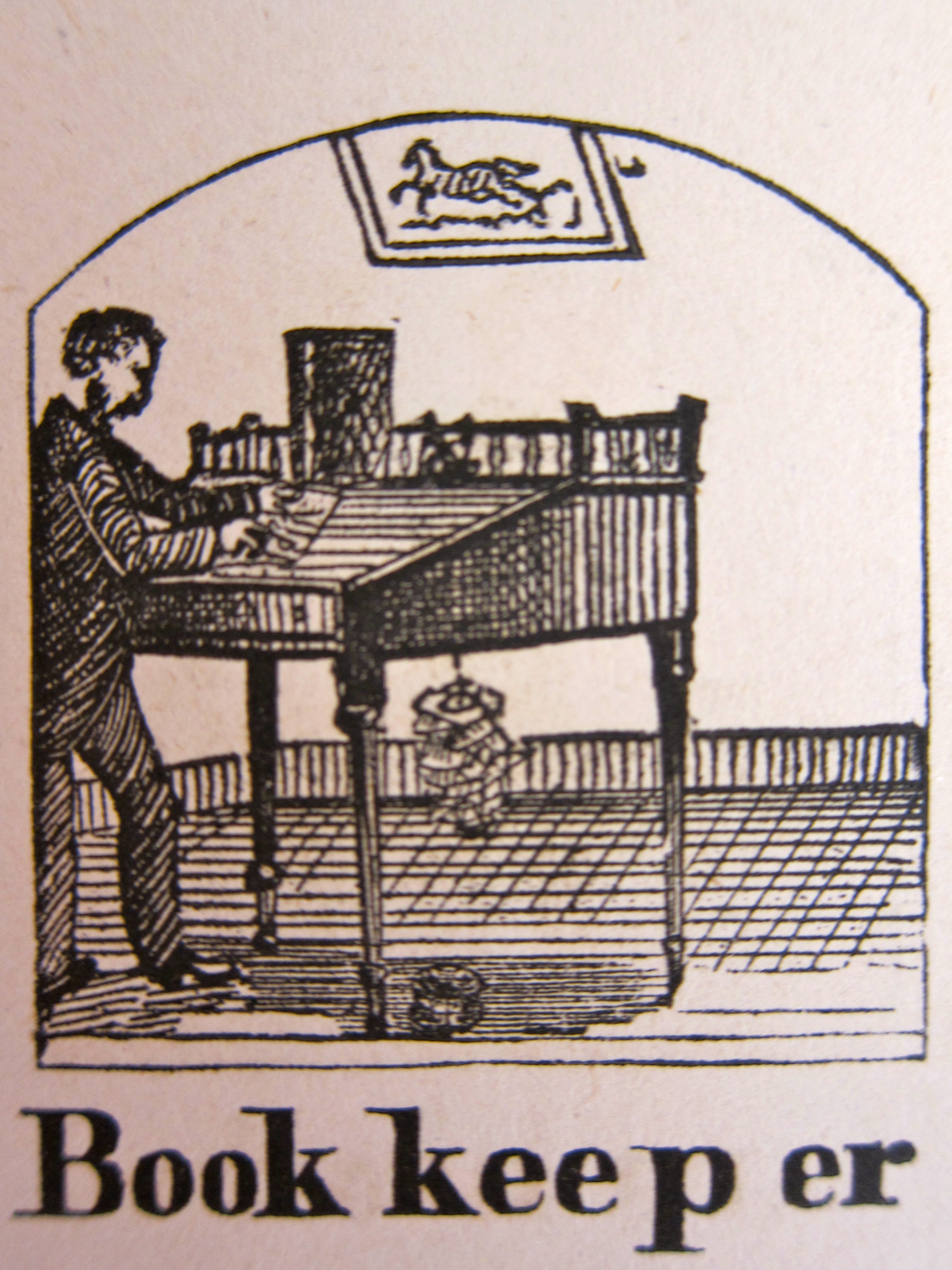
Bookkeeper

Feb 11th Tuesday  This day has been a very busy one

with me, getting ready for the sewing Circle.  Have

washed the front stairs & have been sweeping &

dusting.  Have got things pretty much in order for

tomorrow  It was very unpleasant this morning but this

afternoon it has cleared off very pleasant.  Augustus

is helping Mr Peckham post his books.  went home

with him to dinner & tea

Evelina seemed to feel better today and so went right to work.  Stairs got washed, carpet was swept, table tops were dusted, knick knacks, books and periodicals put in order.  The house would look spanky clean for the Sewing Circle tomorrow. Evelina herself was doing this work, while the servant Jane McHanna handled the regular chores: cooking the meals, washing the dishes and tidying up from the indoor laundry activity of yesterday.  Jane and/or Evelina may have ironed today, too, although it’s doubtful that they could have completed the task.   With all those men’s shirts to care for, ironing at the Ames house often lasted for several days.

In the office, or Counting House, next door, the company’s bookkeeper, John Peckham, was tending to business. Evelina’s nephew, Alson “Augustus” Gilmore, had started work there temporarily as Peckham’s assistant. Augustus is the nephew who has been looking for a place to rent for his growing family, all while beginning to set up a boot manufacturing company in the area. But meanwhile, nepotism being an acceptable, even laudable fact of life in a family-run business, Augustus was being kept afloat financially by work here and there for O. Ames and Sons.   Augustus, a man of robust build, would prove to be a well-known figure around town, especially once he accepted the role of moderator at town meetings, a position he would hold twenty-four times in the next 32 years.